Last updated: August 11, 2026
- Key facts: – A printable planner usually takes under 10 minutes to start.
- Because of that, it can be easier to keep using for 12 months , not just 12 days.
- In that case, the extra setup can pay off over 6 to 12 months .
- For many families, that means a tool you can use in 2 to 5 minutes , not one that needs a long setup.
FTC disclosure: Retailer links below may be affiliate links. If I include them, they can earn me a commission at no extra cost to you.
Quick Answer: For most single parents, the better starting point is a printable budget planner because busy days make simplicity matter; pick a spreadsheet if you want automatic totals and more detailed tracking.
Key facts:
– A printable planner usually takes under 10 minutes to start.
– A spreadsheet is stronger for tracking 3+ months of spending trends.
– Paper works without a phone, login, or Wi-Fi.
– Digital tools help with automatic math and category sorting.
– A hybrid setup often works best: paper for weekly decisions, spreadsheet for monthly review.
Verdict: Juggling bills, school costs, and uneven cash flow? I would choose a printable budget planner for day-to-day control, then use a spreadsheet only if you are happy updating numbers on a screen every week and want deeper tracking.
I write about family budgeting and money systems for real households. The biggest mistake I see is picking the tool that looks smartest instead of the one that actually gets used on tired Tuesdays. Been there.
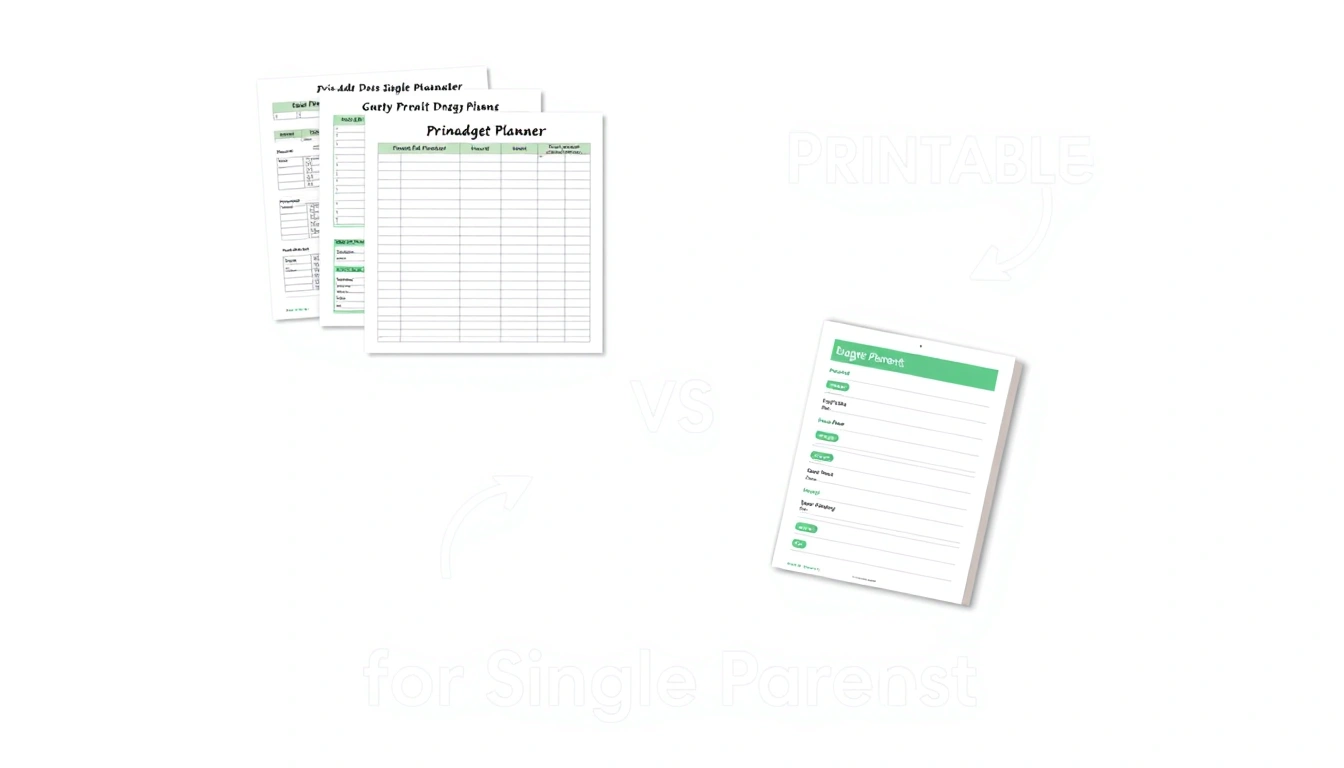
Printable Budget Planner vs Spreadsheet for Single Parents: the short answer
Most single parents are not really asking, “Which is more advanced?” They are asking something much plainer: “Which one will help me stay on top of money when I am tired, interrupted, and short on time?”
My answer is simple:
- Choose a printable budget planner if you need something visual, low-friction, and easy to keep on the kitchen table.
- Choose a spreadsheet if you like automatic totals, custom categories, and a system you can sort, filter, and revise often.
For many single parents, the right answer is not one tool forever. It is often paper for the weekly plan, spreadsheet for the monthly review. That hybrid setup keeps things manageable while still giving you the numbers.
Table of contents
- Printable Budget Planner vs Spreadsheet for Single Parents: the short answer
- Quick comparison
- What I mean by “single-parent budgeting” in real life
- Round 1: Ease of use — printable budget planner wins
- Round 2: Accuracy and calculations — spreadsheet wins
- Round 3: Flexibility for irregular expenses — spreadsheet wins, but only if you will maintain it
- Round 4: Stress level and mental load — printable budget planner wins
- Round 5: Portability and family use — printable budget planner wins
- Round 6: Long-term tracking and pattern spotting — spreadsheet wins
- Printable budget planner: who should get it
- Spreadsheet: who should get it
- The honest weakness of each
- My recommendation by scenario
- Buy options
- FAQ
- Final verdict
Quick comparison
To put it bluntly, the printable budget planner is easier to begin, while the spreadsheet is better for long-term math.
| Decision factor | Printable budget planner | Spreadsheet |
|---|---|---|
| Ease of starting | Faster | Slower at first |
| Works without devices | Yes | No |
| Shows the whole month at a glance | Usually yes | Yes, if set up well |
| Auto-calculates totals | No | Yes |
| Easy to update on the fly | Yes | Sometimes, if you are near a device |
| Good for visual thinkers | Strong fit | Mixed |
| Better for detailed tracking | Limited | Strong fit |
| Less likely to become “another app to maintain” | Yes | No |
| Easier to share or print for a caregiver | Yes | Possible, but less natural |
| Best for inconsistent routines | Yes | Less so |
This comparison matters because single-parent budgets are usually handled in short bursts, not long planning sessions. Five minutes a day can beat a fancier tool with more bells and whistles.
What I mean by “single-parent budgeting” in real life
A generic budgeting article usually assumes a neat paycheck, quiet time, and a tidy desk. Single-parent budgeting rarely looks like that.
It can mean:
- paychecks that do not land on the same day every month
- child-related costs that may arrive suddenly or unpredictably
- school lunches, activities, diapers, or therapy copays that do not fit neatly into a fixed category
- shared custody, child support, or benefits that change the cash picture
- managing money while also managing bedtime, food, laundry, and work
That is why the best budget tool is not the one with the fanciest formulas. It is the one that survives real life. For many families, that means a tool you can use in 2 to 5 minutes, not one that needs a long setup. Anything fussier gets chewed up and spit out by the week.
Round 1: Ease of use — printable budget planner wins
Most single parents will find the printable planner easier in this round because it strips away friction.
Open it. Write on it. Done. No login, no phone unlock, no hunting for the file you saved three days ago. That matters when you are wiped out and trying to budget between dinner and homework.
What I like about paper here is the physical cue. A page on the counter keeps the budget visible. A spreadsheet can hide behind other tabs; a planner stays put. That visibility can help you check the plan once a day without needing a device.
Why it wins: getting started is easier, and coming back to it is easier too.
Honest drawback: paper does not correct mistakes for you. Miss a number or forget to add two expenses, and the page will not rescue you.
Who should skip it: anyone who hates handwriting, loses papers easily, or wants automatic math.
Round 2: Accuracy and calculations — spreadsheet wins
The spreadsheet wins because it does the arithmetic. For single parents, that matters when every dollar is stretched thin and a small math mistake can throw off the week.
A spreadsheet can total bills, subtract variable spending, and show the gap without making you recalculate by hand each time. Change your income, update one figure, and the rest can adjust.
That is not just convenient; it lowers the chance of missing a problem until the bank balance is already too low.
For budgeting principles, I recommend looking at the Consumer Financial Protection Bureau’s budgeting guidance and the FDIC’s money-management resources for a general framework. Those organizations both provide public-facing consumer advice on tracking income, expenses, and savings habits.
- CFPB budgeting resources: https://www.consumerfinance.gov/consumer-tools/budgeting/
- FDIC money-smart budgeting materials: https://www.fdic.gov/resources/consumers/money-smart/
- FDIC budgeting tips and tools: https://www.fdic.gov/resources/consumers/consumer-news/2023-02.html
Why it wins: automatic totals make it easier to spot a shortfall before it becomes a crisis.
Honest drawback: spreadsheets can hide errors if you enter the wrong number into the wrong cell. The math can be perfect and still rest on bad input.
Who should skip it: anyone who gets overwhelmed by tabs, formulas, or screen-based admin.
Round 3: Flexibility for irregular expenses — spreadsheet wins, but only if you will maintain it
Single-parent budgets live or die on irregular costs. Shoes wear out. A school form appears. A dentist visit hits. A birthday gift comes due. A spreadsheet handles those moving parts better than a static page, assuming you keep it updated.
You can create categories for child care, school fees, copays, transportation, and “unexpected,” then move money around as life changes. You can also track patterns over time, which helps you see whether one category keeps running hot.
But that only works if you actually maintain it. A highly customized workbook that no one updates is not a budgeting system. It is a museum piece. Even a plain monthly tracker beats a perfect file you open twice a year. Ugly truth, but there it is.
Why it wins: categories are easier to adjust, and month-to-month comparisons are simpler.
Honest drawback: it depends on discipline. Skip updates for two weeks, and it becomes less useful fast.
Who should skip it: single parents who need a simple, visible system they can use while half-distracted.
Round 4: Stress level and mental load — printable budget planner wins
This is where a lot of comparison articles miss the point.
A budget tool should lower stress, not become another item sitting on your to-do list. For many single parents, a printable planner reduces the mental load because it feels finite. One page. One week. One month. Finished.
A spreadsheet can tempt you into tinkering. You open it to check one bill and end up adjusting formulas, renaming categories, or reorganizing tabs. That may feel satisfying if you like structure. It can also turn into another little job.
A planner is often better when you want a calmer relationship with money. It nudges you toward the essentials instead of polishing the system. Because of that, it can be easier to keep using for 12 months, not just 12 days. Small thing, big difference.
Why it wins: it is simpler to live with.
Honest drawback: simple can also mean limited. If your budget is complicated, paper may not give you enough detail.
Who should skip it: detail-oriented users who feel calmer when every dollar is tracked digitally.
Round 5: Portability and family use — printable budget planner wins
Need to budget around a shared household? Paper usually handles that better.
Hand it to a babysitter, grandparent, or co-parent without worrying about file formats or device access. It is also easier to scribble notes beside a line item: “field trip tomorrow,” “child support not received,” “paid cash for medicine.” That makes it especially useful for single parents who need a family-facing budgeting tool, not a private finance dashboard.
Why it wins: it is easy to share, annotate, and keep visible.
Honest drawback: paper can be lost, damaged, or seen by people you would rather not involve in your finances.
Who should skip it: anyone who needs privacy above all else or wants cloud backup.
Round 6: Long-term tracking and pattern spotting — spreadsheet wins
Want to see whether your grocery bill keeps creeping up, whether one month of overtime changed your savings, or whether a child-related cost shows up every quarter? The spreadsheet is better for that.
The reason is not fancy technology. It is structure. Digital rows and columns make it easier to sort months, compare categories, and review trends without flipping through pages. That matters when you are trying to build a steadier plan over time.
For a single parent trying to move from “survive this month” to “know what is coming next month,” that can matter a lot. A spreadsheet can show a 3-month average, which is often more useful than a single snapshot.
Why it wins: it is better for reviewing history and planning ahead.
Honest drawback: long-term value depends on consistency. If you do not enter the data, the advantage disappears.
Who should skip it: anyone who wants a simple weekly reset rather than a data project.
Printable budget planner: who should get it
I would point a single parent to a printable budget planner if they fit most of these:
- you want something you can start today without setup
- you prefer writing things by hand
- you need a visible reminder on the counter, fridge, or desk
- you are budget-conscious but not excited by spreadsheet maintenance
- your money decisions happen in short bursts between tasks
- you want a tool that feels calmer than a screen
This is the better choice for the parent who says, “I need something I will actually use.” Usually, it works best when the plan fits on one page.
Spreadsheet: who should get it
I would point a single parent to a spreadsheet if they fit most of these:
- you are comfortable with basic digital tools
- you want automatic math
- you have irregular income and need to revise often
- you like sorting and comparing categories
- you want to track patterns over several months
- you do not mind a little setup work up front
This is the better choice for the parent who says, “I want the numbers to tell me what is happening.” It is especially useful if you review your budget once a week.
The honest weakness of each
A clean recommendation needs a downside on both sides. Compare them honestly, and each one has a real tradeoff.
Printable budget planner weakness
It can be too rigid for a complicated budget. If you have several income sources, shifting bills, or frequent one-off expenses, paper can turn messy fast.
Spreadsheet weakness
It can become too easy to ignore. If you do not like opening files and updating cells, the system can fall behind quickly, and then you stop trusting it.
My recommendation by scenario
If I had to choose one for most single parents, I would choose the printable budget planner.
That is not because it is “better” in the abstract. It is because budgeting under pressure usually fails from friction, not from lack of features. Paper is quicker to use, easier to see, and less likely to feel like homework.
I would choose a spreadsheet instead if the parent already likes digital organization, has multiple income streams, or wants to track spending in a very detailed way. In that case, the extra setup can pay off over 6 to 12 months.
Buy options
If you are choosing a printable budget planner, check current options from:
- Amazon
- Walmart
- the planner brand’s own site, if available
If you are choosing a spreadsheet, look for:
- Amazon for downloadable budget templates or budgeting books with spreadsheet files
- Walmart for related digital budget tools where available
- the creator’s or seller’s site, if you prefer direct download support
I am not listing fixed prices because those change constantly. Check the current price before you buy. For current household-budget basics, the CFPB and FDIC both offer free guidance online.
FAQ
Is a printable budget planner better than an app for single parents?
Sometimes, yes. A printable planner is often easier to keep up with because it is visible and simple. An app can help too, but it adds another screen and another login.
Can I use both a planner and a spreadsheet?
Yes. That is often the smartest setup. Use the planner for weekly decisions and the spreadsheet for monthly review or long-term tracking.
Which is better if my income changes from month to month?
A spreadsheet usually handles that better because you can revise totals quickly and see what changes in one place.
Which is better if I am always behind on paperwork?
A printable budget planner is usually the safer choice. It is easier to start, and you do not need to build a system before you can use it.
What is the fastest way to know which one fits me?
Ask yourself one question: do I need help with doing the math, or do I need help with staying consistent? If you need math help, choose the spreadsheet. If you need consistency help, choose the printable planner.
Final verdict
For most single parents, I would pick the printable budget planner first because it lowers friction and is easier to use on real-life, chaotic days.
The one condition that flips my choice is this: if you are disciplined with digital tools and need automatic calculations for irregular income or detailed tracking, the spreadsheet is the better fit.