Last updated: November 20, 2026
Quick Answer: budget for parenting plan changes by counting 4 cost buckets before you agree to the change. In this article on How to Budget for Parenting Plan Changes as a Single Parent, the bill is usually not just one fee; it can include amendment fees, document updates, court filing costs, and the extra setup tied to new exchange logistics. This is general information, not legal advice, and a qualified lawyer should be consulted because family-law rules vary by jurisdiction. For basic court-process guidance, see the U.S. Courts self-help resources and your local court rules.
Key takeaways
- Parenting plan changes often cost more in small pieces than in one large fee.
- The biggest surprises are usually paperwork, filing, and schedule-related admin, not the agreement itself.
- A clear budget starts with your current custody agreement and ends with a written list of every new task.
- If the change affects court approval, documents, or exchanges, the cost can rise fast.
- Some cases need a lawyer or mediator before any money estimate is useful.
Who this applies to
This applies to a single parent who already has a parenting plan or custody agreement and needs to change it without getting blindsided by extra costs. It assumes you know the broad shape of the current plan: who the child stays with, when exchanges happen, and whether the family court already approved the arrangement. If the current plan is informal or there is no order at all, the budgeting job changes because the paperwork path may be different by jurisdiction.
A parenting plan change can be simple on paper and still cost money in four places: amendment fees, document updates, court filing or review, and the logistics of a new schedule. The better the plan is written now, the easier it is to price the change before you sign anything. That said, if the change could affect legal rights in your jurisdiction, or if the other parent will not agree, a lawyer should review the path before you spend money on forms or filing. For modification basics, see family-law modification guidance.
This is not the place for guesswork. A 10-minute change to pickup times can still trigger new notices, new drafts, and a trip to family court. A change that looks small can also turn into a contested custody agreement issue, which is usually more expensive than a clean, agreed amendment. For related cost planning, see parenting plan costs.
How do I budget for parenting plan changes?
You budget for parenting plan changes by turning the change into a checklist, assigning a cost to each item, and setting aside a buffer for paperwork and schedule spillover. The point is not to predict the final total exactly; it is to keep one new step from surprising you later.
- List the exact change on one page, using the current parenting plan as the base and naming the change in one sentence, such as a new exchange time or a revised holiday schedule; verify whether the change affects only timing or also legal terms; problem sign: if you cannot say what changes in under 2 minutes, the scope is too vague to price.
- Check the custody agreement and any family court order for the update path, noting whether the plan needs a signed amendment, a filed motion, or a court-approved modification; verify the required form or process in your jurisdiction; problem sign: if the document mentions court approval and you plan to skip it, the budget is incomplete.
- Price the amendment fee by identifying the cost of drafting, reviewing, or notarizing the change, if your jurisdiction or provider uses those steps; verify what is included in the fee; problem sign: a low upfront quote that excludes revisions, signatures, or copies usually turns into a larger bill.
- Estimate the document update cost by counting every page that changes, including the parenting plan, cover sheet, consent form, and any attached schedule; verify whether you need one original plus copies; problem sign: if each form version must be reprinted or resent, the cost is not just paper, it is time and postage too.
- Set the court filing or review amount aside if the change has to be submitted for approval; verify whether the process uses a filing fee, an appearance, or both; problem sign: if you do not know whether family court is involved, do not budget only for forms.
- Map the new exchange logistics by counting the practical changes, such as a different handoff location, a longer drive, or a new weekday exchange; verify whether the change creates extra fuel, parking, toll, or time-off costs; problem sign: if the schedule shift adds recurring errands, the change has a monthly cost, not a one-time cost.
- Add a buffer for document rework and delay by setting aside a small cushion for extra copies, corrections, and resubmissions; verify that the buffer can cover at least one round of changes; problem sign: if a single typo would force a new filing, your budget is too tight.
- Review the full total against your monthly income and fixed bills, then decide whether the timing of the change should wait for a safer month; verify that the new cost does not crowd out rent, food, or transport; problem sign: if the change would force you to skip essentials, the plan may be too expensive to move on now.
The cleanest way to do this is to separate one-time costs from recurring costs. A one-time amendment fee is not the same as a new exchange route that repeats every week. When those two buckets are mixed, the budget looks smaller than it really is.
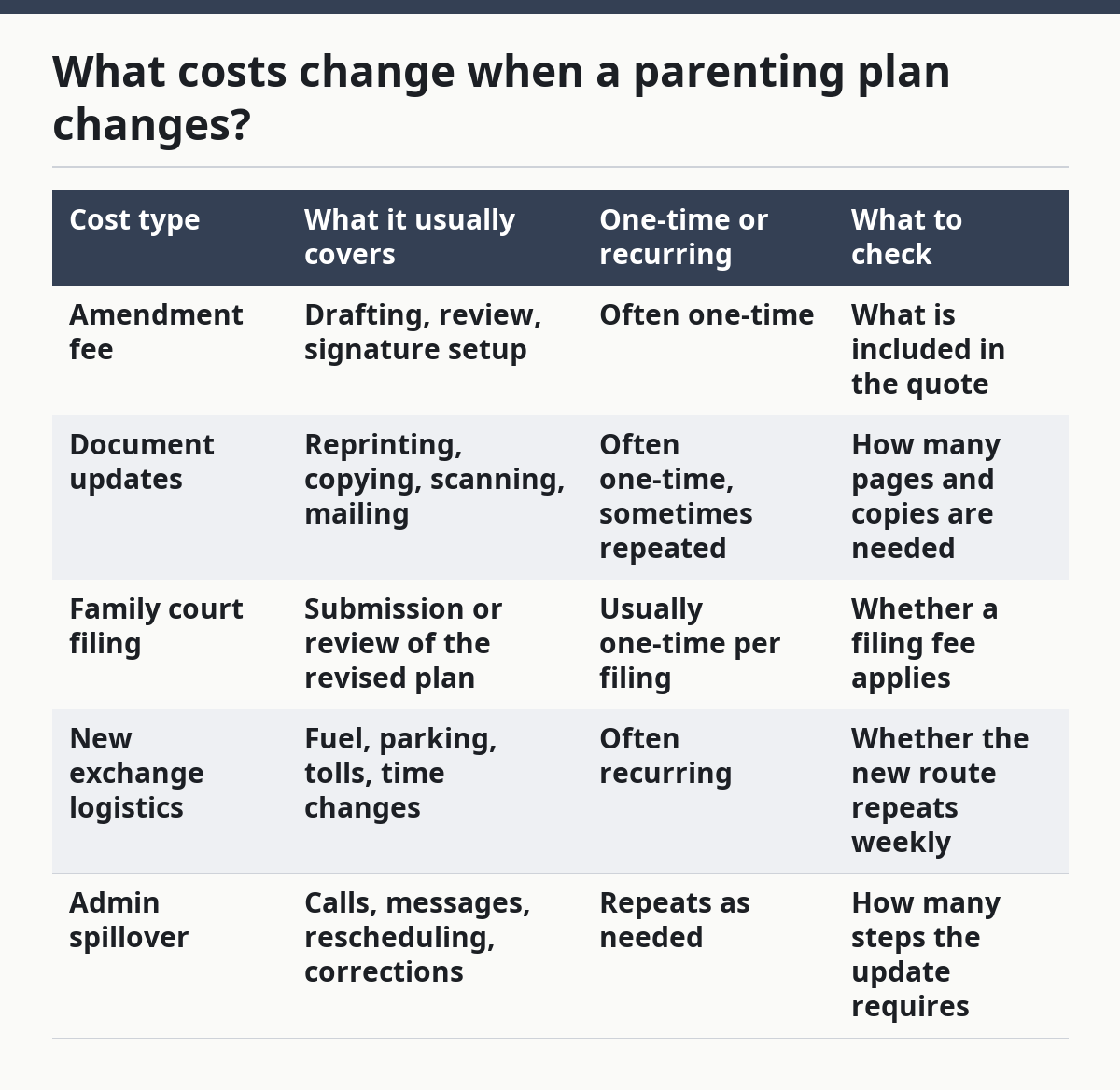
What costs change when a parenting plan changes?
The costs that change are usually legal paperwork costs, document handling costs, and new exchange logistics. Some changes also affect parenting time on specific dates, which can create new travel or schedule admin even if the agreement itself is short. In many cases, the price is not one fee but a chain of small costs.
| Cost type | What it usually covers | One-time or recurring | What to check |
|---|---|---|---|
| Amendment fee | Drafting, review, signature setup | Often one-time | What is included in the quote |
| Document updates | Reprinting, copying, scanning, mailing | Often one-time, sometimes repeated | How many pages and copies are needed |
| Family court filing | Submission or review of the revised plan | Usually one-time per filing | Whether a filing fee applies |
| New exchange logistics | Fuel, parking, tolls, time changes | Often recurring | Whether the new route repeats weekly |
| Admin spillover | Calls, messages, rescheduling, corrections | Repeats as needed | How many steps the update requires |
A generic article often stops at filing fees and misses the small stuff. That is the trap. A child exchange moved by 30 minutes can still create a new parking cost, a different work break, and one extra round of messages every week. Over a year, the small items can matter as much as the legal one.
This is also where people misread a custody agreement. A schedule change that looks simple may still need a written amendment, and a written amendment may still need court approval. If the rules in your jurisdiction require both, the budget needs both. For court-procedure examples, see family court self-help and your local court website.
What if the change is not simple?
Some parenting plan changes need more than a form, and that is the point where the budget should slow down. If the change affects decision-making, school terms, holiday rotation, or repeated exchange disputes, the paperwork can become the expensive part, not the afterthought. In those cases, a mediator or lawyer may be part of the process depending on jurisdiction and the level of disagreement.
When to stop and get qualified help
The other parent will not sign: the change may become a dispute rather than a budget exercise — stop pricing only the paperwork and ask a qualified lawyer what process is used in your jurisdiction.
The current order says court approval is required: a private agreement may not be enough — stop before paying for informal updates and check the required filing path.
The proposed change affects decision-making, not just timing: this is more than a schedule tweak — stop and get legal guidance, because the cost and the procedure usually change.
The change would require repeated exchanges across 2 homes, schools, or care settings: the logistics may add recurring costs every week — stop and recalculate the full monthly effect before agreeing.
The plan is tied to a safety issue, missed handoffs, or enforcement concerns: the matter may need formal review rather than a simple rewrite — stop and seek qualified help before making assumptions.
You do not know whether the document is a parenting plan, a custody agreement, or a court order: the wrong label can lead to the wrong process — stop and identify the controlling document first.
This section is where many readers save money by not forcing a simple budget onto a complex legal change. A 1-page amendment can be cheap. A contested modification can become a very different problem.
What are the mistakes people make?
The most common mistake is budgeting only for the form and forgetting the process around it. That mistake usually leads to an underfunded change, a delayed signature, or an extra court trip. The right alternative is to budget for the whole path, not just the paper.
Another mistake is treating every parenting plan change as one-time. If the update creates a repeated exchange or recurring admin, the cost repeats too; in that case, consult a qualified family lawyer or mediator before assuming it is a one-and-done cost. A better alternative is to split costs into one-time and recurring buckets before you agree. For process guidance, see modifying a custody agreement.
A third mistake is ignoring document updates. If the revised schedule needs new pages, fresh copies, or a corrected attachment, the small admin costs stack up fast. The fix is simple: count every document that changes, not just the main agreement.
A fourth mistake is assuming the old custody agreement still controls when the new one is drafted. In many situations, the old and new versions both matter until the change is properly signed or filed. That is why the budget should include review time, not only drafting time.
A fifth mistake is not checking exchange logistics early enough. If the new handoff adds 20 minutes each way, the cost is not only fuel; it can also affect work hours, child care handoff timing, and stress. The better alternative is to price the route before you agree to it.
A sixth mistake is leaving no buffer for correction. One wrong date or missing signature can mean another round of printing or resubmission. A small buffer keeps a simple error from becoming a budget problem.
When does the usual budget need to change?
The usual budget needs to change when the update is not just administrative. If the change is tied to holidays, long-distance exchanges, school calendars, or repeated schedule swaps, the budget needs to include more than the amendment itself. Those patterns often create 3 kinds of cost: legal, paper, and travel.
A standard approach also needs modification when the parenting plan is old or unclear. If the current version has loose wording, the new draft may need extra cleanup before anyone can sign it. That can mean more drafting time and more back-and-forth, even when the goal is only to adjust one date.
If the process goes through family court, the budget should assume more steps than a private agreement. Court systems can require forms, copies, and a filing route that is different from a simple signed update. That does not mean every case needs the same amount; it means the process itself changes the cost.
A change that affects the child’s routine can also have hidden admin costs. A new exchange day can mean a new calendar, new reminders, and more message traffic between parents. Those are not dramatic expenses, but they are real and they should be counted.
How do I keep the budget under control?
You keep the budget under control by deciding what you will pay before you start the change, not after you have already drafted it. That means setting a ceiling for legal paperwork, a separate amount for document updates, and a small reserve for exchange changes. A 3-part budget is clearer than one vague number.
It also helps to use the current parenting plan as your checklist. If a change touches only one clause, the cost should be closer to one clause than to a full rewrite. If it touches several clauses, the budget should rise with the scope. That keeps you from paying for more than the change really needs.
The final check is simple: if the new agreement creates recurring costs, those costs belong in your monthly budget, not just the one-time change budget. That is the difference between a document update and a long-term expense.
What should I ask before I pay?
You should ask what the fee covers, what documents change, and whether family court is involved. Those three questions catch most of the hidden costs before they land on you. If the answer is vague, the budget is not ready.
You should also ask whether the new arrangement creates extra exchange logistics, such as longer travel, parking, or repeat rescheduling. A small schedule shift can create a regular cost that is easy to miss when you are focused on the legal form. That is especially true when the same change happens every week.
What costs change when a parenting plan changes?
The main costs are amendment fees, document updates, court filing costs, and new exchange logistics. A change can also bring extra admin, such as copying, mailing, scanning, or rescheduling time. The total depends on whether the update is private, needs family court, or requires more than one revised document.
Do I need to pay to update a custody agreement?
Often, yes, but the amount and process vary by jurisdiction and by how the agreement is changed. A private written amendment may cost less than a court-filed update, while a disputed change may cost more. If the wording affects legal rights, a qualified lawyer should be consulted before you pay for the wrong process.
Drafted with AI; not yet reviewed by a person.