Last updated: November 20, 2026
Quick answer: budget for custody mediation fees as a single parent by setting aside enough for the mediator’s first charge plus one extra session, and keep a 3-to-7-day prep cushion. For How to Budget for Custody Mediation Fees as a Single Parent, treat the mediator’s fee, session time, preparation work, and any retainer as separate line items before the first meeting. If the other parent may split costs, plan for your share as if you will pay all of it first, then treat any reimbursement as a later credit. This is general information, not legal advice; family-law rules vary by jurisdiction, so a qualified lawyer should be consulted about your own matter. For a general overview of mediation, see the American Bar Association’s mediation resources.
Key takeaways
- Put custody mediation into your monthly budget as a short-term legal cost, not a vague “court expense.”
- List four buckets: retainer, session fees, prep costs, and filing or document fees tied to the process.
- Assume you may have to pay first, even if a later split is possible.
- Build the plan around a single question: “What can I set aside before the first session without missing rent, food, or transport?”
- If the fee structure is unclear, ask the mediator or family court office before you book time.
What costs belong in custody mediation?
Custody mediation costs are the charges for the mediator, the time spent in sessions, and the work needed to prepare a parenting plan. A mediator may charge a retainer, a session fee, or both, and some family court programs add their own fees or paperwork costs.
The cleanest budget starts with the full list of likely charges, not just the first invoice. For many parents, the mistake is thinking only about one meeting and forgetting the second meeting, document copies, email time, or the cost of getting the parenting plan ready for review. If the court requires a specific form, that can add another small cost even when the mediation itself is low-cost.
A helpful source of structure is your local family court website, because it usually explains whether mediation is voluntary or ordered, how fees are handled, and whether a court program has a sliding scale. The National Center for State Courts also explains court self-help and mediation programs, and the American Bar Association has plain-language mediation guidance. Many state court self-help pages explain what a mediator does and what a parenting plan usually includes.
How do I budget for custody mediation fees?
Therefore, you budget for custody mediation fees by building a 3-part estimate, setting aside money before the first session, and giving each cost its own line in your budget. Start with the mediator’s fee, then add prep and travel, then add a cushion for extra time or a second meeting.
That approach works best when you compare the estimate to one month of cash flow. If the custody mediation line competes with rent, food, or child care, the budget is too tight. For How to Budget for Custody Mediation Fees as a Single Parent, the goal is not the lowest possible estimate; the goal is a realistic one that covers the first payment and a small reserve.
How to budget for custody mediation fees, step by step
- List the mediator fee. Write down whether the mediator charges a retainer, an hourly rate, or a flat session fee, and note the billing unit in minutes or hours. Verify the fee structure in writing before you schedule; a problem is a vague quote that does not say what happens if the session runs long, and if you are unsure, consult a lawyer or the court self-help office.
- Estimate the number of sessions. Use 1 session as the base and add a second session only if your court, mediator, or parenting issues are likely to need more time. Verify whether the mediator books in 60-minute blocks or 90-minute blocks; a problem is underbudgeting because the first session does not finish the plan, so it helps to ask the mediator or a qualified lawyer how local practice usually works.
- Add preparation costs. Include document printing, copies of school or schedule records, and time spent drafting a parenting plan outline before mediation. Verify whether the mediator wants papers sent 3 to 7 days before the session; a problem is showing up without the documents the process expects, and if the timing is unclear, check with the mediator or family court office.
- Set aside your share as a separate envelope. Put your expected share in a dedicated savings bucket so it does not get mixed with grocery or utility money. Verify that the amount covers the first payment plus a small reserve; a problem is treating reimbursement from the other parent as money you already have, so budget conservatively and ask a professional if the split terms are unclear.
- Check for split payment arrangements. Ask whether the mediator can bill each parent separately, bill one parent and reimburse later, or divide the retainer up front. Verify the split in writing; a problem is assuming a 50/50 split when the actual arrangement is different, and a court or lawyer can confirm what is usually enforceable in your jurisdiction.
- Review family court rules. Look at the court’s mediation page for fee waivers, court-connected programs, or required forms. Verify whether the court or the mediator handles the scheduling; a problem is paying privately when the court would have assigned a different process, and court self-help staff can often explain the next step.
- Compare the budget to one month of cash flow. Make sure the mediation line does not crowd out rent, food, transport, or child care during the same month. Verify that the payment fits before the due date; a problem is using credit or skipping essentials to cover the first invoice, so treat the estimate as part of the monthly plan rather than a one-off bill.
- Track every receipt and invoice. Save the retainer receipt, session invoice, and any email that confirms the payment split. Verify that the invoice matches the agreed fee and dates; a problem is losing proof when a billing dispute comes up later, and the receipts help if the court or mediator later asks for documentation.
What should I check before I book mediation?
Because of that budget setup, you should check the fee terms, the court’s role, and the parent communication rules before you book mediation. A 10-minute review can prevent a surprise bill or a wasted session.
The most important question is who controls the process. In some places, family court sends parents to a court-connected mediator; in others, parents choose a private mediator and bring the parenting plan back to court later. That difference changes the budget because court programs may have lower fees, fee waivers, or fixed time slots, while private mediation may bill by the hour. For background on court-connected mediation, the National Center for State Courts and local court self-help pages are useful starting points.
Also check whether your mediator handles only custody and parenting schedules or also helps draft the parenting plan. If drafting is included, that may save money later. If it is not included, you may need extra time or a lawyer to review the written plan, especially if the agreement touches holidays, school breaks, or travel. For a parenting-plan overview, see the Child Welfare Information Gateway or your state court’s family-law materials.
When should I stop and get help instead?
Ultimately, you should stop the DIY budgeting approach and get qualified help when the fee setup, court order, or payment dispute makes the numbers unreliable. The issue is not just price; it is whether the process itself has changed.
The mediator will not give written fee terms: you do not have enough information to budget safely — ask for an email or written agreement before paying any retainer.
The family court has a fee waiver or mandatory program you do not understand: the court may have rules that change your cost to near-zero or move payment to a different step — call the court self-help office or a qualified lawyer.
The other parent says they will split costs, but nothing is written: you may end up paying first and chasing reimbursement later — budget as if you owe the full amount until there is a clear written split.
The parenting issues are broad or contested: a one-session estimate may be too low — expect more time, more documents, and possibly attorney review of the parenting plan.
The mediator is also asking for legal drafting help: the fee may no longer be only mediation — check whether you need a lawyer to review terms before you sign anything.
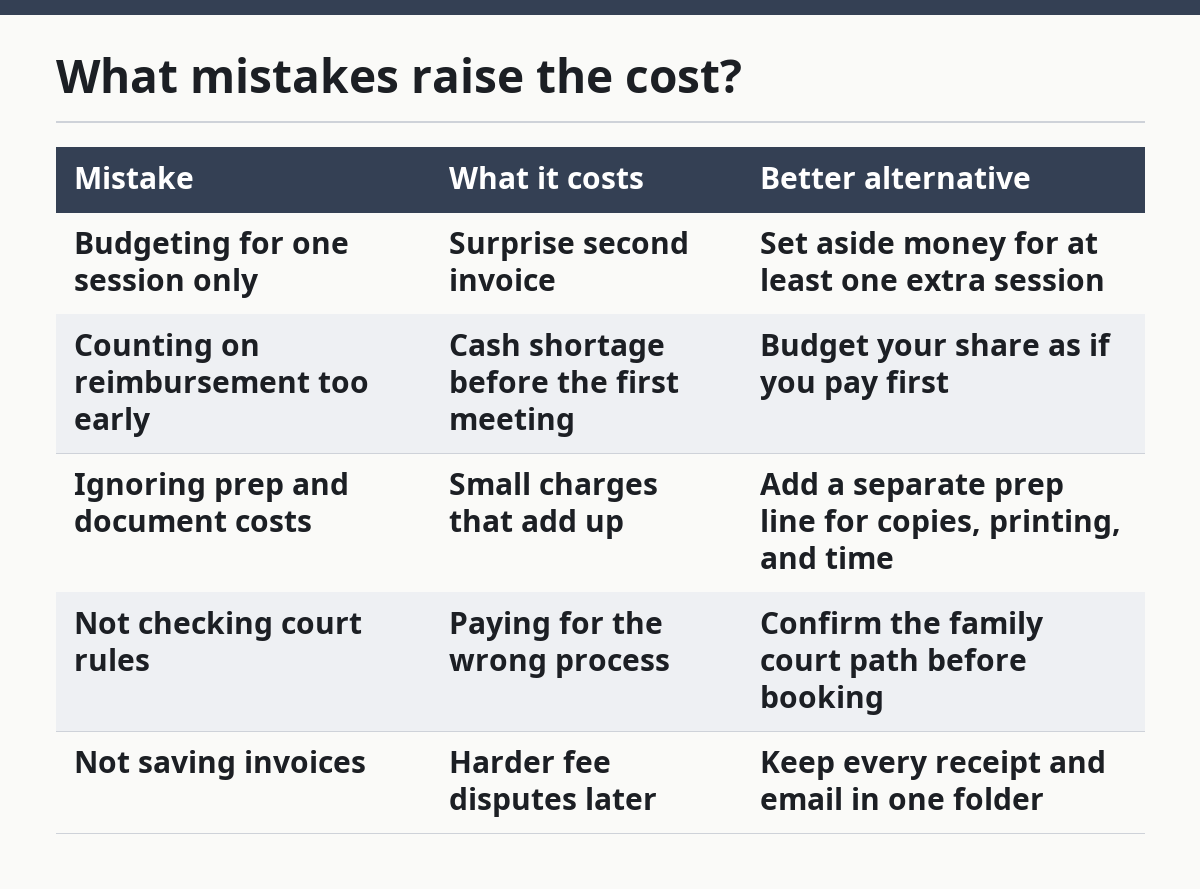
What mistakes raise the cost?
Because mediation is a process, not a single bill, the biggest budgeting mistake is treating custody mediation like a single bill instead of a process with moving parts. That mistake usually leads to shortfalls, rushed decisions, or a stalled session.
Another common error is forgetting preparation time. If you need school calendars, work shifts, or a written list of parenting concerns, those hours matter even if no one bills by the minute. A second mistake is assuming the other parent will pay half on time; that can leave you covering the full retainer at the front end.
People also misread the mediator’s rate. A “session fee” may mean one block of time, not the full case, and a “retainer” may be only the first deposit, not the full total. If the mediator bills in 15-minute increments after the first hour, the final amount can move fast. A careful budget uses the highest likely cost that still fits the court process you are actually in.
| Mistake | What it costs | Better alternative |
|---|---|---|
| Budgeting for one session only | Surprise second invoice | Set aside money for at least one extra session |
| Counting on reimbursement too early | Cash shortage before the first meeting | Budget your share as if you pay first |
| Ignoring prep and document costs | Small charges that add up | Add a separate prep line for copies, printing, and time |
| Not checking court rules | Paying for the wrong process | Confirm the family court path before booking |
| Not saving invoices | Harder fee disputes later | Keep every receipt and email in one folder |
What if the fees are split between parents?
Conversely, split payment can lower your upfront cost, but it only helps if the arrangement is clear and timely. Some mediators bill each parent separately; others bill one parent and expect reimbursement later. The difference matters because it changes when cash leaves your account.
If the split is 50/50, budget for your half and keep the other half visible as unpaid until it is actually received or credited. If the agreement is based on income, the amount may not be equal, so do not assume symmetry. For a single parent, a safer plan is to treat the split as a possible refund, not as guaranteed support for the initial payment. For related budgeting ideas, see family court mediation guidance and what costs belong in custody mediation.
How much detail should go into the parenting plan budget?
Since the parenting plan budget should include enough money to turn the agreement into a usable document, not just a verbal compromise, it often needs more detail than people expect. A parenting plan often covers regular schedules, holidays, handoffs, and decision-making, and each extra issue can mean more time in mediation.
That is why a simple budget usually breaks the process into at least 4 pieces: fee to start, fee to meet, fee to draft, and fee to revise. If your court or mediator wants the parenting plan written before the final session, build in a little more time and copying cost. A plan that looks cheap on paper can still be expensive if it takes two rounds to finish.
FAQ
How much should I set aside for custody mediation?
Set aside enough to cover the mediator’s first charge plus a reserve for one more session or a longer appointment. The exact amount depends on the fee structure, your court’s rules, and whether the parenting plan needs drafting. If the quote is unclear, ask for the retainer, session length, and billing unit in writing before you pay.
Can mediation costs be split between parents?
Yes, they often can be split, but the split depends on the mediator and the court process. The split may be equal, based on income, or handled by separate invoices to each parent. Do not treat a verbal promise as budget certainty; write the arrangement down and assume you may need to pay your share first.
Drafted with AI; not yet reviewed by a person.