Last updated: November 19, 2026
Key Takeaways
- Separate fixed costs from possible costs and assign each one a place before the deadline.
- Set aside money for likely inspection repairs and cleanup, even if the home seems mostly fine.
- Compare the full cost of staying with the full cost of leaving, not just the rent.
- Don’t wait until the last week and then raid the grocery budget for housing costs.
A housing inspection or lease renewal can hit your budget with repair costs, lease fees, and timing pressure all at once. How to Budget for a Housing Inspection or Lease Renewal as a Single Parent means budgeting for the notice, setting aside a repair fund, and comparing the renewal against the cost of staying put. The steps below settle what to save, when to save it, and how to decide whether renewing still fits your housing budget.
What this applies to, and what I’m assuming
This guide applies to a single parent who has received a lease renewal notice, expects a housing inspection, or knows both are coming within the next 30 to 60 days. It assumes you already pay rent, know your lease terms, and can track basic household spending for one month.
This is information, not financial advice. Housing rules, fees, and landlord practices vary by country and can change, so if your lease is unusual or money is already tight, a qualified housing or financial adviser should review your situation. For tenant rights and renewal basics, see Consumer Financial Protection Bureau and Citizens Advice.
Picture this: school pickup is waiting, work is on your calendar, and the landlord texts about a walk-through next week. The budget has to absorb the inspection, the renewal, and whatever repair bill lands after the visit. For a broader family budget frame, see the hub on housing and utilities budget for single parents.
- Read the lease renewal notice line by line, and note the response deadline, any fee, and any change to lease terms; verify the move-out date, fixed term length, and payment due date, and flag any missing numbers as a problem.
- List the likely housing inspection items, such as smoke alarms, leaks, damaged blinds, loose handles, stains, and carpet wear, and mark which ones you can fix yourself and which ones need paid help; check the landlord’s written standard or, if it is unclear, ask a qualified housing professional, and treat unclear wording as a problem.
- Set a repair budget as a separate line, even if the amount is small, and base it on the worst realistic case you can handle without missing rent, groceries, or childcare; verify that the fund sits outside your everyday spending money, and notice if it would force a late rent payment.
- Collect three cost types: a repair fund, any lease renewal fee, and any deposit adjustment, if your landlord uses one; if the paperwork is unclear, ask a qualified housing or financial professional before you budget around it, verify that each cost is written down before you agree to anything, and treat “we’ll sort it later” as a problem.
- Compare the renewal terms against your current budget for the next 12 months, including utilities, transport, and school costs, and verify that the total still leaves a small buffer; if it does not, that is a warning sign.
- Schedule inspection prep across 2 to 7 days so you are not paying for rushed fixes, and verify that cleaning, repairs, and paperwork all fit inside your childcare and work hours; if the plan needs a same-day scramble, the budget is too tight.
- Confirm the final renewal choice in writing only after the costs are clear, the dates are correct, and the inspection issues are either fixed or priced; verify that the signed terms match the notice, and stop if the landlord’s version differs.
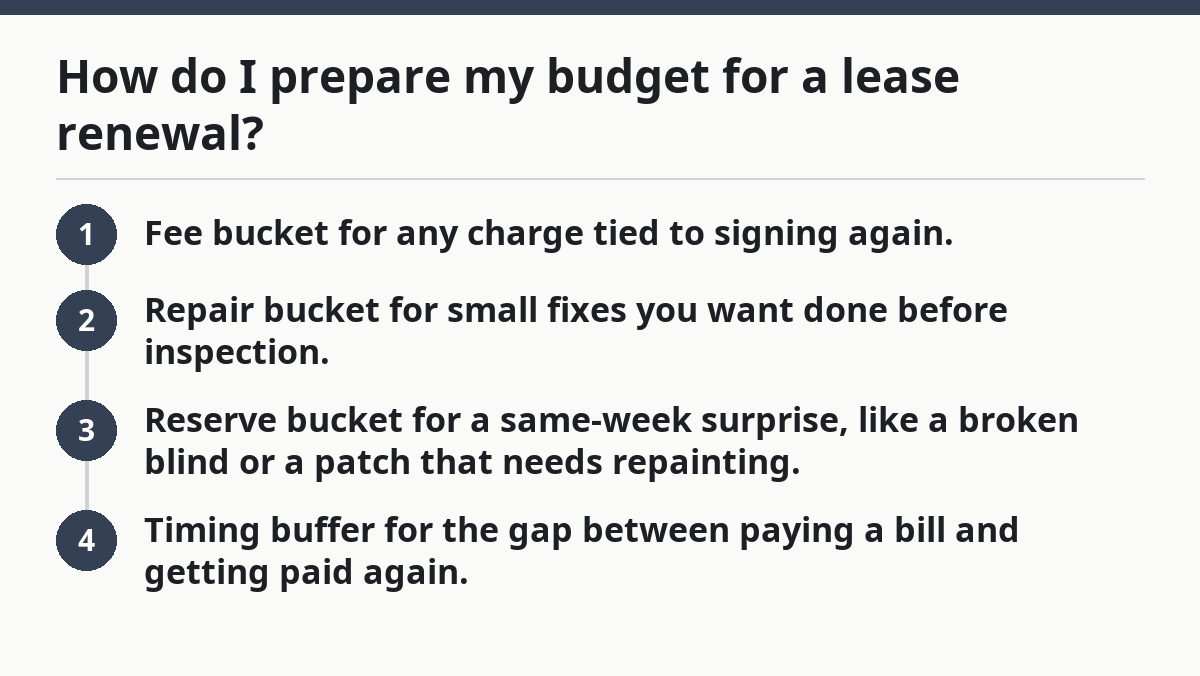
How do I prepare my budget for a lease renewal?
Split the bill pile first. Put the known charges in one column and the maybe-costs in another, then give each one a place in the month before the deadline. The point is not to predict everything; it is to keep a lease renewal from turning into a cash squeeze.
Picture this: the landlord sends a renewal notice, the number is not awful, and still the timing is bad. Rent, childcare, and groceries already eat most of the month, so one extra charge can knock the whole plan sideways.
Start with the renewal notice and pull out five items: response deadline, lease term, rent amount if it changes, any renewal fee, and any condition tied to inspection results. If a fee is mentioned but not explained, ask for it in writing before you budget around it.
Then build a short renewal bucket:
- Fee bucket for any charge tied to signing again.
- Repair bucket for small fixes you want done before inspection.
- Reserve bucket for a same-week surprise, like a broken blind or a patch that needs repainting.
- Timing buffer for the gap between paying a bill and getting paid again.
If the renewal adds a fee you can’t cover without skipping essentials, that is not just a budgeting problem. It is a sign to compare staying, renegotiating, or changing plans. You do not need a crystal-ball forecast—just a clean record of what the landlord may charge and when.
What should I save for before a housing inspection?
Save for the repairs and cleanup that often show up during an inspection, even when the place looks mostly fine. A clean unit can still need money for a loose door handle, a damaged blind, or a wall patch that was easy to ignore for months.
Picture this: the inspection is in 5 days, the home is livable, and the small stuff is piling up. You need a budget that covers the items most likely to trigger a charge or a follow-up visit.
Common inspection costs can be small on their own and annoying together, but check your lease or a qualified housing professional before spending:
- Replacing a burned-out bulb
- Patching nail holes
- Cleaning oven grease or bathroom mold spots
- Fixing a dripping tap
- Replacing a missing screen or broken blind slat
- Paying for a handyman visit when the job is beyond your tools
The biggest budget mistake is treating inspection prep like a free task. Even if you do most of the work yourself, you may still need cleaning supplies, filler, paint, or outside help for one awkward repair. If your landlord has a written inspection standard, use that wording as your checklist so you do not spend on the wrong thing.
How do I decide between renewing and moving?
Compare the full cost of staying against the full cost of leaving, not just the rent number. Lease renewal can be cheaper than moving even when the rent goes up, because moving often brings truck costs, deposits, application fees, and duplicate utility bills.
Picture this: the renewal looks expensive at first glance, and moving sounds like the cheaper escape. Then the actual moving costs start stacking up, and the math stops working fast.
Use a simple comparison:
- Stay cost: renewal fee, repair budget, any rent change, and any inspection-related work
- Move cost: new deposit, application fees, moving truck or van, packing supplies, cleaning, and time off work
- Cash timing: when each bill hits your account
If staying means one repair bill and a modest fee, but moving means several deposits and a gap before the next paycheck, renewal may be the less stressful cash flow choice. On the flip side, if the lease terms are changing in a way that raises costs you cannot absorb, renewal may only postpone the problem.
A good result looks like this: you can name the total cost of staying for the next lease term and still keep money for groceries, transport, and one unexpected bill. If you cannot do that, the budget is telling you something useful.
What mistakes do single parents make around lease renewal?
The biggest mistake is waiting until the last week and then using the grocery budget to cover housing costs. That creates a shortfall somewhere else, and the gap usually shows up fast. Another common error is treating every inspection item as urgent, even when some repairs can wait or are the landlord’s job.
Picture this: the household is already running on tight margins, and a renewal email lands in the same week as a school cost. One rushed decision can cost more than the fee itself.
Four mistakes show up again and again:
- Not separating repair money from rent money. The consequence is a late payment or skipped essential spending. The fix is a separate housing reserve.
- Ignoring the deadline in the notice. The consequence is rushed choices or lost negotiating room. The fix is to mark the date on paper and on your phone.
- Paying for fixes that are not yours to cover. The consequence is wasted cash. The fix is to check the lease and the landlord’s responsibility before spending.
- Signing before checking the lease terms. The consequence is agreeing to a fee or rule you had not budgeted for. The fix is to read every updated term first.
- Assuming a small problem will stay small. The consequence is a larger bill later, especially with leaks or damp. The fix is to budget for early repair, not late repair.
If the budget has no room at all, do not force a renewal plan to fit the numbers. A tight plan with no cushion is not a plan.
What if the standard plan does not fit my situation?
The standard plan breaks down when your lease includes unusual fees, your landlord gives a very short notice period, or the property needs more than minor repairs before inspection. In those cases, the budget has to be built around the actual lease terms, not a generic monthly template.
Picture this: the landlord wants a quick answer, the inspection is close, and the property needs more work than you expected. That is not a normal renewal month, and it should not be budgeted like one.
Change the plan in these situations:
- Very short notice, under 2 weeks: move money from nonessential spending first, because you have less time to spread costs.
- Multiple repairs at once: rank them by landlord responsibility, safety, and penalty risk, then budget only for your share.
- Unclear lease terms: do not estimate blindly; ask for the fee and deadline in writing before counting it.
- Income that changes week to week: base the budget on the lowest realistic income week, not the best one.
- Shared household costs that shift month to month: build the renewal budget from your fixed bills first, then add a small buffer.
For a broad housing budget framework, the hub on housing and utilities budget for single parents sits above this page and covers the bigger money picture. This page stays focused on the lease cycle itself.
How do I keep the repair budget from taking over the month?
Keep it contained by capping the repair fund and giving it a job. That means the money is there for inspection-related fixes only, not for everyday spending that has slipped out of control.
Picture this: one account feeds everything—rent, food, school costs, and every surprise. If the repair money sits in that same pile, it disappears before the inspection does.
A practical setup is simple:
- Put the repair reserve in its own envelope, sub-account, or labeled line in your budget.
- Spend only on items tied to the inspection or lease condition.
- Keep receipts and write down what each repair was for.
- Stop adding to the fund once the inspection is over unless the landlord has listed a follow-up item in writing.
If the repair list is bigger than the money you can spare, call that a warning, not a failure. It may mean you need to ask for more time, request clarity on responsibility, or postpone nonessential upgrades. The point is to keep the housing budget stable, not to make the apartment perfect.
What should I check before I renew?
Check the lease terms, the inspection outcome, and your cash flow for the next full term before you sign. A renewal is not only about staying put; it is about whether the next 6 or 12 months still fit your household.
Picture this: the place works for your family, but the numbers are tight and the landlord’s letter leaves out a detail. That missing detail can matter more than the monthly rent line.
Check these items before you commit:
- The exact renewal deadline
- Any fee attached to renewal
- Any repair obligation placed on you
- Whether the inspection found issues that could turn into charges
- Whether your monthly budget still leaves room after rent and bills
If the answer to any of those is unclear, ask for it in writing. A clear lease renewal is easier to budget than a vague one. The answer you want is simple: you can afford the housing now, and the next lease term will not erase the money you need for the rest of the month.
When should I stop and get help with the numbers?
Stop and get help when the lease terms are unclear, the charges are disputed, or the renewal would leave you unable to cover essentials. This is where a qualified housing, tenant, or financial adviser can help you read the terms and sort the money side for your situation. For free or low-cost guidance, see Consumer Financial Protection Bureau and Citizens Advice.
Picture this: the landlord wants a quick signature, but the figures do not line up and you are already stretched. That is the wrong time to guess.
Unclear renewal fee: you do not know what you are paying for — ask for the charge in writing before you budget or sign.
Inspection damage you did not cause: the bill may not belong to you — gather photos, dates, and the lease terms before paying anything.
Renewal pushes out essentials: the budget no longer covers food, transport, or childcare — pause and review the whole month’s cash flow.
Large repair list: the cost is bigger than your spare money — separate landlord duties from tenant duties before you commit to spending.
Short deadline with no room in the budget: the timing is the problem, not just the amount — ask for more time or outside guidance rather than rushing.
If the plan only works by skipping essentials, it does not work.
How do I prepare my budget for a lease renewal?
Start with the renewal notice, list every fee and deadline, and set aside a repair fund before you sign anything. Then compare the overall cost of staying with your monthly budget for the next lease term. If the numbers do not leave room for groceries, transport, and a small buffer, the renewal needs a closer look.
Should I save for repairs before an inspection?
Yes, because inspection prep often brings small repair costs that add up fast. Even if you do part of the work yourself, you may still need cleaning supplies, patching materials, or paid help for one repair. A separate repair fund keeps those costs from coming out of rent or food money.
Drafted with AI; not yet reviewed by a person.