Last updated: November 19, 2026
Quick Answer: How to Budget for a Roommate or Housemate as a Single Parent starts with a written split for rent, utilities, and payment timing. The budget should be clear enough to use on a busy day, not just on paper. The steps below settle who pays what, when, and what happens if one person is late.
Key Takeaways
- A single-parent roommate budget covers shared rent, utilities, and when each payment is due.
- Set one rule for rent, one for utilities, and one for timing, then use them every month.
- Include the recurring numbers and the written rules that turn them into monthly action.
- Protect yourself with written terms, payment records, and a missed-payment plan before anyone falls behind.
Sharing a home with a roommate can cut housing strain, but the budget works only if the rent split, utilities, and backup plan are written down before the first bill arrives. Because money rules differ by country and situation, a qualified adviser should help with your own case. The steps below settle who pays what, when, and what happens if one person is late.
What this budget needs to cover

A roommate budget for a single parent covers shared rent, shared utilities, and the timing of each payment. It also covers the roommate agreement, which is the written rule sheet for the home: who owes what, by what date, and what happens if a bill is short.
To stay useful, How to Budget for a Roommate or Housemate as a Single Parent has to fit real life. If the plan is not simple enough for a busy day, it will fail when the month gets tight.
The budget also needs to track the home’s fixed costs. Rent is usually the largest monthly number, and utility bills can change from one month to the next.
- Rent and any fixed housing charge, with the total shown honestly rather than as a perfect number
- Utilities such as electricity, gas, water, internet, and trash
- Shared household costs that the agreement says are split
- A backup plan for missed or late payments
- The payment method and due date for each person
The best place to start is the housing-and-utilities budget hub for single parents, then come back here for the shared-home mechanics. That order keeps this page focused on the roommate part. For related help, see the single-parent housing budget guide, the utility bill budgeting guide, and the roommate agreement checklist.
How do I split bills with a roommate?
You split bills by writing one rule for rent, one rule for utilities, and one rule for timing, then using the same rule every month. The right split is the one that matches the housing setup and the roommates’ actual use, not a guess made after the move.
How to Budget for a Roommate or Housemate as a Single Parent works best when the split is predictable from the start. That is what keeps the budget from turning into a monthly argument.
Picture this: you’re looking at a lease, two incomes, and one child’s schedule, and you need a method that won’t cause a fight in month two. A clean split does that.
For background on fair housing and lease terms, check the lease basics guide and the fair housing overview.
- List every shared bill on one page: rent, water, electricity, gas, internet, trash, and any fee the lease says is shared. Verify that each bill appears once. If a charge is missing, the budget will look balanced when it isn’t.
- Mark each bill as fixed or variable. Fixed means the same each month, like rent; variable means it changes, like electricity. Verify that you can tell which bills may swing by a heating season or a hotter month. If you can’t, the estimate is too thin.
- Choose one split method: half-and-half, a different percentage, or a room-based split if the lease and home setup call for it. Verify the method before the first payment date. If one adult uses the largest room or has the main bath, a straight 50/50 split may not match the living arrangement.
- Write the payment date for each bill beside the bill name, not in your head. Verify that the roommate agreement names the same date the landlord or utility company uses, or an earlier date if you need a cushion. If dates don’t line up, late fees become likely.
- Set the transfer method for each payment, such as bank transfer, bill pay, or another trackable method your household uses. Verify that the method leaves a record. Cash without a receipt creates disputes fast.
- Build a shortfall rule for bills that rise above the estimate. Verify that the rule says who covers the extra amount, when it gets repaid, and whether the next bill is adjusted. If there is no rule, the higher bill becomes a personal argument.
- Put the roommate agreement in writing and sign it before money changes hands. Verify that both adults have the same copy. If one person keeps “forgetting” the deal, the budget is already unstable.
The truth is, a rent split only works when the payment timing is just as clear as the amount. A budget that names the amount but not the date is not a plan.
What should go in a roommate budget?

A roommate budget should include the numbers that repeat every month and the rules that turn those numbers into action. It should not try to cover groceries, diapers, school costs, or other personal spending unless the household has made a separate written agreement about those items.
How to Budget for a Roommate or Housemate as a Single Parent works best when the shared budget stays narrow. If the list grows too long, it becomes harder to follow and easier to dispute.
Picture this: you’re trying to keep the apartment steady while your child’s needs change week to week. The budget has to stay narrow, or it becomes too hard to follow.
Include these items:
- Monthly rent share for each adult
- Utility share for each adult
- Due date for each payment
- Backup amount or buffer for a higher-than-usual bill
- Late-payment rule that says when the other person is notified
- House rule notes that affect money, such as guest use that raises utility costs
A workable room share budget usually fits on one page. If it needs a spreadsheet full of side notes, it is probably doing too much.
The best part is that a simple budget makes it easier to prove what was agreed if a payment goes wrong. That matters more than having a fancy format. For a template, see the budget worksheet and the shared-expenses tracker.
How do I protect myself when sharing housing?
You protect yourself by writing down the money rules, keeping proof of payment, and setting a missed-payment plan before anyone falls behind. In a roommate setup, protection comes from documentation, not from trust alone.
How to Budget for a Roommate or Housemate as a Single Parent also needs a paper trail. If a payment is disputed later, the record matters more than memory.
Picture this: you’re the only parent in the unit, the month is already tight, and one roommate says they’ll “catch up next week.” A paper trail keeps that promise from turning into a mystery.
Use these safeguards:
- Keep a signed roommate agreement with the rent split and utility split
- Save screenshots, receipts, or bank confirmations for every transfer
- Ask for a due-date reminder in writing if the household uses one
- Keep your own copy of the lease and utility account details you are allowed to see
- Put house rules in plain language, especially about guests, shared spaces, and any cost that can change the bill
One useful standard is a written record of who paid what and when. That is not fancy, but it is the difference between a memory and evidence.
The main risk is not just a late bill. It is a pattern where one adult pays on time and the other pays “later,” while the child’s home life gets more stressful.
What happens if a roommate misses a payment?
A missed payment should trigger the backup plan the same day, not after the next bill lands. The plan should say who covers the shortfall, when the other adult must repay it, and whether the shared bill changes for the next month.
How to Budget for a Roommate or Housemate as a Single Parent depends on this part. A shortfall that is not defined in writing can spread into the next bill.
Picture this: the electric bill comes in higher than expected, and one roommate cannot cover their part by the due date. If the plan is vague, the whole household absorbs the stress.
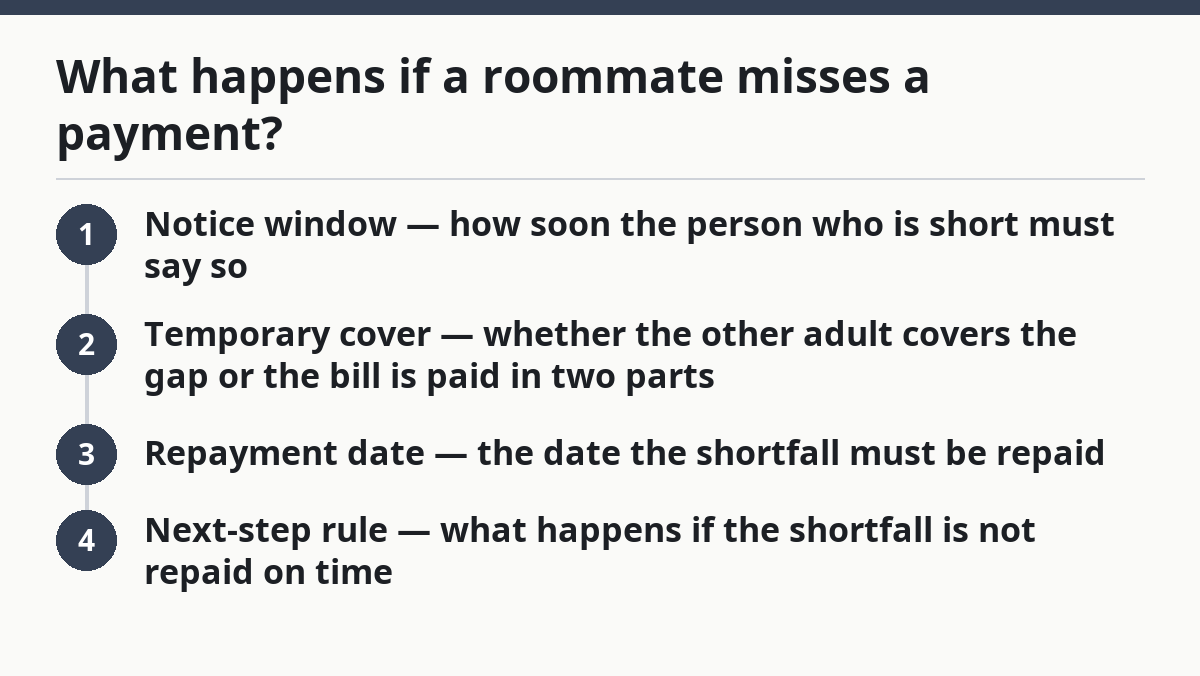
Use a missed-payment rule with these parts:
- Notice window — how soon the person who is short must say so
- Temporary cover — whether the other adult covers the gap or the bill is paid in two parts
- Repayment date — the date the shortfall must be repaid
- Next-step rule — what happens if the shortfall is not repaid on time
If the budget cannot absorb even one late payment without overdrawing another account, the split is too tight. That is a signal to revise the housing setup, not to hope it works out.
The catch is that a missed payment can be a money problem or a behavior problem. If the pattern becomes repeated, the budget is no longer the only issue.
When should a single parent stop using a simple roommate split?
A simple roommate split stops working when the bills, the lease, or the other adult’s payment pattern make the arrangement unstable. That is the point where a written split is not enough on its own.
How to Budget for a Roommate or Housemate as a Single Parent may need a different setup when the arrangement changes. The point is not to force a flat split into a situation it no longer fits.
Picture this: you’ve made the budget, but the numbers keep changing, and one late payment keeps ricocheting into the next bill. The system needs a new rule, not more optimism.
The lease names joint liability: both adults may be on the hook for the full rent — get the lease terms reviewed before relying on a 50/50 assumption.
The utility accounts are in one name only: one adult may carry the credit and late-fee risk — move to a written reimbursement method or ask the utility company how billing works.
One person pays irregularly: the budget becomes unstable — switch to payment before due date only, or reduce shared exposure.
The home setup changes the value of the rooms: a larger room, private bath, or parking space can make a flat split feel unfair — revise the split so it matches the arrangement.
The shortfall is now recurring: repeated gaps mean the current housing cost is too high for the household — a simpler split will not fix that.
On the flip side, if the bills are predictable and both adults pay on time, the standard split usually works well enough. You do not need a complicated formula to keep a home steady.
Common mistakes that break a roommate budget
The most common mistake is treating a verbal promise like a budget. A promise can sound fine on day one and collapse by the second bill. If the arrangement involves legal rights or repeated missed payments, consult a qualified housing or financial professional before relying on a verbal deal. For written-record basics, see the consumer finance guidance and the rental housing rights page.
How to Budget for a Roommate or Housemate as a Single Parent gets shaky when the rules stay informal. A written agreement and a payment trail reduce that risk.
Picture this: you and the other adult agree to “just figure it out later,” and then the water bill comes due. That is how small disagreements turn into debt.
- Guessing the utility share — the bill varies and one person feels overcharged — use a written split method and adjust only after a real bill arrives.
- Ignoring due dates — late fees appear even when the amount is right — write the date beside every bill and set reminders.
- Mixing personal costs with shared costs — the budget gets muddy fast — keep rent and utilities separate from personal spending.
- Using cash with no receipt — nobody can prove payment — use a trackable transfer or written receipt.
- Leaving out the shortfall rule — one missed payment causes a fight — name the next step before trouble starts.
- Changing the deal informally — the agreement stops matching the real payments — update the written roommate agreement any time the split changes.
A clean budget is boring on purpose. Boring keeps the lights on.
What if the standard split does not fit?
The standard split does not fit when the housing setup is unequal, the bills swing hard, or one adult’s work schedule makes payment timing different from the other’s. In those cases, the budget needs a different rule, not more pressure.
How to Budget for a Roommate or Housemate as a Single Parent should account for uneven use and uneven timing. A room that is larger, or a bill that changes month to month, can justify a different split.
Picture this: one adult has the larger bedroom, one has the child most nights, or one pays on a different pay cycle. A flat split may look simple, but it can create a hidden imbalance.
Here are common edge cases and what changes:
- Different room sizes: use a room-based rent split if the home clearly gives one person more private space.
- Uneven utility use: if one adult works from home and raises internet or electricity use, note that in the agreement and decide whether the split changes.
- Split custody or frequent child stays: write down which costs are shared and which are not, so the household does not guess from month to month.
- Bills due before pay day: set an earlier transfer deadline so the shared account is funded before the outside due date.
- One adult covers a bill directly: if one person pays the landlord or utility company, the other should still reimburse by a fixed date in writing.
The best result is not perfect fairness in every line item. It is a system both adults can follow without constant renegotiation.
How should a single parent judge whether the budget is working?
A roommate budget is working if the rent and utilities are paid on time, the shortfall plan rarely gets used, and the written agreement still matches reality after 2 or 3 billing cycles. If those things are not true, the arrangement needs revision.
How to Budget for a Roommate or Housemate as a Single Parent should become easier after the first few bills, not harder. If the same fight returns every month, the budget needs a reset.
Picture this: you’ve made it through a few bills, and the same arguments keep showing up. That tells you the budget is not doing its job yet.
A good result looks like this:
- Each adult knows the amount due before payday
- The shared bills are paid on the same schedule every month
- The agreement covers the same items the bills actually include
- Late payments are rare and handled the same way each time
- The child’s home routine is not constantly interrupted by payment stress
If the budget only works when everyone is “trying really hard,” it is too fragile. A real budget should survive an ordinary month.
How do I split bills with a roommate?
I split bills with a roommate by writing the rent split, utility split, and payment dates in a roommate agreement and then using the same rule every month. The best split is the one that matches the lease and the actual living setup, not a guess. If one bill keeps causing trouble, the split or the timing needs to change.
What should go in a roommate budget?
A roommate budget should include shared rent, shared utilities, due dates, payment methods, and a backup plan for missed payments. It should also note any house rules that affect costs, like guest use or a bill the lease says is shared. If a cost is personal, it should stay out of the shared budget.
How do I protect myself when sharing housing?
I protect myself by keeping the roommate agreement in writing, saving proof of every payment, and setting a missed-payment rule before trouble starts. A paper trail matters more than memory when rent or utilities are late. If the lease or utility account puts too much risk on one person, the arrangement should be reviewed before the next bill.
Drafted with AI; not yet reviewed by a person.