
Last updated: November 19, 2026
Key Takeaways
- Set a support ceiling, split school costs into fixed and flexible parts, and match them to months you can pay.
- Cover the costs that keep your child enrolled, and stop before adult lifestyle spending begins.
- Room-and-board help only works when it fits your cap and supports school access.
- Treat textbooks, transit, and meal money as separate support lines, not one catch-all fund.
A college-age child can strain a single-parent budget fast, especially once tuition, textbooks, food, and transport split into different bills. The answer to How to Budget for a College-Age Child as a Single Parent is to set a hard cap for what you will cover, separate required school costs from adult-living help, and decide in advance what you will not pay. The steps below show how to make that budget work without guessing.
What this budget is for, and what it is not

This budget is for a single parent who is helping a child pay for college and wants a clear line between school support and day-to-day adult support. It assumes you already have a basic family budget, know your monthly income, and can list your fixed bills in one page or one app. This is information, not financial advice; for your own situation, a qualified adviser can help you weigh aid, debt, and cash flow.
Picture this: you have one child in college, one income, and a pile of school bills that do not arrive on the same day. You need a college-age child budget that covers the right things, limits the rest, and does not put your own housing or food at risk.
Start with the costs that affect school access first. Then decide how much you can support for tuition, room and board, a campus meal plan, textbooks, a commuter pass, and small extras like laundry or printing. Do not start with what your child hopes you can pay. Start with what your budget can carry for 4 to 9 months at a time.
This page sits under the larger single-parent budgeting setup and foundations hub, which is where the household budget itself gets built. Here, the focus is narrower: college support only.
How do I budget for a college-age child as a single parent?
You budget for a college-age child by setting a support ceiling, dividing school costs into fixed and flexible buckets, and matching each bucket to the months you can actually pay. The cleanest method is to use seven steps in order.
Picture this: you are staring at financial aid letters, bookstore receipts, and a rent notice all in the same week. The goal is not to make every bill disappear. The goal is to decide what you cover, what your child covers, and what gets cut before the semester starts.
- List every college-related cost you may cover. Include tuition, fees shown on the bill, room and board, a campus meal plan, textbooks, supplies, a commuter pass, and any travel home you plan to help with. Verify that each item is a real charge, not a guess. If a cost is seasonal or one-time, mark it that way. A vague line like “school stuff” hides the true total.
- Separate required school costs from comfort costs. Required costs are the ones tied to enrollment or getting to class, such as tuition, books, housing, food, and local transit. Comfort costs are upgrades, extra spending money, and premium housing. Verify that the required list can be covered before you add anything else. A problem is treating a nicer apartment like a school need, so it is wise to consult a financial aid or budgeting professional and check the school’s cost-of-attendance guidance.
- Set a monthly support cap. Pick the most you can give your child each month without missing rent, utilities, insurance, or your own food. Write the cap down before the semester begins and treat it as fixed for that term. Verify that the cap still works if one bill runs high. Because budgets change, consult a financial adviser or school financial aid office before you lock the number in for the term, and use the school’s published cost-of-attendance figures as a reference.
- Decide which bills you pay directly and which you reimburse. Tuition, housing, and a meal plan are easier to control when paid to the school or landlord. Textbooks or a commuter pass may work better as reimbursement with receipts. Verify that each method matches the bill timing. A problem is handing over cash for a bill that can be paid directly and then losing track of where it went.
- Use financial aid before parent money fills the gap. Complete the FAFSA, review grants, scholarships, work-study, and student loans before deciding how much of the rest you cover. The FAFSA is the Free Application for Federal Student Aid in the U.S.; other countries use different systems and deadlines. Verify that aid is applied to the school year you are budgeting for. A problem is covering a gap that aid could have reduced. See the Federal Student Aid FAFSA page for the current application process and deadlines.
- Choose one rule for student loan co-signing. If you are asked to co-sign, require the payment amount, the term, and the exit rules in writing before you agree to anything. Verify that you understand who is responsible if the student misses a payment. A problem is co-signing without a plan for what happens if the loan is not repaid on time. This is one place where a qualified adviser or loan officer can explain the terms clearly. The CFPB explains how co-signers can be liable for the debt.
- Build a small school buffer. Put aside a little for predictable surprises like a required lab fee, a broken laptop charger, or an extra trip to campus. Keep it separate from household emergency money so the two do not blur. Verify that the buffer is for school-only surprises, not for ongoing spending. A problem is using the buffer to cover repeated shortfalls.
- Review the budget once per term. Check it at the start and midpoint of each semester, or every 4 to 6 months if your school uses quarters. Compare what you planned with what actually happened. Verify that support still fits your income. A problem is waiting until the account is empty before changing anything.
Therefore, the best result is a funded school term, current personal bills, and a child who knows which costs are covered. If that does not happen, the budget is too loose or too generous.
What should I pay for when my child goes to college?
You should pay for the costs that keep your child enrolled and able to attend class, then stop before you start covering adult lifestyle choices. That line is the difference between support and overextension.
Picture this: your child asks for “just a little help” and the request includes a nicer apartment, food delivery, and a parking pass. The truth is, those choices can swallow a budget fast if you do not draw the line now.
A practical split looks like this:
- Usually covered first: tuition support, required fees on the school bill, room and board help if you agreed to it, textbooks, and a commuter pass if the child lives at home or off campus.
- Sometimes covered: a set meal allowance, printing money, basic school supplies, and one planned trip home if distance makes that necessary.
- Usually not covered: entertainment, upgraded housing, subscription services, constant takeout, and spending money with no limits.
Keep the school side and the adult side separate. Tuition and housing are not the same as lifestyle support, even when both show up in the same semester.
For example, if your child lives on campus, a meal plan may be cheaper than handing over food money in pieces, but it is not always the best fit. If the child is a commuter, a commuter pass can make more sense than fueling a car if parking and gas costs are unpredictable. If the child lives at home, meals and transit may be the bigger line items, while room and board help may be zero. Because those choices vary by school and housing setup, check the numbers against the school’s own aid and housing pages before you decide.
That trade-off matters because a budget that pays for everything on paper but leaves no cash for your own groceries is not a working plan.
How much room and board help makes sense?
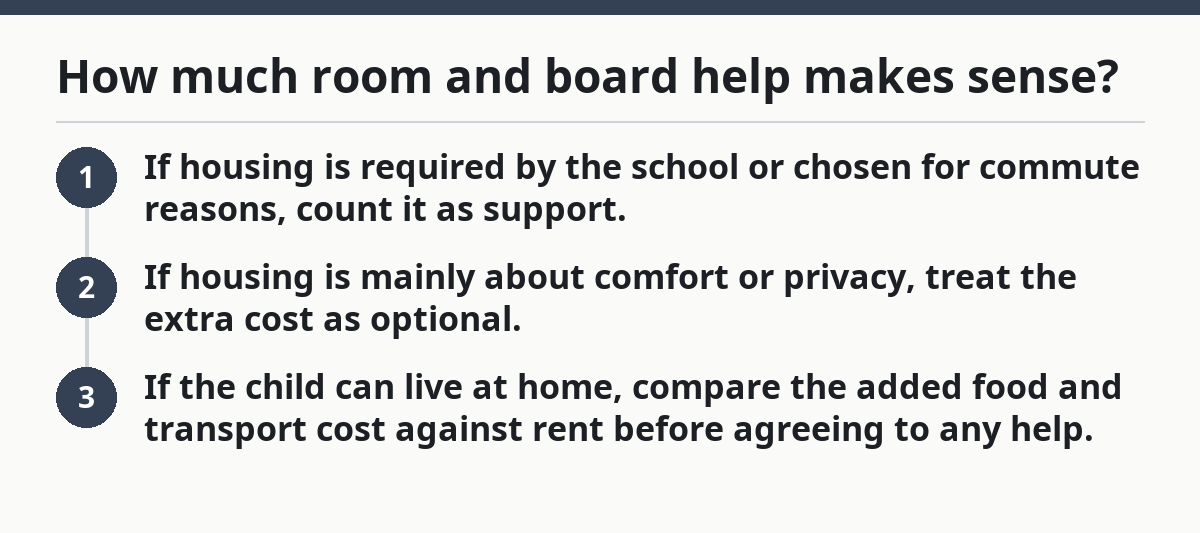
Room and board help makes sense only if it fits your monthly cap and your child’s housing choice is tied to school access. The point is not to subsidize the nicest option; it is to keep the student housed without breaking the parent budget.
Picture this: you are comparing an on-campus room, a shared off-campus apartment, and the child staying at home. Each choice changes the bill in a different way, and the wrong one can lock you into a payment you cannot sustain for 9 months.
For instance, use this filter:
- If housing is required by the school or chosen for commute reasons, count it as support.
- If housing is mainly about comfort or privacy, treat the extra cost as optional.
- If the child can live at home, compare the added food and transport cost against rent before agreeing to any help.
A campus meal plan is useful when the student really eats on campus and the plan saves repeated grocery runs. It does not buy restaurant food, snacks for the whole week, or unlimited freedom to eat off-plan. If the plan is too rigid, it can waste money. If it is too small, the student may still need extra food money, which means the plan was not the right fit.
Ultimately, room and board help works best when the parent pays a fixed amount and the student covers anything above it. That keeps the budget from drifting every time rent rises or the lease changes.
What about textbooks, a commuter pass, and meal money?
Textbooks, a commuter pass, and meal money should be treated as separate school support lines, not one loose “miscellaneous” fund. Each one behaves differently over a term, and each can be capped differently.
Picture this: the bookstore bill lands before aid is disbursed, the bus pass is due monthly, and food money disappears in one grocery run if nobody tracks it. That is why these costs need their own rules.
Here is a clean way to handle them:
- Textbooks: Set a book cap for each term, then look for the cheapest acceptable format first. Used books, rental, or electronic versions may cost less than new copies, but they do not always include access codes or long-term use. Verify what the class actually requires before you pay.
- Commuter pass: If your child rides public transit, a pass may be easier to budget than single fares. A pass buys regular transit use; it does not cover parking, rideshare trips, or travel outside the system.
- Meal money: Decide whether meal money is a weekly amount, a monthly amount, or part of a meal plan. Weekly limits are easier to track. Monthly limits are easier to budget. Neither should be open-ended.
Because textbooks often arrive before aid, overspending happens quickly if you buy the first option you see. It rarely is the only option. But the lowest price is not always the best value if the book needs codes or if a rental deadline lands before finals.
If your child is commuting, the transit line should be tied to a school schedule, not to casual extra trips. If the child is eating on a campus meal plan, food money may need to be lower, not higher.
What are the mistakes that drain a single-parent college budget?
The biggest mistake is saying yes before the rules are written down. That one habit can turn a manageable support plan into a permanent cash leak.
Picture this: the semester begins with good intentions, then the child needs a new laptop case, a parking permit, a nicer dorm, and extra takeout money. One loose yes becomes five.
Common errors and what they cost:
- Paying every bill from the same account: This hides school spending inside household spending and makes it hard to spot the real gap. Use separate lines or separate tracking categories.
- Covering tuition but ignoring books and transit: The school bill gets paid, but the student still cannot attend class comfortably. Add the full attendance cost, not just tuition.
- Treating one semester like the next: Aid, housing, and class loads change. Recheck the budget each term.
- Co-signing without a repayment plan: If the student misses payments, the parent can be on the hook. Read every term first.
- Giving cash with no category: Cash disappears into food, entertainment, or transport with no record. Use a receipt rule or a fixed transfer instead.
- Trying to match another family’s support level: A different parent may have two incomes, lower housing costs, or no debt. Your budget has to fit your numbers, not theirs.
Therefore, the correct alternative is boring but effective: set limits, track by category, and review often. A dull budget is better than a dramatic rescue.
When should this approach change?
This approach should change when the child’s school costs keep forcing your own essentials out of the budget. That is the line where support becomes unsustainable.
Picture this: you are missing your own rent payment, putting off car repairs, or carrying school costs on a credit card month after month. That is not a temporary squeeze anymore. It is a sign the plan needs to shrink.
If tuition keeps rising faster than your income: the original support cap is too high — reduce what you cover, and shift more costs to aid, scholarships, work-study, or the student’s own income.
If room and board are crowding out your essentials: housing help is too large — switch to a fixed amount or ask the child to choose a lower-cost living setup.
If the student is commuting but the transport bill is too high: the commute plan is inefficient — compare transit, carpooling, and living closer to campus.
If your child keeps asking for unplanned extras: the budget lacks a boundary — replace open-ended help with a term limit.
If student loan co-signing is being used to fill a gap you cannot afford: the loan may be the wrong tool for your budget — get qualified advice before signing anything.
If your own emergency fund is being drained for school costs: the budget is crossing into financial risk — pause new support and reset the plan.
There are times when the standard parent-help model does not fit. A child who is part-time, living at home, or taking a reduced course load may need a different setup than a full-time resident student. In those cases, the support plan should follow the actual enrollment pattern, not a generic college budget.
The best sign the plan is working is not that you feel generous. It is that you can pay your own bills, know what the child gets, and adjust without panic.
A college-age child budget that holds up term after term
A college-age child budget holds up when it has a cap, a category for each school cost, and a rule for what happens when money runs short. It does not need to be fancy. It needs to be clear.
Picture this: the school year has a rhythm, and your budget should match it.
Drafted with AI; not yet reviewed by a person.