Last updated: November 19, 2026
Quick Answer: Set aside enough for at least one short-notice care need, such as a 2-hour late pickup or one same-day sitter call, without touching rent, groceries, or transit. How to Budget for Babysitting Backups as a Single Parent works best when you match the fund to the people you can call, the hours you may need, and the late-pickup risk. The steps below show how to build a backup plan that holds up when work shifts change or appointments run long.
Key Takeaways
- Backup babysitting covers the care you use when your regular plan falls through, a meeting runs late, or pickup runs late.
- Start with people you already trust, then set the amount around their availability.
- A backup sitter fund buys speed, reliability, and flexibility for short-notice care.
- Build the backup care list first so you know what the money has to cover.
What backup babysitting has to cover
Backup babysitting covers the care you use when your regular plan falls through, a meeting runs late, or a pickup turns into a late pickup. It is not the same as your everyday childcare line item. This money is for the gaps—the 2-hour scramble, the 4-hour bridge, the one-night emergency.
Picture this: you’re at work, your sitter texts at 3:10 p.m., and you need a backup caregiver who can be at your door in 30 minutes or less. That’s the exact problem How to Budget for Babysitting Backups as a Single Parent has to solve, not the normal Tuesday routine.
The cheapest plan is the one that fits your real schedule and your real caregivers. A cousin who answers once a month is not a plan. A family member, neighbor, or trusted babysitter on a short list is a plan only if you know what each person can do, at what hour, and for how long.
Backup care usually needs to cover:
- emergency sitter pay for same-day help
- late pickup coverage from school or aftercare
- last-minute care when a regular sitter cancels
- backup caregiver time during appointments or overtime
- transportation, if the caregiver must drive
On the flip side, this budget does not need to fund every possible child-care cost. That belongs to your regular childcare plan. This page is about the irregular, last-minute expense that protects work shifts and appointments.
How do I budget for babysitting backups as a single parent?
You budget for babysitting backups as a single parent by listing the situations that trigger extra care, pricing each one the way a real sitter would charge, and setting aside money for the highest-risk gap first. Start with the people you already trust, then build the amount around their availability.
Here’s the catch: the amount you need is not one neat number from a chart. It depends on how often you need a babysitter, how many trusted caregivers you have, and whether your job has unpredictable hours. A parent with a steady 9-to-5 schedule and one nearby aunt needs a smaller backup fund than a nurse with rotating shifts and no local help.
Do this in order
- List every backup moment. Write down the exact situations you need coverage for: school dismissal, a sick-day gap, a work shift that runs late, or a doctor visit that takes 2 hours instead of 1. When this step works, you’ll have a short list you can price instead of guessing.
- Mark who can cover each one. Put names next to the jobs: babysitter, family member, neighbor, or trusted backup caregiver. Note who can do evenings, who can do school pickup, and who can only help on weekends. The result should look like a simple grid, not a vague contact list.
- Estimate the cost of each gap. Use the real minimum time you need covered, such as 1 hour, 3 hours, or an overnight stretch. If a sitter requires a minimum booking, budget for that minimum even if you only need 90 minutes.
- Set a monthly backup line. Pick a recurring amount that can absorb at least one short-notice call a month without breaking rent, groceries, or transit. If the line feels tight, trim the least urgent backup first, not the one that keeps your job intact.
- Keep the money separate. Put the fund in a separate envelope, sub-account, or labeled cash category so it stays available when you need it. When it works, you’ll know the money is there the moment your sitter cancels.
Even a small, named fund can cover a single emergency sitter pay request or a late pickup fee that would otherwise hit a checking account with no warning.
What money does a backup sitter fund actually buy?
A backup sitter fund buys speed, reliability, and flexibility for short-notice care, not luxury service. It pays for the person who can say yes today, show up on time, and stay long enough for you to finish work or get home.
Picture this: your regular childcare falls through at noon, and you need help by 5 p.m. A backup fund can cover the sitter who accepts a same-day request, the neighbor who can bridge the gap for 2 hours, or the cousin who can handle bedtime. It cannot buy certainty if nobody on your list is truly available.
This money usually covers:
- higher pay for emergency sitter pay
- extra hours when a meeting runs long
- late pickup charges from a caregiver or program
- transportation costs if you need a ride to the sitter’s home
- a short booking minimum, even if you only need a brief window
It does not cover a full-time replacement for regular childcare. It also does not fix a weak backup list. If you have no one who can accept a call at 6 a.m. or after 8 p.m., more money alone won’t solve the problem.
Many single parents underbudget the time problem, not just the money problem. A backup caregiver who charges fairly but lives 45 minutes away may still fail you when the school calls and pickup has to happen now. Proximity matters as much as price.
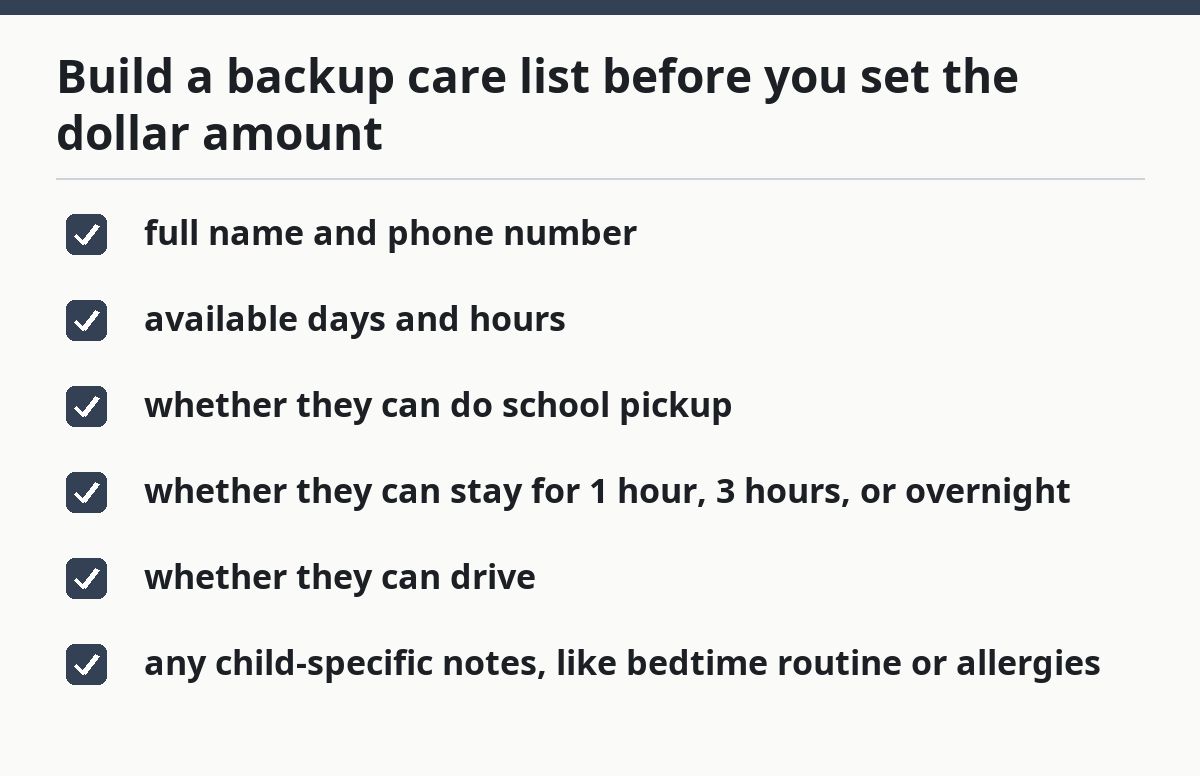
Build a backup care list before you set the dollar amount
You should build the backup care list first, because the list tells you what your money needs to cover. A budget without names and hours is just wishful thinking.
Start with 3 to 5 people you trust. That can include one babysitter, one family member, one neighbor, and one backup caregiver from your broader circle. If a person can only help once a month, write that down. If they can do a 7 p.m. late pickup but not a sick day, write that too.
A useful list should include:
- full name and phone number
- available days and hours
- whether they can do school pickup
- whether they can stay for 1 hour, 3 hours, or overnight
- whether they can drive
- any child-specific notes, like bedtime routine or allergies
Now, you might be wondering how this turns into a budget. It turns into one by assigning the most likely job to the least expensive trusted option that can actually do it. A nearby family member may be the cheapest answer for a 30-minute delay, while a paid babysitter may be the only realistic answer for a late-night work shift.
This is where many budgets fail. They assume one person can do everything. That usually breaks the moment a shift changes on a Friday or a sitter gets sick on a Tuesday.
How to price emergency sitter pay without overpaying
You price emergency sitter pay by thinking in blocks of time, minimums, and urgency, then choosing a ceiling you can live with. The point is not to find the perfect rate. The point is to keep one surprise from wrecking the rest of your month.
Picture this: you need a sitter for a last-minute appointment, and the person who says yes asks for a minimum that covers 2 hours even though you only need 75 minutes. That’s not a trick. It’s the real cost of emergency care, and your budget has to make room for it.
Use these pricing questions:
- What is the shortest booking you’ll pay for?
- Do you need a weekday rate, evening rate, or weekend rate?
- Does a late pickup cost more after a certain hour?
- Will you add gas money, transit fare, or a tip?
- Is the backup caregiver a family member who may need a thank-you payment, even if they do not always charge?
Set a cap for ordinary emergencies and a separate cap for true last-minute care. That keeps a routine work delay from draining the money you need for a rare all-night situation.
If your area has many professional sitters, you may want to ask for a clear emergency rate ahead of time. That is not about haggling. It’s about avoiding a panic call with no number attached.
What common mistakes make backup babysitting cost more?
The biggest mistake is treating backup care like an afterthought, because that can turn every cancellation into a premium purchase; if your situation is unusually complex, a family-budget or childcare professional can help you review the plan. A second mistake is relying on one person for every emergency, which is how a simple plan becomes a crisis.
Picture this: your only backup caregiver is your sister, and she’s out of town the same week your regular sitter has the flu. You now pay more for rush care because the backup list was too thin.
Common mistakes and what they cost:
- No backup list: you pay whatever the only available sitter asks.
- Only one contact: a single no means you are back at zero.
- No time blocks: you overpay for hours you didn’t plan to cover.
- No late pickup line: a small delay turns into a larger bill.
- No cash reserve: you use grocery money to cover care.
Keep at least two categories on the list—paid help and unpaid help. A family member may cover a short gap. A babysitter may cover the long one. A neighbor may be the bridge when school lets out and you’re still on a call.
Cheap backup care that never arrives is more expensive than a paid sitter who can be there in 20 minutes.
Keep your backup fund tied to work shifts and appointments
You should tie the fund to your real schedule, because the biggest backup costs usually come from work shifts and appointments that run long. A doctor visit, late meeting, or overtime shift can all create the same problem: someone has to stay with your child longer than planned.
Picture this: your calendar shows a 4 p.m. appointment, but the actual finish time is closer to 5:30 p.m. That extra hour and a half is where budgeted backup care pays off. Without it, you are calling around with no money set aside.
Use your schedule to split backup care into 3 buckets:
- predictable late pickup risk
- occasional same-day care
- rare emergency coverage
Then give each bucket a place in your budget. The predictable one gets the steadiest line. The rare one gets the smallest line, but it still needs cash. If your job has shifts that change every week, your backup fund needs to be more flexible than a fixed-appointment budget.
For a broader single-parent money plan, the hub on Childcare and school-cost planning for single parents can help you connect this line item to the rest of your family budget without mixing it up with regular childcare costs.
Where to get trustworthy help and set the rules
You should set the rules with your backup caregivers before you need them, because last-minute talks invite confusion. A quick text today can prevent a costly scramble later.
Picture this: your neighbor says yes to school pickup, but you never told them about the 6 p.m. cutoff, the spare key, or the food allergy note. The care may be kind, but the gap still costs you time and stress.
For written help on caregiver agreements and basic home safety expectations, two useful references are:
- the American Red Cross family and childcare safety guidance
- the National Association for Family Child Care standards and caregiver resources
Use those sources to shape your rules, not to replace your own plan. Your backup list should answer who can come, how fast they can get there, and what they need to know when they arrive.
A good rule set usually covers:
- how much notice you’ll give
- how late pickup is handled
- how payment works for paid help
- where emergency contacts are kept
- what to do if the first backup says no
That last one matters most. A backup plan that stops at the first no is not a backup plan. It is a wish.
How much should I set aside for backup childcare?
Set aside enough to cover at least one short-notice care need without stealing from rent, groceries, or transit. The right amount is the one that can handle your most likely emergency—like a 2-hour late pickup or one same-day sitter call—without forcing you to reshuffle the whole month.
Start with your likely gap, not your worst-case fantasy. If you have a family member nearby, your set-aside can stay smaller. If you depend on paid help more often, you need more room for emergency sitter pay and minimum booking time.
Who should be on a backup care list?
Your backup care list should include the people you can call in real life, not just the people who sound helpful. Put in a babysitter, a family member, a neighbor, and any trusted backup caregiver who can handle your child’s routine, school pickup, or a short late stay.
The list works best when each person has a clear job. One may handle weekday evenings, another may only do weekends, and someone else may only be good for a 30-minute bridge until paid care arrives.
How do I plan for a sitter when my regular care falls through?
You plan for a sitter when regular care falls through by naming the backup before the problem happens and setting a fixed amount for the most likely emergency. That means knowing who to call, how fast they can arrive, and what minimum booking time you may have to pay for.
Keep one paid option and one unpaid option ready. If your first choice says no, you want the second choice to be clear, not improvised.
Sources
- American Red Cross — family and childcare safety guidance
- National Association for Family Child Care — standards and caregiver resources
Drafted with AI; not yet reviewed by a person.