Last updated: November 19, 2026
If your paycheck has to cover the next 10 to 14 days, you need a payday-to-payday spending plan as a single parent that assigns every dollar before it drifts away. The fix is to split each paycheck by time, not by month. The steps below show how to map fixed bills, groceries, gas, and your checking account so the money lasts until the next payday.
What a payday-to-payday spending plan as a single parent actually does
A payday-to-payday spending plan keeps your money tied to one pay schedule and the days until the next check. That matters when you’re the only adult in the house, because one surprise charge can quickly knock out groceries, gas, or a daycare copay.
Picture this: you get paid on Friday, rent is due on the 1st, and you still need school lunch money for next Tuesday. A monthly budget can feel too wide and too vague. A payday plan is tighter. It tells you what this paycheck must cover before the next one arrives.
A simple way to think about it is this: each paycheck gets a job, and the job ends on the next payday. Not the end of the month. The next payday.
Use this plan when:
- You know your payday schedule.
- Your fixed bills come every month.
- Your variable expenses change from week to week.
- You want your checking account to stay above zero between checks.
This page is about timing, not a full monthly budget. It also sits inside the larger hub on [income stability and cash flow timing for single parents], where the bigger money picture gets handled without mixing up the two jobs.
How do I plan spending between paychecks as a single parent?
You plan spending between paychecks by writing down what must be paid, sorting it by due date, and giving each paycheck only the expenses that fit before the next one. That is the whole engine.
Because of that, if you skip the dates, you’ll guess. Guessing is what creates end-of-pay-period shortfalls.
Start with a basic list:
- Rent or mortgage
- Utilities
- Child care
- Minimum debt payments
- Groceries
- Gas
- Medicine
- School costs
- Any automatic withdrawals
Then mark which items are fixed bills and which are variable expenses. Fixed bills stay close to the same amount. Variable expenses move, sometimes a little and sometimes a lot.
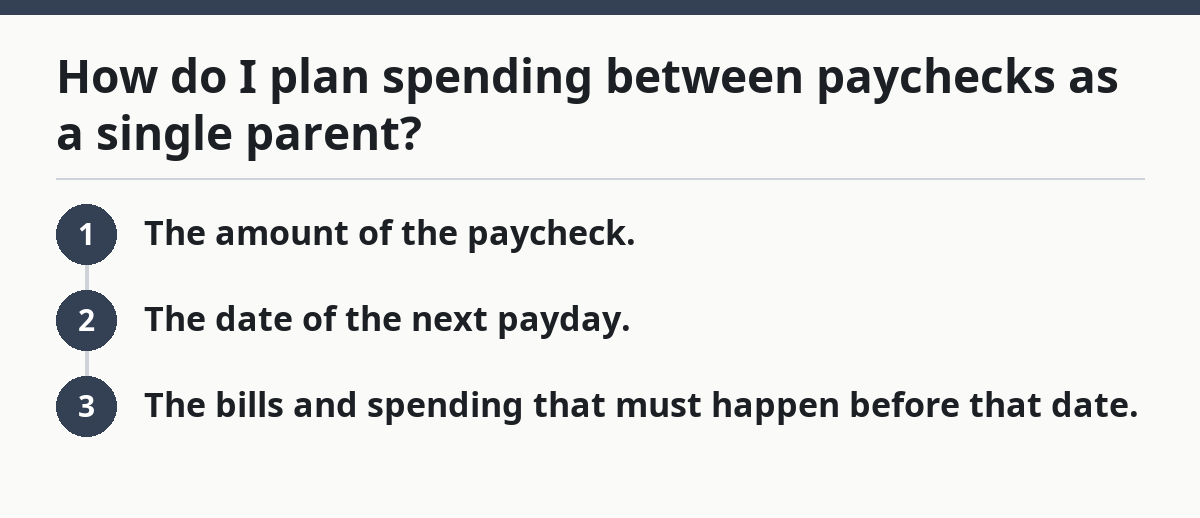
A simple payday plan needs three numbers for each paycheck:
- The amount of the paycheck.
- The date of the next payday.
- The bills and spending that must happen before that date.
Now, you might be wondering how detailed this has to get. Detailed enough to protect the cash, not so detailed that you quit after one week.
Use this quick split:
- Fixed bills first
- Child-related costs next
- Groceries and gas after that
- Anything left goes to buffer or savings
If your paycheck is short, reduce the variable spending before you touch the fixed bills. That means fewer convenience-store stops, fewer extra snacks, and a tighter food list for 7 days.
Map bills to each paycheck before the money lands
You map bills to each paycheck by matching each due date to the paycheck that comes before it, then reserving that money in your checking account as soon as the deposit hits. That keeps one bill from stealing money meant for the next 5 days.
Picture this: your first paycheck of the month arrives on the 5th, and three bills hit before the 20th. If you wait and pay “when you can,” the first payment may eat the gas money. Then you’re scrambling in the school pickup line.
Use this 4-step order:
- List every fixed bill with its due date and minimum amount.
- Put each bill under the payday that arrives before the due date.
- Subtract that amount from the paycheck right away.
- Move the reserved money to a separate spot in the same checking account or a labeled sub-account, if your bank offers one.
That last step matters. Money in the account is not the same as money available to spend.
A plain example:
- Paycheck on the 5th covers rent, electric, and part of groceries.
- Paycheck on the 19th covers child care, phone, gas, and the rest of groceries.
- The last paycheck before month-end covers only what is left.
If a bill lands too close to payday, pay it from the earlier check if you can. That gives you a cushion. A one-day gap is not a cushion. It is a trap.
Build one paycheck plan in your checking account
You build one paycheck plan in your checking account by giving each dollar a label the day it arrives, then spending only from the unlabeled part. The account is the control center, even if the money has multiple jobs.
Picture this: you open your app after payday and see $1,240. That number feels like room to breathe, but it is not free money. Rent, groceries, gas, and a school fee are all already waiting.
Use your checking account like this:
- Deposit hits
- Move bill money to a “do not touch” mental bucket
- Leave the grocery and gas amount available
- Keep a small buffer, if possible, for same-day surprises
A buffer is not extra spending money. It is the amount that keeps a math mistake from turning into an overdraft.
Here’s a clean rule: if you know a bill will hit in the next 10 days, reserve it now. Don’t trust memory. Don’t trust a sticky note alone. Use the bank app, an envelope method, or a ledger app that shows available balance and pending items.
Two common failures show up here:
- Treating all deposits as spendable. Cost: overdraft fees, late payments, and a worse next paycheck. If you are unsure how to handle this, consult a financial professional and check Consumer Financial Protection Bureau guidance on account balances.
- Leaving bills in the general balance. Cost: one grocery run wipes out a utility payment.
Do this instead:
- Label the paycheck on payday.
- Set aside bill money first.
- Spend grocery and gas money from the remainder.
- Stop spending when the labeled cash is gone.
If your bank lets you schedule transfers or bill payments, set them for the same day every payday. A 24-hour delay can be enough to make the money vanish into small purchases.
How to time groceries and gas without running short
You time groceries and gas by assigning them to the days between paychecks, not by hoping one shopping trip will stretch across 2 weeks. That is where most single-parent budgets crack.
Picture this: you bought a full cart on payday, but by day 9 you’re buying lunch meat, milk, and gas in small panic trips. Those stop-and-go purchases cost more and drain your checking account faster than one planned trip.
Use a paycheck window to plan these variable expenses:
- Groceries: plan for the exact number of days until the next paycheck.
- Gas: plan for your commute, school runs, and any weekly drive you can predict.
- Household items: fold them into groceries only if they are truly needed before the next check.
A useful habit is to write the grocery amount on payday, then split it into 2 parts:
- One main shop in the first 3 days
- One smaller top-off near the middle or end of the pay period
That gives you room for fresh food without blowing the whole amount in one trip.
For gas, think in trips, not gallons. School drop-off, work, and one errand loop may be all you need to count. If you can combine errands into one 20-minute route, do that before the tank gets low.
Smaller shopping lists are often easier to protect than a giant “everything” list. A list with 8 items is easier to guard than one with 28.
What should I pay first after payday?
You should pay fixed bills first after payday, then protect child-related costs, then set aside groceries and gas. That order keeps the roof, lights, phone, and work or child care costs from crowding out the rest.
Picture this: payday hits and three creditors start sending alerts. If you pay the loudest bill first, you may still lose the one that matters most. Loud is not the same as important.
Use this sequence:
- Bills that stop life — rent, utilities, car payment, child care.
- Bills with penalties — minimum debt payments, phone, insurance.
- Daily living costs — groceries, gas, school needs.
- Leftover money — tiny buffer or next-paycheck head start.
If two bills are due in the same week, pay the one with the harsher consequence first. A shutoff notice usually beats a fee-only bill. A missing child care payment can threaten your work schedule, which affects the next paycheck too.
Don’t try to “catch up” on everything at once. That is how a paycheck disappears in 48 hours.
A simpler version helps on rough weeks:
- Pay what keeps the month functioning.
- Protect the next 7 to 14 days.
- Delay non-urgent spending until the following payday.
If you want a second source on handling money timing and payment order, the Consumer Financial Protection Bureau and the National Foundation for Credit Counseling both publish plain-language guidance on bill payment and budget setup. See CFPB budgeting tools and NFCC budgeting resources.
Common mistakes that cause end-of-pay-period shortfalls
The most common mistakes are paying from memory, undercounting variable expenses, and letting small purchases eat the last $40. Those errors hit hardest in the final 3 days before payday.
Picture this: the first week went fine, so you relax. Then school supplies, a gas stop, and two extra grocery runs land at once. The account balance drops faster than expected, and you’re left stretching breakfast until Friday.
Watch for these mistakes:
- Ignoring pending transactions. Cost: you think you have more money than you do.
- Paying the same week’s bills all at once without spacing them by payday. Cost: the first bill drains money needed for the rest.
- Treating small purchases as harmless. Cost: $8 here and $12 there can wipe out the grocery cushion. If you are unsure whether a pattern is a budgeting problem or a debt problem, consult a financial professional and review CFPB debt and budgeting guidance.
- Skipping a buffer. Cost: one price change or school fee creates a shortfall.
The fix is not to become stricter in a vague way. It is to become more specific. Put every bill on a date. Put groceries on a date. Put gas on a date. Then leave a small gap between what is due and what is available.
If the paycheck is already spoken for, cut the flexible category first. That usually means treats, extras, and second trips to the store.
A payday plan works because it reduces choices. Fewer choices mean fewer leaks.
A simple payday routine you can repeat every 2 weeks
A simple payday routine turns the plan into a habit in about 15 minutes on each payday. The routine is short enough to repeat and specific enough to stop drift.
Picture this: payday arrives, you’re tired, and the last thing you want is a long money session. That is exactly when a short routine helps. It keeps the plan from turning into a hope.
Use this checklist every payday:
- Open your checking account and note the exact deposit.
- List the bills and expenses due before the next payday.
- Pull out the fixed bills first.
- Set aside groceries and gas for the number of days ahead.
- Mark the remaining balance as your spendable amount.
- Review pending charges before you swipe again.
If you do this on the same day every payday, the plan gets easier to keep. The habit matters more than the spreadsheet.
A pen-and-paper version works too:
- One line for income
- One line for fixed bills
- One line for groceries
- One line for gas
- One line for cushion
That is enough for most single parents who need to keep money alive between checks. It is not fancy. It works because it matches the way the cash actually moves.
Key Takeaways
- A payday-to-payday plan follows your pay schedule, not the calendar month.
- Fixed bills should be assigned to the paycheck that comes before their due date.
- Groceries and gas need their own line, or they will get swallowed by bills.
- A checking account works best when reserved money is mentally or digitally labeled.
- The safest order is: bills that keep life running, then daily costs, then leftover spending.
How do I plan spending between paychecks as a single parent?
Plan spending between paychecks by giving each paycheck a short job that ends on the next payday. Start with fixed bills, then reserve money for groceries, gas, and child-related costs, and keep a small buffer in your checking account if you can. That keeps you from spending next week’s money today.
What should I pay first after payday?
Pay the bills that keep your home and work life functioning first. Rent, utilities, child care, insurance, and minimum debt payments usually come before groceries and extra spending. If two bills compete, pay the one with the harsher consequence first, such as a shutoff, late fee, or work disruption.
Drafted with AI; not yet reviewed by a person.