Last updated: November 19, 2026
Key Takeaways
- Household operations and maintenance covers the home costs that keep it usable, apart from rent or mortgage.
- Fund essentials first, then set aside home money before spending on optional items.
- Your budget path changes when housing type, income pattern, or repair history changes.
- A single-parent home maintenance fund should prioritize items that can stop daily life, cause damage, or worsen if ignored.
Single-parent budgeting for household operations and maintenance is about keeping the lights on, the pipes working, and the house from slowly falling apart while one income carries the load. Quick answer: build separate buckets for routine bills, small repairs, and bigger home fixes, plus a buffer for uneven months. The topic of single-parent budgeting for household operations and maintenance — The Complete Guide is practical because it helps you decide what to fund first, what to delay, and how to avoid surprise gaps.
Information only: this is not financial advice. Budget rules, tax rules, and assistance programs vary by country and change often, so a qualified adviser should look at your own situation.
What actually goes into household operations and maintenance?
Household operations and maintenance means the costs that keep your home usable, not the mortgage or rent itself. If you’re a single parent, that usually means utilities, trash service, internet, cleaning supplies, filter changes, minor repairs, seasonal upkeep, and the little replacements that show up without warning. For household operations and maintenance, the details matter because each line behaves differently in a budget.
Here’s the catch: a lot of people lump all “home costs” together and then wonder why the budget breaks. It breaks because a furnace filter is not the same thing as a broken water heater, and a monthly electric bill is not the same thing as a roof leak. Keep those apart.
The cleanest way to think about it is by timing and urgency:
- Monthly operating costs: electricity, gas, water, trash, internet, pest control if needed
- Predictable maintenance: HVAC filters, smoke alarm batteries, gutter cleaning, lawn care, snow removal
- Small repair drift: leaky faucet washers, toilet flappers, outlet covers, drain parts
- Big-ticket maintenance: appliance replacement, roof work, HVAC service, plumbing repairs
A simple rule helps: if a cost keeps the house functional this month, it belongs in operations. If the cost prevents damage later, it belongs in maintenance; if you’re unsure, consult a qualified professional. According to the Consumer Financial Protection Bureau, budgeting works best when categories are distinct and specific. If it’s neither, it’s probably a wish list item.
The truth is, single parents need a tighter split than most households because there’s less slack if one expense runs long. One missed repair fund deposit can spill into groceries or school fees fast.
Quick check: if you mix every home expense into one pot, you need this guide. If you already separate monthly bills from repair money, you’re ahead.
How do I build a budget when one income has to cover everything?
You build it by funding the non-negotiables first, then carving out money for the home before you spend on anything that can wait. If your income changes month to month, use your lowest reliable month as the base and treat anything above it as support money, not spending money; if you’re unsure how variable income should be handled, consult a financial professional.
Start with a zero-based layout. Every dollar gets a job before the month starts. The method is simple, but it’s not easy. That’s why it works.
- List fixed housing costs first: rent or mortgage, utilities, insurance, internet, and debt payments.
- Add the regular home-running costs: cleaning supplies, filters, light bulbs, trash bags, and basic tools.
- Set a separate home repair line for things that break or wear out.
- Set aside money for one irregular item at a time, like annual HVAC service or gutter cleaning.
- Build a mini buffer so one bill doesn’t wipe out the grocery line.
- Review the budget every pay cycle, not just once a month.
A practical tool helps here: a spreadsheet, a notebook, or budgeting software that lets you split categories. You do not need a fancy app. You need visibility. If your utilities spike in January, the budget should show that before the bill lands. For single-parent budgeting for household operations and maintenance, that visibility is what keeps the plan usable.
A common mistake is to treat repairs as emergencies only. That creates the exact month-to-month panic single parents can least afford, though a qualified adviser can help you decide what truly belongs in emergency savings. Instead, fund maintenance as a known cost, the same way you fund bus fare or school lunches.
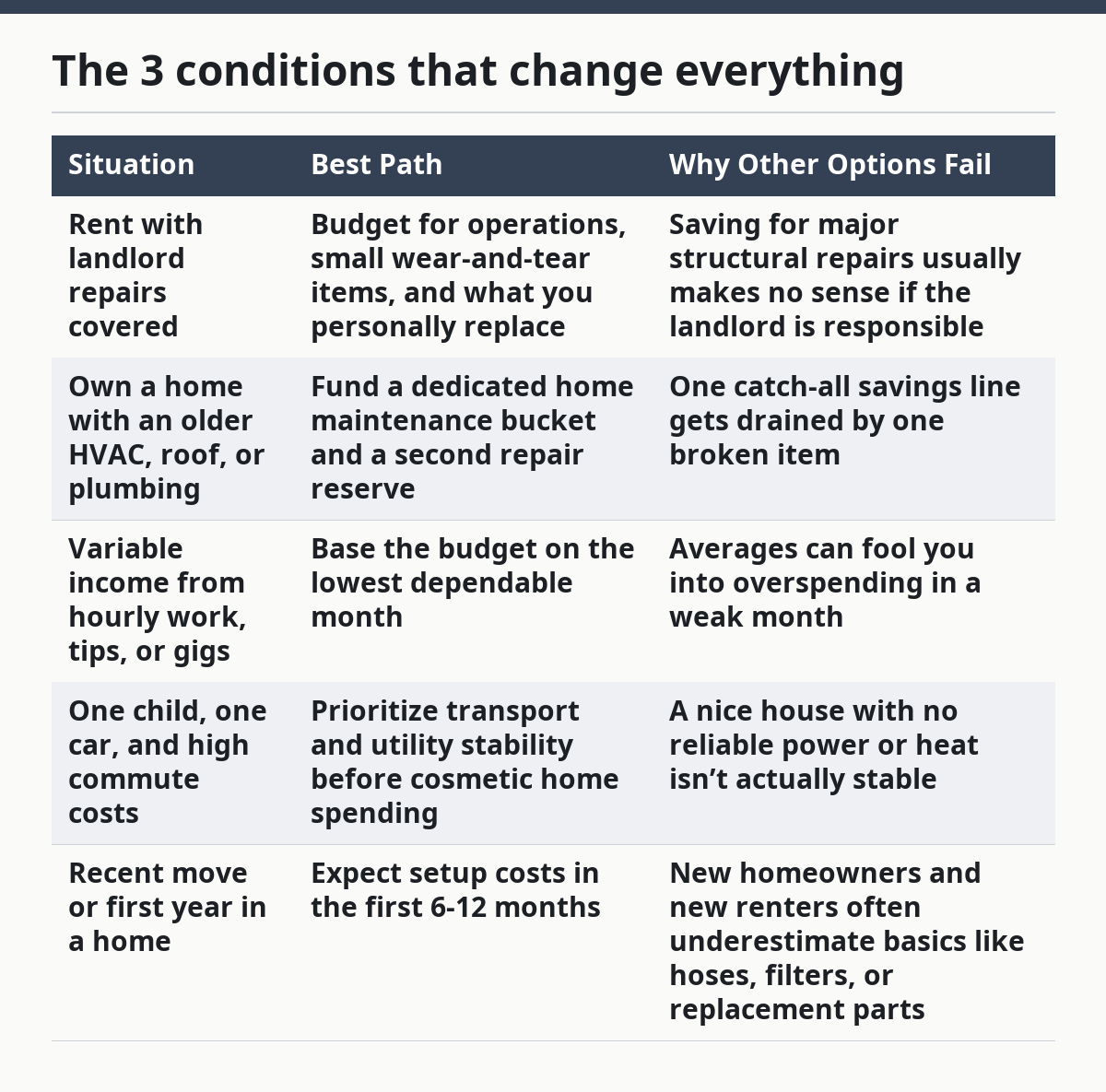
The 3 conditions that change everything
The right budget path changes when your housing type, income pattern, or repair history changes. If one of those shifts, the standard “save a little each month” advice may not be enough. Single-parent budgeting for household operations and maintenance has to flex with those realities.
| Situation | Best Path | Why Other Options Fail |
|---|---|---|
| Rent with landlord repairs covered | Budget for operations, small wear-and-tear items, and what you personally replace | Saving for major structural repairs usually makes no sense if the landlord is responsible |
| Own a home with an older HVAC, roof, or plumbing | Fund a dedicated home maintenance bucket and a second repair reserve | One catch-all savings line gets drained by one broken item |
| Variable income from hourly work, tips, or gigs | Base the budget on the lowest dependable month | Averages can fool you into overspending in a weak month |
| One child, one car, and high commute costs | Prioritize transport and utility stability before cosmetic home spending | A nice house with no reliable power or heat isn’t actually stable |
| Recent move or first year in a home | Expect setup costs in the first 6-12 months | New homeowners and new renters often underestimate basics like hoses, filters, or replacement parts |
If you rent, your maintenance budget should be lighter and more targeted. You still need money for filters, small household replacements, and any damage you’re responsible for, but you usually should not self-fund major systems you don’t own. If you own, the answer flips.
If your income is uneven, your budget needs a floor and a ceiling. The floor covers must-pay items. The ceiling is what you can spend only if the month comes in strong. That difference matters more than any spreadsheet trick.
If your home is older, maintenance is not optional. The older the system, the more the budget should assume parts, service calls, and replacement planning. Cheap now often becomes expensive later.
Quick check: if your housing is rented, owned, or tied to unstable income, your answer changes. If all three are steady, you can use a simpler plan.
What should a single-parent home maintenance fund cover first?
A single-parent home maintenance fund should cover the items most likely to stop daily life, cause damage, or trigger a bigger repair if ignored. That means you fund heat, water, power, and sanitation before you think about upgrades. Single-parent budgeting for household operations and maintenance works best when these priorities are clear.
Picture this: you’re halfway through the month, your child has school in the morning, and the water heater starts leaking. That’s not the time to guess which savings bucket gets emptied. A maintenance fund gives the answer before the crisis starts.
Prioritize in this order:
- Safety and basic function — smoke alarms, carbon monoxide alarms where used, electrical problems, plumbing leaks, broken locks, heat loss
- Damage prevention — roof drips, gutter blockages, mold-prone moisture, clogged drains, failing seals
- System care — HVAC service, filter changes, appliance upkeep, water softener salt if you use one
- Wear items — hoses, toilet parts, faucet washers, caulk, weather stripping
- Deferred extras — paint touch-ups, cosmetic fixtures, décor repairs
The reason for this order is simple: a small leak can become a wall repair, and a dead furnace can become a hotel bill. That’s where household operations and maintenance and family budgeting collide. You’re not just protecting property. You’re protecting routines.
A lot of generic advice tells people to save for “home repairs” as one number. That’s too vague. Use separate labels if you can: one for service, one for surprise fixes, one for replacement planning. A labeled envelope, bank sub-account, or spreadsheet category all work.
The best part is that once the fund exists, you stop making emotional decisions under pressure. A broken part becomes a budget item, not a crisis.
Quick check: if your home fund doesn’t tell you what breaks first, it’s too vague. If it already covers heat, water, and power first, you’re on the right track.
What should I do when money is tight this month?
When money is tight, you protect the home’s basic function first and pause everything that can wait 30 days. That means you pay for utilities, food, transport, and urgent home fixes before you spend on nonessential maintenance or upgrades. Single-parent budgeting for household operations and maintenance is most useful in months like this, because the order of payments matters.
The truth is, a tight month is not the time for perfection. It’s the time for triage.
- List every bill due in the next 14 days.
- Separate must-pay items from can-wait items.
- Fund the bill that keeps the household running: power, water, heat, and shelter.
- Delay noncritical maintenance like cosmetic repairs, paint, or replacement parts that still work.
- Call service providers early if you need a payment arrangement; many have hardship or due-date options.
- Move any leftover cash into the repair line instead of spending it casually.
Two tools help here: a bill calendar and a short list of “shutdown” costs. Shutdown costs are the bills that, if skipped, create immediate trouble. For most homes, those are housing, utilities, food, medication, and transport. Put them in that order if your cash is short.
Now, you might be wondering if home maintenance should still get money in a bad month. Yes, if the item protects against larger damage. No, if it’s cosmetic or can wait without risk. A loose cabinet handle can wait. A leaking supply line cannot.
This is also where generic advice fails single parents. “Cut subscriptions” is not a plan if the real problem is a $140 repair and a $40 gap in the electric bill. The fix is category control, not guilt.
Quick check: if you have to choose between a cosmetic repair and a heat bill, the heat bill wins. If your most urgent costs are already covered, you can keep the maintenance line alive.
How do I plan for repairs without guessing the exact amount?
You plan for repairs by separating known recurring maintenance from unknown breakage and funding both in small, regular steps. You do not need a perfect forecast to make this work. You need categories, dates, and a habit.
A simple structure looks like this:
- Monthly operating costs for bills that repeat
- Scheduled maintenance for expected services
- Repair reserve for unexpected failures
- Replacement fund for large items that wear out over time
That structure matters because not all home spending behaves the same way. HVAC filters might be cheap and regular. A dishwasher motor is neither. Roof work sits in a different bucket again. One bucket cannot handle all three well.
If you own a home, the replacement fund deserves attention even when nothing is broken. Major systems wear out over years, not weeks. Waiting until failure usually means paying under pressure, which is often the least comfortable time to pay anything.
A useful method is to build a 12-month view. Write down the home items you know are likely to recur in the next year: gutter cleaning, dryer vent cleaning, filter changes, pest control, service calls, and seasonal supplies. Then spread those costs across the months that can support them. You’re not guessing. You’re smoothing.
If you rent, keep the same structure but shrink it. Your replacement fund may be for things you personally own, like a vacuum, a fan, or a small appliance. Your repair reserve may mostly cover items you’re responsible for under the lease. That’s the difference.
Here’s the catch: if you never assign a job to repair money, it disappears into groceries, school costs, or “just this once” spending. Labeled money gets used the right way more often.
Quick check: if the same surprise keeps wrecking your budget, you need separate repair and replacement buckets. If those buckets already exist, your next job is filling them consistently.
Edge cases: when the usual advice breaks down
Edge cases need different rules because the normal plan assumes a stable home, steady income, and ordinary repair risk. If any of those are off, adjust the budget, not your expectations. Single-parent budgeting for household operations and maintenance should reflect the house you actually have.
-
You rent a place with slow repairs from the landlord.
What changes: the repair timeline is no longer fully under your control.
What to do instead: keep a small emergency cash buffer for temporary fixes, but don’t over-save for structural repairs that are the landlord’s duty. Keep records, photos, and dated messages. -
Your income is mostly commission, overtime, or gig work.
What changes: the monthly amount you can safely assign changes too.
What to do instead: budget from the lowest predictable income month and treat the rest as backlog money for bills, home maintenance, and reserves; if needed, ask a financial professional how to structure the buffer. -
You live in an older home with repeated system failures.
What changes: one repair is a pattern, not a random event.
What to do instead: stop using one generic repair line for everything and track the repeat offender separately, such as plumbing, roof, or HVAC. -
You share housing with another adult who pays unevenly.
What changes: timing risk becomes as important as amount.
What to do instead: split bills by due date, not just by rough percentage, and keep proof of who paid what. -
A child’s needs create sudden home costs.
What changes: the household’s “maintenance” list grows faster than expected.
What to do instead: include child-related home items in the operating budget if they recur, such as laundry, cleaning, or room repairs from normal wear. -
You’re recovering from a move or separation.
What changes: setup costs and duplicate costs can hit at once.
What to do instead: expect the first 3-6 months to be messy and keep a tighter cash buffer than usual.
A generic budget fails in these cases because it assumes smooth timing. Life doesn’t behave that way. Your budget should.
Quick check: if your home, income, or family setup is unusual, the standard one-line repair fund is probably not enough.
What tools and records make this easier to keep up?
The easiest system is the one you can keep using on a tired Tuesday night with a child asking for help with homework. If a tool takes 20 minutes every day, it will fail. If it takes 10 minutes a week, it has a chance.
A simple setup works best:
- One bill calendar with due dates
- One maintenance list with recurring jobs and next-service dates
- One repair log for what broke, what it cost, and whether it happened again
- One bank account or sub-account for home repair money if your bank allows sub-buckets
- One receipts folder for appliance parts, service calls, and warranty papers
The repair log matters more than people think. If the same part fails twice in 6 months, that tells you something. If your furnace filter gets missed every winter, that tells you something too. Patterns are budget clues.
A spreadsheet is enough for many households. So is a notebook taped inside a kitchen drawer. The point is not technology. The point is a visible system that tells you what comes next.
If you want a cleaner standard, use recurring reminders on a phone calendar. Set the reminder a few days before the bill or service date, not on the day itself. A 3-day buffer can be the difference between a planned payment and a penalty.
The truth is, many households don’t fail because they spent too much once. They fail because they forgot several small things in a row. Records stop that drift.
Quick check: if you can’t answer “what’s due next” in under 30 seconds, your system needs a calendar and a log.
What should I watch for so I don’t underfund the house all year?
You should watch for repeat costs, seasonal spikes, and bills that look small but arrive like clockwork. If you ignore those, the budget looks fine on paper and fails in real life. Single-parent budgeting for household operations and maintenance depends on catching those patterns early.
A few items deserve special attention:
- Seasonal utilities: heating and cooling often swing with weather
- Air filters and HVAC care: cheap per item, easy to forget, expensive when ignored
- Water-related repairs: leaks usually get worse, not better
- Cleaning and replacement basics: trash bags, detergent, light bulbs, batteries, and hoses
- Annual or semiannual service: these are easy to miss because they don’t show up every month
One good habit is a quarterly budget review. Every 3 months, compare what you planned with what actually got spent. If the electric bill keeps outrunning the estimate, adjust the number. If the repair fund never gets used, don’t assume it can be raided for something else.
That review is where you protect yourself from drift. The budget should fit the house you live in now, not the one you hoped you had last year.
There’s also a judgment call here. A “maintenance” expense that keeps happening might really be a replacement problem. If you keep repairing the same appliance, the budget may need a replacement fund, not another patch. That’s not a failure. It’s data.
For broad consumer guidance on financial planning and budgeting, the Consumer Financial Protection Bureau has budgeting resources, and many countries have a national consumer finance or money guidance agency. Check the local version that applies where you live. The CFPB is one authoritative starting point, and local housing or consumer agencies can help with region-specific rules.
Quick check: if your budget changes only after something breaks, it’s too late. If you review it every quarter, you catch the pattern sooner.
FAQ
How much should a single parent set aside for home maintenance?
There isn’t one universal number that fits every country, house, or income level. The better rule is to separate routine operating costs from repair and replacement money, then build a monthly amount that reflects your home’s age, size, and condition. If you need a precise number, a qualified local adviser or housing professional can help you tailor it.
Should renters budget for maintenance too?
Yes, but the list is smaller. Renters usually budget for personal household wear, light replacements, and anything the lease makes them responsible for. They usually do not need to self-fund major building systems, since those are commonly the owner’s responsibility.
What if I can’t save anything right now?
Then protect the basics first and set up the structure anyway. Even a tiny, regular transfer into a repair category can help you see the gap and stop surprise spending from swallowing it. If the gap stays too large, the next step is to review fixed costs, payment dates, and any local assistance options.
Is it better to keep home repair money in cash?
Cash can be useful for small, immediate needs, but it also carries loss and access risks. Many people use a separate bank account or labeled sub-account instead, because it keeps the money visible without being easy to mix into everyday spending. The right choice depends on your security, access, and local banking options.
What’s the biggest mistake single parents make with home budgets?
The biggest mistake is treating home costs as one blurry pile. That hides which bills are monthly, which are seasonal, and which prevent larger damage. Once those are split out, the budget gets easier to manage and much harder to blow up by accident.
Drafted with AI; not yet reviewed by a person.