Last updated: November 19, 2026
A single-parent household needs a monthly spending limit that covers groceries, gas, entertainment, household supplies, and child extras without running the account dry. How to Set a Monthly Spending Limit for a Single-Parent Household starts with the right cap: the amount you can spend on flexible costs after fixed bills and savings are set aside. The steps below show how to set that limit, keep it honest, and reset it before a rough week turns into a rough month.
Key Takeaways
- Your spending limit should cover the moving parts of life, not rent or the electric bill.
- A good cap has category ceilings for groceries, gas, entertainment, household supplies, and child extras.
- A weekly reset keeps one bad day from wrecking the whole month.
- Overspend guardrails matter more than a perfect plan.
- If the limit feels too tight, the fix is usually a category change, not a willpower lecture.
What a monthly spending limit is for a single-parent household
A monthly spending limit is the ceiling for the money you can spend on flexible items in a 30-day stretch, and it should be based on your real bills, not hope. Picture this: you’re looking at a paycheck, a school notice, a grocery run, and a gas tank that never seems full. Your cap has one job: stop flexible spending from eating money needed for fixed costs. For a broader framework, the Consumer Financial Protection Bureau recommends building a budget around income, expenses, and priorities.
That means the limit belongs on groceries, gas, entertainment, household supplies, and child extras like class fees, team snacks, or a birthday gift. It does not belong on rent, utilities, debt minimums, or child care already due. Those costs sit outside the cap because they are not optional in the same way.
A monthly cap works best when it is specific enough to act on. A vague target like “spend less” gets ignored by Tuesday. A clear limit, even if it is tight, gives you a number to protect for the rest of the month.
The best part is that you do not need a fancy system to start.
- Pick the spending buckets first.
- Leave fixed bills out of the cap.
- Use the cap only for the categories that change from week to week.
If you need the broader money system around this, the hub on single-parent budget setup and financial systems should sit next to this page. This article stays on the cap itself.
How do I choose a spending cap?
You choose a spending cap by starting with what is left after fixed costs, then shrinking that number until it fits a normal month, not a perfect one. Picture this: you’re done paying rent, utilities, child care, loan minimums, and savings transfers, and you can finally see the money that has to cover the rest. That leftover amount is the ceiling, not the goal.
Start with a 30-day view of your flexible spending. If you get paid twice a month, do not let one paycheck trick you into spending like the other one is guaranteed to be generous. The cap still has to work across the whole month, including the last 5 or 6 days when money often gets thin.
A practical way to choose the number:
- List the flexible categories you actually use: groceries, gas, entertainment, household supplies, child extras.
- Estimate each category for a normal month, not a holiday month.
- Add a small buffer inside the cap if your life has predictable spikes, like school events or longer drives.
- Compare that total to the money left after fixed bills.
- If the total is too high, cut in the order that hurts least, not the order that feels easiest to ignore.
That last step matters. Cutting groceries too far can backfire fast, and cutting gas too far can strand you. Entertainment and some child extras are usually the first places to trim because they are more flexible. On the flip side, if school costs or fuel costs are high in your area, those lines may need to stay firmer than streaming or eating out.
A monthly spending limit is not a moral score. It is a working number, and it should fit your real life. If it does not, the number is wrong.
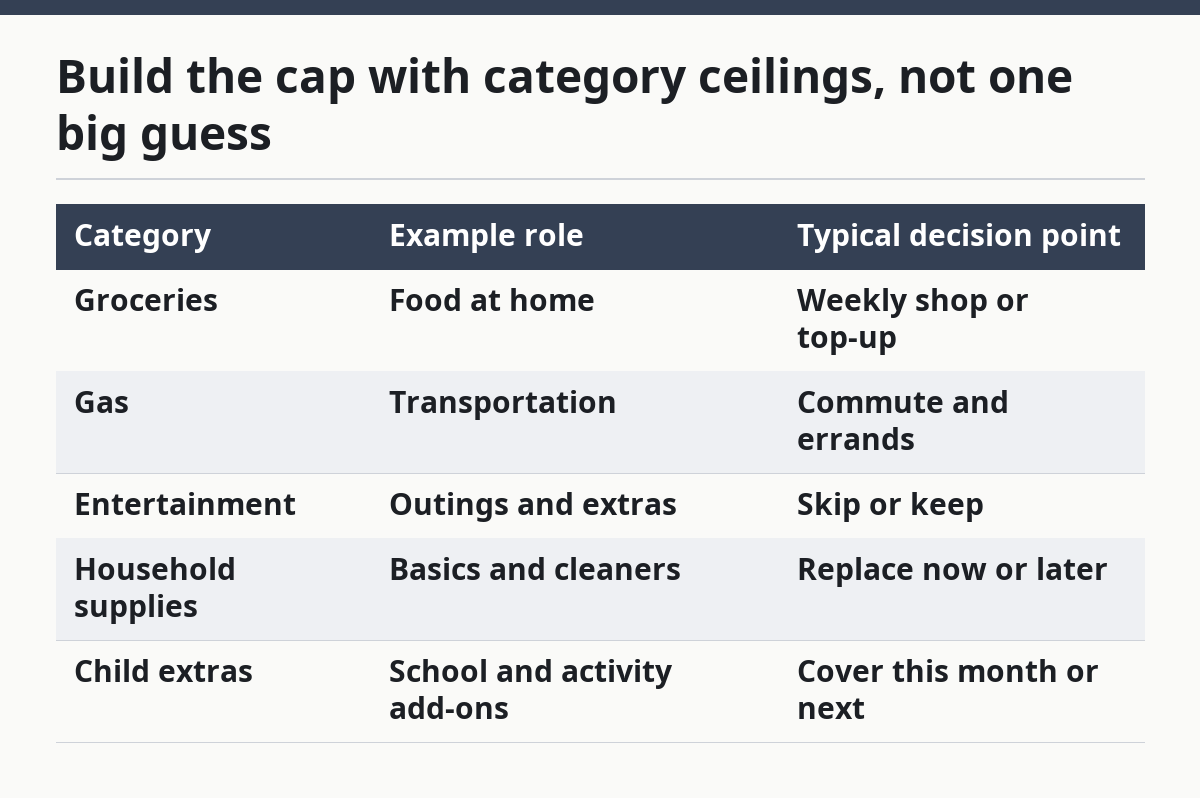
Build the cap with category ceilings, not one big guess
You build the cap with category ceilings because one lump number is too easy to blow in the first 10 days. Picture this: you buy groceries on Monday, fill the tank on Wednesday, then realize the weekend has nothing left for a movie, school supplies, or a last-minute household item. Separate ceilings stop one category from stealing from the others. A simple comparison helps:
| Category | Example role | Typical decision point |
|---|---|---|
| Groceries | Food at home | Weekly shop or top-up |
| Gas | Transportation | Commute and errands |
| Entertainment | Outings and extras | Skip or keep |
| Household supplies | Basics and cleaners | Replace now or later |
| Child extras | School and activity add-ons | Cover this month or next |
A useful setup divides the cap into 5 lines:
- Groceries
- Gas
- Entertainment
- Household supplies
- Child extras
Each line gets its own ceiling for the month. That does two things. First, it shows where the money really goes. Second, it gives you a clean place to cut when one category runs hot. A household supply run at $18 should not come out of the same mental bucket as a child’s school fee.
Here’s the catch: the ceilings do not need to be perfect on day one. They need to be close enough to guide the month. A ceiling can be a little high if the category is hard to predict, like child extras. It can be lower if the spending is easy to delay, like entertainment.
Use this simple rule when you set them:
- Groceries should cover food you actually eat at home.
- Gas should cover the routes you already drive.
- Entertainment should match one or two realistic outings.
- Household supplies should cover basics like soap, paper goods, and cleaning items.
- Child extras should hold the small surprises that show up on forms, flyers, and group chats.
If a category keeps breaking its ceiling for 2 or 3 months in a row, the ceiling is probably too low. Raise that one line and cut somewhere else. Do not keep pretending the same number will magically work in month 4.
The weekly reset that keeps a monthly limit honest
The weekly reset keeps a monthly limit honest by stopping small overspends from hiding until the 28th. Picture this: you’re halfway through the month and already telling yourself you’ll “fix it later.” That is how a $12 overage becomes a $60 problem. A 10-minute weekly reset catches the drift early.
Do the reset once a week, on the same day, for 10 to 15 minutes. Sunday night works for many people because the week is already closing, but any 7-day rhythm is fine if you keep it steady. The point is repetition, not perfection.
Use this short reset:
- Check each category ceiling against what has already been spent.
- Mark any category that is over by even a small amount.
- Move money only if the trade-off is real and immediate.
- Note the next 7 days of likely spending, such as gas, a school lunch deposit, or a grocery restock.
- Decide one thing to slow down before the next weekend.
That last step matters most. If entertainment is running hot, make the next 7 days quieter. If groceries are low because you stocked up, do not panic and raid another line. A category that looks messy for one week may still be fine by month-end.
The best part is that a weekly reset takes less time than a single extra store run.
- Track only the 5 categories you set.
- Use a calendar reminder every 7 days.
- Make one correction, not five.
- Treat the reset like maintenance, not punishment; if the numbers feel hard to manage, a financial professional or trusted budgeting counselor can help you review them.
A limit that only gets checked at the end of the month is already too late.
What to do when overspending starts mid-month
You stop overspending mid-month by freezing the damage, not by trying to “be good” for the rest of the month. Picture this: you’re already $24 over in groceries and $15 over in gas, and the month still has 12 days left. The move now is containment.
Start with the category that is most flexible in the next 7 days. If entertainment is over, cut it to zero for a week. If groceries are the problem, switch to a short list and skip convenience buys. If gas is high, batch trips and combine errands so you are not driving twice for the same task.
Use these guardrails:
- Stop spending in the overspent category for 3 to 7 days.
- Cover only true needs, not wants.
- Pull from another category only if you can name the exact trade-off.
- Watch for “small” buys that add up in 2 or 3 days.
- Reset the next week with a lower target, not a fantasy promise.
This is where a lot of generic advice fails. It says to “cut back” without saying what that means on a school night at 6 p.m. Real life has receipts, tired kids, and a gas tank that still needs filling. A useful guardrail is specific: no takeout for 5 days, no browsing stores, one grocery trip with a list, or one entertainment plan canceled before money leaves the account.
If your cap keeps breaking because the same category is too small, do not keep squeezing it. Raise that ceiling and lower another one that has more slack. That trade is the real fix.
Mistakes that make a monthly cap fail
A monthly cap fails when the number ignores your real routine, your kid’s needs, or the size of your weekday expenses. Picture this: you’re using a limit that looks neat on paper but falls apart the first time school needs supplies, the car needs fuel, and dinner has to happen. The cap breaks because the math was not built for your life.
The biggest mistakes are predictable:
- Setting one total and never splitting it into categories.
- Forgetting child extras and then calling them “emergencies.”
- Using the same cap for a calm month and a busy month.
- Treating a bad week like proof that the whole plan failed.
- Cutting groceries so hard that the family ends up ordering food more often.
Each mistake has a cost. A single big bucket hides where the money leaks. Forgotten child extras create surprise spending that wrecks the month. A cap that never changes becomes useless when sports season, school fees, or a long drive changes the pattern.
The fix is plain. Build category ceilings, leave a little room for predictable spikes, and review the numbers every 7 days. If you keep overspending in the same place, that is not a character flaw. It is a signal that the limit needs a better shape. If the overspending feels tied to stress or feels unmanageable, a financial counselor or other qualified professional can help you sort out the numbers.
The truth is, the best spending limit is one you can keep using in a tired week.
- Keep the categories few.
- Keep the numbers visible.
- Keep the weekly reset short.
- Keep the cap tied to real life, not wishful thinking.
A limit that survives Tuesday is better than a perfect one that dies on Monday.
How this fits a larger single-parent budget system
A monthly spending limit works best as one part of a larger budget system, not as the whole system. Picture this: you have a cap for flexible spending, but the rest of your money still needs a place to go before the month starts. This page handles the cap; the broader budget lives in the parent system around it.
That larger system decides what happens to rent, utilities, debt minimums, savings, and other fixed costs. This page stays narrower on purpose. It helps you set the ceiling for flexible spending after the non-negotiables are already handled.
A good sign that the cap is working is simple: you know how much is left in groceries, gas, entertainment, household supplies, and child extras before the month ends. You do not need to memorize every receipt, but you do need to know which bucket is running hot.
If you want the cap to last, keep 3 rules in mind:
- Fixed bills stay outside the limit.
- Flexible categories get their own ceiling.
- The weekly reset decides whether the number still fits.
Now, you might be wondering whether the cap should change every month. Sometimes it should. A back-to-school month, a holiday month, or a month with more driving can justify a different ceiling. The change should be tied to a real shift, not a mood.
How do I stop overspending mid-month?
You stop overspending mid-month by freezing one category, tightening the next 7 days, and checking what can wait until next month. Picture this: you’re staring at a nearly empty category and trying not to reach for the card again. The answer is a short pause, not a perfect rescue.
First, stop new spending in the category that went over. Then choose one backup move: fewer store trips, cheaper meals at home, or a canceled outing. If the overage came from groceries, use what is already in the kitchen before shopping again. If it came from entertainment, switch to free plans for a week.
The goal is to keep the rest of the month from turning into a chain reaction. One overage can be contained if you act within 24 hours. Left alone, it spreads into gas, food, and impulse buys.
A simple rule helps:
- Over by a little: pause that category for 3 days.
- Over by more: pause it for 7 days.
- Over by a lot: review the ceiling and cut another line with care.
That is not punishment. It is damage control. And it works better than waiting for the next payday to fix what this week already spent.
How do I choose a spending cap?
Choose a spending cap by looking at what remains after fixed bills and then assigning that leftover money to flexible categories. Make sure the number covers groceries, gas, entertainment, household supplies, and child extras for a normal month. If the total is too tight, adjust the category ceilings instead of pretending the same number will work.
What if my spending limit is too low?
A spending limit is too low when you keep breaking the same category for 2 or 3 months in a row. Raise the category that is failing and lower one with more room, such as entertainment or another flexible line. If groceries or gas are the problem, the limit may need a bigger reset because those costs are harder to squeeze.
How do I stop overspending mid-month?
Stop the overspending by freezing the category, cutting the next 7 days of spending, and using only true needs until the month turns. If the overage is small, a 3-day pause may be enough. If it is larger, review the ceiling and make one clear trade-off instead of trying to fix everything at once.
Drafted with AI; not yet reviewed by a person.