

Last updated: November 18, 2026
Quick answer: use a two-layer budget with 2 account buckets—one for fixed bills and one for weekly spending—plus a small buffer. In this article, Single-parent budget setup and financial systems — The Complete Guide means a simple system that protects essentials first and leaves the rest available for weekly spending when income is uneven.
Jump to key takeaways | What setup works for a single parent? | How do you budget when paychecks change? | FAQ

Key takeaways
- Start by separating money that must pay rent, utilities, and debt from money that can wait a week.
- Build around your lowest reliable income month, not your best month.
- Use a 7-day or 14-day spending rhythm if paychecks change week to week.
- Keep one small buffer in checking so one late payment does not break the whole plan.
- A good system is one you can still follow on a tired night after work and pickup.
What setup works for a single parent?

The most practical setup for a single parent is a bill-first system with separate spending buckets, because it keeps essentials protected before day-to-day money gets touched. If income comes in unevenly, a single all-in-one checking account usually turns into guesswork, overdrafts, and last-minute transfers.
The simplest version uses three places for money: one place for bills, one for near-term spending, and one for savings or a buffer. You do not need a perfect app or a fancy spreadsheet to start. You need clear rules for what happens to each dollar within 24 hours of payday.
A good target is to assign money in this order: housing, utilities, childcare, transportation, food, minimum debt payments, then everything else. That order matters because it protects the costs that stop life from working if they go unpaid. A phone bill can wait a day; a missed rent payment or childcare gap usually cannot.
If your income is low or inconsistent, it is usually safest to start from your lowest predictable month, not your average month. That feels conservative, but it stops the common trap where one good month hides the fact that the next month will be tight. If your work hours swing by 10 or 20 hours, the low month is the one that decides whether the system survives.
The Consumer Financial Protection Bureau has plain-language guidance on budgeting and savings at consumerfinance.gov. The Financial Industry Regulatory Authority also explains budgeting basics at finra.org. Use those as references, but keep the setup simple enough to run on your phone in under 10 minutes.
Quick check: if money feels harder to manage because paychecks change, this is the right starting structure.
How do you budget when paychecks change?
You budget from your floor, not your ceiling, and you give every paycheck a job the day it lands. If your income changes from week to week, the main mistake is building a monthly plan around the biggest check you hope to get. That works until one shift is cut, one child gets sick, or one payment comes late.
The cleanest method is to divide your world into fixed bills, flexible expenses, and true extras. Fixed bills are rent, insurance, childcare, phone, and minimum debt payments. Flexible expenses are groceries, gas, school supplies, and toiletries. Extras are eating out, clothing upgrades, and nonurgent purchases.
A weekly rhythm often works better than a monthly one. If you are paid every 2 weeks, you can assign the first check to the first half of the month’s must-pay items and the second check to the rest. If the timing is less predictable, treat every deposit as a reset point and cover the nearest bill deadlines first. If that is difficult to do on your own, a nonprofit credit counselor or another qualified professional in your area can help you map the timing.
Here is the decision rule that helps most: if a bill is due within 7 days, set that money aside immediately; if it is due in 8 to 30 days, hold it in the bills bucket; if it is farther out, do not let it compete with food or fuel money today. That keeps long-range bills from swallowing the week.
- List every fixed bill with due date, amount, and whether it is flexible or nonnegotiable.
- Mark the 3 soonest due dates on a calendar, not just in your head.
- Set aside money for those 3 bills first from the next paycheck.
- Move the rest into weekly spending buckets for groceries, gas, and child needs.
- Hold back a small cushion in checking so a timing delay does not trigger a fee.
- Repeat the same order every payday for at least 2 months before changing anything.
This approach is not for someone with highly variable freelance income and large irregular expenses unless they also build a larger buffer. If that is your situation, the paycheck-by-paycheck method still works, but the buffer becomes more important than the spreadsheet. A budget without a timing buffer breaks the first time a bill clears 2 days early.
Quick check: if your pay dates move around or your hours change, use a paycheck-based budget, not a calendar-month budget.
Which accounts should a single parent use?

A single parent should use at least two accounts if possible: one checking account for bills and one separate place for savings or a cushion. If everything stays in one account, the food money and the rent money look the same until the day a debit card swipe empties the wrong pile.
A simple setup can be built with one checking account and one savings account, or with one checking account plus labeled sub-buckets inside a banking app. The tool matters less than the rule: bills do not share a pool with weekly spending. If your bank lets you nickname buckets or set automatic transfers, that helps, but it is not required.
Here is a practical comparison.
| Situation | Best Path | Why Other Options Fail |
|---|---|---|
| Paychecks are steady and bills are mostly fixed | One checking account plus one savings account | A single account blurs bill money and grocery money |
| Paychecks arrive at odd times | Checking for bills, separate spending bucket for weekly costs | Monthly budgets break when money lands after bills are due |
| You often overspend after payday | Split deposits into bills, buffer, and weekly spending on the same day | Waiting to sort money later invites impulse spending |
| You are behind on bills | Bills-first setup with a strict payment calendar | General “save first” advice does not protect housing or utilities |
| You have only enough room for one account right now | One checking account with written bucket rules | No account structure makes it harder to see what is already spoken for |
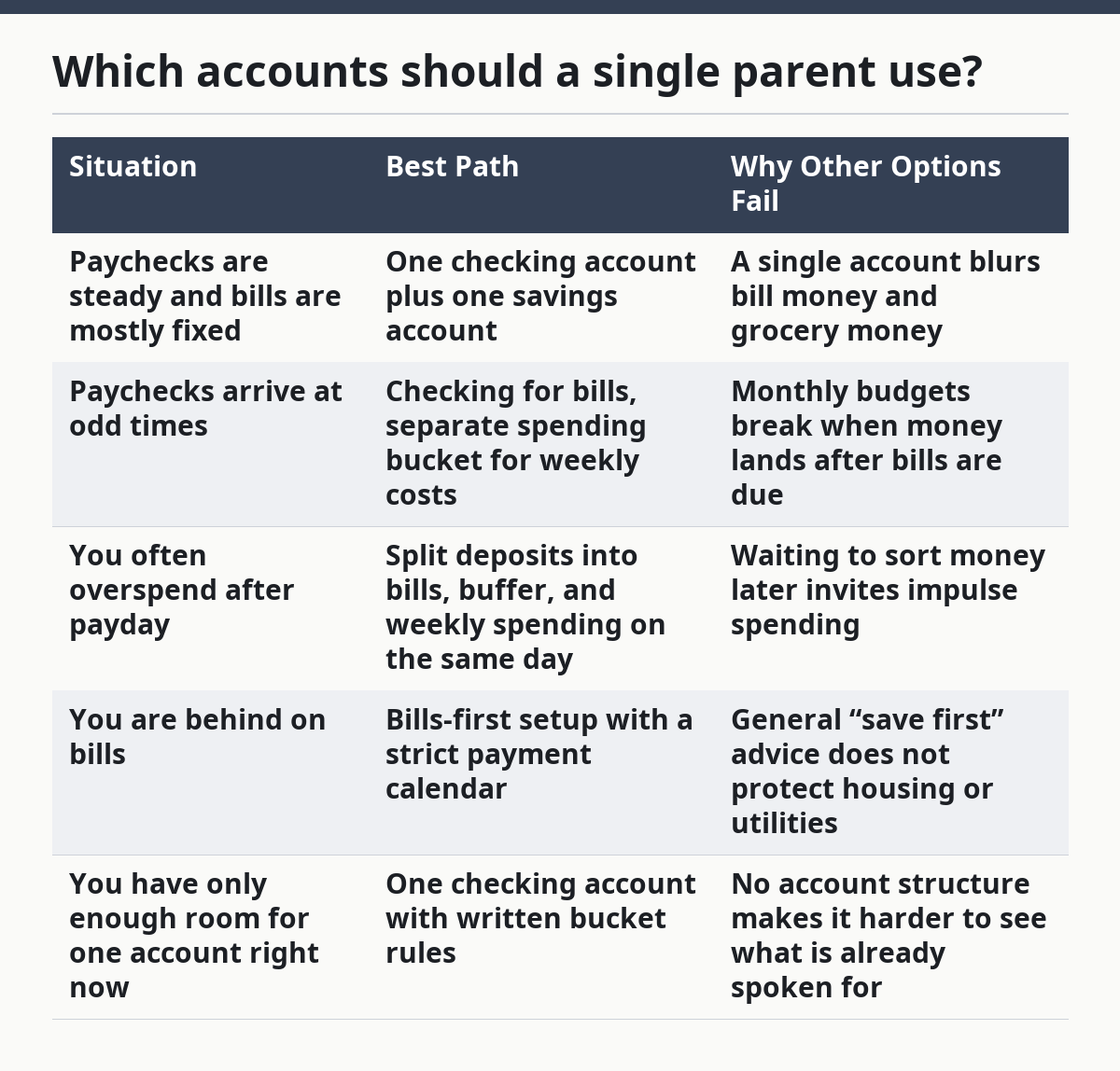
If you can only manage one account for now, keep a written ledger or phone note with three columns: bills, weekly spending, and buffer. That is less elegant, but it still helps prevent double-spending. The key is to label money before it gets used, not after.
A savings account is not the same thing as a reward jar that gets raided for random extras. It is better treated as a place for emergency money, car repair money, and any amount that must wait until the next check. Even a small buffer matters because it can stop a 1-day timing problem from becoming a fee chain. If you are unsure how much to keep there, a financial counselor can help you set a number that fits your situation.
Quick check: if money vanishes between payday and bill day, you need separate buckets, even if they are only mental at first.
How do you build the budget from zero?
You build it from zero by listing obligations first, then matching them to the least risky income pattern you have. If you try to budget from wishful categories like “fun,” “miscellaneous,” and “other,” the plan will collapse the first time a school form or car issue appears.
Start with the bills that protect housing, work, and childcare. Then add transportation, food, debt minimums, and basic household items. Only after that should you assign money to wants. That order is not moral; it is practical. A child’s daycare slot, a bus pass, and a phone plan are not optional in the same way a streaming service is optional.
- Write down every must-pay item due in the next 30 days.
- Circle the ones that stop daily life if they are late: housing, power, childcare, transport, and phone.
- Match those bills to your next paycheck in the order they are due.
- Set a weekly grocery and gas limit that fits the lowest paycheck, not the best one.
- Choose one small buffer target, even if it is modest, and keep it separate from spending money.
- Only then assign anything left to extras, gifts, or debt above the minimum.
A lot of generic budgeting advice says to start with goals like travel or savings percentages. That is the wrong starting point for many single parents. When income is irregular, the first goal is stability, not optimization. If the budget cannot survive a surprise $50 or a delayed payment, the next goal is too early.
Use real due dates, not billing-cycle guesses. Many bills are set on autopay, and that can make timing feel safe when it is not. If the due date is before payday, move the bill money earlier in the cycle or change the due date if the creditor allows it.
A simple spending guardrail helps: keep one day each week for nonessential purchases, and do not shop on the app or card the rest of the week unless it is on the written list. That reduces small leaks without turning the budget into punishment. A budget that feels like a trap will not survive a stressful month.
Quick check: if your current budget is mostly “hope and cleanup,” start with bills, due dates, and the lowest income month.
What should change if the month gets tight?
If the month gets tight, the plan should switch from normal budgeting to triage, with housing, food, transport, and childcare at the top. When money is short, the problem is not how to save more. The problem is which bills can move and which ones cannot.
Use a triage list with three groups: must pay now, can wait, and can be reduced. Must pay now includes rent, utilities that keep the home running, childcare, and transportation needed for work. Can wait includes some debt payments, subscriptions, and nonessential purchases. Can be reduced includes groceries, fuel, and discretionary spending, but only to a point that still keeps life working.
- Stop all nonessential spending for 7 days.
- Pay the bills that keep housing, work, and childcare intact first.
- Call or log in to move due dates or request hardship options on any bill that is due before income lands.
- Trim variable spending with a hard weekly cap for groceries and gas.
- Pause extra debt payments until the month stabilizes.
- Rebuild the normal budget only after the next paycheck is assigned on paper.
This is where standard advice can go wrong. Telling a stressed parent to “just cut lattes” or “set aside 20%” misses the real problem. In a tight month, one missed childcare payment or one overdraft fee can do more damage than a few small purchases. The fix is not a moral lecture; it is a payment order.
If you already have debt collectors calling, or if you are choosing between basics, get professional advice from a nonprofit credit counselor or another qualified professional in your area. The budget still matters, but debt and legal timelines can change the order of priorities. This article cannot replace advice that depends on your local rules and exact balances.
Quick check: if one missing paycheck would break the month, switch to triage and protect the bills that keep you working and housed.
When is the standard advice wrong?
The standard advice is wrong when it tells you to save first, automate everything, or build a 3-month cushion before the basics are stable. Those ideas are useful in the right setting, but they fail when a single parent is juggling unpredictable income, school schedules, and bills that cannot wait.
Here are the edge cases where the normal plan breaks down.
-
Situation: you are paid in cash or irregular side jobs.
What changes: the money is less predictable and easier to spend quickly.
What to do instead: use a same-day split rule, where a set portion goes to bills, a set portion goes to weekly spending, and the rest goes to buffer money before anything else. -
Situation: your income varies by 20% or more from month to month.
What changes: a normal monthly budget becomes a guess.
What to do instead: budget from the smallest reliable month and treat extra income as a bonus for bills, buffer, or debt. -
Situation: you are behind on rent or utilities already.
What changes: protection comes before optimization.
What to do instead: put every paycheck through a crisis order: housing, power, childcare, transport, food, then minimum debt. -
Situation: you share costs with an ex or another adult.
What changes: timing and trust matter as much as amounts.
What to do instead: write the shared-cost dates on a calendar and keep your own buffer so one missed transfer does not wreck the whole month. -
Situation: you have a big tax refund, bonus, or child-support payment.
What changes: a lump sum can disappear fast if it is not assigned.
What to do instead: split it into 4 buckets the same day it arrives: overdue bills, buffer, next month’s fixed costs, and a small amount for immediate pressure relief. -
Situation: you are one emergency away from using credit cards again.
What changes: the first goal is to stop the next cash crunch, not to perfect debt payoff.
What to do instead: build a tiny cash cushion first, even if debt payments stay at the minimum for a while.
The wrong advice for this reader is advice that assumes steady salary income, two adults in the house, or a big leftover amount after bills. That is not a character flaw in the reader; it is a mismatch between the advice and the life. A useful system fits the month that actually exists.
Quick check: if a standard budget template keeps failing in the same place, the issue is likely timing, not discipline.
How do you keep the system working week after week?
You keep it working by reviewing it at the same point every 7 days and by making one person responsible for the money decisions. If the system depends on memory, it will fail on the busiest week of the month. A short weekly check-in beats a long monthly cleanup.
The weekly review should take 15 to 20 minutes. Look at the balance, the next 7 days of due dates, and any spending that drifted off plan. Then make one correction, not ten. If groceries ran high, lower the next week’s flexible amount. If the car needed repairs, move money from extras before touching rent money.
Use a repeatable checklist.
- Check today’s balance in checking and savings.
- Review the next 7 days of bills and transfers.
- Confirm that rent, utilities, childcare, and transport are covered.
- Compare flexible spending to the weekly cap.
- Move any leftover cash into buffer or next month’s bill bucket.
- Write down one change for next week and stop there.
A budget system becomes stronger when the rules are simple enough to follow under stress. If the process takes an hour, it will get skipped. If it takes 15 minutes and always happens on the same day, it can survive a hard week. The goal is not perfect control; it is fewer surprises.
The best tools are the ones you will actually open. A spreadsheet, a notebook, a banking app with buckets, or a basic calendar can all work. If you already have a tool you check every day, use that before adding a new app. More tools often mean more places to hide spending.
Quick check: if the budget only gets attention when money is already gone, it needs a weekly review, not a new philosophy.
FAQ
What is the simplest budget for a single parent with irregular income?
The simplest budget is a bills-first plan with weekly spending limits and one small buffer. Put rent, utilities, childcare, transport, and minimum debt payments ahead of flexible spending, then divide the rest into weekly amounts. This works better than a monthly wish list because it matches uneven pay.
Should I use cash envelopes if I am a single parent?
Cash envelopes can help if card spending gets out of control, but they are not required. They work best for groceries, gas, and small household spending, not for rent or online bills. If cash is hard to carry or manage, labeled buckets in a checking account can do the same job with less friction.
How much money should stay in checking?
Enough to cover near-term bills and avoid overdrafts, plus a small cushion. The exact amount depends on your due dates and paycheck timing, so the right number is the one that keeps transactions from bouncing. If checking is always near zero, the system needs a bigger buffer or faster bill timing.
What if I can only save a tiny amount each month?
Save the tiny amount anyway, because a small buffer can stop one timing problem from becoming a fee chain. Even a little set aside on every payday gives you room to handle a late payment, a small repair, or a week where hours drop. The point is consistency, not size.
Is debt payoff more important than saving?
Not always, and not for every month. If your budget is unstable, a small buffer often comes before extra debt payoff because it prevents new fees and new debt. If you are behind on essentials, the order changes again, and housing, childcare, and utilities come first.
Drafted with AI; not yet reviewed by a person.
