
Last updated: November 18, 2026
Quick answer: build one family budget first, then split it into shared costs and per-child costs, because that is what changes when there are two or more children in the home. If you need a starting number, use a monthly budget review window of 15 to 20 minutes and a simple three-part structure: shared costs, child-specific costs, and a small reserve. The point is to keep the budget clear enough to handle school costs, snacks, activity fees, clothing, and age gaps without guessing in a single-parent household with two or more children.
What does a multi-child household budget need to cover?
A multi-child household budget needs three layers: the bills that keep the home running, the costs that belong to one child, and the costs that all children share. That structure matters because a family of three does not spend in neat equal slices, even when the children live under the same roof.
A simple starting point is the 50/30/20 rule, which allocates 50% of net income to needs, 30% to wants, and 20% to savings and debt repayment, according to Consumer.gov. In a single-parent home with two or more children, that split is only a guide, not a law. Childcare, school costs, and transport can push “needs” higher, so the real job is to see where your money already goes before you decide what the budget should look like. The CFPB budget worksheet can help you start that review.
This page is for a parent who already knows the basics of monthly bills and wants a better structure for a larger household. It is not the right fit if you need a first-ever budget for a new baby, if you are sorting out a teenager’s budget on its own, or if a child has needs that require a separate plan.
How do you split costs between shared and per-child lines?

You split costs by asking one question for every expense: does this cost serve the whole household, or does it follow one child? That one question keeps the budget from getting messy when children are at different ages or in different activities.
Shared household items usually include food in the main pantry, toilet paper, laundry soap, dish soap, heating, internet, and part of the car or transport budget. Per-child lines usually include children’s clothing, school costs, snacks, activity fees, and anything tied to one child’s class, sport, or school trip. A good budget keeps those lines separate even if the money comes from the same account.
| Budget line | Shared by all children | Set for one child |
|---|---|---|
| Groceries for home meals | Yes | No |
| Snacks sent in lunch boxes | Sometimes | Often |
| Children’s clothing | No | Yes |
| School costs | No | Yes |
| Activity fees | No | Yes |
| Shared household items | Yes | No |
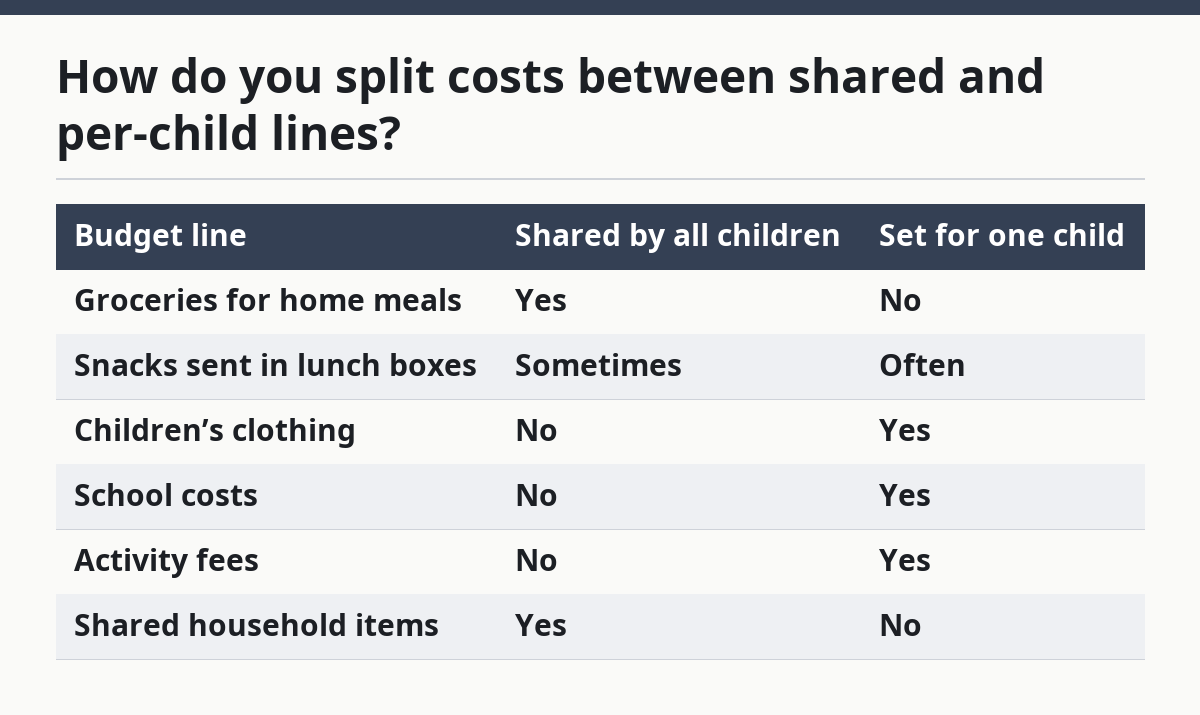
The table is useful because the wrong label changes the whole budget. If you put school costs into the shared bucket, you may undercount what one child really costs. If you put toilet paper into a per-child line, you make the budget harder to read and easier to abandon. For a practical example of category tracking, see the budget review step.
How do you build the budget step by step?
You build it by mapping income first, then assigning every cost to one of the three layers, then checking the numbers against a monthly reset. A monthly budget check-in should take 15 to 20 minutes, according to Consumer.gov, which is short enough to repeat and long enough to catch leaks.
- List all net income for the month. Use the money that actually lands in the account, not the gross pay on a pay slip. Verify that each deposit is in the same month you plan for; if pay dates move around, the budget will feel wrong even when the amounts are right.
- Write every fixed household bill. Include rent or mortgage, utilities, phone, transport, and debt payments that happen on the same date each month. Check whether any bill changes with season or usage; if it does, mark it as variable instead of fixed.
- Separate shared household items from child-specific items. Put groceries, toilet paper, cleaning products, and laundry soap into shared costs, then place children’s clothing, school costs, snacks, and activity fees into child lines. If a cost can belong to more than one child, split it by use rather than guessing.
- Build a line for each child. Give every child a small section for clothing, school items, and activities. Verify that the section matches the child’s age and schedule; if one child has school supplies and another has sports fees, the same line will not work for both.
- Use hand-me-down planning on purpose. Mark items that can move from one child to another, such as jackets, uniforms, or shoes that still fit. Check condition and size before you count on reuse; if the item will not last through the next season, consult a professional or a trusted retailer about whether it is safe and practical to reuse it.
- Sort age gaps into separate timing buckets. Age gaps change when clothing, school costs, and food costs peak. Verify whether one child is in a lower-cost phase while another is in a higher-cost phase; if yes, the budget needs staggered lines rather than one average amount.
- Set aside a short-term buffer for surprises. Use a small reserve for the month because snack requests, school notices, and activity fees often arrive together. If the reserve is often empty before the month ends, the problem may be that one category is too low.
- Review the budget once a month for 15 to 20 minutes. Compare what you planned with what actually happened. If one category is over every month, move money there before the next month starts instead of pretending the pattern will disappear.
This process works best when the budget has real categories, not one large “kids” line. It fails when every cost is lumped together, because then school costs get hidden inside groceries and activity fees get lost inside clothing. For the same reason, keep shared household items separate from child-specific spending.
Which benefit rules might matter?
Benefit rules might matter because some households get extra help based on family size, age, or single-income status, but those rules differ by country and change often. One example is Family Tax Benefit Part B, which gives extra help to single-income families, including sole parents, especially with children under 5, according to Wikipedia.
Another example is Child Benefit, which is payable for children under 16, or under 18 if they are in full-time education, Youthreach training, or have a disability, according to Wikipedia. Some benefit systems also vary payments by age or number of children, so it is safer to check the official rules in your own country rather than assume one formula applies everywhere. It also says the monthly amount rises to €322.53 per child at age 6 and to €356.43 per child at age 12.
Those figures matter for budgeting because age and family size can change the cash that comes in and the cash that goes out. The yearly family allowance noted by the same source is paid until 18, or longer if the child stays in education, up to age 25, and children over 6 and under 12 get an allowance of €115 every August per child, while children over 12 get an allowance of €235 every August until schooling ends. If you have this kind of benefit in your country, put it on the income side only when it is actually paid, not when you expect it.
When does the standard approach stop working?
The standard approach stops working when one child’s costs stop acting like “child costs” and become a separate budget problem. That can happen in several situations, and each one changes how you should think about the numbers.
One child is on a very different schedule: school, meals, and transport no longer line up with the other children — split that child’s costs into a separate line so the rest of the family budget stays readable.
Hand-me-downs are not reliable anymore: the item does not fit, wears out too fast, or is season-specific — stop counting it as savings and budget for replacement in the child’s own line.
School costs arrive in clusters: uniforms, supplies, lunches, and activity fees hit in the same month — shift money ahead of time instead of draining the grocery line.
Shared household items keep running out early: soap, toilet paper, and laundry products vanish before month-end — raise the shared household item line rather than taking the difference from children’s needs.
Benefit timing does not match bill timing: money arrives at one point in the month and school costs hit at another — keep a small timing buffer so one late bill does not throw off the whole budget.
One child’s costs keep dominating the family plan: the budget no longer supports equal-looking lines — treat the household as uneven by design, not as a failure of discipline, and rework the plan around actual use. For more on uneven spending, return to the budget structure.
What mistakes cost the most?
The biggest mistakes are the ones that hide cost differences between children. A budget for two or more children fails fast when it assumes every child costs the same in every month.
One common mistake is using one flat “kids” line for everything. The consequence is that school costs, clothing, and snacks blur together, and you cannot tell which child is running over budget. The better alternative is to give each child a small set of lines.
Another mistake is treating all clothing as reusable. The consequence is a false savings estimate that disappears when sizes change or the season changes. The better alternative is to plan hand-me-downs only for items that are still likely to fit and still in usable shape, and to consult a professional if you are unsure whether an item is still safe to reuse.
A third mistake is forgetting shared household items. The consequence is that the budget looks balanced on paper while the household runs short on soap, paper goods, or detergent. The better alternative is to give shared items their own line, separate from food and child-specific spending.
A fourth mistake is ignoring age gaps. The consequence is that a younger child’s lower costs hide an older child’s higher school or activity costs. The better alternative is to review each child’s line separately and let the budget reflect the stage each child is in.
A fifth mistake is skipping the 15 to 20 minute monthly check-in. The consequence is that small drifts turn into big gaps before anyone notices. The better alternative is to compare actual spending with the plan once a month and adjust the next month, not the last one. A simple monthly review catches those drifts early.
How should the budget change for different ages?
The budget should change by age because children do not cost the same at every stage, even when they live in the same home. The most useful shift is to stop averaging and start timing.
A younger child may need more clothing changes, more snacks, or more small replacements, while an older child may bring larger school costs or activity fees. If one child is under 6 and another is older, the budget should not treat both lines as identical, especially when benefits or allowances change at set ages such as 6 or 12, according to Wikipedia.
This is where age gaps matter most. If one child is likely to outgrow clothes fast, hand-me-down planning works only for a short window. If one child is in a stage where school costs cluster in August or at the start of the term, that child needs a separate timing plan, not just a bigger average number.
The best adjustment is to keep the same budget structure, but change the amounts and timing inside it. That keeps the household stable without pretending that all children use the same resources in the same way.
Key takeaways
- A multi-child budget works best when it separates shared household items from child-specific spending.
- Clothing, school costs, snacks, and activity fees should each have a place, not a single catch-all line.
- Hand-me-downs help only when size, season, and condition make reuse realistic.
- Age gaps change timing, so one child’s costs can peak while another’s stay low.
- A 15 to 20 minute monthly check-in is enough to spot problems before they spread.
How do I split costs between children?
I split costs by looking at who uses the item and how often. Shared items like toilet paper and laundry soap belong in the household line, while school costs, activity fees, and most clothing belong to the child who uses them. If two children use one item, split it by likely use rather than by guesswork.
What expenses rise with more kids?
More children usually raise shared household items, food at home, clothing, and school-related costs. The total also rises because there are more chances for snacks, activity fees, and replacement items to show up in the same month. The biggest change is often not one huge bill but several medium bills landing together.
How do I budget for different ages?
I budget for different ages by giving each child their own line and adjusting the line for the stage they are in. A child under 6 will not have the same pattern as a child at 12, and benefit rules in some places change at those ages. The budget works better when timing, clothing, and school costs are tracked separately.
Sources
- zaplookup.com, The Complete Household Budgeting Guide for Families at Every Income Level — ZapLookup.com (checked 18 Nov 2026)
- Wikipedia, Child benefit – Wikipedia (checked 18 Nov 2026)
Drafted with AI; not yet reviewed by a person.