

Last updated: November 18, 2026
Quick Answer: Start by rebuilding your budget around your next 1 to 2 paychecks, not your refund, and review it again after the first 2 or 3 pay periods. If your W-4 changes, your paycheck changes first, and your monthly plan has to change with it. This article explains how to absorb a smaller refund or a larger paycheck without guessing when you are budgeting for tax withholding changes as a single parent.
As a starting point, the IRS Form W-4 and the IRS Tax Withholding Estimator are the two tools most people use to check their withholding: IRS Form W-4 and IRS Tax Withholding Estimator. The IRS also explains withholding basics on Tax Withholding. Tax rules differ by country and change often, so use this as information, not financial advice, and talk with a qualified adviser about your own situation.
Key takeaways
- A withholding change affects cash flow now, not just next spring.
- A smaller refund usually means more money in each paycheck, but only if the numbers are right.
- A larger refund can hide a budget gap during the year.
- A practical plan is to rebuild your monthly budget around take-home pay, not around the refund.
- If your income changes, your W-4 should be checked again, not left alone for a full year.
What changes when your withholding changes?

Tax withholding changes your paycheck before tax time, and that shift can help or hurt your monthly budget depending on how you use the cash flow. A W-4 update changes how much tax your employer holds back from each paycheck, which can shrink your refund later or reduce what you owe later.
That matters more for a single parent because one wage has to cover rent, food, school costs, and the usual surprise bill. A refund can feel like a cushion, but if your withholding is too high, part of that cushion is really your own money sitting with the tax office during the year.
For example, a generic article often misses the main trade-off: a bigger refund is not free money, and a bigger paycheck is not extra money either. It is the same income, just timed differently. The question is whether your household can handle a smaller tax refund if it means steadier monthly cash flow.
One useful rule of thumb is to think in 12 months, not one tax season. If your paycheck rises by even a modest amount after a W-4 update, that change needs a home in your budget immediately. If you leave it unassigned, it disappears into food, fees, and small purchases before you notice.
How do I budget for tax withholding changes?
You budget for tax withholding changes by rebuilding your monthly plan around your new take-home pay, then assigning the difference before it disappears. That means you adjust the budget line by line, not just at tax time.
- Check your most recent paycheck stub and your W-4 settings before changing anything. Verify the current withholding status, filing status, and any extra withholding line so you know what is changing. If you cannot tell whether the new paycheck will be higher or lower, the budget can be wrong from the start.
- Use the IRS Tax Withholding Estimator or your payroll system to compare the old and new paycheck amount. Verify the estimated take-home pay for one pay period and for a full year. If the estimate does not match your stub, stop and correct the inputs before you budget from it.
- List your fixed monthly bills first: rent or mortgage, utilities, transport, phone, and child-related costs that repeat every month. Verify that each one is tied to a due date and a dollar amount you can actually pay from your paycheck. If a bill changes by season, mark the higher amount, not the average.
- Set the amount of the paycheck change aside in your budget before you spend it. Verify that this amount has a purpose, such as groceries, school costs, or a small emergency cushion. If the extra money has no name, it will get absorbed by day-to-day spending.
- Reduce any line that was built around a larger refund, such as holiday spending or annual school fees, by the amount your refund is likely to shrink. Verify that you are not counting on money that will no longer arrive in the same size. If the budget only works with a large refund, it is too fragile.
- Build a 1-month buffer inside your checking account if your cash flow is tight. Verify that the buffer covers one high-bill week or one gap between pay and due dates. If you cannot hold that buffer, a smaller refund may be risky until the rest of the budget is stable.
- Track the next 2 or 3 paychecks after the W-4 change and compare them to the estimate. Verify the change in take-home pay line by line, not by memory. If the paycheck is materially different from what you planned, revisit the W-4 rather than forcing the budget to absorb a bad estimate.
- Adjust your tax withholding again after an income change, a job change, or a new dependent status. Verify that the new W-4 still matches your household reality. If your income rises or falls during the year and you ignore it, the refund or tax bill can drift far from what you expected.
Therefore, the point of this process is not to make tax season exciting. It is to keep your rent money, utility money, and grocery money from being crowded out by a refund plan that no longer fits. If you want a broader framework for the rest of the year, the hub on [Single-Parent Income Protection and Benefit Planning] should sit next to this page in your planning folder.
How much of a refund should I count on?

You should count on less refund money than you are tempted to expect, because withholding changes can shrink a refund without warning your monthly budget. A safer approach is to treat the refund as irregular income until your tax situation is settled.
That does not mean a refund is bad. It means the refund should have a job before it arrives. A common mistake is to build a budget that quietly depends on a refund covering school fees, car work, or debt payments, then discover that a better W-4 left less money in the tax pipeline.
| Option | What it does to your paycheck | What it does to your refund | Budget effect |
|---|---|---|---|
| More withholding | Lowers take-home pay now | Usually raises the refund later | Easier to save at tax time, harder to stretch monthly cash |
| Less withholding | Raises take-home pay now | Usually lowers the refund later | Better monthly cash flow, but less room for a big refund check |
| No change | Keeps the current pattern | Keeps the current pattern | Simple, but may leave an old mistake in place |
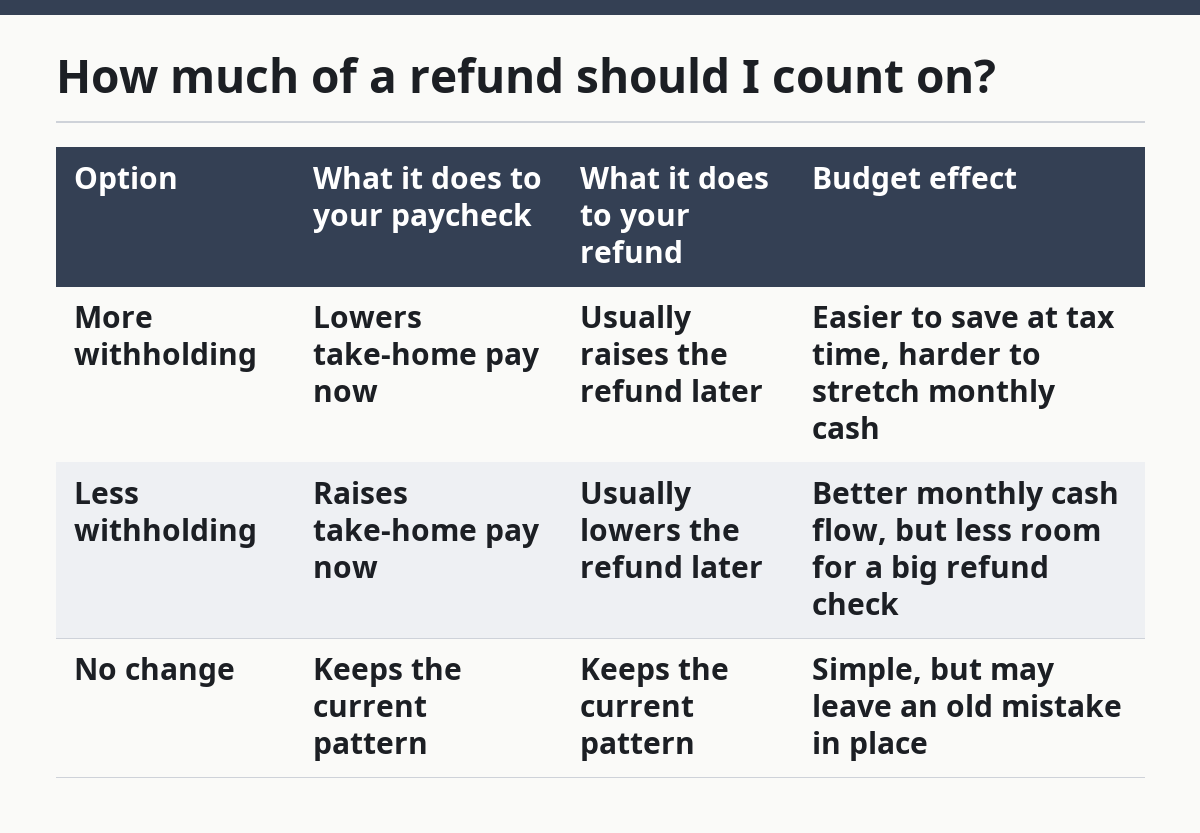
The table is not a promise of any outcome. It is a way to see the trade-off clearly. A single parent with thin cash flow may need the higher paycheck more than the larger refund, but that choice only works if the extra money is kept in the monthly budget instead of being spent before bills are due.
Which W-4 updates matter most?
The W-4 updates that matter most are the ones that change the size or timing of tax withholding. A filing status change, a new dependent, a second job, or a large income swing can all change the paycheck in a way your current budget does not expect.
A W-4 is not just a tax form to file once and forget. It is a control for how much tax comes out of each paycheck. If your family situation changed during the year, the old withholding pattern may no longer fit your household math.
So the biggest budgeting risk is not the form itself. It is assuming the current withholding still matches your real life. A single parent who starts a new job, adds child-care costs, or loses a source of support should look at withholding sooner rather than later, because waiting until tax filing time can leave the budget out of balance for months.
Keep one simple habit: after any income adjustment, review the W-4 within the next pay cycle or two. That does not mean changing it every time a bill arrives. It means checking whether your paycheck still supports the budget you actually use.
When should I stop and get help?
You should stop treating withholding as a simple budget tweak when the change could push you into a tax bill, a failed budget, or a choice you do not fully understand. In those cases, a qualified tax or financial professional can check the numbers for your own situation.
Your income changed midyear: A raise, a job loss, overtime, or a side job can change withholding enough to upset the budget — review the W-4 before the next pay period if you are unsure what the change does, and consult a qualified tax professional if the numbers are unclear.
You share support or custody changes with another adult: Dependent-related tax treatment can shift and affect withholding — verify the tax rules before you rely on a refund or smaller paycheck to fill a gap, and get qualified advice if custody or support arrangements changed.
Your refund has been paying for bills you need every month: That means the budget depends on money that arrives once a year — move those costs into monthly categories or get help reshaping the plan.
You cannot explain why your paycheck changed: Payroll errors and W-4 mistakes happen — compare the stub with the form and ask payroll to check it before the problem grows over 2 or 3 paychecks.
You expect the tax bill to be used for debt or major purchases: A refund is not a dependable budget line — stop counting on it until you know the withholding pattern is correct.
You are facing tax rules from more than one country or state: Cross-border or multi-jurisdiction rules can make withholding harder to read — get qualified help instead of guessing.
Each of these situations matters because the wrong withholding setting can quietly drain cash for months. The consequence is not just a smaller refund; it can be a budget that breaks at the grocery store, the pharmacy, or the rent due date. If the paperwork is confusing, that is the signal to slow down.
What mistakes do single parents make with withholding?
Single parents usually make the same handful of withholding mistakes, and each one has a real budget cost. The fix is usually simpler than the mistake.
The first mistake is treating a refund like income. That is risky if you do not also review the refund against the current W-4 or a qualified tax adviser. The consequence is a budget that looks stronger than it is, then collapses when the refund arrives smaller than expected. The better alternative is to budget from paycheck income and assign the refund only after it clears.
The second mistake is not updating the W-4 after a family or work change. The consequence is that the paycheck keeps being taxed as if nothing happened, which can leave either too much or too little in the check. The better alternative is to review withholding after any major income adjustment.
The third mistake is using a refund to catch up on monthly bills. The consequence is that the household runs lean for months, then the refund disappears on overdue expenses. The better alternative is to spread the money across the year, even if that means a smaller refund later.
The fourth mistake is changing the W-4 and then not checking the next 1 or 2 paychecks. The consequence is a bad estimate that sits untouched long enough to hurt the budget. The better alternative is to verify the first few stubs against the plan and adjust early.
The fifth mistake is forgetting that withholding rules vary by country and can change. The consequence is copying advice that does not fit the local tax system. The better alternative is to use the rules that apply where the tax is actually filed.
What if my paycheck is already tight?
If your paycheck is already tight, the goal is to make the new withholding fit the bills you have, not the budget you wish you had. That often means keeping a closer eye on the first 2 pay periods after any W-4 change.
A smaller refund can be useful in a tight budget if it improves cash flow during the month. The risk is that the extra take-home pay gets eaten by variable costs and never lands where you meant it to go. That is why the first assignment for any paycheck increase should be a specific bill or savings bucket, even if the amount is small.
When cash flow is thin, timing matters as much as total income. A refund in April does not help with a bill due this week. A paycheck that lands 3 days earlier or later can change whether the account stays above zero.
On the other hand, this is also the point where a generic “just save the difference” plan fails. A single parent often needs a practical plan for bills due now, not a theory about long-term savings. If the numbers are too tight to absorb a withholding change, the answer is usually to slow down, check the W-4 again, and get qualified help before making a bigger adjustment.
Should I change my withholding after becoming a single parent?
Usually yes, if your tax situation changed enough that your current W-4 no longer matches your household. A change in filing status, dependents, or income can shift your paycheck and refund pattern. The safer move is to check the form against your current situation before the next pay cycle.
How do withholding changes affect monthly cash flow?
Withholding changes affect monthly cash flow by moving money between your paycheck and your tax refund. Less withholding raises take-home pay now, while more withholding lowers take-home pay now and may increase the refund later. If your budget depends on every paycheck, that timing difference matters more than the yearly total.
FAQ
How often should I review my W-4 as a single parent?
Review it after a job change, a dependent change, a custody change, or any time your paycheck or refund no longer matches your budget. A quick check every few months is reasonable if your income is unstable.
What number should I budget from: gross pay or take-home pay?
Use take-home pay. Gross pay is not the money that reaches your checking account, and withholding changes affect the amount you can spend each month.
Can a bigger refund be a bad thing?
Yes. A bigger refund can mean you gave the IRS too much of your money during the year. That may be fine if you need forced savings, but it can hurt monthly cash flow.
What should I do if the IRS estimator and my paycheck do not match?
Check the inputs, then compare them with your payroll stub. If it still does not make sense, ask payroll or a qualified tax professional to review it before you change the W-4 again.
Drafted with AI; not yet reviewed by a person.
