Last updated: August 11, 2026
Quick Answer
Raising kids on one income changes the math. For most single parents, debt snowball is easier to stick with, while debt avalanche usually costs less in interest. A simple rule helps: if one balance carries a rate 5 percentage points or more above the others, avalanche often saves more money; when you need visible wins to keep going, snowball may work better.
Key Facts / Key Takeaways

- Debt snowball pays the smallest balance first, then moves up.
- Debt avalanche pays the highest interest rate first, then moves down.
- A plan that you can follow for 6 to 24 months is better than one that fails in month 2.
- A single unexpected $400 expense can disrupt a tight budget, so a small emergency cushion matters.
- When one debt rate is much higher than the others, avalanche usually has the math advantage.
- If progress needs to feel real, snowball often creates faster motivation.
- Should debt include taxes, collections, secured loans, or legal risk, consult a qualified professional before choosing an order.
Raising kids on one income is not a spreadsheet exercise. It is a blunt question: which payoff method will survive the month when the car needs brakes and the grocery bill jumps again? For most single parents, the debt snowball works better because momentum matters more than theoretical savings. I write about personal finance for readers who need decisions, not jargon, and this is information, not financial advice; for your own situation, talk with a qualified financial adviser. Simple. But not easy.
The Real Difference Between Debt Snowball and Debt Avalanche
Both methods use extra payments on top of the minimums. The order changes.
Snowball starts with the smallest balance first, then moves to the next smallest, regardless of interest rate. That quick payoff can feel like a breath of air. One account gone. Less clutter.
Avalanche takes the highest interest rate first, then works downward. On paper, that usually trims interest costs more than snowball does. Cold math. Cleaner math.
For a single parent, the trade-off is not academic. Your schedule is crowded, cash flow may swing from month to month, and your budget has less room for disappointment. In that setting, snowball wins when you need visible progress to stay motivated. Avalanche wins if you are disciplined, your payments are steady, and you can tolerate a slower emotional payoff.
Generic articles often miss the real issue: these methods are about behavior under pressure. A plan that looks “optimal” can fall apart by month two if it drains your motivation. A simpler approach can beat the better spreadsheet result because you keep using it. That is the part people forget.
Debt Snowball: Who Should Actually Use This (and Who Shouldn’t)
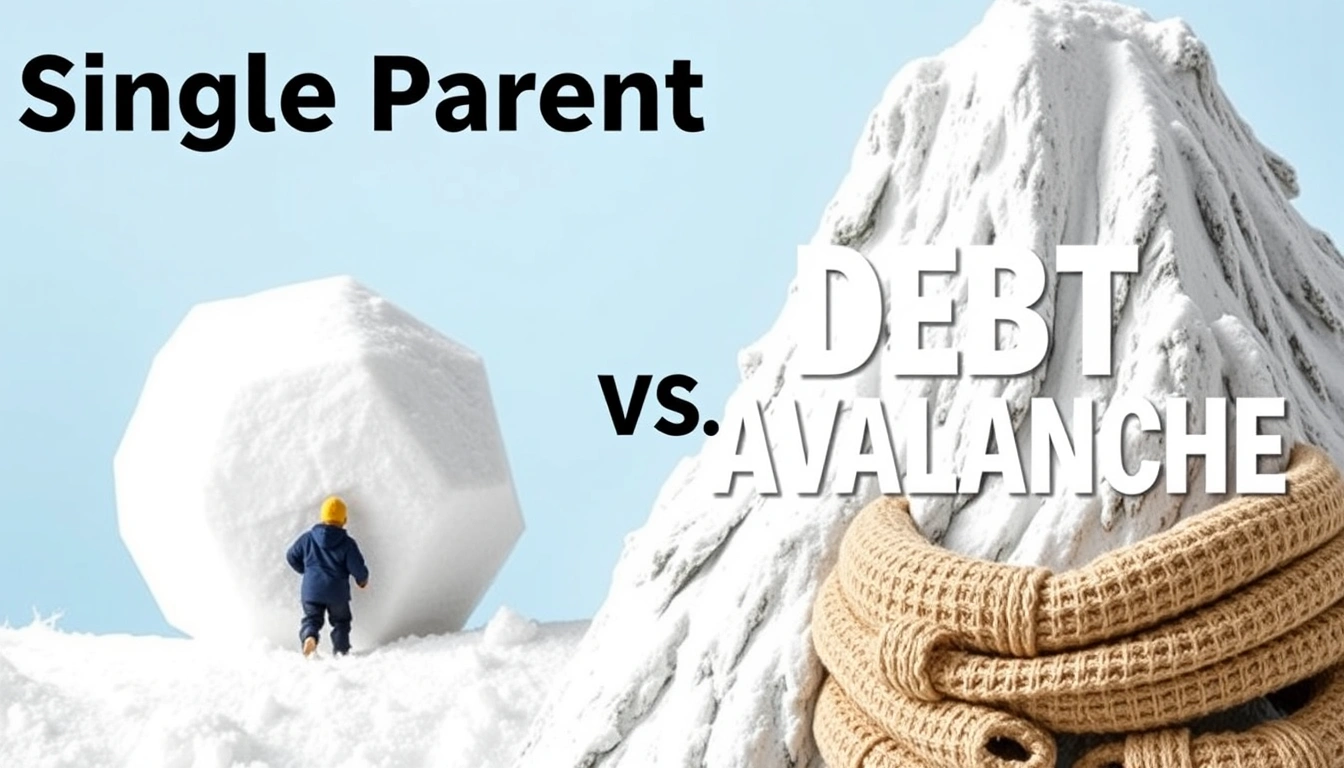
I would steer a single parent toward the debt snowball if motivation is the main problem. That is the method’s real strength. It gives you the psychological win of crossing accounts off your list, and that matters when you are carrying the mental load of a household alone.
Small balances make snowball even more attractive. A paid-off account reduces clutter, and one less bill means one less due date to track. That can make a messy budget feel manageable again. For a single parent juggling child care, school costs, transportation, and irregular expenses, that simplification has real value.
The downside is plain: you may pay more interest than you would under avalanche, especially if a larger balance has a high rate. Momentum over math. That is the trade. Not a flaw, necessarily. Just a trade.
Who should skip snowball? A single parent who is already highly disciplined, tracks every payment carefully, and can stick with a plan even when progress feels slow. When you do not need the emotional lift, the snowball’s main advantage shrinks. It can also be the wrong fit if one balance has a much higher interest rate than the rest and you are confident you will keep following the plan without needing quick wins.
I also would not use snowball as a substitute for basic stability. Should your budget be so tight that one unexpected copay or repair pushes you back onto a card, then method choice matters less than fixing the cash gap. Honestly, the hole comes first.
Debt Avalanche: The Specific Situations Where It Wins
Debt avalanche works best for the single parent who can stay steady and wants the most efficient payoff path. I say “wins” carefully here: it wins on interest logic, not on morale. The method directs extra money to the costliest debt first, which can reduce the drag from interest over time.
That matters most when you have a clear, stable budget and your bills are predictable enough that you can make the same extra payment every month. When you already check balances, track due dates, and avoid missed payments, avalanche can be the cleaner choice.
The strongest case appears when the rate gap between debts is meaningful. If one balance carries a much higher rate than the others, paying that one first is often the more efficient use of limited dollars. Some articles stop there and make avalanche sound automatically superior. It is not. A strategy that dies in the real world is useless. Harsh, but true.
The weakness is emotional. You might work longer before you see an account disappear. For some people, especially single parents who are already stretched thin, that delay is enough to make the plan feel punishing. That does not mean you lack discipline. It means the method may be asking too much of your attention when your life already asks for too much.
I would skip avalanche if you are likely to abandon the plan after a few months because the payoff feels invisible. I would also be cautious if your income changes often and you need the flexibility of making small, satisfying progress rather than waiting for a distant win.
The Honest Side-by-Side
Here is the clearest way I can put it: snowball is easier to follow, avalanche is more efficient when you follow it. For a single parent, that difference often decides the outcome.
| Criteria | Debt Snowball | Debt Avalanche | Winner for this condition |
|---|---|---|---|
| First visible progress | Faster emotional wins | Slower, less obvious wins | Snowball if you need motivation |
| Interest saved over time | Usually less efficient | Usually more efficient | Avalanche if rate differences are meaningful |
| Simplicity | Very simple to understand and track | Also simple, but harder to stick with emotionally | Snowball if you feel overwhelmed |
| Best for irregular cash flow | Helpful because small wins keep you engaged | Can feel harder to maintain | Snowball when your budget changes often |
| Best for disciplined payers | Good, but not optimal on cost | Strong fit if you stay consistent | Avalanche |
| Best for many small balances | Excellent for clearing clutter | Less satisfying at the start | Snowball |
| Best when one debt has a much higher rate | May delay the costly balance | Targets the expensive balance first | Avalanche |
| Motivation after a setback | Easier to restart | Harder if the big balance is still there | Snowball |
| Long-term cost control | Can cost more in interest | Usually better on interest control | Avalanche |
| Emotional stress | Often lower because progress is visible | Can feel slower and more abstract | Snowball |
For single parents, I think the most useful comparison is not “Which is smarter?” It is “Which one survives a hard month?” That is where snowball often pulls ahead. When you can sustain avalanche, use it. When you need a method that gives you a reason to keep going, snowball is the more realistic tool. The quote nearly doubled overnight? No. But the feeling can be close.
Our Verdict: Which One to Choose and Why
Choose debt snowball if you are a single parent who needs quick wins, gets discouraged by slow progress, or has a budget that changes too often to feel confident in a strict long-game plan. Choose debt avalanche if you can stay consistent, your budget is stable enough to support regular extra payments, and you want the more interest-efficient method. Neither when you do not yet have a basic emergency cushion and every surprise expense sends you back to borrowing.
That is my direct call.
I would favor snowball for most single parents because behavior beats theory when life is crowded. A payoff plan has to fit around school pickups, work shifts, illness, and expenses that arrive without warning. If the method is too hard to follow, the math advantage disappears. Period.
I would favor avalanche for the single parent who is already organized, emotionally steady about money, and determined to squeeze as much efficiency as possible from each extra dollar. When that sounds like you, avalanche is the cleaner system.
One practical warning: if your debt includes money that could trigger collection, legal action, or loss of essential services, payoff order may need to be reconsidered with professional guidance. A qualified adviser can help you sort the order based on your full situation, not just the balance list.
When to Reconsider This Choice Entirely
There are times when the snowball-versus-avalanche debate is the wrong debate.
First, if you do not have enough cash to handle a normal surprise expense, your priority may be building a small emergency fund before accelerating debt payments. Without that buffer, one flat tire can put you right back where you started. The Federal Reserve has found that even a $400 emergency can strain many households.
Second, if your income is unstable, a rigid payoff plan may be less useful than a plan that protects essentials first. A single parent with variable shifts or uneven child support may need flexibility more than speed.
Third, if any debt is tied to a hardship situation such as medical bills, tax debt, or a legal issue, the payoff method alone may not solve the problem. Those situations can have different rules and consequences, so a qualified professional is worth speaking with. The IRS, for example, treats tax debt differently from credit-card debt.
Fourth, if your total debt is already manageable and the real issue is overspending, the answer is not a different payoff order. It is a spending plan that stops new balances from growing.
The point is simple: debt strategy should support your life, not compete with it. When the method you choose makes you feel like you are failing every week, it is the wrong method even if it looks efficient on paper. Fair trade? Maybe. But that is reality.
How I Would Decide in Real Life
If I were helping a single parent choose between these two methods, I would start with one question: “Do you need motivation or optimization?”
When the answer is motivation, I would go with snowball. When the answer is optimization and the budget is stable, I would go with avalanche. When the answer is “I can’t keep up either way,” I would pause the debate and fix cash flow first.
I would also look at the number of debts. With several small balances, snowball can clean up the mess faster in a way that feels tangible. With fewer debts and one clearly expensive balance, avalanche has a stronger case.
That is the decision lens I trust: not theory, not guilt, and not the idea that one method is morally better. The better method is the one you can keep using until the debt is gone. In practice, that often means the plan that survives 12 months, not the one that looks smartest for 12 days. A long haul. Not a photo finish.
FAQ
Is debt snowball bad because it may cost more in interest?
No. It is a trade-off, not a mistake. When the emotional boost keeps you consistent, that consistency can be worth more than the interest difference.
Can I switch from snowball to avalanche later?
Yes. People often switch after they build momentum. The important part is to keep paying above the minimums and avoid adding new debt.
Which method is better for a single parent with irregular income?
Usually snowball, because it is easier to restart after a hard month. When your income is stable despite being tight, avalanche becomes more realistic.
Do I need to choose one method forever?
No. You can start with snowball for motivation and move to avalanche once you feel steadier. The best plan is the one you can follow.
Should I talk to a professional before choosing?
Yes, especially if your debts involve taxes, collections, secured loans, or legal risk. A qualified financial adviser can help you match the method to your situation.