Last updated: November 19, 2026
Variable child expenses are the part of a single-parent budget that change from month to month, and the best way to handle them is one flexible line item, not a dozen tiny budgets. The steps below show how to average, split, and adjust that line so school supplies, kids’ clothes, activities, birthday gifts, and miscellaneous child costs stop ambushing your paycheck.
What belongs in your variable child expenses line?
Picture this: you’ve paid rent, daycare, and groceries, and then a school flyer asks for $18 by Friday, your child needs shoes, and a birthday party pops up next week. A variable child expense line catches those costs before they land in your checking account.
This line should cover kids’ clothes, activities, school supplies, birthday gifts, and miscellaneous child costs that don’t happen every single month. If the amount changes based on the season or the child’s age, it belongs here. If it repeats on a fixed schedule, it belongs somewhere else in the budget.
That line should not try to do every job.
Use it for:
- clothes that wear out before the next size jump
- school supply runs in August and January
- after-school clubs, sports fees, and one-off activity costs
- birthday gifts for classmates and relatives
- random child costs like a field trip form, hair accessories, or a last-minute spirit day shirt
The truth is, many single parents split these costs into separate categories and then forget one. That usually means the budget looks neat for 2 weeks and falls apart by week 3. A single line works better because it leaves room for messy real life.
If you want the full budget system around this line, the hub on single-parent budget setup and financial systems can sit alongside this page. This article stays focused on the one line item that changes the most.
How do I set up the line without guessing?
You set it up by averaging past spending, choosing a monthly number, and building a small buffer for the months that run hot.
Start with the last 6 to 12 months of child-related spending. Pull bank statements, card statements, and receipts. Sort each expense into one bucket: clothes, activities, school supplies, birthday gifts, or miscellaneous. Then total each bucket and divide by the number of months you reviewed. That gives you a rough monthly average, even if the spending happened in chunks.
Here’s the catch: the average is not the final answer. It is the starting point. A January that includes winter coats and a September that includes school supplies are not equal, so the line needs room to breathe.
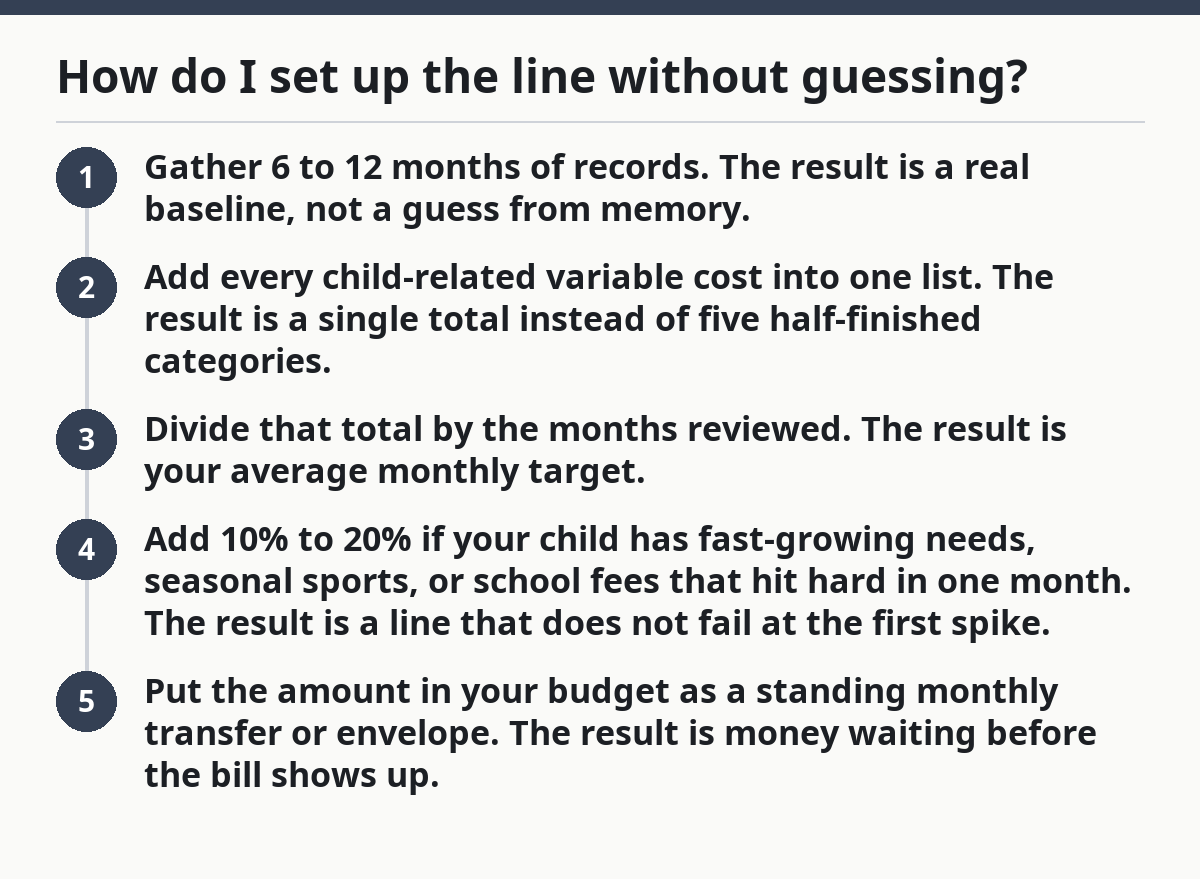
Use this 5-step setup:
-
Gather 6 to 12 months of records.
The result is a real baseline, not a guess from memory. -
Add every child-related variable cost into one list.
The result is a single total instead of five half-finished categories. -
Divide that total by the months reviewed.
The result is your average monthly target. -
Add 10% to 20% if your child has fast-growing needs, seasonal sports, or school fees that hit hard in one month.
The result is a line that does not fail at the first spike. -
Put the amount in your budget as a standing monthly transfer or envelope.
The result is money waiting before the bill shows up.
If you use a spreadsheet, one row is enough for the monthly budget line and one column is enough for actual spending. If you use paper, keep a simple running total. The tool matters less than the habit.
How do I handle seasonal child spending without blowing up the budget?
You handle seasonal child spending by smoothing the cost across 12 months instead of letting one season swallow the month.
Picture this: you know back-to-school season will cost more, but you also know December, spring sports, and growth spurts can spike spending too. A seasonal budget line stops those spikes from becoming emergencies. It works best when you treat the line as an annual pool, even though you fund it monthly.
A clean way to do it is to estimate the year, then divide by 12. If school supplies cost about the same every August and clothes usually need a refresh in the fall, those expected peaks stay inside the same line. You are not building separate budgets for each season. You are spreading the pressure out.
That approach helps with:
- August and January school supply runs
- seasonal clothing changes
- activity fees that show up in clusters
- birthday seasons when your child has several parties in a row
- small holiday-adjacent costs that sit inside child spending, not a separate holiday budget
A simple rule keeps this line honest: if the cost repeats every year, let the line hold it; if the cost changes a lot with age, adjust the line at the next monthly review.
The best part?
You do not need a perfect forecast. You need a line that keeps December from wrecking February.
A useful check comes from the Consumer Financial Protection Bureau’s budgeting guidance and the UK MoneyHelper budget planning tools, both of which push the same basic idea: track real spending, then adjust the plan after you see the pattern. Those are good reference points, not magic formulas.
How should I budget for each child without overcomplicating it?
You should split the line per child only if one child’s costs regularly outrun the others.
Picture this: one child is in cleats and team fees, another is still growing out of shoes twice a year, and a third only needs occasional school supplies. A single family line can work, but a per-child note inside it keeps the numbers fair. You do not need three full budgets. You need a way to see where the money goes.
Use one of these two setups:
- One shared line with notes. Best when children’s costs are close enough that you can manage them together.
- One line plus child tags. Best when one child has a clear pattern, like sports, dance, braces-related supplies, or frequent size changes.
If you choose tags, list each child under the same line and add a rough monthly share beside the name. Example: Child A $25, Child B $40, Child C $15. The total still lives in one budget line, but you can see who drives the cost.
This matters because a budget that ignores differences can feel “balanced” on paper and unfair in real life. A child in year-round activities is not the same as a child who mainly needs school supplies and the odd birthday gift.
Do not create a separate category for every little thing.
That turns one budget line into a filing cabinet.
Instead, pick the level of detail that helps you make a decision in under 5 minutes. If the extra tracking does not change how you spend, drop it.
How do I adjust the amount each month without starting over?
You adjust it by setting a review date, comparing planned to actual spending, and changing the line by a small amount instead of rebuilding the whole budget.
Picture this: the month is over, your child grew 2 shoe sizes, and you spent more than planned on activities. That does not mean your budget failed. It means the line needs a correction. A monthly reset keeps the budget alive.
Use this simple review:
- compare the budgeted amount to what you actually spent
- note which bucket caused the gap
- raise or lower next month’s line by a small step
- move unusual costs into the right month if they were clearly seasonal
- keep the same line if the amount was close enough
A good review takes about 10 to 15 minutes. Put it on the same date each month, like the first Sunday or the day after payday. That keeps you from reacting to one bad week.
Common mistakes show up fast here:
- Setting the line too low. The cost gets pushed onto a credit card or another category. Fix: raise the line before the next cycle.
- Mixing fixed and variable child costs. This makes the number look high or low for the wrong reason. Fix: move recurring fees out of this line.
- Forgetting seasonal spikes. August, winter, and birthday-heavy months can throw off a budget that only uses one average. Fix: keep a 12-month view.
- Never revisiting the amount. Kids grow, interests change, and activity costs shift. Fix: review monthly, not once a year.
A lot of parents want one perfect number. That is the wrong goal. A budget line for variable child expenses should be adjustable, not frozen. If it changes by $10 or $20 when school starts or shoes wear out, that is normal.
What mistakes make this line fail?
This line fails when it tries to be both a savings plan and a catch-all emergency fund.
Picture this: you put every kid cost into one category, then use it for a class trip, a pair of jeans, and a birthday present, only to find the line empty when school supply season hits. That problem is usually not overspending. It is bad category design.
The biggest mistakes are simple:
- Waiting for the bill to arrive before funding the line. That forces you to scramble. Set the money aside monthly instead.
- Using one month’s spending as the full-year rule. A July summer activity month can distort the whole budget. Use several months.
- Treating every child expense as unexpected. Many are predictable, even if the date changes. Put them in the line.
- Keeping no record of what the line actually covered. Then next month’s number is just a guess again.
One practical fix is a short note beside each expense. You only need 3 columns: date, item, amount. A page of notes is enough to spot whether school supplies, clothes, or activities are doing the damage. That record also helps you decide whether the line needs a 5% bump or a bigger reset next month.
This is not the right system if your child costs are already fixed and fully predictable every month. In that case, a separate fixed category makes more sense than a variable line. But for lumpy, uneven spending, this setup is the cleaner fit.
What should the finished budget line look like on paper?
The finished budget line should show one monthly amount, one actual-spending column, and one short note field for the reason behind spikes.
Picture this: you open your budget at payday and want the number to make sense at a glance. You do not need a complicated worksheet. You need a line that tells you how much is available, how much was used, and why it changed.
A simple layout looks like this:
- Budgeted amount: the monthly amount you set for variable child expenses
- Actual spent: what left your account
- Difference: what is left over or what you still need to cover
- Note: “school supplies,” “new shoes,” “birthday gifts,” or “activity fee”
You can keep that in a spreadsheet, a notebook, or a budgeting app. The method matters more than the platform. If the app hides the details, use a notes app or paper backup so you can see the pattern across 3 to 6 months.
When the line is working, it does three jobs at once: it protects the rest of the budget, it makes child spending visible, and it gives you a monthly number that can change without drama. That is the whole point.
Key takeaways
- Build one flexible child-expense line instead of chasing every small cost separately.
- Base the number on 6 to 12 months of real spending, not memory.
- Spread seasonal costs across the year so one month does not take the hit alone.
- Track each child inside the same line only if the differences matter.
- Review the line every month and change it a little at a time, not from scratch.
How do I estimate irregular kid costs?
Start with the last 6 to 12 months of statements and total the child-related spending that changes from month to month. Then divide by the number of months you reviewed. That gives you a baseline you can raise or lower when school starts, clothes wear out, or activities shift.
Should I average child expenses over a year?
Yes, if the costs rise and fall with the seasons. A 12-month average smooths out the months with school supplies, clothes, and birthday gifts, so you are not overreacting to one spike. If the spending is truly fixed every month, it belongs in a different budget line.
What counts as a variable child expense?
A variable child expense is any child cost that does not land in the same amount every month. That usually includes kids’ clothes, activities, school supplies, birthday gifts, and miscellaneous child costs. If the amount changes with age, season, or events, it belongs here.
Drafted with AI; not yet reviewed by a person.