
Last updated: November 19, 2026
Key Takeaways
- A class party contribution is a school-party item, food, or money families send when a teacher asks.
- Set a monthly amount you can keep, then use it for each request instead of deciding from scratch.
- Single parents can budget by setting a yearly cap, dividing it monthly, and matching requests to that limit.
- Match the request to your budget, not to the loudest option on the sheet.
Class party contributions feel small until the sign-up sheet lands on your phone, and then they start adding up fast for a single parent. How to Budget for Class Party Contributions as a Single Parent is simple: set a monthly cap, decide your “yes” amount before the teacher request arrives, and keep it as a recurring school cost. The steps below show how to handle snack items, craft supplies, and holiday parties without scrambling, and a small monthly amount can keep those requests from becoming a last-minute problem.
What a class party contribution really costs you

A class party contribution is the money, food, or supplies you send when the teacher asks families to help with a classroom party. Picture this: you’re getting a note home for a holiday party, a snack item, and a craft supply in the same week. The cost is rarely one big bill — it’s a string of small asks, and it often fits better into a school-year budget than into a one-time shopping trip.
The smartest budget is the one that treats these asks like a line item, not a surprise, and if you are unsure how to set that line item, consult a budgeting professional or review guidance from the Consumer Financial Protection Bureau before you set your amount. If your school year already has enough moving parts, this category can sit inside your annual school and family event costs for single parents instead of fighting with groceries, rent, or transit money.
Here’s the catch: the request is often open-ended. One sign-up sheet may ask for “chips,” “juice boxes,” or “stickers,” which sounds harmless until you realize you’re also covering tape, paper plates, or a last-minute backup item.
A simple way to name the cost:
- Food donation: a snack item, usually one bag, box, or tray
- Craft supply: glue sticks, markers, paper, or similar class materials
- Teacher request: the note or email asking for help
- Sign-up sheet: the list that shows who is bringing what
- Classroom party: the event where the items are used
A lot of generic budgeting advice misses the real problem: this is not a one-time party. It is a series of small asks across a school year, and the people who get squeezed hardest are the ones who answer every request.
How much should you set aside each month?
You should set aside a small monthly amount that you can actually keep, then stop treating each request like a fresh decision, and if the amount feels hard to choose, consult a financial professional or use FDIC guidance on budgeting basics before you lock it in. Picture this: you have one teacher request for a holiday party in December, another for a craft supply in February, and a spring classroom party that wants snacks.
The point is not to guess the “right” amount for every family. The point is to build a cushion so the next sign-up sheet does not steal from dinner money or rent.
Use this rule of thumb:
- Pick a monthly cap that fits your budget, even if it feels modest.
- Divide it into school months, not calendar months, if that helps you plan.
- Keep the money in a separate envelope, cash jar, or account sub-bucket.
- Roll unused money forward for the next classroom party.
If you want a number to start with, choose a figure you can repeat for 9 months without stress. A small amount that shows up every month is better than a larger amount you miss after two rounds. That approach is more realistic than chasing a perfect figure, because the best budget is the one that still works when you are tired, short on time, and asked for one more item on a Friday afternoon.
On the flip side, do not budget by emotion. A cute class photo or a guilt-heavy message from the room parent can push you to overspend. That is exactly how a “small” contribution becomes a problem.
How do you budget for class party contributions as a single parent?
You budget for class party contributions as a single parent by setting a yearly ceiling, breaking it into monthly pieces, and matching each request to that limit. Picture this: you’re looking at a sign-up sheet for a holiday party and wondering if you should send cupcakes, napkins, or nothing at all. You need a rule before the ask lands, because one clear limit is easier to follow than a new decision every week.
Here is a practical procedure that keeps the decision fast.
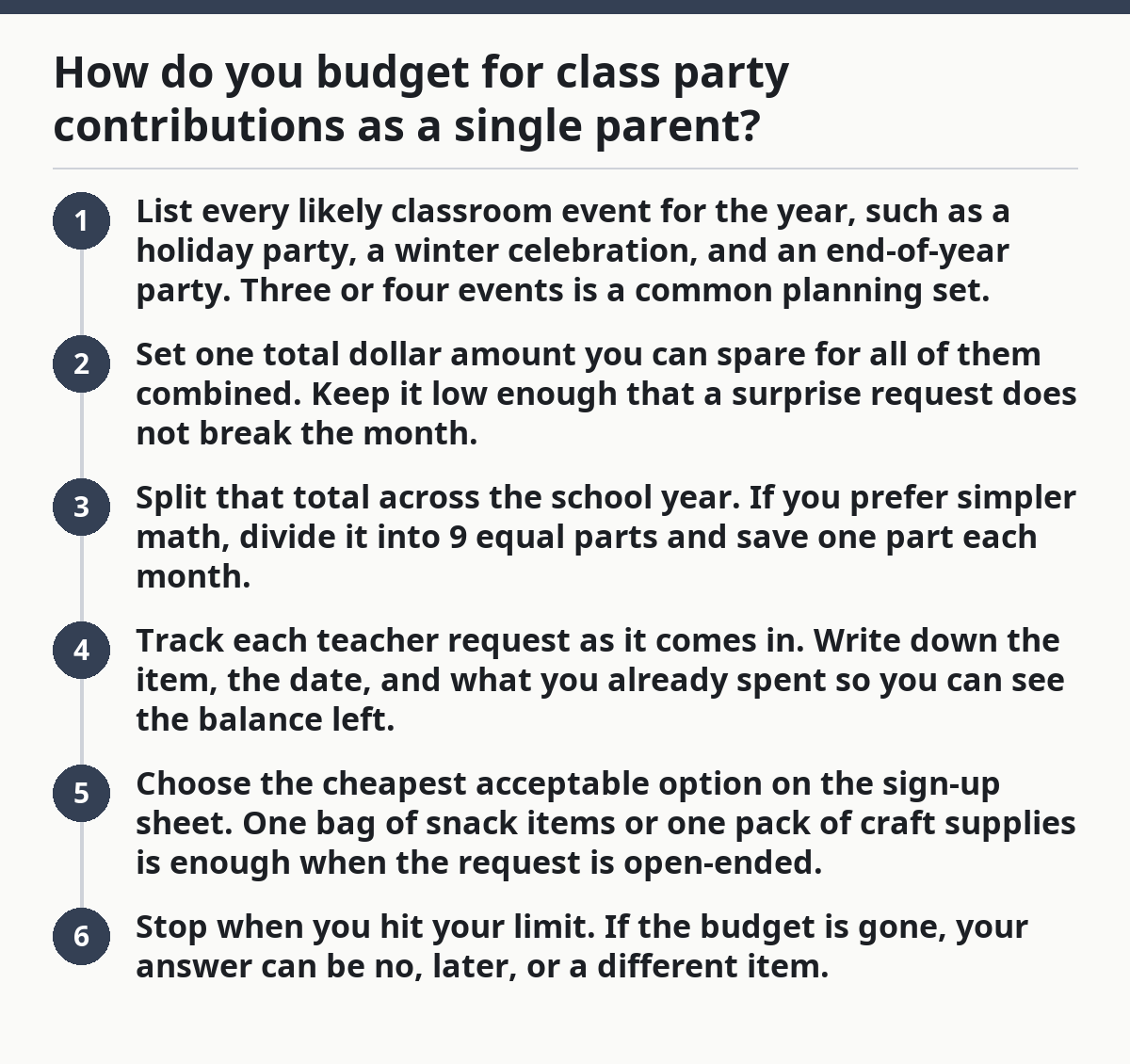
- List every likely classroom event for the year, such as a holiday party, a winter celebration, and an end-of-year party. Three or four events is a common planning set.
- Set one total dollar amount you can spare for all of them combined. Keep it low enough that a surprise request does not break the month.
- Split that total across the school year. If you prefer simpler math, divide it into 9 equal parts and save one part each month.
- Track each teacher request as it comes in. Write down the item, the date, and what you already spent so you can see the balance left.
- Choose the cheapest acceptable option on the sign-up sheet. One bag of snack items or one pack of craft supplies is enough when the request is open-ended.
- Stop when you hit your limit. If the budget is gone, your answer can be no, later, or a different item.
The truth is, the hardest part is not the math. It is deciding in advance that you do not have to say yes to every classroom party request. A budget without a stopping point is just a wish.
If you like structure, use a note on your phone with four fields: event, requested item, cost, and remaining balance. That tiny record saves you from double-buying markers or sending two snack items when one was enough.
What should you do when the sign-up sheet asks for food, crafts, or money?
You should match the request to your budget, not to the loudest option on the list. Picture this: the sign-up sheet asks for 12 juice boxes, a box of stickers, or a cash donation. One item may fit your month; another may not, and the goal is to keep the response tied to your plan instead of the pressure in the room.
The best part is that most classroom party needs are flexible if you ask early and keep the tone plain.
Use this quick filter:
- Food donation: choose shelf-stable items when possible, because they are often cheaper and easier to buy in one trip.
- Craft supply: buy the smallest usable pack, not the deluxe pack.
- Money request: only give cash if the school or teacher clearly prefers it and you can spare it.
- Holiday parties: expect more than one ask close together, so protect a little room in the budget.
- Teacher requests: answer with what you can do, not what you wish you could do.
If the request is for a shared supply, one low-cost item is usually enough. If the class needs a craft supply that you can’t afford, send a short note: “I can’t cover this one, but I hope the event goes well.” That is kinder to your budget than forcing a purchase you will regret later.
One common mistake is buying the “fancy” version of a simple item. Glittery plates, themed napkins, and name-brand snacks can triple the cost without helping the party much. A plain pack of napkins still wipes sticky hands.
How do you handle holiday parties without blowing the budget?
You handle holiday parties by planning for them before the season starts and treating them like a predictable cost, not a special emergency. Picture this: October turns into November, and suddenly the classroom party calendar fills up with costume day, holiday treats, and a sign-up sheet for cookies.
Holiday requests hit hard because they cluster. If you wait until the email arrives, you end up reacting instead of budgeting.
Build in these guardrails:
- Save a little extra in the months before the winter party season.
- Keep one backup item at home, like napkins or plain snack bags.
- Choose one contribution per holiday party, not three.
- If the teacher request is vague, ask what the class needs most.
- Skip anything that requires extra tools, like a knife, a hot tray, or complicated assembly.
The cost trap here is easy to spot. A “small” holiday contribution often becomes a bag of ingredients, a last-minute store trip, and an extra item because you felt awkward saying no. That can turn a modest request into a messy budget hit.
If you know holiday events are coming, label part of your school envelope “party season” and let that money sit untouched. Even $5 kept back each month can make the December requests feel less sharp, because you are spending from a plan instead of from panic.
What if you can’t afford the requested item?
You should reply early, politely, and with a clear limit. Picture this: you open a message asking for cupcakes, craft paper, or a cash donation, and there is no spare room in the budget this week. You still have options.
A short response works better than silence. Silence forces the teacher or room parent to guess, and that usually creates more pressure than honesty does.
Try one of these moves:
- Offer a different item. If the request is for a snack item, maybe you can send paper napkins or cups instead.
- Ask for the lowest-cost need. The teacher may have one thing that matters more than the rest.
- Say no without a long story. A plain “I’m not able to contribute this time” is enough.
- Watch for future sign-up sheets. You may be able to help next month instead of this one.
- Protect your budget first. Rent, food, and utilities come before any classroom party ask.
The trade-off is real: saying yes every time can make you feel involved, but it can also create a pattern you cannot sustain. A budget that survives school season is better than one that looks generous for two weeks and then breaks.
If your child’s teacher seems to expect a contribution, remember that a request is still a request. It is not a bill. That distinction matters.
How to keep school party requests from sneaking into other parts of your budget
You keep school party requests out of other budget lines by giving them their own spot and checking it once a month. Picture this: you already paid for groceries, and now a classroom party note wants applesauce cups or stickers by Friday. If you do not separate it, that request will quietly raid another category.
A simple system works well:
- Put party money in a separate envelope or account bucket.
- Review it on the same day each month, like the 1st or 15th.
- Mark each contribution on a calendar.
- Keep receipts for at least one school year.
- Replace used money as soon as your next paycheck lands.
This is not about perfect tracking. It is about making the next decision easier than the last one.
The best source for this kind of planning is your own school calendar and the notes you keep from the teacher request. If you want a broader framework for the rest of the year, the annual school and family event costs for single parents hub can help you fit class party contributions into the bigger picture without mixing them with lunch money or tuition.
A common mistake is waiting to “see what happens.” That leaves you with too many surprises and no cushion. A small, named budget line is calmer than guesswork.
Common mistakes that make class party budgeting harder
You make class party budgeting harder when you treat every request like a one-off emergency. Picture this: one sign-up sheet asks for a snack item, another asks for a craft supply, and you keep buying from the same pocket of money. That is how the budget leaks, especially when the requests keep coming across the school year.
Watch for these mistakes:
- Saying yes before checking your remaining balance.
- Buying more than the sign-up sheet needs.
- Choosing the most expensive version of a simple item.
- Forgetting that holiday parties usually come in clusters.
- Covering for other families so often that your own budget disappears.
Each one has a cost. The biggest cost is not the money itself — it is the pressure and resentment that build when you feel trapped by repeated teacher requests.
The fix is plain:
- Keep a hard cap.
- Use the cheapest usable option.
- Answer late requests with “not this time.”
- Save a small amount every month, even when no party is on the calendar.
That habit turns class party contributions into a routine school expense instead of a drain on the rest of your month.
Do parents have to contribute to class parties?
No, parents usually do not have to contribute to class parties. A teacher request or sign-up sheet is usually voluntary, even if it feels social pressure-heavy.
If you cannot afford the snack item or craft supply, you can say no. If you want to help later, choose a future classroom party when your budget has room.
How much should I spend on classroom events?
You should spend only what fits your budget after your must-pay bills are covered. A class party contribution should be a small, planned line item, not a reason to cut groceries or late fees.
A good approach is to set one yearly cap, then split it into monthly pieces. If that cap feels too tight, lower it and stick to it.
What if I can’t afford the requested item?
If you can’t afford the requested item, respond early and keep it brief. You do not owe a detailed explanation.
Offer a different contribution only if it fits your budget, or simply say you’re unable to help this time. A polite no is better than a purchase that breaks your month.
Drafted with AI; not yet reviewed by a person.