
Last updated: November 19, 2026
Key Takeaways
- Budget for rent, deposit, fees, insurance, and move-in costs before you sign.
- Turn the lease into exact payment targets and save in that order.
- Expect smaller charges beyond rent, even when the monthly amount looks manageable.
- Check lease timing and refund rules before you set your savings target.
You need money ready for the security deposit and first month’s rent before you sign, and the rest of the move-in bill can sneak up fast. This guide on How to Budget for a Security Deposit and First Month’s Rent as a Single Parent starts with the lease amount, then adds the deposit, fees, and a small cash buffer. The steps below show how to total it without guessing.
Who this applies to, and what to gather first

This applies if you’re a single parent trying to get keys on a new place and you already know the rent, or can get a lease quote, for at least one apartment or house. It assumes you can gather a few numbers in one sitting: monthly rent, the deposit rule in the lease, application fee, renters insurance quote, and any move-in fee.
You do not need a perfect spreadsheet to start. You do need the lease language, because security deposit rules, application fees, and move-in charges vary by state, city, and landlord.
If the rent amount changes by unit, do the math for each unit separately. A $1,400 unit and a $1,650 unit are not the same budget problem.
Before you add anything up, use the housing and utilities budget for single parents hub as the bigger picture. This page only handles the cash you need to close on the place.
How much do you need before you sign?
You need enough cash for first month’s rent + security deposit + application fee + renters insurance + move-in costs. That total is the number to save toward first.
The truth is, many people budget only for rent and miss the other line items. Then the lease is ready, but the bank balance isn’t. That gap is what causes rushed decisions.
A clean way to think about it is this:
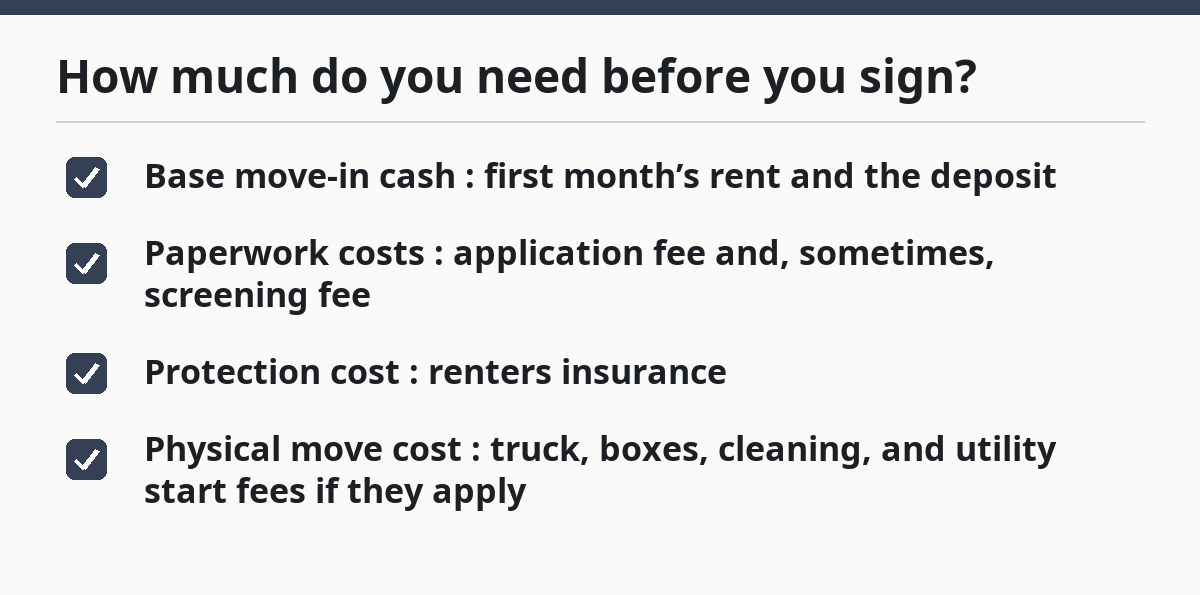
- Base move-in cash: first month’s rent and the deposit
- Paperwork costs: application fee and, sometimes, screening fee
- Protection cost: renters insurance
- Physical move cost: truck, boxes, cleaning, and utility start fees if they apply
If the landlord asks for the first month up front and a deposit equal to one month’s rent, your cash target starts at two months of rent before fees. If the deposit is lower or higher, use the lease, not a guess.
How to budget for a security deposit and first month’s rent as a single parent
You budget for it by turning the lease into a short list of exact payments, then saving in that order: rent, deposit, fees, insurance, and move-in extras. Here’s the catch: if you save in the wrong order, the lease can still fall through even when you’ve been saving.
- List the rent amount from the lease and verify whether the first month is due at signing or at move-in. If the lease uses a prorated first month, check the exact day count; a problem is assuming a full month when the lease charges a partial one.
- Add the security deposit amount exactly as written and verify whether it is refundable, partially refundable, or split into two payments. If the lease says “deposit” but also lists a nonrefundable fee, those are different charges.
- Write down the application fee and any screening fee before you apply. Verify whether each fee is per adult or per household; a problem is applying to three places and paying the same fee three times.
- Quote renters insurance for the property address and verify the required liability limit, if the landlord gives one. If you don’t have the address yet, ask for the minimum coverage requirement first so you don’t buy the wrong policy.
- Estimate move-in costs in cash: boxes, tape, cleaning supplies, gas, a truck, or paid help if you need it. Verify whether the building charges an elevator or move-in reservation fee; a problem is forgetting a required fee that shows up on move-in day.
- Create a separate savings target for the move-in total and verify the gap against your current savings. If the gap is more than one paycheck can cover, the problem is timing, not math.
- Set a weekly transfer amount and verify it still fits after bills, food, childcare, and transportation. If the transfer forces you to skip essentials, the target is too aggressive for the current month.
- Keep a 10% cushion for small surprises if your budget allows it. Verify that the cushion stays untouched unless the landlord adds a real charge; if you spend it early, you lose your margin.
The practical goal is simple: by the time you apply, you already know the amount needed to sign. That keeps you from racing the clock between approval and move-in.
What move-in costs should I expect besides rent and deposit?

You should expect at least a few smaller charges, even if the rent itself looks manageable. Some are one-time, some are first-month only, and some depend on the property.
The most common extra items are:
- Application fee: often charged per adult applicant
- Screening fee: sometimes separate from the application fee
- Renters insurance: usually paid monthly or annually, depending on the policy
- Utility start fees: electric, gas, water, or trash setup
- Moving costs: truck rental, packing supplies, cleaning products, or paid help
- Association or building fees: if the property has them
The mistake is treating these as side notes. They are part of the cash-to-close plan. If you ignore them, the deposit and first month’s rent can look affordable when they are not.
What should you check before you save a dollar?
You should check the lease terms, the payment timing, and the refund rules before you set the target. That sounds basic, but it changes the number in a real way.
Ask or look for these details:
- Is the security deposit equal to one month’s rent, a flat amount, or something else?
- Is the first month due before move-in, at move-in, or after approval?
- Is there a nonrefundable fee in addition to the deposit?
- Are application and screening fees charged for each adult?
- Does the landlord require renters insurance with a specific liability amount?
- Are utilities turned on in your name before move-in?
- Is there a cleaning, parking, or elevator fee?
If any answer is missing, get it in writing. A verbal “probably” is not budget data.
For standards and tenant rights questions, a housing counselor or local tenant group can help you read the lease language. The U.S. Department of Housing and Urban Development is also a useful starting point for housing guidance: https://www.hud.gov/ . The Consumer Financial Protection Bureau also has plain-language housing and budgeting resources: https://www.consumerfinance.gov/ .
When does this approach stop working?
This approach stops working when the move-in amount is unclear, unstable, or far beyond what one month of saving can cover. Then the budget needs a different plan, not more guessing.
The lease has two deposits: it means your cash target may be much higher than expected — get the exact written total before you keep saving.
The landlord wants all adults to apply separately: it means application fees can multiply fast — compare the total fee stack before you pay.
Your income changes week to week: it means a fixed transfer may fail — switch to percentage-based saving tied to each paycheck.
You still owe major bills this month: it means move-in savings can’t come from rent money — protect essentials first, then save the remainder.
The move date is less than 30 days away: it means the target may be too large to reach in full — ask whether the lease can wait or whether a later unit is possible.
This is information, not financial advice. For your own situation, especially if the lease terms are confusing or your cash flow is tight, a qualified housing counselor or financial professional can help you compare options.
The mistakes that throw off a move-in budget
You throw off the budget when you count only the deposit and rent, then forget the smaller charges that land at the same time. Those small charges can be enough to block the move.
- Using the advertised rent only: the consequence is a budget that looks complete but misses fees — the fix is to use the lease total, not the ad.
- Assuming the deposit is refundable cash you can spend later: the consequence is a shortfall at signing — if you are unsure how the lease treats it, check the written terms or consult a housing professional before counting it as available cash.
- Ignoring per-person fees: the consequence is a larger bill if more than one adult applies — the fix is to multiply the fee by each applicant.
- Forgetting insurance: the consequence is a delay if the landlord requires proof before keys — the fix is to quote and bind the policy early.
- Leaving out moving supplies: the consequence is last-minute spending on credit or cash advances — the fix is to set a small, separate move-in line.
- Not leaving a buffer: the consequence is no room for an extra charge or utility start fee — the fix is to keep a cushion in the account.
A good budget does not just total the rent. It tells you whether you can hand over money and still get through the rest of the month.
How do I keep the savings plan realistic?
You keep it realistic by matching the target to the time you actually have and the income you can count on. A plan that only works on a perfect month is a weak plan.
Therefore, save from each paycheck, not from vague leftovers.
- Save from each paycheck, not from vague leftovers
- Set the goal in writing with a date beside it
- Separate rent money from grocery money
- Recheck the lease whenever the unit or date changes
- Reduce the target only if a fee is truly optional
If your target is still too high, look at timing first. A later move date can help more than a complicated budget trick.
What does a good result look like?
A good result is when you can name the move-in total, pay it without clearing your checking account, and still keep enough for the next week’s essentials. That’s the real standard, not just “I have the rent.”
You’re in good shape if:
- You know the exact rent, deposit, and fee list
- You have the first month’s rent ready
- You can cover application and insurance costs without borrowing
- You still have cash for food, gas, childcare, and transit after payment
- You have proof of renters insurance or know how quickly you can get it
If the budget only works by emptying the account, it’s too tight. On the flip side, if you can cover the move and keep a small cushion, you’ve got a workable plan.
How much should I save before moving?
Save enough to cover the first month’s rent, the security deposit, and every fee the landlord lists before you apply. If you only save for rent, you can still come up short at signing. The exact target depends on the lease, so use the written numbers, not a rule of thumb.
What move-in costs should I expect?
Expect more than rent and deposit. Application fees, renters insurance, utility start fees, and small moving costs often show up in the same week as the lease signing. The total can change a lot by property, so ask for the full move-in sheet before you commit.
How do I budget for apartment move-in fees?
Add every fee to the same move-in total, then save for that total in order of urgency: rent first, deposit second, required fees third, and moving extras last. If a fee is per person or per application, count it that way from the start. That keeps the budget honest and helps you avoid a signing-day surprise.
Drafted with AI; not yet reviewed by a person.