
Last updated: November 19, 2026
Housing and utilities can swallow a single-parent budget fast. The fix is to cap the housing line first, then build the rest of the month around what’s left. This guide to Budgeting for Housing and Utilities as a Single Parent — The Complete Guide shows how to set that cap, what to count, and where single parents usually get tripped up.
I write on personal finance and household budgeting, and this is information, not financial advice; for your own situation, a qualified adviser or local housing counselor can help. For context on housing-cost standards and household budgeting, see the U.S. Department of Housing and Urban Development and the Consumer Financial Protection Bureau, along with the Federal Trade Commission’s consumer budgeting guidance.
Key Takeaways
- Put housing, power, water, trash, internet, and other must-pay bills in one bucket.
- Use take-home pay, not gross pay, when you set the ceiling.
- Make room for costs that show up once or twice a year, not just monthly bills.
- If rent is already too high, the budget has to change in housing first, not at the grocery store.
- A written plan works better than memory when you’re managing one income and a full house.
How much of your pay should housing and utilities take?
Budgeting for Housing and Utilities as a Single Parent works best when housing and utilities fit inside one monthly ceiling. Start with take-home pay. Protect the bills that keep the lights on and the roof over your head.
Most budgeting systems treat housing as the biggest fixed cost. Single parents need to treat utilities as part of the same decision, not as an afterthought. A qualified adviser can help you test the number against your own situation.
Picture this: rent, power, water, and internet all land in the same week. The numbers start fighting each other. One rule has to set the ceiling before the rest of the month starts.
Use this order:
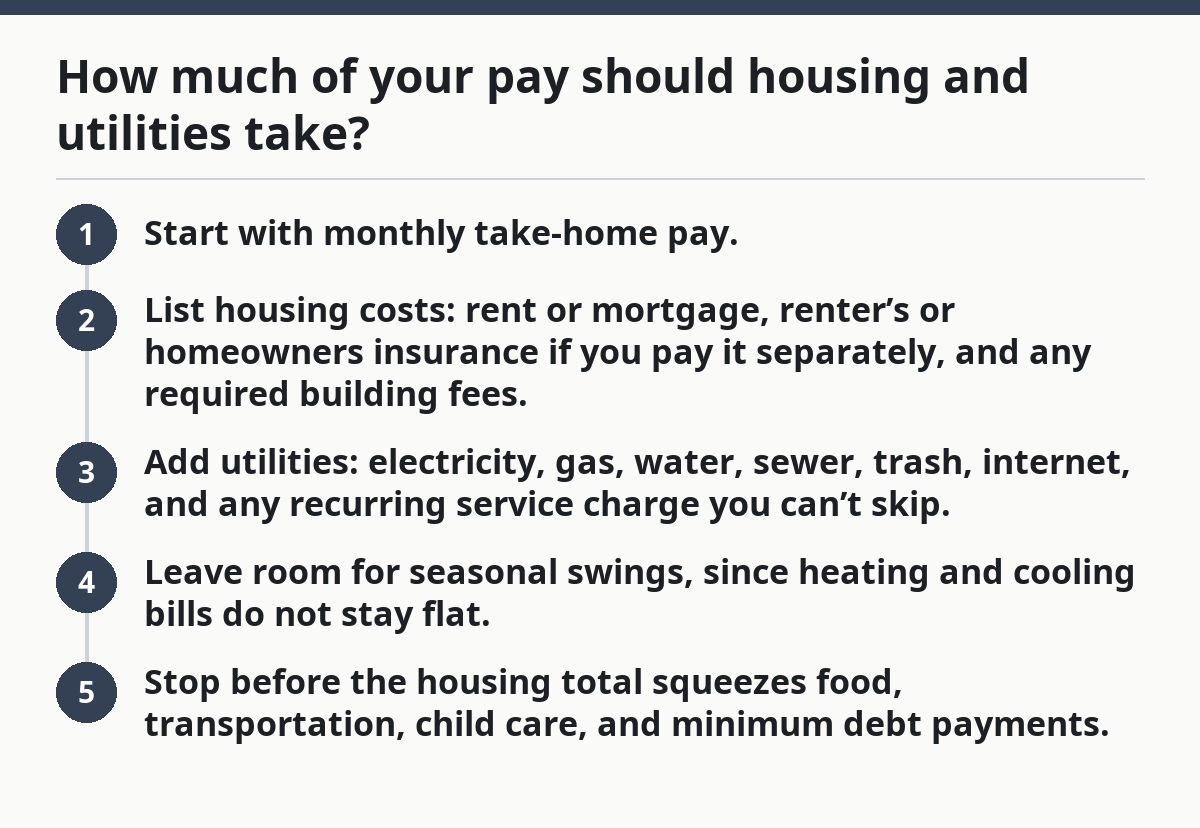
- Start with monthly take-home pay.
- List housing costs: rent or mortgage, renter’s or homeowners insurance if you pay it separately, and any required building fees.
- Add utilities: electricity, gas, water, sewer, trash, internet, and any recurring service charge you can’t skip.
- Leave room for seasonal swings, since heating and cooling bills do not stay flat.
- Stop before the housing total squeezes food, transportation, child care, and minimum debt payments.
The old “one-size-fits-all” percentage rule can help as a rough screen, but it is not a law and it is not universal. Rules, benefit limits, rent standards, and local utility rates differ by country and by city, so a number that works in one place can fail badly in another.
A better test is simple:
- If housing and utilities leave you unable to cover food, transport, child care, and debt minimums, the budget is too tight.
- If the bill changes every month and you never save for the high months, the budget is unstable.
- If your housing cost forces repeated borrowing, it is too high for your current income.
Two good public references for structure are the U.S. Department of Housing and Urban Development and the Consumer Financial Protection Bureau. Their tools and plain-language guides can help you compare rent, debt, and cash flow without guessing.
What counts as housing and what counts as utilities?
Housing is the place cost; utilities are the keep-it-running costs. Single parents should group them together because they hit the same paycheck. That sounds obvious until a budget leaves out internet, trash, or a quarterly water bill and the month falls apart anyway.
Picture this: rent is written down, then the electric bill lands three days later, and the internet bill is due right after school forms need printing. The budget is not wrong because of math; it is wrong because it forgot whole categories.
Count these under housing and utilities:
- Rent or mortgage payment
- Tenant fees, HOA fees, or building charges if they recur monthly
- Electricity
- Gas or heating fuel
- Water and sewer
- Trash collection
- Internet
- Phone if it is required for work, school pickup, or household access
- Renter’s or homeowners insurance if it is a recurring bill in your setup
- Repairs you pay directly as a homeowner
- Any prepaid meter top-up or service fee
Do not quietly leave out these common extras:
- Deposit installments
- Late fees
- Reconnection fees
- Space heater or window-unit electricity spikes
- Seasonal fuel deliveries
- Laundry costs if your building charges for machines
That last list matters because the bill you forget is the one that breaks the month. A budget that only counts the obvious line items is not a real budget; it is a wish list with a due date.
One practical move helps a lot: write the bills in the order they hit your account, not the order that feels neat on paper. A rent bill due on the first and an electricity bill due on the tenth can still drain the same paycheck if your paydays are on the fifth and twentieth.
How do you build the budget around one parent income?
Set the housing ceiling first. Then sort the rest of the month into fixed bills, flexible spending, and emergency gaps. That order matters because single-parent budgets are usually less forgiving than two-income households; one missed shift or one sick day changes the whole plan.
Picture this: child care, school costs, and groceries have already claimed their share. You do not need a prettier spreadsheet. You need a plan that still works after a surprise coat, a field trip, or a higher power bill.
Use a three-part layout:
- Fixed housing costs: rent or mortgage, insurance, required fees.
- Utility reserve: a monthly set-aside that covers the bills when they run high.
- Other essentials: food, transportation, child care, medicine, minimum debt payments.
Then give every bill a timing label:
- Due at the start of the month
- Due mid-month
- Due late in the month
- Seasonal or irregular
That timing matters because a budget can look fine on paper and still fail on day 12 if all the big bills arrive before the next payday. A single parent often needs a “bill buffer” more than a fancy category system.
A simple cash-flow check helps:
- If you get paid once a month, the first 10 days matter most.
- If you get paid weekly or biweekly, match each bill to the paycheck that covers it.
- If utility bills swing, a qualified adviser can help you average them into a reserve instead of treating the lowest bill as normal.
Honestly, a good budget for one parent is not about perfection. It is about preventing the same emergency twice. If the power bill keeps jumping in winter, the budget should learn from that fact instead of acting surprised every year.
The best way to handle utility bills that change each month

Budgeting for Housing and Utilities as a Single Parent gets harder when utility bills change each month. So the practical move is to build a reserve from real bills, not hopes. If your power, gas, or water bill changes with the season, a flat monthly guess will fail the first time weather changes or the kids are home more.
Picture this: summer hits, the air conditioner runs longer, and the electric bill comes in higher than the rest of the year. If you set your budget from the lowest month, you are borrowing from future you without meaning to. That math stops working fast.
Start with the last 12 months of bills if you have them. If you only have 6 months, use those and be cautious. Then:
- Add the bills together.
- Divide by the number of months you reviewed.
- Treat that result as your monthly utility target, and consider a qualified adviser if your household pattern is unusual.
- If one season is always worse, a modest cushion above the average can help.
If you do not have old bills, build from what you can see now:
- Ask the utility company for typical monthly usage ranges.
- Review past bank statements.
- Ask your landlord, HOA, or property manager what fees recur.
- Watch for billing cycles that are every 2 months or quarterly.
The upside of averaging is that it smooths out the rough months. The downside is that it can hide a real problem if one bill is high because of waste, leaks, or a bad rate plan. If the average keeps climbing, look for the reason instead of just feeding the number.
One more warning: do not set aside utility money and then spend it because the account balance looks healthy. That money has a job. If you need to keep it apart from checking, use a separate savings bucket or a labeled sub-account if your bank offers one.
What if rent is already too high?
If rent is already too high, the budget has to change in housing, not in groceries alone. Trimming food, child activities, and clothing can help for a month; it cannot fix a housing cost that eats too much of each paycheck.
Picture this: you are cutting coupons, skipping takeout, and still falling short every month because the rent line is simply too large. That is not a budgeting failure. It is a housing-cost problem.
Here are the main pressure-release options:
- Ask whether a lease renewal, unit swap, or payment plan is possible.
- Check whether utility costs can be reduced with weatherization, a cheaper internet plan, or lower heating use.
- See whether a housing voucher, local aid, or nonprofit program fits your situation.
- If you own the home, look at whether insurance, taxes, or maintenance are driving the total higher than the income can support.
Not every option is available everywhere. Local rules, waiting lists, and eligibility standards vary. That is why a budget should include a “housing pressure” note: what is pushing the number up, and what is available in your area to bring it down?
The hard part is that some fixes are slow. A better apartment may not open this month. A benefit application may take time. A utility company may offer a budget plan that spreads the bill out, but not erase it. Still, naming the problem is better than pretending the rest of the month can absorb it forever.
If housing costs are crowding out food or medicine, the budget is telling you something direct: the current setup is not sustainable. That sentence is uncomfortable, but it is more useful than pretending the math will soften on its own.
What should a single-parent housing budget include besides the rent?
A single-parent housing budget should include every bill tied to keeping the home usable, not just the monthly rent or mortgage. That means the budget has to catch the costs that show up in the cracks: deposits, repairs, seasonal spikes, and the bills tied to school or work access.
Picture this: rent is steady, but the fridge dies, the internet bill rises, and the water bill lands higher after a busy month at home. The home cost is not just rent anymore. It is the whole chain that keeps family life functioning.
Add these lines if they apply:
- Home maintenance or repair fund
- Appliance replacement fund
- Emergency hotel or temporary housing fund if you have no backup housing
- Internet upgrade if school or work depends on it
- Parking fees
- Storage fees
- Laundry or dryer costs
- Pest control or cleaning fees if they recur
- Moving costs set aside in case a lease ends
That list sounds long because family housing is rarely one simple bill. A single parent often has fewer backup options, so the budget needs to be more complete, not less.
A useful test is this: if the cost affects whether the family can live, work, study, or sleep in the home, it belongs in the housing budget. If the cost only feels related, but does not affect the home itself, it may belong somewhere else.
Do not ignore repairs if you own the place. A roof issue, plumbing problem, or furnace repair is not “later money.” It is housing money, and it should be planned for before the surprise arrives.
How do you protect the budget when money gets tight?
You protect the budget by separating survival bills from everything else and putting the housing bill at the front of the line. That does not make the month easy, but it lowers the chance that one bill delay turns into a housing crisis.
Picture this: a kid gets sick, a shift gets cut, or child care runs late, and suddenly the account balance looks smaller than expected. This is when a plan matters most, because panic spends faster than logic.
Use this order:
- Housing
- Utilities needed to keep the home running
- Food
- Transportation and child care needed for work
- Minimum debt payments
- Everything else
If there still is not enough, do not hide the shortfall. Write it down. Then decide which bill can be delayed, which provider should be contacted, and whether a payment plan exists. Missing the number on paper only makes the problem later and louder.
A few habits help:
- Keep a small buffer in checking if possible.
- Watch due dates, not just balances.
- Put reminders on the calendar for bills that change monthly.
- Review the housing line every month, not only at lease renewal.
A written system gets easier after the first few months. You stop rediscovering the same problem over and over. You still have hard months, but they stop feeling random.
The real difference between a tight budget and an unsafe one
A tight budget means the numbers are strained; an unsafe budget means the housing line is threatening basic stability. That difference matters because a tight budget can sometimes be managed with timing changes, while an unsafe one needs a bigger fix.
Picture this: one month is rough because of a high water bill, but the next month should recover. That is tight. Now picture month after month where rent crowds out groceries and every utility bill becomes a crisis. That is unsafe.
The line is usually crossed when:
- You borrow to cover rent or utilities most months.
- You skip essentials to keep the lights on.
- You cannot absorb even small bill changes.
- You rely on late fees, reconnection, or eviction warnings as part of normal life.
Those signs tell you the budget is not just stressed. It is unstable. And instability is expensive; late fees and reconnection fees can make the next month harder than the last.
This is where single parents need a clear-eyed view. A budget should protect the child’s home life, not just preserve appearances on paper. If the numbers only work by assuming constant luck, the plan needs revision.
Exception scenarios
- You have a temporary income dip. If the shortfall is tied to one short period, a payment plan or bill deferral may be enough to bridge it.
- You expect child support or a tax refund soon. If the money is real and scheduled, you can plan around the gap, but do not spend it twice.
- You just moved and costs are still settling. First-month deposits, setup fees, and utility transfers can make the budget look worse than it will be later.
- You qualify for local help. Rental aid, energy assistance, or housing support can change the math, but eligibility rules vary by place.
What questions should you ask before you lock the budget in?
Before the budget is final, ask three direct questions: what is the true monthly housing cost, which bills swing through the year, and what happens if income drops for one month. Those questions catch the mistakes that ruin most first drafts.
Picture this: the spreadsheet looks fine, but one bill is missing and another is only guessed at. The budget seems balanced until the first real due date arrives.
Ask:
- Does this total include every recurring home bill?
- Are utilities averaged, or is one low bill making the plan look better than it is?
- Is there any room for a repair, fee, or seasonal spike?
- If income falls, which bill gets a call first?
- Is the housing total leaving enough for food, transport, and child care?
If the answer to any of those is “I don’t know,” the budget is not ready yet. That is not failure; it is the point where the plan gets better.
Frequently asked questions
How do I budget if rent takes most of my paycheck?
Check whether the rent leaves enough for the rest of the basics. If it does not, the problem is not your categories; it is the size of the housing cost relative to income. In that case, you usually need a housing-side fix, a utility reduction, or help from local programs, depending on what is available where you live.
Should I count internet as a utility?
Yes, if your family needs it for school, work, or basic household life. A lot of single-parent homes depend on internet the same way they depend on power, so leaving it out can make the budget fail even when the rent looks fine. If the bill is optional in your case, it can sit in a separate category.
What if my utility bill changes every month?
Use an average from past bills and build a cushion for the high months. If you only budget the cheapest month, the plan will break when weather changes or usage goes up. A rolling average is usually more honest than guessing at a flat number.
What should I do first if I can’t pay everything?
Protect housing and the utilities that keep the home safe first, then contact the bill holder before the due date if a payment will be late. Late contact is better than silence because it may open the door to a payment plan or a temporary arrangement. If the shortfall is repeated, the housing cost itself may need to be reworked.
Is there a right percentage for housing?
There is no single percentage that fits every country, city, or family. Some budgeting rules use broad percentages as a guide, but local rent levels, benefit rules, and utility costs change the picture fast. Use percentages only as a rough check, not as a universal standard.
For help specific to your area, look to your local housing authority, utility provider, or a qualified financial counselor who knows the rules where you live.
Drafted with AI; not yet reviewed by a person.