Last updated: November 19, 2026
Key Takeaways
- List every school-year cost first, even the repetitive ones, so nothing sneaks into the budget later.
- Build one childcare budget for normal weeks, then add extra coverage for overtime, sick days, and closures.
- School costs usually arrive in many small bills, not one large one.
- When money is tight, protect rent, utilities, food, and childcare before anything else.
Single parents need a plan for childcare, school fees, supplies, transport, and backup care before the bill hits.
Quick Answer: start by setting aside at least $20 a month for a $240 annual uniform cost, then build the rest of your monthly school-cost budget from there.
Childcare and school-cost planning for single parents — The Complete Guide works best when you treat the school year like a 12-month budget, not a one-time shopping trip.
The sections below show what to count, what to cut, and where the hidden costs usually show up.
I write about family budgets and school costs for a living, with a focus on the real bills that break a monthly plan, and this guide stays on childcare and school-cost planning for single parents throughout.
What childcare and school-cost planning actually covers
Childcare and school-cost planning means building one budget for every child-related expense you can predict in a 12-month year, then adding a small cushion for the costs that show up without warning.
That sounds simple in theory, but the year does not behave simply.
Picture this: you’ve paid rent, food, and the electric bill, and then a school form comes home asking for field-trip money, classroom supplies, and a uniform item by Friday. If you’re a single parent, that one week can punch a hole in the whole month. The goal is to stop those surprises from becoming a crisis, and that is the core of childcare and school-cost planning for single parents — The Complete Guide.
For many families, the biggest line items are childcare, school fees, transport, uniforms, meals, and backup care. A plan that ignores even one of those is not a plan; it’s a wish list, and it will not hold under pressure.
Here’s the catch: school costs are not just tuition or daycare. They include the small charges that come in waves.
- Registration or activity fees
- Before- and after-school care
- Class trips and special events
- Uniforms, shoes, and seasonal clothes
- Lunch money or packed-lunch supplies
- Devices, internet access, and printed work
- Childcare for snow days, sick days, and late work shifts
The smartest way to handle this is to separate fixed costs from variable costs. Fixed costs are the same most months, like a childcare contract or bus pass. Variable costs change, like field trips or summer camp. That split makes the budget easier to trust, and it keeps childcare and school-cost planning for single parents grounded in real numbers.
A good first rule is to turn yearly costs into monthly amounts. If school requires $240 for a uniform bundle, that is $20 a month if you save for 12 months. This keeps the annual pain from landing all at once.
Start with the numbers you can’t dodge
The first job is to list every cost that will show up this school year, even if it feels annoying or repetitive.
If you skip the boring stuff, the budget will fail in the real world.
Picture this: you are staring at a notebook, a bank app, and three school emails at the same time. The better move is not to estimate from memory. It is to pull every cost from a bill, a school calendar, or a daycare contract and write it down once.
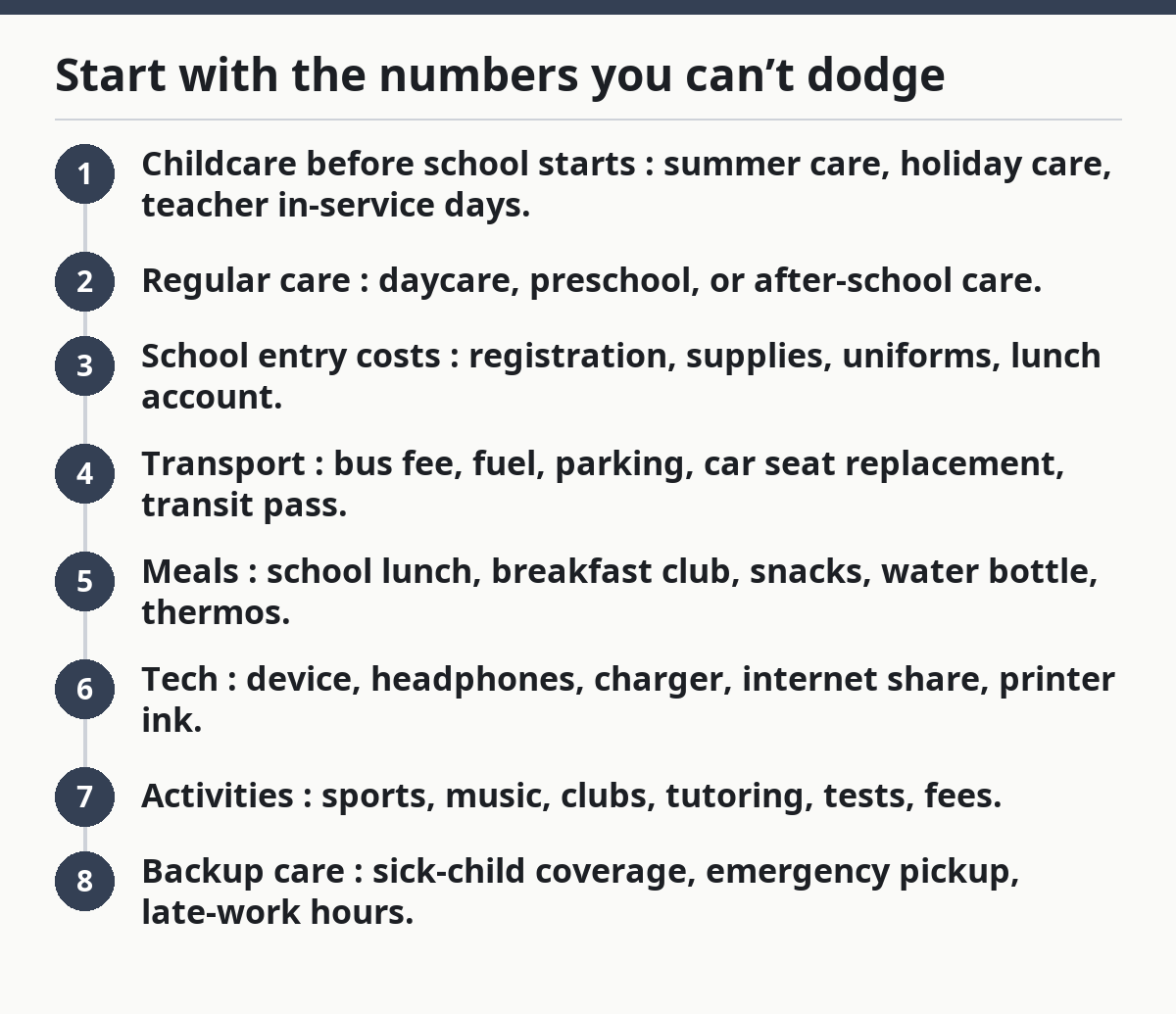
Use this short checklist to build the base budget:
- Childcare before school starts: summer care, holiday care, teacher in-service days.
- Regular care: daycare, preschool, or after-school care.
- School entry costs: registration, supplies, uniforms, lunch account.
- Transport: bus fee, fuel, parking, car seat replacement, transit pass.
- Meals: school lunch, breakfast club, snacks, water bottle, thermos.
- Tech: device, headphones, charger, internet share, printer ink.
- Activities: sports, music, clubs, tutoring, tests, fees.
- Backup care: sick-child coverage, emergency pickup, late-work hours.
A school calendar matters as much as a budget sheet. The dates tell you when money leaves the account.
No calendar, no control, and that is why childcare and school-cost planning for single parents starts with dates, not guesses.
If your child is in daycare, read the contract line by line. Many contracts charge for late pickup, holiday closures, and missed days. Some still bill the full fee when a child is absent. That means “I didn’t use the seat” does not always mean “I don’t owe the money,” especially when the contract says otherwise.
For school-age children, the hidden cost is often timing. Fees bunch up in August, January, and again in spring. A family can handle one spike and still get crushed by the second one. That is why annual planning matters more than monthly guessing, and why this guide keeps returning to the full year.
How do I budget childcare when my work hours change?
You budget childcare for changing work hours by building a base plan for your normal week, then adding a second layer for overtime, sick days, and school closures.
If your income moves, your childcare plan has to flex too.
Picture this: your shift runs late twice this week, the school closes for a professional day, and your usual pickup person is unavailable. That is exactly where single parents get stuck. The bill is not just the scheduled care — it is the backup care that saves the job, and childcare and school-cost planning for single parents has to include both.
A workable childcare budget starts with three buckets:
- Core care: the care you pay every week no matter what.
- Flexible care: extra hours, drop-in days, summer cover, snow days.
- Emergency care: the person or service you call when your plan breaks.
A cheaper weekly rate is not always cheaper overall. A center with lower base tuition but high late fees can cost more than a slightly pricier place with longer hours. Ask about the fees that hide in the rules, not just the headline rate.
Use these questions before you commit:
- What does a late pickup cost?
- Is there a fee for school holidays or teacher workdays?
- Do sick days lower the bill?
- Is part-time care priced fairly, or does the per-day rate jump?
- What happens during a summer break?
- Do they charge to hold a spot?
That last one matters. A spot-holding fee can be worth it if it protects your schedule, but it can also become dead money if your work pattern changes.
Read the contract.
If you have a variable schedule, try to build your care plan around the most expensive month, not the easiest one. That gives you room to breathe. It also keeps you from spending the child support payment on a week you didn’t see coming, which is why childcare and school-cost planning for single parents works better when it is built around worst-case timing.
School costs that slip through the cracks
School costs slip through the cracks because they do not arrive as one bill.
They arrive as ten small bills with different due dates.
Picture this: one child needs gym shoes, another needs a trip form signed with cash attached, and the school app asks for a donation for class events. None of those items is huge alone. Together, they can eat the week’s grocery money, especially when childcare and school-cost planning for single parents has not yet accounted for them.
The costs that surprise parents most often are these:
- Uniforms and shoes: children grow fast, and replacement timing is rarely kind.
- Field trips: fees can cluster in one term.
- Testing and graduation costs: especially in older grades.
- Electives and extracurriculars: band, sports, clubs, art supplies.
- Tutoring and homework support: sometimes one subject turns into a monthly expense.
- School photos and yearbooks: optional, but socially loaded.
- Class gifts, spirit days, and event costs: small individually, messy together.
A practical move is to create a school sinking fund. Put away a set amount each month for known school costs, even if the amount is tiny. The point is not perfection. The point is not being surprised.
For families with very tight cash flow, grouping school costs by term can make the month easier to read. August to September, January, and spring each get their own mini budget. That makes it easier to see where the pain really lands.
Don’t forget school meals and transport. Those are not side issues. A daily lunch purchase can quietly become a major line item by the end of the month, and bus fees or fuel can change the whole picture. Childcare and school-cost planning for single parents needs those costs in the same plan, not in a separate folder.
The budget that works when money is tight
The budget that works when money is tight is the one that protects rent, utilities, food, and childcare before anything else.
If those four are unstable, the rest of the plan will wobble.
Picture this: your paycheck lands, the rent is due, and school has already sent home two envelopes. This is where a lot of single parents try to make the school budget “fit” after the rest of life is paid. That usually fails. The smarter move is to assign every dollar a job before it disappears, and that is especially true in childcare and school-cost planning for single parents.
Use this order:
- Housing
- Utilities
- Food
- Childcare needed to keep working
- Transport to work and school
- Medical costs and medicines
- School essentials
- Savings for school extras and backup care
That order may not feel fair. It is practical.
If you need to cut, cut the optional layers first:
- paid activities before core childcare
- branded supplies before basic supplies
- nonrequired extras before essentials
- monthly subscriptions before school necessities
One mistake keeps showing up in tight budgets: parents cut backup care first. That is risky. If one sick day forces you to miss work, the lost wage can be bigger than the cost of having a backup plan.
Short-term savings can bring long-term trouble.
Many schools and childcare providers have payment plans, fee waivers, or lower-cost alternatives if you ask early. Some districts also have meal support, fee reductions, or device-lending programs. You do not need to wait until you are behind to ask about help.
For a practical outside reference, the U.S. Department of Education’s student support and family resource pages are useful starting points for school-related aid, and Child Care Aware of America explains how families can compare care options and local assistance. Those pages do not solve the budget for you, but they help you find the rules instead of guessing.
How to build a backup plan for sick days, closures, and overtime
A backup plan is the difference between a bad week and a job problem.
It needs at least one person, one service, and one rule for when to use each.
Picture this: your child wakes up with a fever, school says stay home, and your workday starts in twenty minutes. If your whole plan depends on one grandparent, one friend, or one sitter, the first missed call can wreck the whole day. Childcare and school-cost planning for single parents has to account for that kind of interruption.
A backup plan should answer four questions:
- Who can pick up the child fast?
- Who can stay with the child for a few hours?
- Which days are covered by paid care?
- What is the last-resort option if no one is available?
Write those names and numbers down now, not later. Put them in your phone and on paper. If you drive for work, keep the paper copy in the car.
You also need a rule for school closures. Many schools have at least a few closure days each year that do not line up with paid holidays. Teacher training days, weather closures, and half-days can all create a care gap. If you wait until the week of the closure, you will pay more or scramble harder, so childcare and school-cost planning for single parents should include a closure calendar.
Backup care options usually fall into four groups:
- family or friends
- an in-home sitter
- drop-in care
- work-based flexibility or shift swaps
Each has trade-offs. Family may be free but unreliable. A sitter may be dependable but costly. Drop-in care may solve one emergency and fail on another. Work flexibility sounds good until a manager says no.
This is also where a small emergency fund matters. It does not need to be large to be useful. Even a modest cushion can cover one extra pickup, one sick day, or one school closure without using a credit card.
Should I ask for help with childcare or school fees?
Yes — if the bill threatens rent, food, or work, asking for help is the right move.
That is not failure. It is damage control, and it belongs in childcare and school-cost planning for single parents.
Picture this: the school asks for a fee you cannot pay this week, and you are tempted to ignore the form. Don’t. Schools, childcare providers, churches, local charities, and community groups often have payment plans, fee reductions, or donated supplies, but only if someone asks.
Start with the place that sent the bill:
- Ask for a payment plan.
- Ask if the fee can be split across two or three dates.
- Ask whether there is a reduced-rate option.
- Ask whether school supplies can be donated.
- Ask whether the activity has a scholarship or fee waiver.
Then check public and community support:
- school meal programs
- childcare assistance programs
- district fee waivers
- emergency family funds
- local mutual-aid groups
- community centers and libraries
A lot of parents wait because they feel embarrassed. That delay can cost more than the original bill. The earlier you ask, the more options usually stay open.
Silence is expensive.
If your income changes month to month, document that. Keep pay stubs, work schedules, and care invoices together. Those papers help when you apply for assistance or ask for a revised payment arrangement.
Here’s the catch: help programs can have forms, wait times, and income rules. That means they are not instant fixes. Still, they are worth the effort because one successful application can reduce pressure for months, not days.
The plan that keeps single parents from getting blindsided
The plan that keeps you from getting blindsided is a simple system: list annual costs, convert them to monthly amounts, protect childcare first, and keep a backup care list ready.
That is the core move.
Picture this: you have a calendar, a spreadsheet or notebook, and a separate stash for school costs. Nothing fancy. What you now have is a system that sees the year before the year sees you, and it fits childcare and school-cost planning for single parents much better than guesswork does.
Use this five-step setup:
- Write down every childcare and school cost you know about.
- Mark when each bill comes due.
- Convert yearly costs into a monthly amount.
- Build a small backup fund for closures and emergencies.
- Review the plan before each school term starts.
The best version of this plan is one you can keep using on a tired Thursday night. If it needs a perfect app, a perfect mood, or two quiet hours, it will fail. Paper works. A notes app works. A spreadsheet works. The tool matters less than the habit.
A strong plan also has one honest rule: if the budget gets tight, protect care that lets you keep working. That may mean dropping one activity, not the childcare slot. The child can miss a club. Missing a paycheck hits harder.
When this plan changes completely
The plan changes completely if your care is subsidized, your work schedule is fixed, or your child has a support need that creates extra recurring costs.
In those cases, the budget is still useful, but the order of costs changes.
Picture this: your childcare costs are partly covered by an employer benefit or public assistance program, or your child needs regular therapy transport that runs every week. The standard “school extras first, childcare second” mindset does not fit. Your recurring obligations may already be locked in.
Recheck the plan in these situations:
- you move from preschool to school-age care
- your work hours change by shift or season
- a child starts therapy, tutoring, or after-school support
- a school changes its fee structure
- you lose or gain childcare assistance
Each of those changes can shift the budget by a real amount. A plan that worked in September may fail by February. That is normal.
Update it.
If a cost is recurring and unavoidable, treat it like rent. If it is optional, put it lower in the list. That one distinction helps more than any fancy budgeting trick.
FAQ
How much should I set aside for school costs each month?
Set aside a monthly amount that covers the school costs you already know about, then add a small cushion for forms, supplies, and one-off fees. If you have annual items like uniforms or field trips, divide them by 12 so they stop hitting your wallet all at once.
What if childcare is my biggest expense?
If childcare is your biggest expense, protect it before extracurriculars and optional school spending. Childcare is often the cost that keeps your work income alive, so cutting it first can backfire fast. Ask about subsidies, sliding-scale care, and payment plans before you give up the slot.
How do I handle school fees when my income changes every month?
Use a baseline month from your lower-income period, not your best month. That keeps the budget honest and reduces the risk of overspending when business is good or shifts are plentiful. When income rises, send the extra money to school costs, backup care, or an emergency fund.
Should I pay for school extras or save that money?
Save first if the money would otherwise leave you unable to handle childcare, food, or transport. Optional school extras are easier to skip than a missed care payment or an overdue utility bill. If your basics are covered, then choose the extras that matter most to your child.
What’s the first thing to cut if money gets tight?
Cut optional activities, branded items, and nonrequired extras before you cut core childcare, school transport, or food. If the budget still does not work, ask the school or provider about payment plans or fee help. The goal is to trim the edges without breaking the month.
Drafted with AI; not yet reviewed by a person.