Last updated: November 19, 2026
Quick Answer: In income stability and cash flow timing — The Complete Guide, the fastest fix is often a working buffer of $500 to $1,000, paired with dated bill tracking. If your income is steady but your balance falls before payday, the problem is usually timing; if the pay itself swings, it is stability. Income stability and cash flow timing are about how predictable your money is; income stability and cash flow timing also cover when that money actually lands versus when bills leave. If those two do not match, even a good income can feel unstable, and the fix is usually a mix of reserves, payment timing, and a cash-flow calendar.
Key Takeaways
- Steady pay can still leave cash flow tight when bills and paydays do not line up.
- Income stability is about the paycheck.
- Timing matters most when the balance drops before payday and then recovers.
- Reducing moving parts usually improves income stability fastest.
Why steady income still feels shaky
Steady pay does not automatically mean steady cash flow, and that gap is where most people get into trouble. A salaried employee paid on the 15th and last day of the month can still miss rent if rent drafts on the 1st and three utilities hit the same week. The problem is often not income size; it is the spacing between inflows and outflows.
Income stability and cash flow timing each have two parts. First is predictability: can you count on getting paid at all? Second is variability: does the amount swing from month to month, or even week to week? Cash flow timing adds a third layer: lag. A freelance invoice paid in 30 days can be perfectly real income and still fail to cover this week’s gas bill.
A clean way to think about it is this: stability protects you from income shocks, while timing protects you from liquidity shocks. A person can have the first and still suffer the second. That is why a household with two reliable paychecks can still carry late fees, overdrafts, or credit card float if the calendar is wrong. For a plain-English overview, the Consumer Financial Protection Bureau explains budgeting and cash flow in practical terms at consumerfinance.gov, and the Federal Trade Commission outlines overdraft and account-timing risks at ftc.gov.
For practical planning, the first step is not budgeting in the abstract. It is mapping every income source and every required payment to exact dates. Use month-by-month dates, not categories. Rent due on the 1st is different from “housing.” An automatic transfer on the 28th is different from “savings.” That level of detail is what shows you whether the problem is income volatility or payment mismatch.
Two useful outside references for the mechanics of money timing are the Consumer Financial Protection Bureau’s materials on budgeting and cash flow and the Federal Trade Commission’s guidance on overdrafts and account timing. Those pages are useful because they focus on behavior, not theory: CFPB on budgeting and bill timing, and FTC on avoiding bank-fee surprises.
The difference between income instability and cash flow timing
Income instability is about the paycheck. Cash flow timing is about the calendar. They overlap, but they are not the same problem, and treating them as the same can lead to bad advice, so it is worth consulting a financial professional if the picture is unclear.
A person with irregular income may be a contractor, commission salesperson, seasonal worker, tipped employee, creator, or small business owner. Their issue is that the amount or frequency of income changes. A person with stable income may be a teacher, office worker, nurse, or salaried manager. Their issue is usually timing: twice-monthly pay against weekly bills, or monthly pay against uneven spending dates.
The simplest test is this:
- If your income amount changes a lot, your main problem is stability.
- If your income amount is consistent but you still get squeezed before payday, your main problem is timing.
- If both are true, you need both a buffer and a scheduling system.
That distinction matters because the solution differs. Stability problems call for smoothing income, building a larger reserve, or changing the mix of earned income. Timing problems often improve with bill-date changes, split deposits, or a cash-flow reserve that sits in checking and gets replenished automatically.
A generic article would stop here and say “make a budget.” That is too blunt. A budget tells you what should happen across a month. It does not tell you whether the first 10 days of that month are survivable. If your rent, car payment, and childcare all clear before your second paycheck, the budget may look fine on paper and fail in real life.
The right lens is “liquidity by date.” Write down:
- Money expected on each date.
- Bills that must leave on each date.
- The lowest balance you will hit before the next inflow.
That lowest balance is the number that matters. If it goes negative, the timing is broken even if the month ends in the black.
How to tell which problem you actually have
Because the timing issue wins when the balance dips before payday but recovers after, the next step is to test the month in date order. Stability wins when the whole month is too thin, even after the money arrives. If you cannot tell which one you have, the next 30 days will make it obvious.
Use a simple three-line test:
- Record all inflows for the next month, with dates.
- Record all non-discretionary outflows for the same month, with dates.
- Subtract the outflows from the inflows in date order, not by category.
If the running balance goes negative before a paycheck clears, your cash flow timing is off. If the running balance stays positive but the surplus is tiny or unpredictable, income stability is the bigger issue. If you get one fat deposit after three lean weeks, the real problem is often concentration: too much income arrives in one chunk, and the rest of the month is exposed.
This is where many people misread their own finances. They look at monthly totals and say, “I made enough.” But bills do not care about monthly totals; they care about due dates. A single NSF fee or late fee can distort the whole month, especially when it triggers more fees or raises borrowing costs.
For variable earners, the same test should be done using a conservative month. Do not build the plan on a best-case month unless the best-case is also the floor you can truly rely on. For salaried earners, watch for “calendar compression”: three auto-payments, a tax bill, and a school fee landing in the same 10-day window. That is a timing problem, not a spending problem.
If your lowest balance is negative or uncomfortably close to zero, the priority is to create a buffer that covers the gap between inflow and bills. If your monthly income itself is too volatile, then no amount of date-shifting alone will fix it. You need a larger reserve, a more predictable revenue mix, or both.
What actually improves income stability
Income stability and cash flow timing improve fastest when you reduce the number of moving parts. The goal is not perfection. The goal is a floor you can plan around.
For employees, stability usually comes from the job structure itself: salary instead of variable overtime, fixed hours instead of on-call shifts, or a role with less commission dependence. For freelancers and contractors, stability often comes from better client concentration management, retainer work, or recurring service contracts. A single retainer that pays the same amount each month is more valuable than three one-off projects that all arrive at different times.
A reserve also stabilizes income in practice, even though it does not change the income source. A reserve turns a bad month into a manageable month. For irregular earners, a larger emergency buffer is not a luxury; it is the operating system. Without it, every payment delay becomes a personal crisis.
The trade-off is that more stable income sources often pay less upside than variable ones. A salaried role may trade away commission upside for predictability. A retainer client may cap the top end in exchange for regular payment. That is not a flaw; it is the price of stability.
Where people go wrong is chasing “more income” while ignoring concentration risk. Ten clients is usually safer than two, but only if payment terms are decent and the work is actually diversified. One large customer can still create instability if they pay net 45 and routinely stretch to net 60. Stability is not just about amount; it is about payment discipline.
If you are trying to improve stability, look at these levers first:
- fixed pay versus variable pay
- number of pay sources
- payment terms
- recurring versus one-off work
- reserve size
- dependence on one client, employer, or season
That list is more useful than generic advice to “diversify income,” because diversity only helps if the separate streams do not all arrive on the same schedule.
How to fix cash flow timing without changing your whole life
Cash flow timing improves when you move dates, not just dollars. If the schedule is wrong, you can often fix the schedule before you change the job.
The cleanest fix is to align bills with income. Many lenders, landlords, and service providers will let you change a due date. Even moving one bill by a week can break a dangerous cluster. A practical target is to spread major fixed charges across the month so that no single week carries all of them.
Second, use a dedicated checking cushion. This is not a full emergency fund. It is a working buffer that covers ordinary timing gaps. A buffer only helps if it stays separate from discretionary spending. If it is the same account where lunch, subscriptions, and grocery runs all happen, it will disappear.
Third, split deposits when possible. If one paycheck covers fixed bills and another covers variable spending, send them to different accounts. That is a simple way to prevent accidental overspending. It also makes it easier to see whether you are truly short or just mentally short because all money is pooled together.
Fourth, automate transfers on the same day as payday, not later. The delay between deposit and transfer is where missed goals happen. If savings only happen “after the bills are paid and I see what is left,” there is often nothing left.
The drawback of timing fixes is that they do not solve a structurally weak income base. If you are constantly borrowing from next month to survive this month, moving dates only buys time. That is useful, but not enough. The calendar should reduce friction, not hide a deficit.
The honest side-by-side
Cash flow timing wins for people who have predictable income but uneven bill dates. Income stability wins for people whose pay itself changes too much to plan safely. Neither wins if the household is underfunded relative to basic living costs.
| Criteria | Income stability | Cash flow timing | Winner for this condition |
|---|---|---|---|
| Income amount changes month to month | Directly addresses the problem | Helps only after income arrives | Income stability |
| Fixed bills hit before payday | May not solve the gap | Directly improves the gap | Cash flow timing |
| Best fit for salary or pension income | Useful if the source itself is shaky | Usually the faster fix | Cash flow timing |
| Best fit for freelancing or commission work | Usually the bigger need | Still helpful, but secondary | Income stability |
| Risk of overdrafts and late fees | Reduces long-run volatility | Reduces short-run timing failures | Cash flow timing |
| Planning with a 30-day budget | Helps estimate the average month | Helps only if dates are tracked too | Income stability |
| Need for a reserve fund | Critical for irregular earners | Useful, but smaller buffers may work | Income stability |
| Speed of improvement | Slower if it requires changing work | Can improve in days by shifting due dates | Cash flow timing |
| Long-term resilience | Stronger if the income floor rises | Helps, but does not raise the floor | Income stability |
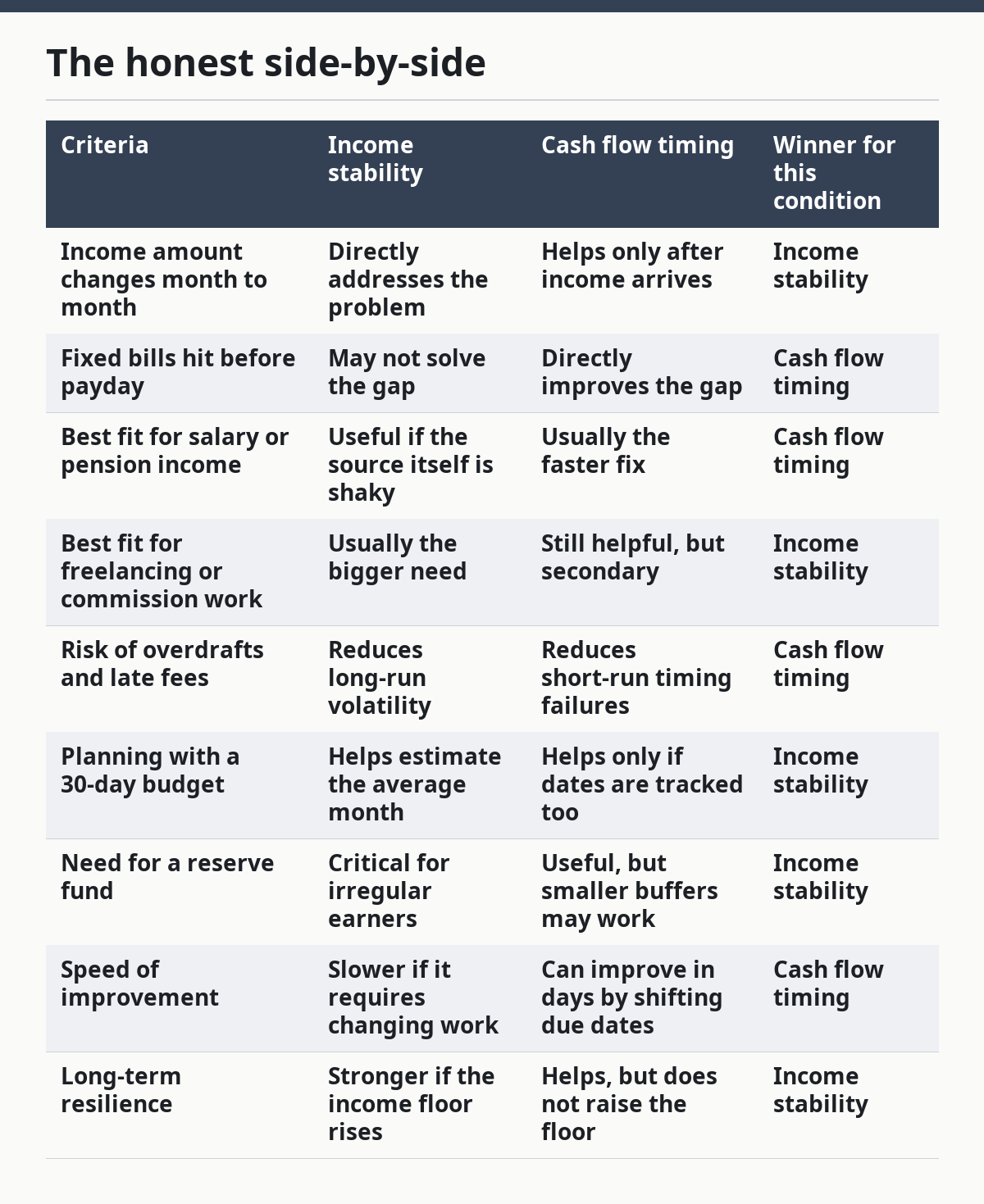
The table points to a practical rule: if the issue is a mismatch between paydays and due dates, fix timing first. If the issue is that income itself is unpredictable, fix stability first. In many real households, timing is the quicker win and stability is the deeper problem.
Which one should you prioritize first?
Prioritize cash flow timing first if your income is steady and your balance drops because bills are bunched together. Prioritize income stability first if your pay swings enough that next month is hard to predict. If both are broken, start with timing only if it will immediately stop late fees; otherwise build stability and reserves first.
That is the cleanest call because timing fixes are usually faster. A due-date change, a split deposit, or a 2-account setup can improve a bad month without changing your job. But those fixes work best when the underlying income floor is already solid enough to support them.
Income stability should come first when the monthly average is deceptive. A freelancer who has one strong month and two weak months does not need a prettier calendar; they need a more predictable revenue base. That might mean retainers, fewer clients with better payment terms, or a stronger reserve so weak months do not force bad decisions.
The wrong move is to ignore one problem while treating the other as the whole story, and if the situation feels complicated, consult a financial professional or another trusted adviser. A person with unstable income and perfect bill timing still needs a buffer. A person with stable income and poor timing still needs a date map. Both may need to move money between accounts, but for different reasons.
A practical rule of thumb: if you can solve the next 30 days with scheduling changes alone, start there. If you cannot, your income base is too thin or too erratic to rely on timing alone.
When the usual advice stops working
The usual advice stops working when the budget is already lean, the income pattern is irregular, or the fees are eating the margin. At that point, the fix is not another app; it is a structural change.
Here are the main exception scenarios where the overall verdict flips:
-
Your income is stable, but one annual bill causes the damage.
In that case, the issue is not income stability or ordinary cash flow timing. It is sinking-fund timing. A car insurance premium, property tax bill, or school fee can create a one-time cliff that needs a dedicated monthly reserve. -
Your income is irregular, but every bill is flexible.
If rent, loan payments, and utilities are all date-adjustable, timing may be enough for a while. That does not eliminate income instability, but it can prevent the worst short-term damage while you build a reserve. -
You are using credit to bridge ordinary gaps every month.
That means neither problem is being solved well enough. At that point, the household needs a spending reset, a higher income floor, or both. A timing tweak alone will just move the debt from one statement cycle to the next. -
Your income is stable but delayed by invoicing or payroll lag.
A professional on net-30 terms can look “stable” on paper while feeling broke for half the month. That is still a cash-flow timing issue, even though the earnings are regular.
Those exceptions matter because the usual guidance does not fit every household, and if the situation is unusually tight, it is wise to consult a financial professional before making major changes. The trade-off is that exception handling is slower and less convenient. Sinking funds, reserve accounts, and payment-date negotiations take effort. But those tools are real fixes, not cosmetic ones.
The Verdict: which one to choose and why
Choose cash flow timing if your income is predictable but your bills arrive in the wrong order. Choose income stability if your earnings swing enough that you cannot plan the next month with confidence. Neither if your income is structurally too low to cover basic costs even after timing fixes and a reserve.
That verdict is strict because the wrong priority wastes time. A fixed-salary worker does not need to obsess over “more stability” if the real issue is rent due three days before payday. A freelancer with lumpy revenue does not need a prettier bill calendar if the actual problem is that the money itself is unreliable.
If the reader wants the shortest path to less stress, start with timing. If the reader wants the deeper fix, build stability. The best households often need both, but they do not need them in equal doses at the same moment.
What should I do this week if money keeps missing the date?
Start by listing every inflow and every bill by exact date for the next 30 days. Then identify the first date the balance goes negative or uncomfortably low. That single date tells you whether the problem is a payment-calendar mismatch or an income gap.
If the gap is only a few days, call the billers and ask to move due dates. If the gap is larger or repeats every month, build a working buffer and push for more predictable income terms. A 30-minute calendar review can reveal the real problem faster than a month of guesswork.
Is a monthly budget enough to solve this?
A monthly budget is not enough if the cash arrives and leaves on different dates. It helps with totals, but it misses the order of events, which is often the real problem.
A budget becomes useful only when it is paired with a cash-flow calendar. The month tells you whether the numbers work; the calendar tells you whether the timing works. Most financial stress lives in the second layer.
Do I need an emergency fund or a cash buffer?
You usually need both, but they serve different jobs. An emergency fund handles true shocks like job loss, repair bills, or medical expenses. A cash buffer handles ordinary timing gaps between payday and bills.
If your problem is getting through the week before a paycheck lands, a smaller checking buffer may help more than a classic emergency fund alone. If your income is irregular, a larger reserve matters because it covers both timing gaps and weak months.
Which is harder to fix, income stability or cash flow timing?
Income stability is usually harder to fix because it often requires changing the income source itself. That can mean a new role, new clients, better payment terms, or a bigger reserve.
Cash flow timing is usually faster to improve because due dates, transfer timing, and account structure can change in days. The catch is that timing fixes only go so far if the income floor is unstable.
Related reading
- How to build a monthly budget
- Emergency fund guide
- How to change bill due dates
- Overdraft fees explained
Drafted with AI; not yet reviewed by a person.