Last updated: November 18, 2026
Key Takeaways
- Protect housing, utilities, and key income-related bills first.
- Stabilize the next 72 hours, cover essentials, then rebuild the month in 3 days.
- Replace the old plan with a one-page catch-up plan for the rest of this month.
- Bills with immediate penalties or daily-life consequences usually come before lower-risk debts.
A budget recovery plan can help you get back on budget after a bad month as a single parent because it tells you what to pay first, what can wait 30 days, and how to stop one rough stretch from turning into three. The goal is not to rebuild a perfect budget system tonight; it is to steady the month you are in and protect the basics.
What to pay first after a bad money month

Pay the bills that keep the lights on, the roof over your head, and your credit from getting hit again. That usually means housing, utilities, child care, insurance, transportation to work, and the minimum payments that protect you from late fees and overdraft fees.
If money is tight, the order matters more than the total. A rent payment that is 3 days late can trigger a late fee or a notice you do not want to manage while parenting and working. A missed minimum payment on a credit card can create a fee and a higher interest rate on the balance. A car payment that slips can make commuting harder tomorrow.
This is the moment to get specific. List every bill due in the next 14 days, then mark each one as:
- must pay now
- can be paid on a later date this month
- can wait until next month without penalty
That simple triage is the heart of a recovery plan. If a bill has a grace period, use it only if you know the real due date and the last day the payment can arrive without a fee. If a creditor offers a one-time extension, consider it only when it prevents a worse problem, such as a bounced payment or a utility shutoff, and check with a nonprofit credit counselor or financial professional if you are unsure; the Consumer Financial Protection Bureau explains that asking for help early can improve options.
One thing this page is not for: long-term debt strategy. This is not the place to compare payoff methods or redesign your entire money system. It is for damage control after a bad month.
How do I recover after overspending?
Because overspending usually shows up as a short-term cash problem, recover by stopping the leak, covering essentials, and rebuilding the month in 3 days, not 30. The first job is not “make up for everything”; it is to keep the next 2 weeks stable.
Use this sequence:
- Freeze nonessential spending for 72 hours. Pause restaurant orders, delivery apps, subscriptions you can cancel in under 5 minutes, and any store run that is not for a real household need. The result is breathing room before more money leaves.
- Check your current balance and pending transactions. Use your bank app, not memory. Pending card charges and automatic payments can make a “safe” balance disappear fast, especially after a weekend or holiday.
- List every essential bill due before your next paycheck. Include the minimum payments, transit costs, groceries, and child-related expenses that cannot move. The result is a short, usable priority list.
- Pay the bills that cause the biggest penalty if missed. Rent, utilities, car payments, and minimum payments usually belong here. The goal is to avoid late fees, shutoff risk, and extra interest.
- Set a 7-day cap for the rest of the week. Choose one number you can actually live with for food, gas, and small household costs until the next payday. A weekly cap is easier to hold than a vague “be careful” rule.
- Move any spare cash into a sinking fund only after essentials are covered. If you have a car repair, school fee, or annual expense coming in the next 60 days, set aside a small amount now so the next surprise does not become another bad month.
- Write down the trigger that caused the overspend. A birthday, school event, grocery stock-up, or bill timing problem is not a moral failure; it is a pattern to track so next month can be smaller, clearer, and less reactive.
The biggest mistake here is trying to “catch up” by starving the household for the rest of the month. That usually leads to a second overspend. A tighter 7-day plan beats a harsh 30-day promise you cannot keep.
Reset the budget without pretending the month never happened

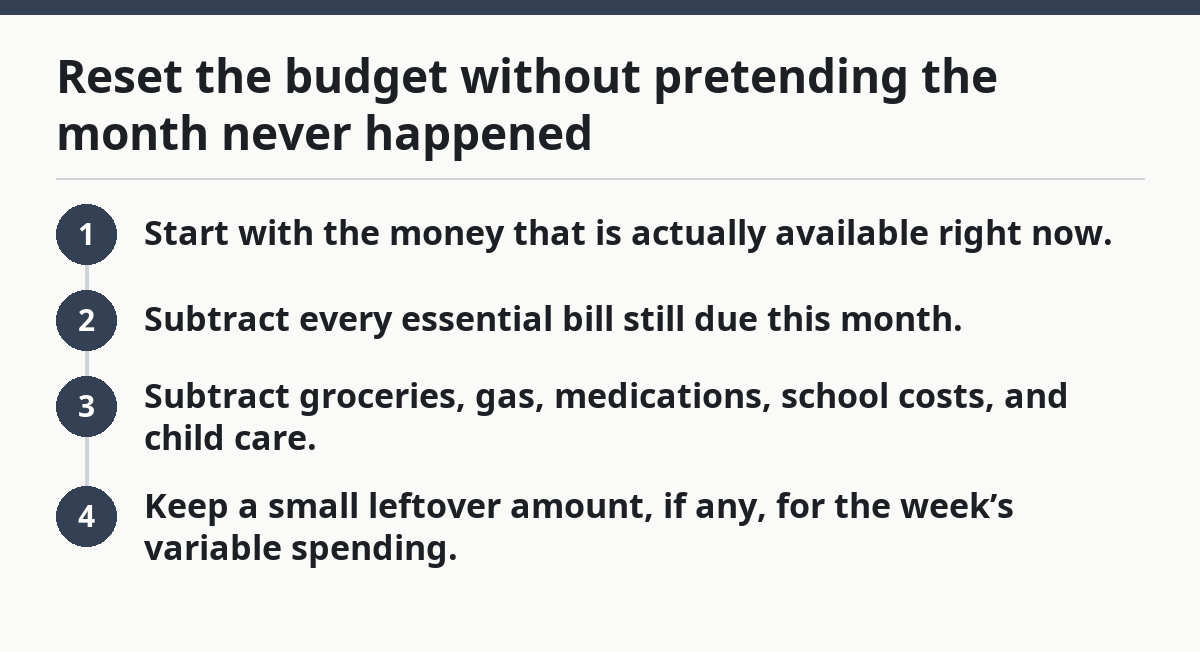
Once the spending leak is under control, reset the budget by replacing the old plan with a one-page catch-up plan for the rest of this month. Do not force last month’s numbers to fit a month that already changed.
A practical reset has 4 parts: current balance, bills left, money left, and the next paycheck date. Write those on paper or in a notes app. Then rebuild the month from today forward.
A simple method:
- Start with the money that is actually available right now.
- Subtract every essential bill still due this month.
- Subtract groceries, gas, medications, school costs, and child care.
- Keep a small leftover amount, if any, for the week’s variable spending.
That leftover amount is not free money. It is the buffer for the one thing that often appears after a rough month: a field trip envelope, a prescription refill, a school supply request, or a gas price jump. If the leftover is zero, the plan is still valid. It just means the next few days need stricter choices.
This is also where a single parent needs to ignore the fantasy of “perfect catch-up.” You do not need to restore every sinking fund this month. You need to prevent new damage. If the car registration sinking fund gets nothing this cycle, that is a trade-off. It is better than missing rent to chase a full reset.
A useful check: if your reset plan cannot be written in 10 minutes, it is too complicated for a recovery month. Strip it down until it fits one page.
For a broader plan that helps keep income swings from wrecking the whole month, the hub on Single Parent Income Stability belongs here, not after the damage has already spread. For budgeting basics and debt-management guidance, the Consumer Financial Protection Bureau budgeting tools can help you pressure-test the numbers.
Which bills can wait, and which ones cannot?
Because the reset is only useful if the right bills stay current, bills that create immediate penalties or disrupt daily life usually cannot wait; bills with lower consequences often can. The job is to delay pain, not create it somewhere else.
In general:
- Must pay now: rent or mortgage, utilities near shutoff, child care that keeps you working, car payment if the vehicle is needed for income, and minimum debt payments.
- Can often wait a little: medical bills in collections, nonessential subscriptions, some store accounts, and discretionary spending.
- Can be reduced instead of skipped: groceries, gasoline, household supplies, and school-related extras.
This is where honesty matters. A bill that feels “small” may still be expensive if it triggers late fees or a service interruption. A $25 minimum payment may look tiny on the page, but missing it can still cost more than paying it on time. On the other hand, paying an old medical bill before housing is usually the wrong move if the lender is not threatening your daily stability.
If you need to contact a creditor, keep the conversation short and direct. Ask for:
- the due date
- the fee for paying late
- whether a payment arrangement is available
- whether one payment can be moved 7 to 14 days
Some companies will cooperate; some will not. The point is not to negotiate every line item. The point is to protect the essentials while keeping penalties as low as possible. The Federal Trade Commission also advises consumers to confirm payment terms in writing when possible, which can reduce confusion later.
One caution: if a bill is tied to housing, utilities, or transportation, do not push it aside just because another account is louder on the phone. Loud collections are not always urgent collections, and the loudest caller is not always the one that affects tomorrow morning.
How to catch up without wrecking next month
Once you know which bills can wait, catch up by using the next 1 or 2 paychecks to repair the damage in small pieces, not by draining the next month before it starts. A recovery plan fails when every extra dollar is used to “fix” last month and none is left for this one.
Split any extra money into 3 buckets:
- current essentials that are still unpaid
- overdue balances that can be cleared without creating a new shortfall
- a small sinking fund for the next expected expense
That last bucket matters. If you ignore sinking funds after a bad month, the same category of surprise will hit again. Even setting aside a modest amount for car maintenance, school costs, or annual bills can stop the next emergency from becoming a repeat event.
Here is the trade-off: paying down every overdue balance quickly feels satisfying, but it can leave you exposed to the next grocery run or utility bill. A slower catch-up is less dramatic and usually safer. For a single parent, safer often wins.
Use a 30-day rule for nonessential purchases during the recovery month. If something is not needed for health, work, transportation, or the child’s day-to-day routine, wait 30 days before buying it. Many wants cool off. A few remain real. That pause protects cash without requiring willpower every hour.
If you get paid weekly, review the plan every Friday for 10 minutes. If you get paid every 2 weeks, do it on payday and again mid-cycle. Small check-ins keep the budget from drifting back into guesswork.
For budgeting basics, the National Foundation for Credit Counseling and the Consumer Financial Protection Bureau both have practical budgeting and debt-payment guidance worth reviewing, especially if you need a second set of eyes on your numbers. The Budgeting Basics guide and Debt Management page can also help you compare next steps without starting from scratch.
Mistakes that make a bad month worse
The fastest way to stay stuck is to confuse punishment with recovery. Skipping meals, ignoring bills, or trying to “make it up” with one giant paycheck fix usually costs more later.
The common mistakes are simple:
- paying every overdue bill a little and none of them enough
- emptying the checking account to feel caught up
- using a credit card for routine spending without a repayment plan
- forgetting about pending charges and automatic drafts
- cutting groceries so hard that you trigger a bigger overspend next week
Each mistake has a cost. Partial payments can still leave late fees in place. Emptying the account can cause overdraft fees. Swiping for basics without a cap can move the problem from this month to next month. Ignoring automatic drafts can make a “safe” balance vanish overnight.
What to do instead is less dramatic and more effective:
- pay the bills that hurt the most if missed
- keep a small checking cushion if possible
- use cash or a fixed card limit for groceries and gas
- check pending transactions before making a new plan
- keep food spending realistic enough to last the month
This is also the point where a bad month can feel personal. It is not. A single parent often has more timing problems than a married two-income household: fewer hands, fewer backup options, and more expenses tied to one paycheck. The fix is not shame. The fix is sequence.
If bills are so far behind that you cannot cover housing, utilities, or child care without choosing between them, contact the creditor or a nonprofit credit counselor before the next payment date. That is a financial risk moment, not a moral failure. The credit counseling resource can help you decide whether a payment plan or a hardship call makes sense.
What to keep doing for the next 30 days
Keep doing a 10-minute money check every week until the month stops feeling shaky. That short routine is enough to catch small problems before they become another bad month.
Each week, check 5 things:
- bank balance
- pending transactions
- bills due in the next 14 days
- any sinking fund that needs a small refill
- whether the food and gas budget still matches reality
If the plan broke, adjust it on the spot. Do not wait for the next month to “fix itself.” Most recovery plans fail because the numbers are treated like a verdict instead of a draft. They are a draft.
A good recovery month still has limits. You may not be able to save much. You may need to pause extra debt payments. You may need to say no to one thing your child wants. That is not ideal, but it is workable. The real goal is a steady month with no new fees, no surprise overdrafts, and no second emergency layered on top of the first.
Frequently asked questions
How do I recover after overspending?
Recover by stopping new nonessential spending, checking your real bank balance, and paying the bills that can create fees first. Then build a short catch-up plan for the rest of the month. The goal is not to erase every mistake at once; it is to prevent more damage over the next 7 to 14 days.
What should I do first after a bad money month?
Do the bills first. Start with rent, utilities, child care, transportation, and minimum payments that protect you from late fees or service problems. After that, look at groceries, gas, and any sinking funds. A clear payment order is more useful than trying to “fix” the whole budget in one sitting.
How do I restart my budget without starting over?
Restart it from today, not from the first of the month. Use the money you still have, list the bills still due, and rebuild the next 1 to 2 weeks only. Keep the same broad categories if they still work, but change the numbers to match reality. A budget reset is a repair job, not a reset button.
Drafted with AI; not yet reviewed by a person.