Last updated: November 19, 2026
Key Takeaways
- Keep essentials covered while you wait for the deposit.
- Sort bills into three groups: before deposit, can wait, and must be paid now.
- A minimum support reserve helps you avoid starting at zero each month.
- Use partial support payments on the most urgent bill first.
Child support payment timing can leave you covering bills before the money hits. Quick answer: plan for the gap with a small reserve, bill timing, and partial payments. If you are looking for How to Plan for a Gap Between Child Support Deposits as a Single Parent, the steps below show how to keep the bank balance steadier when support deposits arrive late or on a different schedule.
What to do when child support deposits do not line up with bills
Picture this: your rent is due on the 1st, the electric bill is due on the 12th, and the child support deposit lands on the 15th. You still have to keep the lights on and food in the house, even if the support payments show up later than you expected.
The fix is to treat the gap like a regular bill of its own — not like a surprise, and if you are unsure what counts as safe timing, consult a financial professional. That means mapping due dates, setting a minimum support reserve, and deciding which bills can wait 3 to 7 days without penalty. The truth is, a plan for child support deposit timing works best when it is plain and boring.
- Write down every due date.
- Mark the support deposit day.
- Circle the bills that can be delayed.
- Cover the first week first.
Then use that map to build your month around the money that arrives first, and keep the plan visible so the timing does not catch you off guard. For more on budgeting and cash flow timing, see the CFPB’s budgeting guidance and Income and Expenses page, plus USA.gov’s child support overview.
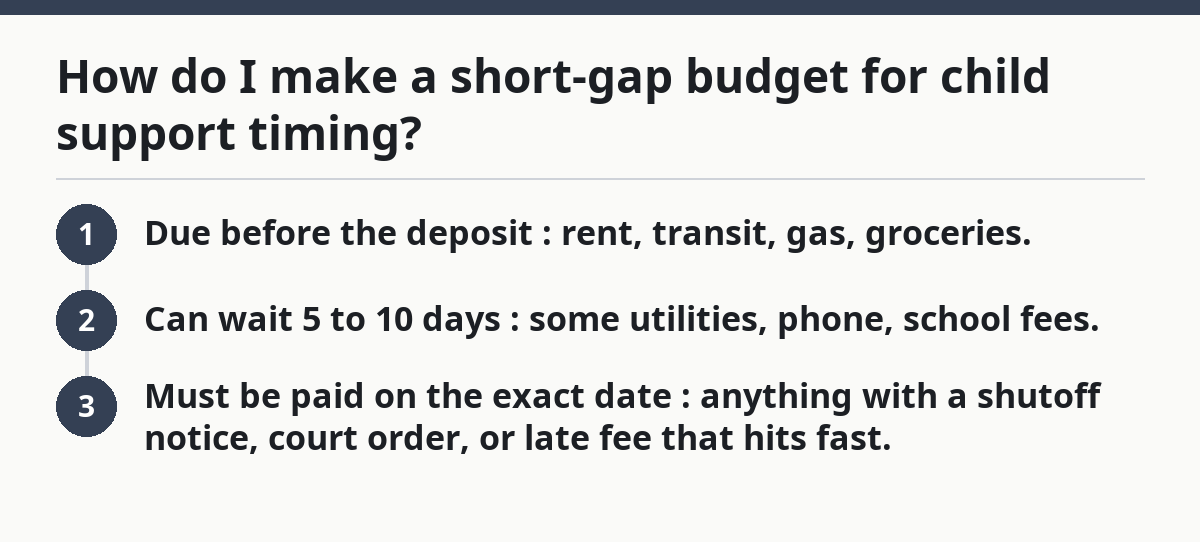
How do I make a short-gap budget for child support timing?
You make a short-gap budget by separating “must pay now” from “can wait until the deposit clears.” Start with a 30-day view, then cut it into two parts: the days before support arrives and the days after it arrives.
A simple way to do this is to sort bills into three piles:
- Due before the deposit: rent, transit, gas, groceries.
- Can wait 5 to 10 days: some utilities, phone, school fees.
- Must be paid on the exact date: anything with a shutoff notice, court order, or late fee that hits fast.
That gives you a working plan instead of a hope. If your support deposit usually arrives on the 10th but bills hit on the 1st, then the 1st-to-9th window is the problem you are solving.
Use one worksheet or one note on your phone and list:
- the bill name,
- the due date,
- the amount,
- whether a partial payment is accepted,
- the latest safe payment date.
This is the part most generic advice skips. It tells you to “budget better” and leaves out the timing issue. Timing is the issue, and a clear worksheet helps make that timing visible. For a broader cash-flow framework, the CFPB budgeting page is a useful reference, and the U.S. Department of Health & Human Services child support overview explains how support systems are administered.
Build a minimum support reserve before the gap hits
A minimum support reserve is the small cushion that keeps you from starting at zero every month. Even $25 to $100 set aside from support or other income can buy time when a deposit lands late by a few days.
Here’s the catch: this reserve is not your emergency fund. It is your timing buffer. Its job is to cover the gap between when bills are due and when child support clears, not to handle a broken transmission or a hospital bill.
Use this reserve for:
- groceries for 3 to 5 days,
- a utility bill that can’t slide,
- a school charge that would trigger a penalty,
- a transit pass if it keeps work trips moving.
Keep it in the same bank where you can see the bank balance fast, or in a separate savings account if your bank lets transfers move quickly. If you keep it mixed into daily spending, it disappears.
A reserve also changes how you handle partial payments. Instead of waiting for the full support deposit, you can pay the most urgent bill first and hold the rest for the next due date.
How to use partial support payments without falling behind
You use partial support payments by applying them to the highest-risk bill first, not by spreading them thin across everything. That keeps one account from going overdue while you wait for the rest of the deposit, and if the payment order feels uncertain, a financial professional can help you sort it out.
Partial deposits can still help a lot if you assign them on purpose. A $50 deposit on Monday and another $150 on Friday can mean the difference between a paid utility bill and a shutoff notice.
Try this order:
- cover rent or housing first if a late fee is large,
- cover utilities next if shutoff rules are strict,
- cover transportation so you can keep earning,
- then fill in food and school costs.
If the support payment comes in pieces, write the pieces down. Track the date, amount, and what you used it for. A simple notebook is enough. You are not trying to be perfect; you are trying to keep the money from drifting away in small spends.
A common mistake is spending a partial deposit on groceries, snacks, or fast fixes before you touch the account that will charge a fee tomorrow. That can cost more than the item felt worth. Pay the bill that gets expensive fastest, or check with your bank or a financial professional if the timing is unclear.
A 3-step way to cover the gap
- List the next 14 days of bills. Use the actual due dates and amounts, not guesses. The result is a short map of pressure points.
- Assign the first deposit to one bill. Put it on the bill with the biggest late fee, shutoff risk, or penalty. The result is one less problem rolling forward.
- Hold the rest in reserve. Leave the remaining support money untouched until the next bill window opens. The result is a smaller risk of running dry before the month ends.
What bills should be covered before child support arrives?
You should cover the bills that create the biggest penalty first, even if they are not the largest amounts. A $40 utility late fee can hurt more than a $20 grocery shortfall because the utility bill can snowball.
Start with the bills that keep the house running:
- housing,
- heat or cooling,
- water,
- electricity,
- transit for work,
- medicine or childcare tied to work hours.
Then look at due dates that fall before the support payment. If the child support deposit is late by 4 days, the bill due on day 2 is the one that needs the most protection.
This is also where people make a costly mistake: they try to keep every bill perfectly current and end up short on cash for the first 10 days of the month. That usually leads to overdrafts or card balances. Better to protect the bills with the harshest penalties and let the less urgent ones wait briefly.
If a bill allows a 7-day grace period, use it carefully and write down the new date. If it does not, move it to the front of the line.
How do I handle deposit delays from child support?
You handle deposit delays by assuming they can happen and setting a default backup plan before they do. Child support payment timing can shift because of the bank, the payment method, weekends, holidays, or processing delays.
The honest move is to build a rule for yourself:
- if the deposit is one day late, use the reserve;
- if it is 3 days late, pause nonessential spending;
- if it is a week late, contact the child support office or the payment service that handles the transfer.
Keep the call short and factual. Have the date, amount, and case or payment reference ready. That makes it easier to ask whether the payment was sent, received, or held up in processing.
Also check the bank balance before you spend from pending money. A pending transfer is not the same as money you can count on. If you treat it like cash too early, you can overdraw the account, so it is wise to confirm availability with your bank or a financial professional.
The mistake here is waiting until you are already short. That turns a timing problem into a full-budget problem. A backup plan works best when it is written down on a 3×5 card or in your notes app, not remembered under stress.
Common mistakes that make the gap worse
You make the gap worse when you spend support as if every deposit will arrive on the same day. A gap between deposits is not a one-off glitch; it is a pattern to plan around.
The biggest mistakes are usually these:
- using the full deposit in the first 48 hours,
- paying flexible bills before fixed ones,
- assuming a partial deposit means the rest will arrive the same day,
- forgetting to save the due dates for the next cycle.
Each one has a cost. The first drains the reserve. The second can trigger fees. The third leaves you short on a bill that still waits. The fourth repeats the same scramble next month.
Use a simple rule instead:
- first 48 hours: cover due bills,
- next 7 days: protect essentials,
- after that: refill the reserve.
That rule is plain enough to follow on a tired day. It also stops child support from disappearing into small purchases that do not solve the timing gap.
One more thing: do not build the month around money that has not cleared yet. That is how a small delay becomes a rent problem.
What a steady month looks like with support deposits
A steady month starts with a reserve, a bill list, and a clear order for the first deposit. It does not require a perfect balance or a fancy app.
Picture this: you know rent is due on the 1st, groceries on the 3rd, and child support usually lands on the 8th. You move the reserve to cover the first week, pay the most dangerous bills first, and let the rest wait. That is how the plan works in real life.
A simple monthly rhythm can look like this:
- week 1: cover essentials and track the bank balance daily,
- week 2: use the deposit, pay the urgent bills, refill the reserve,
- week 3: hold spending steady,
- week 4: prepare for the next gap.
That rhythm is not flashy. It is practical.
The key is to stop treating child support as money that belongs to the same day it was scheduled for, and if the schedule or payment method is unclear, consult a financial professional or your child support office. The deposit date is useful, but the due dates on your bills are what control your week.
FAQ
What if child support comes late?
Use your reserve first. If the payment is late by a day or two, pay the bill that charges the fastest penalty and delay the bills that have a little room, but check the terms and consult the agency or a financial professional if the late-fee rules are unclear. If the delay keeps happening, document the dates and contact the agency or payment service that handles the support payments.
How do I budget when child support is uneven?
You budget around the timing gap, not the hope that every deposit will arrive on time. Start with the bills that come before the support deposit, keep a small reserve, and use partial payments on urgent bills first. That keeps your bank balance from swinging too hard between deposits.
Drafted with AI; not yet reviewed by a person.