
Last updated: November 18, 2026
Child support income in How to Budget for Variable Child Support Payment as a Single Parent should be treated as money that may arrive on time, late, partial, or not at all in a given month, and the U.S. Office of Child Support Enforcement advises parents to plan around actual payment patterns rather than assuming perfect timing. Quick answer: base your budget on $0 child support, then treat any payment as extra until it clears. The safest approach is usually to build your plan around a steady baseline and use child support as a flexible layer on top.
Start with an income baseline you can actually trust
Your income baseline is the amount you can cover without child support, and it is the number that keeps the rest of the budget from collapsing. If child support is sometimes $400 and sometimes $0, the budget should not assume $400 every month just because the court order says that amount.
Begin with the money that is most predictable: wages, benefits, tax credits you receive regularly, or other fixed support that does not swing month to month. Put child support in a separate line called “variable child support income,” or a similar label that reminds you it can change. That label matters because it changes how you spend it.
A simple rule works better than wishful thinking: build the monthly plan on the lowest dependable amount you can expect to have for the next 30 days. If your fixed income covers rent, utilities, groceries, and transportation, then child support becomes the money that fills gaps, funds savings, or pays down debt. If your fixed income does not cover essentials, the budget needs to be trimmed before the next month starts.
This is the point where many single parents get trapped. They count the court order as if it were a paycheck, then a missed or late payment forces credit card use, overdrafts, or skipped bills. The cost is not just stress; it is momentum. One missed payment can turn into a cascade of fees.
A better baseline has three parts:
- Essential bills: housing, utilities, food, child care, transportation, medicine.
- Minimum debt payments: only the amount needed to stay current.
- Small cushion: even $25 or $50 set aside when support arrives can reduce the damage from volatility.
The child support amount in the court order still matters. It tells you what should be paid and what your arrears planning may need to recover. It should not be treated as guaranteed cash in the weekly budget.
For a related framework, see the single-parent budget foundations guide and how to build a zero-based budget.
How should I budget around child support that changes every month?

You should budget around child support by splitting it into two parts: the amount you expect from the court order and the amount you can safely spend only after it lands. That keeps you from building a plan on money that has not cleared yet.
Here is the core method:
- Write down the court order amount and the average timing. If the order says $300 on the 1st and the payment often arrives on the 8th, treat that gap as part of the system, not a surprise.
- Make a no-child-support version of your monthly budget. Cover rent, utilities, food, transportation, child care, and minimum debt payments first. If the budget does not work without child support, cut a line item before spending a support dollar.
- Create a “received” line and an “expected” line. Expected money is only planning data. Received money is money you may spend.
- Assign the first child support dollars to the most exposed bill. That might be groceries, a utility bill, or the balance on a past-due account.
- Move any extra payment into a buffer account or savings envelope. Even one extra $100 payment can help cover a future shortfall.
- Review the budget once a month, not every time anxiety spikes. Monthly review is enough to notice patterns without rewriting the plan every 48 hours.
The result should be a budget that still works if support is late or smaller than expected. That is the whole point. Child support can improve the month, but it should not be the reason the month survives.
This approach is not for anyone trying to use child support as if it were fixed salary. If the money is volatile, the budget has to be more conservative than your emotions want it to be.
For a broader money framework, this sits inside the single-parent budget foundations approach: start with the bills that must be paid, then build outward. If you are also managing debt, the debt snowball vs. avalanche comparison can help you decide where extra support should go first.
Separate expected support from extra payments before you spend a dollar
Separate expected support from extra payments because they solve different problems and disappear at different speeds. The court order is the expected amount; anything above that is extra and should not be absorbed into routine spending.
Use three buckets if you can:
- Bucket 1: expected child support
- Bucket 2: extra child support payments
- Bucket 3: arrears catch-up or cushion
Bucket 1 is what you plan around on paper. Bucket 2 is the amount that arrives above the baseline, which may happen when a parent pays late, sends a partial catch-up, or covers a special expense. Bucket 3 is where the extra money goes until you decide what it must do.
The reason this matters is simple. If you spend an extra payment the same day it arrives, the next month starts with no protection. If you move it to the cushion first, you give yourself a 2-step buffer: one missed payment is easier to absorb, and a late payment does less damage.
A practical rule is to divide extra support before it hits checking:
- 50% to the budget cushion
- 25% to urgent back bills
- 25% to a child-specific need or debt reduction
That split is not sacred, but the idea is sound: do not let extra support vanish into ordinary spending. A one-time overpayment on groceries is easy to forget; a $200 cushion can protect you for weeks.
The trade-off is obvious. Saving extra support can feel strict when the household is already stretched. But using it as if it were recurring income is worse. The latter creates a false monthly picture and makes next month harder.
If you want a phrase to use at home, use this one: “expected money pays the plan; extra money fixes the plan.” That sentence keeps the categories clean.
Build a budget cushion for late or partial child support

A budget cushion is the money that keeps a late payment from becoming a crisis, and it should sit in a separate account or envelope you do not use for weekly spending. For variable child support, the cushion is not a luxury; it is the structure that makes the plan survivable.
Start small if that is all the budget allows. A cushion of even $100 can cover a utility gap, a tank of gas, or a grocery top-up when support is late. The size matters less than the habit. Put something aside every time money arrives, even if it is only $10.
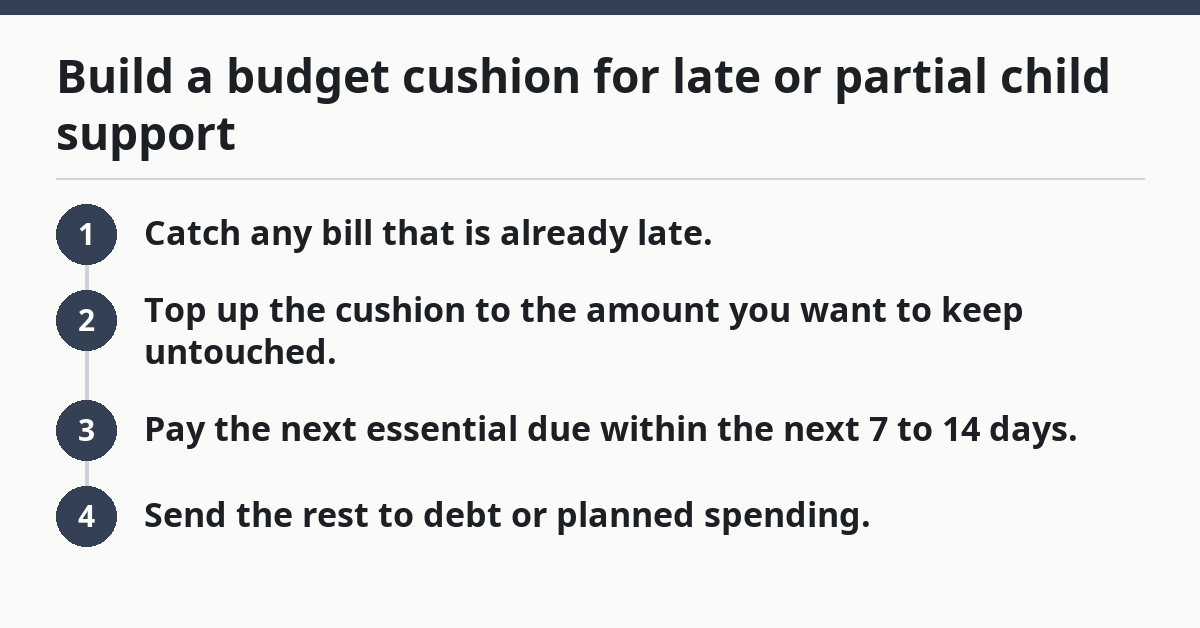
Use a simple order of priority when child support hits:
- Catch any bill that is already late.
- Top up the cushion to the amount you want to keep untouched.
- Pay the next essential due within the next 7 to 14 days.
- Send the rest to debt or planned spending.
If the payment is partial, do not spread it evenly across everything. That is how small amounts disappear without stabilizing anything. Pay the bill that has the harshest consequence first, such as rent or electricity, then move down the list.
A cushion also helps with payment volatility. If support lands on the 3rd one month and the 17th the next, the cushion smooths the timing gap. That lets the rest of the budget stay calendar-based instead of event-based.
One honest limitation: a cushion does not solve a long stretch of nonpayment. If child support is missing for multiple months, the budget may still need emergency help, a temporary cut in nonessentials, or legal follow-up on the court order. The cushion buys time; it does not replace income.
If the support pattern is chaotic, your first goal is not perfection. It is 30 days of stability.
Plan for arrears without counting on them as monthly income
Plan for arrears as recovery money, not as spending money, because arrears are often irregular and may arrive in pieces. If you treat arrears like monthly income, you can end up building obligations around money that is already owed but not yet in hand.
The safest approach is to give arrears their own job before they arrive. Decide in advance what they will do, such as:
- refill the cushion,
- cover a past-due utility,
- pay off a school expense,
- reduce credit card debt,
- fund a child-related need that has been waiting.
That decision removes the pressure to improvise. It also prevents the classic mistake of using arrears to inflate the regular lifestyle budget. Once that happens, the next short month becomes harder than it needed to be.
If the arrears payment is large enough to change the picture, use a 24-hour pause before spending it. You do not need a 10-day committee meeting. You do need one day to sort the money into jobs. A pause keeps the payment from being absorbed by impulse buys or scattered upgrades.
Keep in mind that an arrears payment may not be predictable in timing or size. It can come in a lump sum, a partial amount, or after a long delay. That is why the budget should never rely on it for rent, childcare, or other bills due every month.
A practical rule: if you would be in trouble when the arrears do not arrive, the plan is too dependent on them. Arrears should improve the budget, not hold it together.
For child support questions that involve enforcement or the court order itself, a lawyer or local child-support office may be the right source. Financial planning can organize the money you receive, but it cannot fix a payment that has not arrived.
Common budgeting mistakes that make child support volatility worse
The biggest mistake is counting child support as if it were guaranteed salary, and the cost is usually overdrafts, late fees, and panic spending. The fix is to budget from your baseline income and treat every support payment as conditional until it clears.
Another common mistake is using the full payment as soon as it arrives. That feels efficient, but it leaves no room for a payment delay of 5 or 10 days. The better move is to assign the money in stages: essentials first, cushion second, extras last.
A third mistake is spreading a partial payment across too many bills. If you put $40 on four different problems, you may solve none of them. One bill paid down enough to stop a shutoff or late fee is usually better than a symbolic payment everywhere.
A fourth mistake is failing to track the actual payment pattern. If the court order says one amount but the real pattern is smaller or later, the budget has to reflect the real pattern, not the hoped-for one. A basic monthly note in your phone is enough: amount, date received, and whether it was full, partial, or late.
The last mistake is skipping the cushion because the month feels tight. That decision often creates a larger problem later. Even a tiny reserve matters because it changes how many missed-payment days you can survive without borrowing.
Who this method is not for: anyone who insists on budgeting child support as fixed monthly income no matter what the payment history says. If the numbers are volatile, the budget has to admit it.
For rules and definitions around child support and enforcement, a government child-support agency page or a family-law professional association page can be useful reference points. The budget itself still has to be built around the real cash flow.
For more context, see the child support enforcement basics page and how to make a monthly budget.
Keep the budget honest with a simple monthly review
A monthly review keeps the budget honest by comparing the court order, the amount received, and the bills that actually got paid. Without that check, child support volatility can hide in the numbers for months.
Use a 15-minute review at the same point each month, such as the last Sunday or the first payday after rent clears. Write down four things:
- what the court order says,
- what arrived,
- how many days late it was,
- what expense had to wait because of the gap.
That review tells you whether the cushion is big enough. It also shows whether the budget is too tight in one category, like groceries or transportation. A repeated shortfall is not a character flaw; it is a signal that the plan needs revision.
If the gap between expected and received support keeps widening, lower the expected amount in your budget immediately. Do not keep the old number because it “should” arrive. A budget that refuses to update is just a wish list with due dates.
This review also helps with judgment calls. If extra support arrived three months in a row, you may be tempted to raise spending. Wait. Three months is a pattern, but it is not proof of stability if the court order and payment history still swing. A safer move is to keep living on the baseline and use the extra money to strengthen the cushion.
The goal is not to squeeze every last dollar into a spreadsheet. The goal is to make sure the spreadsheet matches the child support income that actually lands in the account.
Key Takeaways
- Build the budget on income that is already dependable, not on the highest payment you hope to receive.
- Treat the court order as a target, not a guarantee.
- Put extra payments in a separate job before they disappear into routine spending.
- Keep a small cushion so a late or partial payment does not trigger fees or borrowing.
- Review the pattern once a month and lower the expected amount if reality keeps missing it.
How do I budget when child support changes every month?
Budget with the lowest dependable amount, then treat anything above that as extra. That keeps rent, food, and utilities from depending on money that may arrive late or in a smaller amount. A monthly review helps you reset the numbers instead of chasing each change as it happens.
Should I count child support as guaranteed income?
No, not if the payment history shows delays, partial amounts, or missed months. The court order says what should happen, but your budget should reflect what actually lands in the account. Count it as expected income only after you have a baseline that works without it.
How do I plan for late child support payments?
Use a cushion and pay the next most urgent bill first when support arrives. A small reserve of even $100 can bridge a timing gap and keep late fees from piling up. If late payments are frequent, lower the expected support line in your budget and rely on the real pattern instead of the order alone.
Drafted with AI; not yet reviewed by a person.