
Last updated: November 18, 2026
Key Takeaways
- Single-parent budgeting often means one income, one decision-maker, and less room for timing mistakes.
- Spreadsheets offer control, apps offer speed, and envelopes help enforce firm spending limits.
- Budget from the lowest dependable income, then give extra money a job after essentials are covered.
- Begin with fixed bills, then child-related irregular costs, then lifestyle spending.
Budgeting as a single parent works best when you use one simple system to track every dollar, protect the bills that cannot slip, and build a small buffer for the weeks that go sideways. In this Tools and Methods for Budgeting as a Single Parent — The Complete Guide, the right tools are the ones that make that process easy to keep doing on a tired day, not the ones with the most features.
This is information, not financial advice. A qualified financial adviser should be consulted for your own situation, because tax rules, benefits, debt rules, and account features differ by country and change over time. For general budgeting guidance, see Consumer Financial Protection Bureau resources and MoneyHelper guidance. For debt and money-management support, consult local official sources such as the CFPB and MoneyHelper.
Single-parent budgeting is mostly a question of fit: spreadsheet if you want control and low cost, app if you want speed and automatic tracking, and cash-envelope or sinking-fund methods if your spending gets blurry between paydays. The best choice often depends on how variable your income is, how many bills you juggle, and how much time you can realistically spend each week.
The one question this guide answers

The answer is: use a budgeting system that matches your income pattern and your attention budget, then build it around bills, essentials, and a small emergency buffer before you worry about anything else.
For a single parent, the problem is rarely “I need more categories.” It is usually “I need a system I can keep up with while handling childcare, school costs, transport, and a schedule that changes every week.” A method that needs 30 minutes a day will fail fast if your day starts before sunrise and ends after bedtime. A method that updates itself with bank feeds can help, but only if it still separates fixed bills from variable spending well enough to catch problems early.
The practical goal is not perfect budgeting. It is visibility. You need to know, by the middle of the month, whether rent, utilities, groceries, transport, and child-related costs still fit inside what is left. That means choosing a tool that shows four things clearly: money coming in, money already committed, money still available, and money that must stay untouched for later bills. A simple spreadsheet, an app with bank connections, or an envelope-style system can all do that. The goal is to reduce day-to-day decision fatigue, not to impress anyone with a complicated setup.
What makes single-parent budgeting different?
Single-parent budgeting is different because there is usually one income stream, one decision-maker, and more timing pressure around every expense.
That combination changes the tools. A household with two incomes can sometimes absorb a late bill or a surprise school fee with a partner’s paycheck. A single-parent household often cannot. That means the budget has to be built around cash-flow timing, not just monthly totals. A “monthly” budget can look fine on paper and still fail on day 12 if school lunches, car fuel, and a utility bill all hit before the next paycheck clears.
This is where many generic budgeting guides get it wrong: they treat every expense as if it is equally flexible. It is not. Rent, childcare, insurance, medication, transport to work, and basic groceries are not optional in the same way a streaming subscription is. A useful budgeting method must separate fixed obligations from variable wants and from seasonal or irregular costs such as uniforms, school trips, holiday care, vehicle servicing, or annual fees. If your situation is complicated, it can help to consult a qualified financial adviser or debt counselor and to use official guidance from sources such as the Consumer Financial Protection Bureau or MoneyHelper.
The most useful tool for a single parent is the one that can do three jobs at once. It must help with planning, show what is safe to spend today, and make irregular expenses visible before they become emergencies. That is why “just track your expenses” is too vague. Tracking is only half the job. The other half is scheduling the money.
A good fit also respects time. If you only get 15 minutes every Sunday night, a method with automated imports and a small number of categories may be better than a detailed manual ledger. If you prefer to see every transaction and reconcile it yourself, a spreadsheet may be the better fit. Neither is universally better. The right choice depends on whether your bigger problem is forgetting, overspending, or not having enough margin in the first place.
Spreadsheet, budgeting app, or cash envelopes?

Spreadsheet wins for control, budgeting app wins for speed, and cash envelopes win when spending needs hard limits.
That is the short version. The longer version is more useful, because the right tool depends on the kind of money leak you are trying to stop. A spreadsheet gives you the most freedom. A budgeting app gives you the least friction. A cash-envelope system gives you the strongest visual boundary. For many single parents, the best answer is not one tool alone but a combination: app for tracking, spreadsheet for planning, and envelopes or sinking funds for categories that regularly blow up.
Spreadsheet budgeting
A spreadsheet is strongest when you need custom categories, irregular income planning, and clear visibility without paying for software.
Its biggest advantage is flexibility. You can build a month around your pay schedule instead of around a generic calendar. You can create separate lines for school fees, after-school care, car repairs, and holiday childcare. You can also change the structure when your life changes, which matters more than it sounds. A budget that cannot adapt after a job shift, custody change, or rent increase is not useful for long.
The trade-off is that a spreadsheet depends on your consistency. If you forget to update it for a week, the numbers can become stale quickly. It also does not warn you automatically when you overspend unless you build those checks in yourself. That means it suits a parent who is comfortable with a weekly review and wants a clear, inexpensive system. It is less suitable if the idea of manual entry makes you stop using it entirely.
Budgeting apps
A budgeting app wins when you need quick visibility and bank-feed automation.
These apps are built to reduce manual work. Many can import transactions from bank accounts and card accounts, then group spending into categories with less typing. That matters when your time is already fragmented. An app can make it easier to see that groceries are running high or that a subscription renewed without warning.
The downside is that automation can create false confidence. Bank feeds are not always instant, transaction categories can be wrong, and some apps make the user work around the app’s design instead of the other way around. Many also use subscription pricing or limit some features behind paywalls. Before choosing one, check whether the app supports your bank, whether it lets you create the categories you actually need, and whether it shows due dates and balances in a way that makes sense for bills. Official consumer guidance from the Consumer Financial Protection Bureau can help you compare features before you commit.
Cash envelopes and sinking funds
Cash envelopes work best for categories that are easy to overspend, while sinking funds help you prepare for known irregular costs.
The envelope method uses physical cash or digital equivalents to cap spending in specific areas. It is blunt, which is exactly why it can help. If groceries, takeout, school snacks, or personal spending keep creeping up, a fixed envelope creates a hard boundary. Once the category is empty, spending stops.
Sinking funds are the quieter version of the same idea. Instead of waiting for a school trip, annual insurance payment, or holiday cost to appear as a crisis, you set money aside gradually for that purpose. This method is one of the most practical tools for single parents because it reduces the shock of irregular bills. The drawback is obvious: it requires discipline and enough margin to save a little before the expense arrives. If every dollar is already spoken for, the method works only after you have trimmed or restructured the budget.
Head-to-head comparison
| Criteria | Spreadsheet | Budgeting app | Winner for this condition |
|---|---|---|---|
| Setup time | Slower at first; you build the structure yourself | Faster if bank connections work well | App, when time is tight |
| Custom categories | Highly customizable | Depends on the app | Spreadsheet, when your costs are unusual |
| Automatic tracking | Usually manual | Often automated through bank feeds | App, for reduced admin |
| Cost control visibility | Very clear if built well | Clear if the interface is good | Spreadsheet, for full transparency |
| Overspending barriers | Soft barriers only unless you check often | Soft barriers only unless alerts are strong | Cash envelopes, for hard limits |
| Irregular income handling | Excellent for planning pay cycles | Good if the app supports buckets or assigned money | Spreadsheet, for variable income |
| Irregular expense planning | Excellent with sinking-fund lines | Good if it supports goal categories | Spreadsheet, for detailed planning |
| Learning curve | Moderate | Low to moderate | App, for beginners |
| Best fit | Parent who wants control and customization | Parent who wants speed and automation | Depends on time and habits |
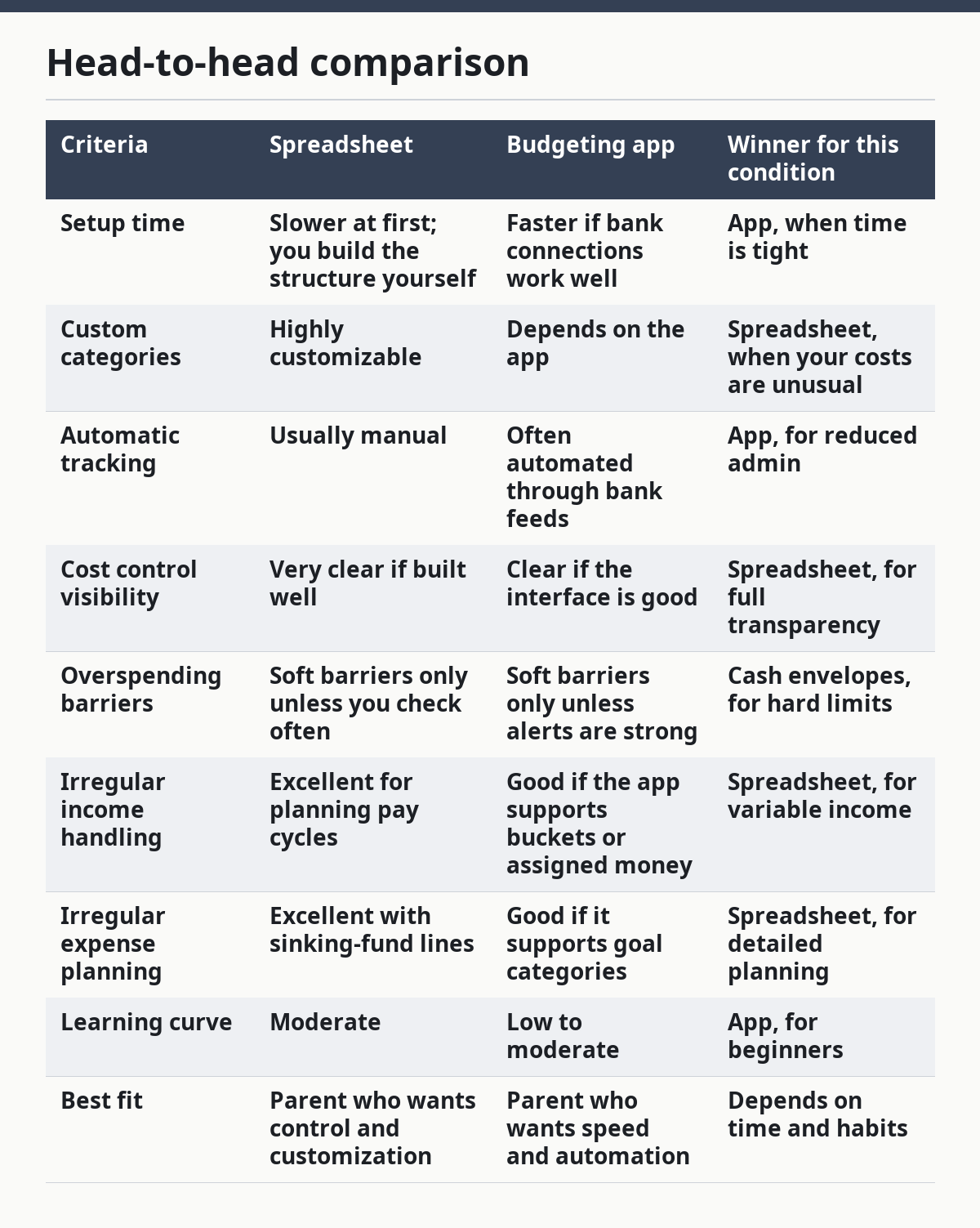
The honest verdict on this comparison is that spreadsheets are more powerful, but apps are easier to stick with. Cash envelopes are the strictest tool, but they only solve part of the problem. If your issue is forgetting, the app is usually better. If your issue is unclear cash flow, the spreadsheet is better. If your issue is overspending in a few categories, envelopes or sinking funds are better than either one alone.
How do you build a budget that survives irregular income?
The answer is to budget by the lowest dependable income you expect, then assign every extra dollar a job only after the essentials are covered.
This is one of the most important adjustments for a single parent with overtime, shift work, gig income, child support that varies, freelance work, or a second job that changes week to week. A budget based on your best month is fragile. A budget based on a realistic low month is harder to live with on paper, but much safer in practice.
Start with the bills that must be paid first: housing, utilities, food, transport, childcare, insurance, minimum debt payments, and any medications or essential services. If your income arrives twice a month, set up your budget by paycheck rather than by calendar month. That makes it easier to match money to due dates. If your income is highly variable, use a “buffer” account or a holding category so that you can smooth the peaks and dips instead of treating every large payment as spendable income. If you are unsure how to set this up, seek guidance from a qualified financial adviser or an official consumer money guide before making major changes.
A spreadsheet is especially useful here because it can show the relationship between due dates and pay dates. That is not just accounting neatness. It tells you whether a bill is really affordable or merely affordable once a month. Many households discover that the problem is timing, not total income. A bill due three days before payday can cause a cash squeeze even if the monthly totals look fine.
The main weakness of this method is emotional. Budgeting to a lower number can feel pessimistic, especially if some months are much better than others. But that caution is not defeatist; it is what keeps one good week from being spent twice. If your income is stable and predictable, you do not need this exact method. If your income changes from month to month, ignoring variability is the fast route to overdrafts and shortfalls.
What categories matter most in a single-parent budget?
The answer is to start with fixed obligations, then add child-related irregular costs, then only after that split the rest into lifestyle spending.
A useful budget for a single parent usually works best with categories that reflect real life instead of generic labels like “miscellaneous.” The first group is fixed obligations: rent or mortgage, utilities, insurance, phone, internet, transportation to work, and minimum debt payments. The second group is child costs: childcare, school supplies, clothes, activities, lunch money, medical copays, and birthday or holiday expenses. The third group is variable essentials: groceries, household items, fuel, and prescriptions. The last group is flexible spending: eating out, subscriptions, hobbies, gifts, and nonessential purchases.
The key is to separate “regular” from “predictable but irregular.” A school uniform is not monthly, but it is predictable. A car repair is not monthly, but it is likely enough that it belongs in the plan. Sinking funds are the simplest tool for this job. Even a small monthly allocation can stop a known expense from ambushing the budget.
A lot of generic budgets fail here because they treat children’s costs as if they are neatly monthly. They are not. A child grows out of shoes, a class sends home a trip form, a school asks for a contribution, and suddenly the month is different. If the budget does not have a place for those costs, they get pulled out of grocery money or put on a card. That is not a category problem; it is a planning problem.
One useful rule is to keep the number of categories low enough that you will actually review them. Too many lines can feel precise while hiding the big picture. A single parent usually gets better results from 8 to 12 meaningful categories than from 30 tiny ones. The right number is the one you can inspect in 10 minutes and still understand.
Which tools make weekly budgeting easier?
The answer is to use a weekly review, bill calendar, and simple alerts, because that is what catches problems before they become emergencies.
A weekly review is the most underrated budgeting tool for a single parent. Ten to fifteen minutes once a week can show whether groceries are on pace, whether a bill is due, and whether the spending that looked harmless is starting to crowd out essentials. That review can happen in a spreadsheet, an app, or even on paper. The tool matters less than the habit.
A bill calendar is another high-value tool, especially if due dates are scattered. Put every recurring bill on one calendar or one spreadsheet tab, then match each payment to the paycheck that will cover it. That reduces the “surprise due date” problem. If your bank or budgeting app offers low-balance or due-date alerts, those can help too, but they should support the system, not replace it.
For many readers, the best practical setup is a combination of one digital planner and one physical check-in. The digital side handles the data. The physical side keeps the habit visible. A note on the fridge, a calendar on the wall, or a simple 1-page budget sheet can keep bills from drifting out of sight when life gets busy. The point is not to add more work. It is to make the important numbers hard to ignore.
The main weakness of weekly budgeting is that it can feel repetitive. It is. That is also why it works. Single-parent finances often fail because the system asks for monthly attention but the household needs weekly attention. A 30-day review cycle is too slow when childcare changes, fuel costs shift, or school expenses land mid-month.
Exception scenarios: when the verdict flips
The overall choice flips if your biggest problem is not tracking, but access, control, or risk of missed payments.
1) You are paid weekly and most bills are small but frequent
A spreadsheet often wins here, not because it is fancy, but because weekly income lines up better with weekly management. If your money comes in small bursts and your costs hit often, a custom sheet can show exactly which paycheck covers which bill. A standard monthly app view may hide the timing problem.
2) You regularly spend too much in one or two categories
Cash envelopes or a very strict category system wins when the problem is not knowledge, but boundary-setting. If groceries, takeout, or discretionary spending keeps overrunning the budget, a hard limit helps more than another dashboard. The drawback is inconvenience: once the envelope is empty, the method is doing its job, which can feel uncomfortable.
3) Your schedule leaves you no time for manual entry
A budgeting app wins when time is the scarcest resource and you need automation to keep the system alive. If a manual spreadsheet becomes a task you keep postponing, the “better” tool is the one you will actually open. The downside is reliance on bank feed quality and the app’s category logic.
4) You need to separate money for a future bill that is 3 to 12 months away
Sinking funds win when the issue is not current overspending but future predictability. School trips, annual memberships, insurance renewals, holiday costs, and vehicle maintenance are classic examples. A general spending tracker may show where money went, but a sinking fund shows what must already be waiting.
The verdict: which one to choose and why
Choose a spreadsheet if your income changes from week to week, your bills need to be mapped to paydays, and you want full control over categories. Choose a budgeting app if your main problem is staying consistent and you need bank-feed automation to keep the budget alive. Neither if you need immediate debt relief, are missing essentials every month, or do not yet have enough stable income to cover the basics; in that case, a qualified financial adviser or debt counselor should help you sort the priorities first.
That is the clearest answer I can give. A spreadsheet is the stronger tool for a single parent with irregular income, multiple fixed bills, or several child-related sinking funds. An app is the stronger tool for a single parent who already knows the categories but needs less friction to keep tracking them. The wrong move is choosing a complex system you will abandon in two weeks.
A lot of readers think they need a “better budget.” Usually they need a simpler one, or one that matches the shape of their life. If you have only one hour a week, start with a small spreadsheet and a bill calendar. If you have almost no time and enough bank support, start with an app that can handle categories cleanly. If a few spending areas keep breaking the month, add envelopes or sinking funds before you add more detail.
How should you start this week?
The answer is to pick one tool, list every fixed bill, and set one weekly review date within the next 7 days.
Do not try to rebuild the whole household in one sitting. Start with the non-negotiables: housing, utilities, food, transport, childcare, debt minimums, and the next known irregular bill. Then choose the tool that makes those numbers easiest to see. If you are starting from zero, a 1-page spreadsheet is often enough. If you already have too many accounts and no clarity, an app may give you faster visibility.
After that, add one sinking fund for the expense that most often ruins the month. For many single parents, that is school costs, car repairs, or childcare gaps. Keep the first version simple enough to maintain on a tired night. A budget that gets used imperfectly is better than a perfect budget that disappears after the first busy week.
The point is not to become a budget expert. The point is to create a money system that can survive ordinary family life.
FAQ
Should a single parent use a spreadsheet or an app?
A spreadsheet is better if your income is irregular or you need custom categories for child-related costs. An app is better if you need automation and want less manual work each week. If your budget keeps failing because it is not being updated, choose the tool you are most likely to open.
What is the best budgeting method for irregular income?
Budget from your lowest dependable income and assign extra money only after essentials are covered. This reduces the chance that a good week gets spent twice. It also helps to separate bills by due date, not just by month.
How many budget categories should I have?
Keep it small enough to review in about 10 minutes. For many single parents, 8 to 12 meaningful categories is enough to see the big picture without creating busywork. Too many categories can make the budget harder to maintain.
Do sinking funds really help with child-related expenses?
Yes, because many child costs are predictable even when they are not monthly. School supplies, uniforms, activities, birthdays, and seasonal clothing are easier to manage when you set money aside before the bill arrives. The amount and timing should fit your own budget and priorities.
What if I keep overspending on groceries or takeout?
Use a harder boundary for that category, such as a cash envelope or a strict weekly cap in your app or spreadsheet. The goal is to make the limit visible before the money is gone. If overspending is constant, a financial adviser or debt counselor can help you look at the bigger picture.
Drafted with AI; not yet reviewed by a person.