
Last updated: November 18, 2026
A return-to-work budget helps you cover the first month back, when childcare, commuting, work clothes, and delayed paychecks hit at the same time. If you are returning after parental leave as a single parent, it is usually safest to budget for a 30-day overlap, not just a normal month.
This is information, not financial advice. Your own situation may need a qualified adviser, especially if your income, benefits, tax credits, or childcare rules change by country or employer. For general budgeting guidance, see the Consumer Financial Protection Bureau and MoneyHelper.
Key takeaways
- The first month back usually costs more than a normal month because new work costs arrive before your pay settles.
- Start with the date of your first paycheck, then build a 30-day bridge from savings, benefits, or reduced spending.
- Childcare, commuting, work clothes, and lactation supplies should each have their own line in the budget.
- Fixed costs need a different plan from costs that change week to week.
- If your budget only works when every payment arrives on time, it is too tight for the transition month.
What is a return-to-work budget?

A return-to-work budget is a short-term plan for the month you go back to work after parental leave. It assumes your expenses change before your income fully stabilizes, which is why a normal monthly budget often misses the gap.
This budget matters because the first 4 to 6 weeks can bring a new childcare bill, extra fuel or transit costs, and work clothes you did not need while home. It also matters because some parents do not get paid on the same day their childcare starts. That mismatch is the problem this budget is built to solve.
A useful return-to-work budget names the exact date of your first shift, the date of your first paycheck, and the due date for each new cost. If one of those dates is unknown, the budget is not ready yet. A blank line for “miscellaneous” is not enough when childcare can be the difference between staying on track and falling behind.
This approach is for a single parent who has a known return date and expects regular or semi-regular pay. It is not the right tool if your work is seasonal, your income comes only from commissions, or you are still deciding whether to return at all; those situations need a different budget structure. For a broader framework, the single-parent budgeting hub on this site can sit above this page and help with the next step.
What costs change when I go back to work?
The costs that change first are childcare, commuting, work clothes, and supply costs tied to feeding or pumping. Those usually show up within the first 1 to 2 weeks of work, while pay may arrive later.
Use a simple split: fixed costs, variable costs, and one-time setup costs. Fixed costs are the same each cycle, like a set childcare fee. Variable costs move with the week, like fuel, transit fares, or parking. One-time setup costs happen once at the start, like a work bag, a new pair of shoes, or lactation supplies.
| Cost type | What it includes | How to budget for it |
|---|---|---|
| Fixed | Childcare fee, recurring transit pass, parking permit | Put the full amount in the month it is due |
| Variable | Fuel, extra meals out, backup childcare hours | Add a cushion line so the budget can absorb change |
| One-time setup | Work clothes, shoes, pumping or lactation supplies | Spread the cost over 1 to 2 pay cycles if needed |
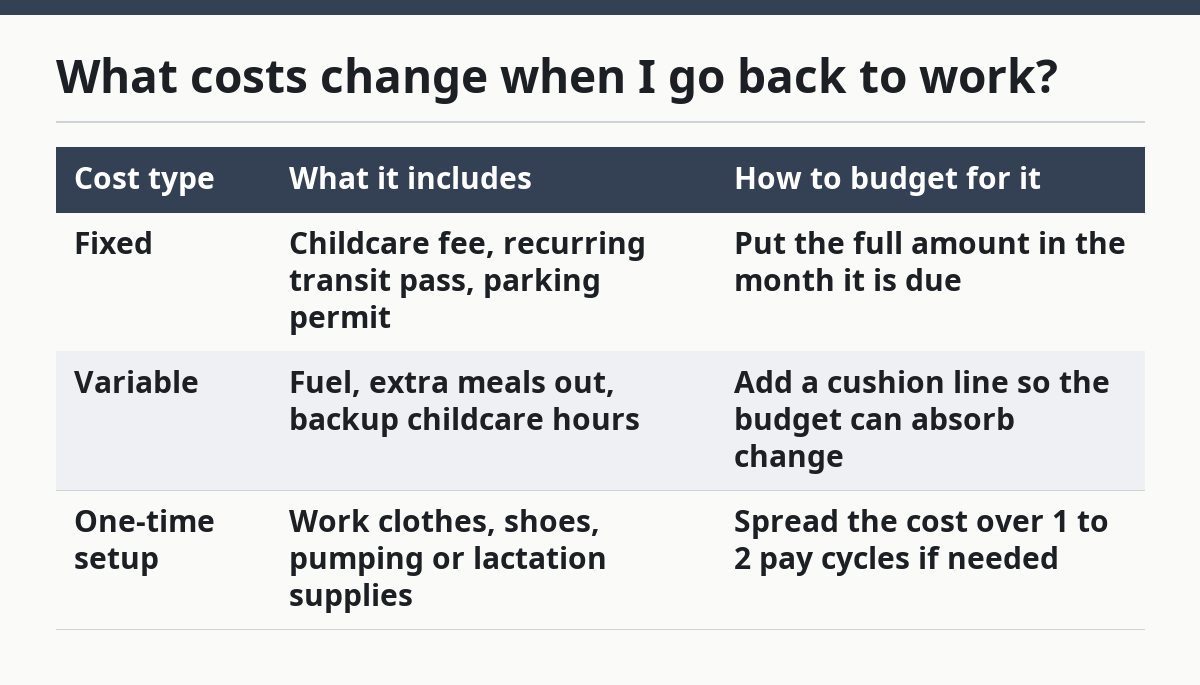
This split helps because not every new cost behaves the same. A childcare bill is not the same as a one-time pair of work shoes, and a transit pass is not the same as gas used only on office days. If you mix them together, you cannot tell what is actually breaking the budget.
How do I build the first month back budget?

You build the first month back budget by lining up your expenses against your paycheck dates, one date at a time. Start with the day you return to work and map the next 30 days, because the first pay period often does not cover the new costs that start immediately.
- Write down your first work day and first payday. Put both dates on paper or in a note app, then count the days between them. If there are 14, 21, or 30 days with no pay, that gap must be covered before anything else. A problem shows up if you assume your paycheck arrives before your childcare starts.
- List every new work cost in one place. Include childcare, commute, work clothes, lactation supplies, parking, and any lunch or coffee costs you expect to change. Keep each line separate rather than using one “work” bucket. If a cost has no amount yet, mark it as unknown instead of guessing.
- Separate one-time costs from recurring costs. A work shirt is not the same as weekly fuel. Put one-time items in the first 1 or 2 pay periods so they do not disappear inside a monthly average. If you cannot tell whether a cost repeats, the budget is too vague to rely on.
- Price childcare for the exact days you need it. Use the restart date, the number of workdays per week, and any backup hours you may need during the first month. Childcare often costs more at the transition point because hours may not line up neatly with your old routine. A problem shows up if your care schedule assumes perfect pickup times every day.
- Estimate commuting costs by route, not by habit. Count the miles, transit trips, parking days, or fares linked to the new schedule. A 5-day office week and a 2-day office week do not cost the same. If your commute estimate is copied from a pre-leave routine, it may be too low.
- Build a paycheck bridge for the gap before money lands. Set aside enough to cover the first 2 to 4 weeks of new costs, depending on when pay starts. The goal is not to perfectly cover the full month, but to prevent a cash shortfall before the first paycheck clears. If the bridge depends on every bill arriving late, it is fragile.
- Create a small backup line for schedule changes. Add room for 1 unexpected childcare pickup, 1 extra transit day, or 1 day of work clothes replacement if your role requires it. That buffer is not a luxury; it is the margin that keeps the plan standing when the schedule shifts. If the budget breaks from one small change, it was too tight.
- Check the plan against your lowest cash balance. Look at the day before each paycheck, not just the month total. A budget can look fine on paper and still fail if your account hits zero on day 12. If you cannot cover that low point, reduce spending or adjust timing before you return.
A good return-to-work budget is not the one with the most detail. It is the one that tells you, by date, whether you can pay for childcare and still get to the next paycheck.
How do I handle childcare restart and schedule changes?
You handle childcare restart and schedule changes by treating them as cash-flow events, not just calendar events. The budget should reflect when care starts, how many hours you need, and how often the schedule can change without costing more. For a practical budgeting method, the CFPB’s budgeting tools and MoneyHelper’s budget planner are useful starting points.
The biggest mistake is budgeting for a perfect week when your first month is unlikely to be perfect. A doctor appointment, a late handoff, or a shorter workday can change both childcare and transport costs in the same week. If your care provider bills in 15-minute, hourly, or full-day blocks, use that billing unit in the budget.
A schedule change also affects your backup plan. If you need a second caregiver or emergency care, put that in the budget as a separate line, not as part of general spending. If there is no backup line at all, the first illness or late meeting can push you into debt.
The best version of this step is usually boring: know the care start date, know the billing rule, know the pickup window, and know what happens if you are 30 minutes late. If any of those are unclear, call it an unknown cost until you have the answer.
What should I do about paychecks?
You should budget around the paycheck date, not the calendar month, because the first payment after leave often arrives after new costs have already started. That means the order of cash matters as much as the total amount.
A simple way to think about it is this:
| Pay situation | What it changes in the budget | Risk if ignored |
|---|---|---|
| First paycheck arrives after return | You need a bridge for early costs | You may run short before pay lands |
| First paycheck is smaller than usual | Net income may not match your old budget | You may overspend based on a full-pay assumption |
| Pay timing is irregular | Bills and childcare may hit before income | Your account can dip even if the month looks balanced |
If you are returning to work after leave, your first pay cycle may also include deductions or partial periods. Do not build the month on the assumption that the first check equals a normal one. If the amount is not confirmed, budget conservatively and treat the missing figure as a risk, not a promise, and consider checking with payroll or a qualified adviser if the deduction pattern is unclear.
This is also the place to check whether any benefits or tax credits change with your return. Rules differ by country and can change over time, so verify them with the official body in your area. For general budgeting help, the Consumer Financial Protection Bureau and MoneyHelper both publish practical budgeting guidance; use the official pages that match your country, not a social media estimate.
When should I stop and rethink the plan?
You should stop and rethink the plan when the first month back cannot be covered without assuming everything goes right. That is usually a sign the budget needs a smaller schedule, a different childcare setup, or qualified advice about benefits and taxes.
Your first paycheck is still unknown: you cannot build a reliable bridge without the pay date — wait for the payroll schedule or ask HR before locking in childcare.
Your childcare hours are not confirmed: the biggest new cost is still open — do not guess at a rate you have not been given.
Your commute depends on multiple changes at once: new route, new parking, and new workdays together can distort the estimate — price each piece separately first.
Your budget only works if you skip all backup care: that means one sick day could break it — add a backup line or reduce the work schedule.
Your income will change after return in a way you do not understand: partial pay, deductions, or benefits changes can affect cash flow — get qualified help before making the budget final.
This does not mean the return is impossible. It means the standard monthly template is the wrong tool until the dates and costs are clearer.
What mistakes cost the most?
The costliest mistake is using your old budget as if nothing changed. Parental leave ends, but childcare, commuting, and work clothes create a new pattern that the old numbers do not capture.
Another common mistake is averaging one-time costs across 12 months and calling that “handled.” That hides the real cash hit in the first 30 days, which is exactly when money is tightest. A work outfit or lactation supply purchase may be small in the long run, but it can still cause a shortfall in week 1.
A third mistake is forgetting that schedule changes can affect two lines at once. If you need to leave early, childcare and transport may both rise. If you stay late, a late pickup fee and extra gas may hit together.
A fourth mistake is treating the first paycheck as if it is already in the account. Until it clears, it is not spending money. A budget based on money that is not there yet is not a budget; it is a hope.
A fifth mistake is not naming the trade-off. If the budget is too tight, the choice may be between fewer workdays, a different childcare pattern, or delaying some purchases. Leaving that choice unspoken only delays the problem by 1 pay cycle.
FAQ
What costs change when I return to work?
The main changes are childcare, commuting, work clothes, and any lactation supplies or pumping-related items you need. Those costs often begin before your first full paycheck, so they should be listed by date, not just by category.
How do I prepare for the first month back?
Prepare by matching every new cost to a calendar date and every date to a paycheck. The first month is usually a bridge month, so the goal is to cover the gap between when costs start and when income arrives.
What should I budget before paycheck one?
Budget for childcare, commute costs, any required work clothes, and a small backup line for schedule changes. If you do not know the exact amount of one item, mark it as unknown and confirm it before the first workday.
Drafted with AI; not yet reviewed by a person.