
Last updated: November 18, 2026
Quick Answer: in a custody exchange month, budget for 3 priority cost areas first: transport, meals, and kid gear. A custody exchange budget is a short-term plan for the extra costs that show up when a child moves between homes, and it works best when you separate normal monthly bills from the duplicate costs tied to the swap. For general budgeting guidance, see the Consumer Financial Protection Bureau, and if your situation is complex, consult a qualified adviser. This is general information, not financial advice.
Key Takeaways
- A custody exchange month can add recurring costs across 3 areas: transport, food, and kid gear.
- Start with exchange costs first, then fit optional spending into the month.
- Transport, meals, and child items are the first categories to protect.
- Single parents can overspend if they treat exchange costs as one-offs instead of monthly items.
Who this applies to
This applies to a single parent who already has a basic monthly budget and needs to handle one month with custody handoffs, two sets of kid items, and travel between homes. It assumes you know your regular rent, food, transport, and bills, but need help spotting the costs that rise only because a child is moving back and forth.
It is most useful when the exchange month has extra handoff driving, extra meals, duplicate toiletries, school items that travel, or a need to keep backup clothing at both homes. It is not meant for shared expense app management, childcare splitting, or roommate budgeting, because those are different money problems with different rules.
If the exchange month also includes court changes, major income loss, or debt you cannot cover, a budget alone may not be enough. In that case, a qualified financial adviser or legal aid service that understands child-related costs may be the better next step than trying to solve it with a spreadsheet and guesswork. For broader budgeting support, Consumer.gov offers basic planning guidance.
What changes in a custody exchange month?
A custody exchange month changes spending because some costs happen twice, even if your normal monthly budget does not change much. The most common pressure points are transport, meal duplication, child clothes, school bags, and shared supplies that get passed from one home to another.
Think of the month in two layers. The first layer is your normal fixed costs, such as rent, utilities, and regular groceries. The second layer is the exchange layer, which includes the extra fuel, tickets, snacks, small replacements, and backup gear that appear because the child is moving homes.
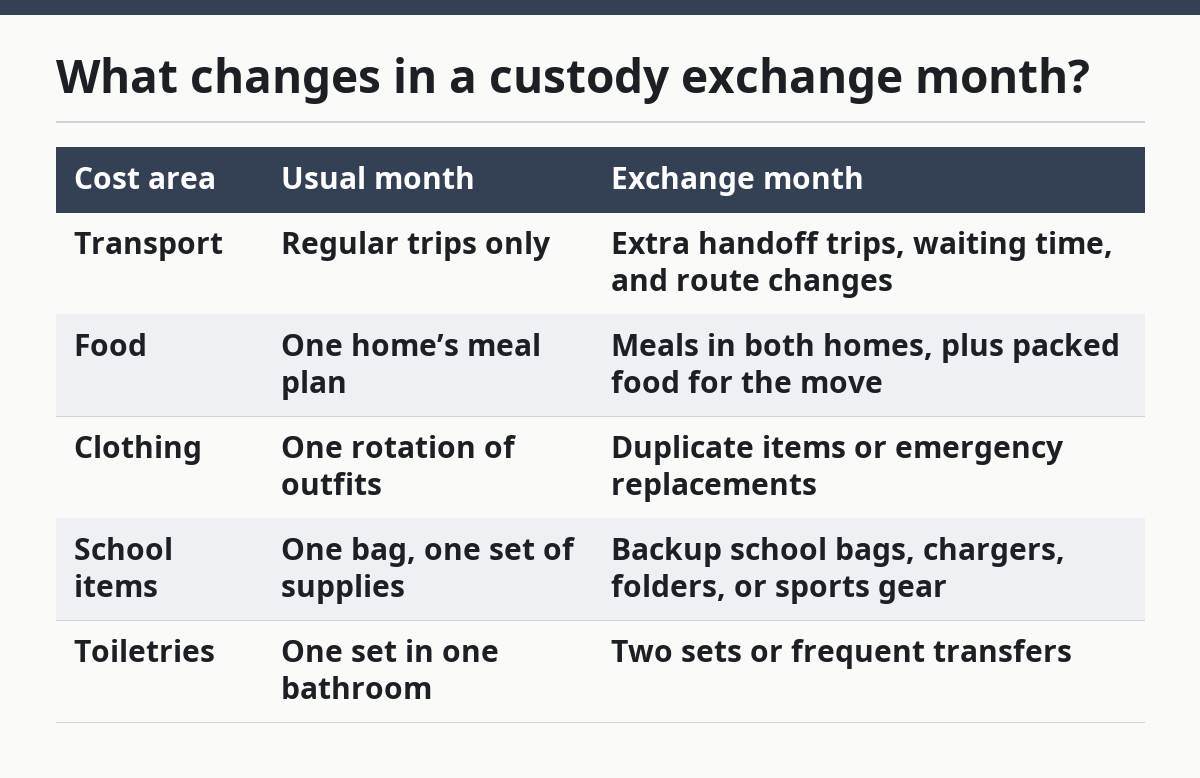
A simple way to see the difference is to compare the usual month with the exchange month:
| Cost area | Usual month | Exchange month |
|---|---|---|
| Transport | Regular trips only | Extra handoff trips, waiting time, and route changes |
| Food | One home’s meal plan | Meals in both homes, plus packed food for the move |
| Clothing | One rotation of outfits | Duplicate items or emergency replacements |
| School items | One bag, one set of supplies | Backup school bags, chargers, folders, or sports gear |
| Toiletries | One set in one bathroom | Two sets or frequent transfers |
The month becomes harder when the exchange schedule is uneven. A 2-day swing may create more duplicate spending than a steady 1-week pattern, because the child needs the same items in both places but uses them for less time in each home.
How do you build the budget step by step?
You build the budget by listing the exchange costs first, then fitting them into the month before you spend on anything optional. Start with the actual schedule, not a guess, because a Friday pickup and a Sunday drop-off create different transport and meal costs than a school-day handoff.
- Write the exchange dates on one calendar. Mark every handoff, overnight, and school transfer for the month. Verify that pickup times, drop-off times, and locations are clear. A problem shows up if you cannot tell whether one trip replaces another or adds a separate trip.
- List every extra trip. Count each drive, bus fare, train fare, or ride-share tied to the exchange, even if the trip is short. Verify whether the trip is one-way or round trip. A problem shows up if you only budget for the handoff and forget the return leg.
- Separate food into normal meals and exchange meals. Add the meals the child eats during travel, handoff waits, and the first day in each home. Verify whether you need packed lunches, dinner backup, or snack food on transfer days. A problem shows up if the exchange day pushes you into takeout because the fridge was not stocked.
- Check kid gear that moves or duplicates. Make a list of child clothes, school bags, uniforms, sports items, chargers, and toiletries. Verify whether the child needs one set in each home or a packed bag that travels. A problem shows up if the child keeps forgetting a core item and you keep buying replacements.
- Budget for shared supplies that get used twice. Include soap, toothpaste, hair items, snacks, and school consumables when both homes need a working stock. Verify whether the item is consumed once or split across homes. A problem shows up if you assume one purchase covers both places for the whole month.
- Add a small backup line for schedule changes. Keep a buffer for one missed pickup, one late train, or one extra meal. Verify that the buffer is separate from your grocery money and rent money. A problem shows up if one change wipes out the rest of your food plan.
- Compare the exchange month to a normal month. Subtract the normal cost from the exchange cost so you can see the change clearly. Verify which costs are temporary and which repeat every month. A problem shows up if you treat a one-off month as if it were the new normal.
- Set the order of spending before the month starts. Pay for transport and food first, then clothing and school items, then anything extra. Verify that the first two categories are covered before optional purchases. A problem shows up if discretionary spending comes first and the handoff money runs short.
What should I budget for first?
You should budget for transport, meals, and kid gear first, because those are the costs most likely to rise during exchanges. If the month is tight, those three areas usually cause the biggest problems before anything else does.
Transport comes first because a missed or changed exchange often costs more than expected. Meals come next because handoff days can force extra snacks, takeaway, or duplicate groceries. Kid gear comes third because child clothes, school bags, and toiletries are easy to forget until the child arrives without them.
The order matters because a custody exchange budget is not about perfect planning. It is about protecting the items that let the exchange happen without strain. A small bag of snacks or a second school jumper may cost less than a last-minute replacement trip, and that difference matters in a month with tight cash flow.
Where do single parents usually overspend?
Single parents usually overspend when they treat exchange costs as small one-off extras instead of recurring monthly items. The money leak is often not one large bill but several small ones: one extra drive, one takeaway meal, one missing jumper, one duplicate school item, then another.
The most common mistakes look like this:
- Forgetting the return trip: the consequence is a transport shortfall, and the correct alternative is to budget for the whole exchange loop, not only pickup.
- Assuming food will “work itself out”: the consequence is emergency spending on takeaway, and the correct alternative is to pre-plan meals for handoff days.
- Buying duplicates without a system: the consequence is paying twice for items that could have been packed once, and the correct alternative is to use a fixed handoff bag for school and clothes.
- Leaving school items in the wrong home: the consequence is replacement purchases, and the correct alternative is a checklist for bags, books, chargers, and uniforms.
- Using the grocery budget as the exchange buffer: the consequence is running short on food later in the month, and the correct alternative is a separate line for exchange-week costs.
- Treating a schedule change as rare: the consequence is an empty cushion when plans shift, and the correct alternative is to keep a modest buffer for timing changes.
A good budget here is not neat; it is specific. If the month has four handoffs, then the budget should reflect four handoffs, not a vague idea of “a few extra trips.”
When should you stop using a simple budget?
You should stop using a simple budget when the exchange costs are no longer predictable enough to track by hand. That usually means the month includes repeated schedule changes, long-distance travel, or spending that crosses into debt before the exchange is over.
Frequent pickup changes: this means your transport cost is unstable — switch from a fixed estimate to a per-trip log and update it after each handoff.
Long-distance exchanges: this means fuel, tickets, parking, or overnight costs may be too large for a casual estimate — build a separate travel line and review whether the current plan is still workable.
Repeated duplicate purchases: this means the child’s items are not staying organized between homes — stop guessing and use a written handoff list for clothes, school bags, and shared supplies.
Meal spending keeps rising: this means transfer days are pushing food costs beyond the normal grocery plan — set a dedicated exchange-day food amount and separate it from weekly groceries.
Money meant for bills is getting used for handoffs: this means the budget is crossing into rent, utilities, or debt payments — pause new spending and get qualified help before the shortfall grows.
This is the point where a spreadsheet alone stops being enough. A financial counsellor, legal aid worker, or other qualified adviser who understands child-related costs may help you sort out the larger pattern. For help with debt and budgeting basics, see the National Foundation for Credit Counseling and Consumer.gov.
What happens when the child moves between homes?
When the child moves between homes, the budget shifts because some items need to exist in both places or travel back and forth. The biggest changes usually show up in clothes, school bags, meal planning, and shared supplies that do not stay in one bathroom or one kitchen.
A child who moves homes also changes how you shop. You may need backup socks, a second toothbrush, extra snacks, or a duplicate notebook so the child is not constantly carrying the same item across town. If the month includes school, sports, or a special activity, the gear can become the main cost even when the handoff itself is cheap.
That is why a custody exchange budget should be built around movement, not just around dates. The more often the child moves, the more likely it is that small items will be lost, forgotten, or bought twice.
How do I keep the budget from breaking mid-month?
You keep the budget from breaking by checking it after the first exchange week, not only at the start of the month. If transport, food, or gear has already gone over plan once, the rest of the month needs a reset instead of blind optimism.
A practical check uses three questions. Did the handoff cost what you expected? Did the meal plan hold for the travel day? Did the child return with the needed clothes, school bag, and shared supplies? If the answer to any of those is no, adjust the next exchange before it happens.
This page fits the broader single-parent budgeting by life stage and family situation hub, which is the better place to compare this month with other family costs. Here, the goal is narrower: keep the exchange month from turning into a string of avoidable cash leaks.
What should I budget for custody transition weeks?
Budget for transport, food, and duplicate child items first. Transition weeks often cost more because the child needs a handoff bag, travel snacks, and backup clothes in more than one place. If the schedule includes school-day exchanges, add time and travel costs for the school run as well.
How do custody swaps affect spending?
Custody swaps affect spending by creating duplicate and time-sensitive costs that do not show up in a normal month. Transport rises, meals become less predictable, and child clothes or school bags may need to exist in both homes. The effect is usually spread across many small purchases rather than one large bill.
What costs appear when the child moves between homes?
The main costs are transport, meal duplication, child clothes, school bags, and shared supplies. A child moving homes may also trigger small replacement purchases for toiletries, sports items, or school gear. The exact mix changes with distance, age, and how often the child swaps homes.
Drafted with AI; not yet reviewed by a person.