
Last updated: November 18, 2026
Key Takeaways
- Envelope budgeting caps category spending; zero-based budgeting assigns every dollar in the full monthly plan.
- Envelope budgeting fits aisle, pump, and late-night decisions.
- Cash envelopes suit single parents who need fewer choices.
- Zero-based budgeting fits parents dealing with unassigned money and hidden gaps.
Envelope budgeting and zero-based budgeting both help single parents give every dollar a job, but they solve different problems. In the topic of Envelope budgeting vs zero-based budgeting for single parents, envelope budgeting wins for simplicity and hard limits on variable spending; zero-based budgeting wins when a single parent needs tighter control across every budget category, including bills, sinking funds, and irregular costs.
For many households, the choice is practical, not philosophical. The CFPB budgeting guide and the NEFE budgeting resources both stress that a usable budget is the one a family can keep using month after month.
As a writer who covers personal finance and household budgeting, I would frame the choice this way: pick the method that matches how much time, cash handling, and mental energy you actually have on a school night, not the one that sounds more disciplined on paper.
What is the real difference between an envelope system and a zero-based budget?

The real difference is that an envelope system controls spending by category cash limits, while a zero-based budget controls the whole monthly plan so income minus planned expenses equals zero. For a single parent, that means one method is built around restraint at the point of purchase, and the other is built around assigning every dollar before the month starts.
Envelope budgeting, sometimes called cash envelopes, is the simpler of the two. You decide on categories such as groceries, gas, kids’ clothing, dining out, and school activities. Then you put a set amount into each envelope, either physically or in a digital envelope setup, and stop spending when the envelope is empty. The method works best when variable spending is the main problem.
Zero-based budgeting is broader. Every dollar gets assigned to a budget category: rent, utilities, insurance, childcare, groceries, debt payments, savings, emergency fund contributions, and anything else you expect. The “zero” does not mean no money left in your account; it means no unassigned money left on paper. That structure is useful when a parent’s finances have many moving parts and a missed bill can cause trouble.
The difference matters because single parents usually need two things at once: fast decisions and strong control. Envelope budgeting gives faster guardrails. Zero-based budgeting gives more complete planning. If the main pain point is overspending on takeout or school-week extras, envelopes can feel easier. If the main pain point is that money disappears before the month ends and bills arrive out of order, zero-based budgeting usually has the edge.
For a broader map of tools and methods, the hub on Tools and Methods for Budgeting as a Single Parent belongs with this choice guide.
The Honest Side-by-Side
Envelope budgeting is the better fit when the decision has to be made in the aisle, at the pump, or on a tired Thursday night. Zero-based budgeting is better when the decision has to be made before the month starts. The table below shows the trade-offs that actually change the choice.
| Criteria | Envelope budgeting | Zero-based budgeting | Winner for [condition] |
|---|---|---|---|
| Setup time | Faster to start with a few categories | Takes more planning up front | Envelope budgeting for parents who need a quick start |
| Handling variable spending | Strong for groceries, fuel, fun money, school extras | Strong, but only if categories are detailed | Envelope budgeting for narrow overspending problems |
| Bill coverage | Weak if used alone for fixed monthly bills | Built for fixed and variable bills together | Zero-based budgeting for full household planning |
| Cash flow control | Good for limiting discretionary spending | Better for directing every dollar before spending | Zero-based budgeting for uneven monthly demands |
| Mental load | Lower once the envelopes are set | Higher because every dollar gets assigned | Envelope budgeting for low-bandwidth weeks |
| Visibility | Very clear inside each category | Very clear across the whole month | Zero-based budgeting for seeing the full picture |
| Flexibility with card spending | Harder if you rely on cards or digital payments | Easier to run in digital form | Zero-based budgeting for mostly card-based households |
| Overages | Stops spending in one category but can leave other bills exposed | Catches overruns if the plan is reviewed | Zero-based budgeting for preventing hidden shortfalls |
| Best use case | Variable spending caps | Complete monthly allocation | Depends on whether the problem is “too much spending” or “no plan” |
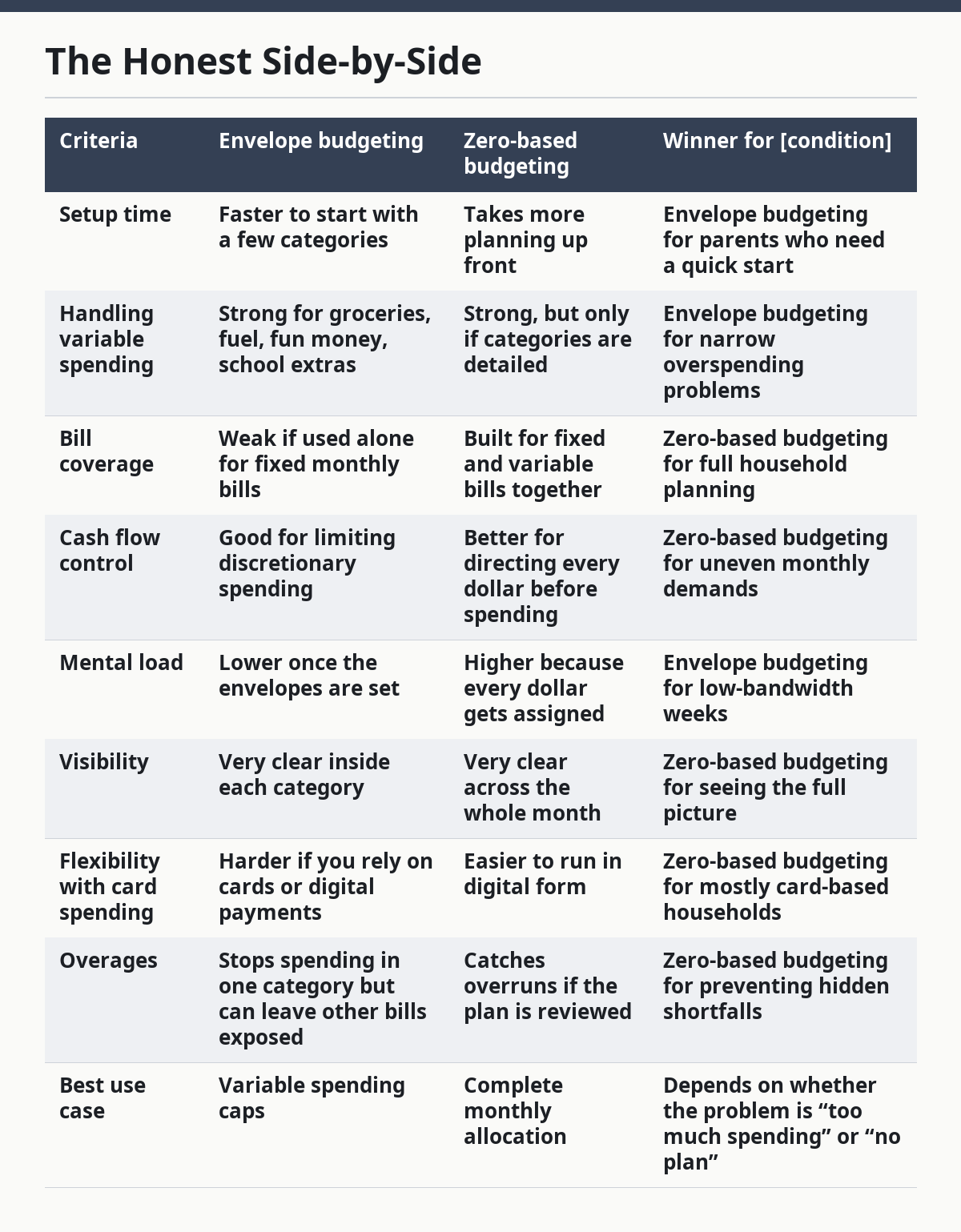
The table is not saying one method is universally better. It is saying that envelope budgeting is a category fence, while zero-based budgeting is a full budget architecture. That distinction is exactly why a single parent may love one and hate the other.
One practical source worth reading for the zero-based method itself is the Consumer Financial Protection Bureau. Their budgeting guidance explains the “assign every dollar” approach in plain language, which is the right starting point for the method rather than a sales pitch.
When cash envelopes make life easier

Cash envelopes win for single parents who need a smaller decision tree. If the month is already packed with daycare drop-off, a split school pickup, and a work schedule that changes every week, the simpler system is often the one that gets used. Envelope budgeting makes the limit visible in a way a spreadsheet sometimes does not.
This method is strongest for variable spending. Groceries, kids’ snacks, birthday gifts, field trip money, gas, and weekend extras are the categories that usually drift. A cash envelope puts a ceiling on each one. When the envelope is empty, the decision changes from “Can I still spend?” to “Does this deserve money from another category?” That pause is useful when impulse spending is the issue.
The trade-off is obvious: cash envelopes can be awkward for fixed bills and for parents who rarely use cash. Rent, electricity, internet, or after-school care do not fit neatly into literal envelopes, and carrying cash for every category is not practical in many places. If a family mainly pays by card or app, a strict cash-only version can become annoying fast.
Envelope budgeting is also weaker when unexpected costs hit in the middle of the month. If the gas envelope is empty and the school needs art supplies the same week, the system forces a trade-off. That is not a flaw, exactly; it is the point. But the consequence is real. The parent has to move money from one envelope to another, and that can feel like robbing Peter to pay Paul unless the categories were set carefully.
Envelope budgeting is best for a single parent who wants fewer moving parts, has visible trouble in 3 to 5 spending categories, and needs a method that can be understood in one sitting. It is a poor fit for a household with many fixed obligations, lots of online payments, or income that changes from week to week.
When a zero-based budget does the heavier lifting
Zero-based budgeting wins when the main problem is not just overspending, but unassigned money and blind spots. For a single parent, that matters because one late utility bill, one childcare change, or one school fee can throw off the whole month if the money was never given a job in the first place.
This method is stronger because it handles the full picture. A zero-based budget can include rent or mortgage, utilities, childcare, groceries, transportation, debt payments, savings, irregular annual costs, and “future” categories such as car repairs or holiday spending. That makes it a better fit when the reader needs a monthly map, not just a spending cap. It also works better when income arrives on uneven dates, because the plan can be built around the timing of paychecks rather than a pile of cash in envelopes.
The cost is complexity. Zero-based budgeting asks for more attention every month, sometimes every week. Categories need updating. Due dates matter. A single parent with a wide age gap between kids, multiple school costs, or a rotating schedule may find the method powerful but mentally expensive. If the budget is not reviewed, the method loses its advantage quickly.
There is also a behavioral cost. Zero-based budgeting can feel like homework. A parent who is already stretched thin may set up a perfect plan and then stop using it because the upkeep is too heavy. That is the biggest weakness: not the method itself, but the follow-through it demands.
The CFPB and the National Endowment for Financial Education both publish budgeting guidance that points toward the same principle: the best budget is one that reflects actual household priorities and can be maintained month after month. Zero-based budgeting is the right tool when accuracy matters more than simplicity.
Which budgeting method is easier for single parents?
Envelope budgeting is easier for most single parents at the start, but zero-based budgeting is easier to live with when bills are complicated. That answer sounds split because it is split by task.
For the first week, envelope budgeting is usually simpler. It asks for fewer categories, fewer decisions, and less setup. A parent can start with groceries, gas, childcare extras, and kids’ spending without building a full monthly plan. That matters when time is scarce.
Over the long run, zero-based budgeting can become easier if the household has many recurring bills or irregular expenses. Once the structure is in place, the parent is not constantly asking whether there is money hidden somewhere in a category. The plan already tells the money where to go. That reduces guesswork, even if it increases setup time.
So the answer depends on what “easy” means. If easy means “I can start tonight with a pen and four envelopes,” envelope budgeting wins. If easy means “I want fewer surprises when bills hit,” zero-based budgeting wins. The wrong choice is trying to use a method that is easy to begin but impossible to maintain for 12 months.
For single parents who are already juggling school calendars, custody schedules, and income that changes by the week, easy should mean sustainable. A method that gets used imperfectly is better than a perfect system that dies after one month.
The verdict: which one should a single parent choose?
Choose envelope budgeting if the main problem is overspending in a few variable categories and the household needs a simple system with visible limits. Choose zero-based budgeting if the main problem is bill timing, uneven income, or money that disappears because no plan assigns every dollar. Neither if income is so unstable that even basic monthly categories cannot be forecast without professional help.
That is the clean call. Envelope budgeting is the lighter tool. Zero-based budgeting is the more complete one. If a single parent can keep only one method alive, the decision should turn on whether control at the point of spending matters more than control across the whole month.
I would not push envelope budgeting on a parent with many fixed obligations and card-only spending. It can become too narrow. I would not push zero-based budgeting on a parent who is overwhelmed, sleep-deprived, and already drowning in administrative tasks. It can become another job.
One more practical point: these methods are not moral tests. A budget category is a tool, not a verdict on discipline. The better method is the one that reduces late fees, panic, and guesswork without adding more chaos.
When should a single parent reconsider the choice entirely?
A single parent should reconsider both methods when the budget is constantly broken by emergencies, debt collections, or income swings that change from week to week. In those cases, the issue may be less about the budgeting method and more about the structure of the household finances.
If variable income is the norm, a zero-based budget can still work, but only if it is built around the lowest reliable income level and reviewed often. If that is not realistic, even a disciplined plan may fail because the numbers are too fragile. If spending is the real problem and cash use is practical, envelope budgeting can still help, but it will not solve a deficit caused by income that does not cover basic needs.
Another reason to step back is a budget that requires constant repair. If the parent has to move money between categories every few days, both systems may be too detailed for the current season of life. A simpler survival plan may be needed first, with a more exact method later.
Ultimately, the budget has to fit the life stage, the payment schedule, and the amount of attention the parent can spare in a normal week, not an ideal one.
Which budgeting method is easiest for beginners?
Envelope budgeting is usually easiest for beginners. It starts with a few visible spending categories and does not require a full monthly allocation model. The trade-off is that it handles bills less completely, so a beginner may outgrow it if fixed expenses and irregular costs become harder to track.
Is envelope budgeting good for irregular income?
Envelope budgeting can help with irregular income, but it is not the strongest fit on its own. It works best for variable spending limits, not for planning when income arrives on uneven dates. A parent with uneven pay may need a more complete monthly plan, then use envelopes for categories that tend to run hot.
Can you combine envelope and zero-based budgeting?
Yes, and that combination is often the most practical option. A parent can use a zero-based budget to assign every dollar, then use cash envelopes or digital envelopes for the categories most likely to be overspent, such as groceries, dining out, or kid-related extras. That keeps the full plan intact while adding a hard stop where it matters most.
Drafted with AI; not yet reviewed by a person.