
Last updated: November 18, 2026
Key Takeaways
- Keep single-parent cash flow protected first; spending totals matter less than bill timing.
- List must-pay bills, then match them to payday dates before anything else.
- Envelope budgeting helps with tight limits; zero-based budgeting helps assign every dollar.
- Start with only the budget categories that truly affect your household.
Budgeting basics for single parents start with one goal: make sure the essentials are covered first, then build a simple system that can survive irregular income, child-related costs, and real-life interruptions. Getting Started Budgeting Basics for Single Parents — The Complete Guide begins with a budget you can keep using when school forms, groceries, rent, and childcare all hit in the same week.
This is information, not financial advice. Money rules, benefit rules, tax rules, and debt laws vary by country and change often, so a qualified adviser should review your own situation before you make major decisions.
What single-parent budgeting needs to do differently

Getting Started Budgeting Basics for Single Parents — The Complete Guide starts with cash flow, not just spending totals. A two-adult household can sometimes absorb a surprise bill with another paycheck or a shared calendar; a single-parent household usually cannot, so the budget has to make timing matter as much as totals.
That changes the starting point. A generic budget often begins with “spend less.” A budget for one parent begins with “which bills must never bounce if the week goes wrong?” That usually means rent or mortgage, utilities, transportation, food, childcare, prescription costs, and minimum debt payments. If any of those are late, the cost is not just a fee. It can become a shutoff notice, a missed shift, or a missed pickup deadline.
The other difference is that child costs are not neat monthly averages. A school trip, a growth spurt, a new pair of shoes, a co-pay, or a daycare closure does not wait for the 1st of the month. A useful budget has room for irregular child expenses inside it, not outside it. That often means assigning small amounts to a “school,” “kids,” or “surprises” category each month, even if the number is modest.
The third difference is emotional, but it has financial consequences: decision fatigue. A single parent often carries the full burden of every spending choice. If the system requires too many daily decisions, it fails when life gets busy. A better budget uses a few simple categories, a repeatable payday routine, and a clear rule for what gets paid first.
For government help, benefit eligibility, and tax credits that may affect your numbers, use official sources in your country. In the U.S., the Consumer Financial Protection Bureau’s budgeting resources and the IRS tax guidance pages are reliable starting points; in the U.K., the MoneyHelper service is a good public resource. Those pages change over time, so consult a qualified professional and check the current guidance on the Consumer Financial Protection Bureau, IRS, or MoneyHelper before treating any rule as universal.
How do I start a budget when money is tight?
You start by listing the bills that must be paid before anything else, then you match those bills to the dates money actually arrives. That is the cleanest way to budget when there is not much slack, because a low balance is usually a timing problem before it is a spending problem.
Begin with four pieces of paper, a notes app, or a spreadsheet. On one list, write every source of income you can count on in a normal month, including wages, child support if it is regular and actually received, and any stable benefits you know will continue. On a second list, write fixed bills with due dates. On a third, write variable essentials like groceries, gas, school costs, diapers, and medicine. On a fourth, write anything optional, such as streaming, takeout, or nonessential shopping.
Then separate “must pay” from “should pay if possible.” This distinction matters. A $75 school activity fee and a $75 utility bill are not the same kind of expense, even if the amount looks identical. One may be delayed with a plan; the other may trigger a shutoff risk. The budget should reflect consequence, not just cost.
If the total essential spending is higher than the income you can count on, the answer is not to pretend the gap does not exist. The answer is to find the gap early. That may mean calling creditors before a payment is missed, asking about hardship programs, checking whether any bills can be moved, or looking for local aid through schools, churches, community groups, or municipal services. A financial adviser or a nonprofit credit counselor can help you sort options without guessing.
The most common beginner mistake is building a “perfect month” budget. That fails the first time a child gets sick, the car needs fuel at the wrong time, or a paycheck lands two days later than expected. A starter budget should be built for the messy month you actually live in.
Which budgeting method works best for a single parent?

The envelope method wins for people who need tight spending limits, while a zero-based budget wins for people who need every dollar assigned on purpose. The better choice depends on how variable your income is and how much detail you can realistically maintain on a tired day.
The envelope method: why it helps when cash is too easy to spend
The envelope method works because it creates a hard limit. Money is separated into categories before it disappears into impulse spending, and that makes it easier to say, “This category is empty until next payday.” For a single parent, that kind of boundary can be valuable for groceries, gas, school fees, and kid-related extras that tend to drift upward over the month.
The strength of this method is clarity. If the grocery envelope is empty on the 18th, the budget has already answered the question of whether restaurant food fits this week. That can reduce second-guessing and prevent the feeling that every card swipe is a fresh debate. Physical envelopes are one option; digital “buckets” or subaccounts can serve the same purpose if your bank offers them.
The weakness is that it can be rigid. If one envelope gets emptied early because a child needs medication or a school event appears with little warning, the whole system can wobble unless you have a backup category. It also assumes you have enough cash flow stability to divide money evenly. If your income arrives in uneven chunks, a strict envelope system can feel like a monthly juggling act.
This method fits a parent who needs visual limits and spends too freely under stress. It is not ideal if your pay is highly irregular, if most bills are due by automatic draft, or if moving money around by hand will cause missed payments.
Zero-based budgeting: why it fits uneven income better
Zero-based budgeting works because every dollar gets a job before the month starts. Income minus assigned expenses equals zero, but that does not mean you spend everything. It means you tell each dollar where it belongs: bills, groceries, savings, debt, childcare, school costs, or buffer.
That structure is powerful when money is tight because it exposes trade-offs. If a school fee is due this month, you can see exactly which category gives way. If a medical bill lands unexpectedly, you know which planned spending can be reduced instead of guessing. For a single parent, that visibility is often more useful than having a vague “spend less” goal.
The drawback is that zero-based budgets take more effort up front. They demand a full list of categories and a willingness to adjust them often. If the budget only works when you have a quiet Sunday afternoon, it may be too fragile. It can also become too detailed, with tiny categories that create burnout instead of control.
This method fits a parent who wants every dollar assigned and can handle a weekly review. It is less useful if you are overwhelmed by detail or if your bills are too unstable to predict at all.
Honest side-by-side
| Criteria | Envelope method | Zero-based budgeting | Winner for this condition |
|---|---|---|---|
| Best for cash spending control | Strong, because category limits are visible | Moderate, because control depends on tracking discipline | Envelope method for overspenders |
| Best for irregular income | Weak unless envelopes are funded carefully | Strong, because you assign dollars as they arrive | Zero-based budgeting for variable pay |
| Setup effort | Lower at the start | Higher at the start | Envelope method for beginners |
| Detail required | Low to moderate | Moderate to high | Envelope method for simplicity |
| Handling surprise kid expenses | Hard unless a buffer category exists | Easier if an emergency category is built in | Zero-based budgeting |
| Works well with automatic bills | Can be awkward if too much cash is involved | Strong, because bills are assigned first | Zero-based budgeting |
| Reduces daily decision fatigue | Good once categories are set | Good if the categories stay stable | Tie |
| Risk of feeling restrictive | Medium | Medium to high | Envelope method for emotional ease |
| Best when money arrives in one paycheck | Good | Good | Tie |
| Best when money arrives in pieces | Weak | Strong | Zero-based budgeting |
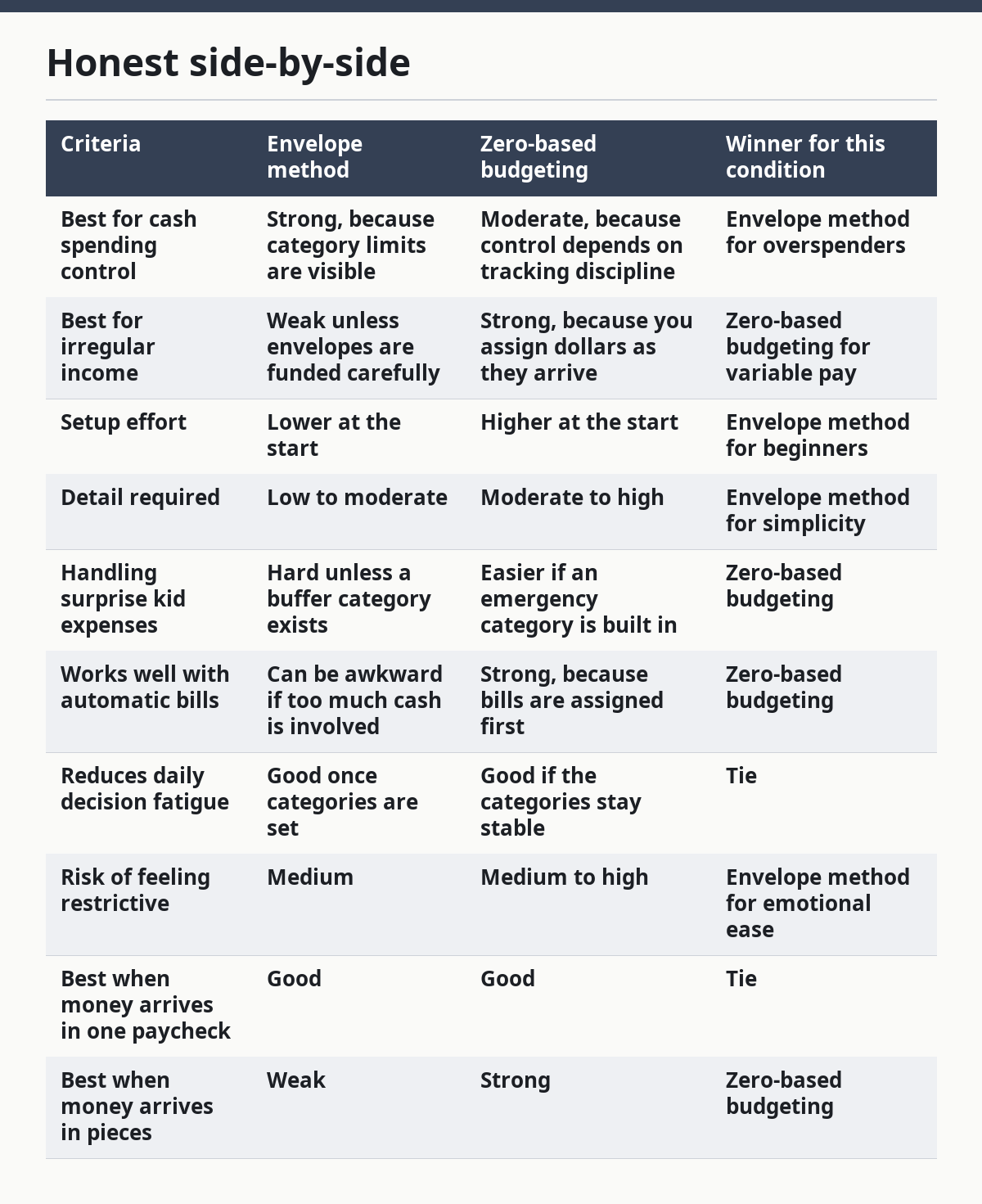
The practical call is simple: use the envelope method for day-to-day spending control, and use zero-based budgeting for the overall plan if your income varies. Many single parents do best with a hybrid: bills and savings are assigned in a zero-based plan, while groceries, gas, and kid spending are tracked with envelopes or digital buckets.
What should go into the first version of your budget?
The first version of your budget should include only the categories that actually move your life. A starter budget works better with eight to twelve clear lines than with thirty tiny ones.
Start with housing, utilities, food, transportation, childcare, healthcare, debt minimums, and a small buffer for child expenses that do not happen every month. That buffer matters more than most beginners expect. A budget that leaves out school events, birthday gifts, sports fees, broken shoes, or copays is not realistic; it is a spreadsheet fantasy.
After the essentials, add one small category for annual or irregular costs. That can include car registration, holiday expenses, back-to-school purchases, or membership fees. Even if the amount is tiny, the category prevents the budget from being wrecked by a bill that only appears once or twice a year.
The key is to keep the first draft simple enough to use in 15 minutes, not 90. If the process is too long, you will stop doing it when life gets busy. A first budget should be boring, because boring is maintainable.
Do not add every possible expense right away. No beginner needs a separate line for each snack, each app subscription, and each school fundraiser. Those details can be grouped later if they matter. The first job is to make sure the essentials are covered and the money is not disappearing without a name.
A useful rule is to review the budget after the first full month and again after the second. One month can be distorted by a birthday, a sick day, or a delayed bill. Two months usually show the pattern. If the food category is too low, fix it. If a category is never used, merge it. If a line creates stress but not useful information, cut it.
How do I budget for childcare, school costs, and kid surprises?
You budget for child-related costs by treating them as recurring, even when they do not arrive on a fixed schedule. The mistake is to call these expenses “unexpected” forever, because that keeps them outside the plan where they do the most damage.
Childcare is often the first item to place under a magnifying glass because it can behave like a second rent payment. If care is weekly, monthly, part-time, or dependent on school days, the budget should reflect the actual pattern you face, not a theoretical average. If your schedule changes, your childcare costs may change too, so build the budget around the schedule you are most likely to keep.
School costs need their own category because they are repetitive, not rare. Supplies, lunch money, uniforms, field trips, and activity fees can be spread across the year if you set aside money before the bill arrives. A small monthly reserve often works better than a frantic scramble in September or whenever the school asks for payment.
Kid surprises are the hardest category because they are both predictable and unpredictable. Children outgrow clothes, need replacement shoes, break items, get sick, or discover a new interest that comes with gear or fees. The answer is not to guess every possible cost. It is to create one flexible line item for “kids extras” and let it absorb the mess.
The trade-off is obvious: money set aside for child costs cannot do something else. That can feel frustrating in a tight month. But the alternative is worse, because when these costs are ignored, they tend to push the budget into debt or overdraft. A parent who knows a school fee is coming in three weeks can usually plan around it; a parent who treats it as an emergency spends more and feels more stress.
If the numbers are still too tight, bring the budget to a school social worker, a nonprofit counselor, or a community support program if one is available. Local support systems differ by area, and they often know about fee waivers, food programs, or assistance that does not appear in a general internet search.
What if my income changes from week to week?
If your income changes from week to week, your budget should be built on the lowest predictable amount, not on your best month. That is the safest way to avoid a plan that looks fine on paper but collapses the first time a slower week shows up.
A variable-income budget works best when you separate “baseline bills” from “extra if available.” Baseline bills are the ones that keep the household running. Extra money can go to overdue items, savings, or upcoming irregular costs. This order keeps the budget from relying on income you may not actually receive.
The method is straightforward. Estimate the smallest amount you can reliably expect in a normal month, after taxes and deductions if possible. Then build the budget so that rent, utilities, transportation, food, childcare, and minimum debt payments fit inside that amount. If they do not fit, the gap is structural, not moral. That means the plan needs adjusting, not self-blame.
When extra money comes in, give it a rule before it arrives. Without a rule, it will disappear into pressure relief spending because tired people reach for whatever feels urgent. A practical rule might be to split extra income among overdue bills, an emergency buffer, and a known upcoming expense. The exact split depends on your own situation and any adviser’s guidance.
One caution: if your income swings a lot, monthly budgeting may not be enough. A weekly check-in can work better because it gives you a faster correction point. That does not mean rebuilding the whole budget every week. It means checking the cash on hand, the next due dates, and the next paycheck so you can keep the plan aligned with reality.
How do I build a small emergency buffer without wrecking the budget?
You build a small emergency buffer by treating it as a recurring bill, not a leftover. That approach works because leftovers are unreliable, and an emergency fund built from leftovers usually stays tiny.
The first target should be modest enough that it does not break the budget. The exact amount depends on your country, bills, and income pattern, so I am not giving a universal figure. The principle matters more: start with a buffer that can cover a small repair, a copay, or a short disruption without sending the whole month into debt.
If your budget is extremely tight, the buffer may have to start as a few dollars a pay period rather than a full emergency fund. That is still useful. The point is to create a habit and a separate place for surprise costs. A separate savings bucket is better than pretending emergencies do not exist.
The weakness of this step is obvious: money in a buffer feels unavailable for current needs. That can be painful when there is already not enough. But the cost of having no buffer is usually higher. One flat tire, one urgent prescription, or one schedule disruption can trigger a cascade of late fees and stress. A small reserve does not erase that risk, but it reduces the damage.
Keep the buffer in a place that is easy to identify and hard to spend accidentally. If your bank allows naming subaccounts, that can help. If not, a separate savings account can serve the same purpose. The exact account type depends on your institution’s rules and any deposit insurance or withdrawal limits in your country, which is another reason to check local guidance before moving money.
What mistakes should single parents avoid first?
The biggest mistake is building a budget that assumes the next month will be normal. For a single parent, “normal” is not a planning strategy. The budget has to survive sick days, school notices, delayed payments, and the week when a car problem appears at the worst possible time.
A second mistake is undercounting child costs. People often remember the obvious bills and forget the steady stream of smaller ones. Those smaller costs add up fast, and because they are scattered, they are easy to miss until the account balance is already low.
A third mistake is trying to manage everything in your head. Mental budgeting works for a few items, not for a household that depends on precise timing. If the plan is not written down, saved, or entered in a system you will actually open, it will drift.
A fourth mistake is using a budget to judge yourself instead of direct money. Shame does not lower the grocery bill. A budget should tell you what needs attention next, not become a scoreboard for how hard life is. If the plan is too painful to face, simplify it.
A fifth mistake is waiting until the budget is “perfect” before starting. It never will be. The first version is allowed to be imperfect if it helps you see the gaps. A working budget with errors beats a polished plan that never gets used.
If debt, missed payments, or collection activity are already in the picture, ask a qualified financial counselor or adviser how to prioritize those obligations in your location. The right order can depend on local laws, the type of debt, and whether any court deadlines are involved.
When should I rethink the whole budget system?
You should rethink the whole system when the budget keeps failing for the same reason three times in a row. A one-off miss is normal; repeated failure means the structure is wrong.
If your income has changed from steady to highly variable, a monthly budget may no longer fit. If childcare now takes a larger share of income, your categories may need a reset. If debt payments are crowding out basics, the plan may need professional review rather than another round of category trimming. If you are using too many categories and cannot keep up, the budget is too complex.
That is the right moment to switch methods, not to force the same setup harder. A single parent who can no longer keep a detailed spreadsheet may need a simpler category system. A parent whose spending is drifting may need firmer limits. A parent whose pay comes in three uneven pieces may need weekly money checks instead of one monthly review.
The wrong move is to keep patching a system that does not match your life. If the budget only works in the rare weeks when everything is calm, it is not a real budget yet. It is a theoretical document.
A good reset usually starts with the same three questions: what must be paid, when does the money arrive, and which categories always run short? Once those answers are clear, the system can be rebuilt around reality instead of hope.
Choose an envelope method if your main problem is overspending in a few categories and you need visible limits fast. Choose zero-based budgeting if your income is uneven, your bills are mostly fixed, and you want every dollar assigned before it disappears. Neither method is enough if your basic bills exceed your reliable income or you are dealing with a debt or benefit problem that needs professional review.
Can I budget if my income changes every month?
Yes, but the budget should be built from the lowest reliable income, not the highest one. That keeps the essentials covered even in a weaker month and turns extra income into a bonus with a job.
The most useful habit is a weekly check-in. Look at what came in, what is due next, and which category is running low. That is more practical than waiting until month-end, because variable income can create short gaps that a monthly review misses.
How do I handle school expenses that show up all at once?
You handle school expenses by spreading them across the year before they arrive. A small monthly category for school costs usually works better than treating every fee as a surprise. If a school charge is still too large, ask the school or local support organizations whether payment plans, waivers, or assistance programs exist.
What if I keep using money meant for something else?
That usually means the budget is too tight, too vague, or too complicated to follow under stress. The fix is not more guilt; it is a clearer rule for essentials, a smaller number of categories, and a review of whether your income can truly support the plan. If the gap is structural, a qualified adviser or counselor should help you sort the next step.
Do I need savings before I start budgeting?
No, budgeting comes first because it shows where the money is going and where savings can fit. A buffer can start very small, even if the first amount is modest. What matters is giving that money a separate place so it is not mixed with day-to-day spending.
Drafted with AI; not yet reviewed by a person.