Last updated: November 19, 2026
Quick Answer: For How to Budget for Household Supplies as a Single Parent, start with about $50 to $100 a month if you are unsure, then adjust after 2 to 3 months of receipts and weekly checks. This range is a starting point, not a universal rule, because household basics vary by family size, storage space, and shopping habits. Consumer Financial Protection Bureau
Key Takeaways
- Household supplies are non-food items that keep a home clean and functioning.
- A realistic budget starts with your average monthly basics, plus a small buffer for replacement months.
- A dedicated category works better than “miscellaneous” because it forces the right trade-off.
- A restocking cadence is the schedule that tells you when to buy before you run out.
Household supplies budgeting works best when you treat non-food consumables as their own category: toilet paper, dish soap, laundry detergent, trash bags, sponges, and similar items get a fixed amount before the month starts. Small repeat buys can quietly drain money meant for rent, food, or transportation. For a very tight budget, check the plan with a financial counselor or another qualified professional. Consumer.gov
What belongs in your household supplies budget

Household supplies are the non-food items you use to keep the home clean and functioning. Usually that means paper goods, cleaning products, laundry supplies, and trash management basics, plus a few refill items such as dish soap and disinfecting wipes.
Think “stock and replace,” not rooms. A purchase that disappears in days or weeks belongs here. Toilet paper, paper towels, dish soap, laundry detergent, trash bags, hand soap, and all-purpose cleaner are the core items. A package of sponges or a bottle of window cleaner may last longer, but it still fits in the same budget bucket.
Food, personal toiletries, and one-time household purchases such as a vacuum or mop generally do not belong here. Mixing those in makes the line hard to read. A $12 broom bought once can throw off a month if you lump it with monthly basics.
For a single parent, the category matters because spending is rarely smooth. One week may cost almost nothing. Another may include a bulk buy at a warehouse club or a full reset after a move, a sick week, or a spill-heavy month. A clean category keeps those spikes visible instead of burying them in “miscellaneous” leakage.
I would keep this separate from entertainment, school supplies, and pharmacy items, too. That split makes it easier to see whether the budget is too tight or whether household basics are simply being paid for out of three different lines.
How do I figure out a realistic amount?
Start with your actual monthly basics, then add a small buffer for replacement months. Track 2 to 3 months of receipts and build a number you can live with. Consumer Financial Protection Bureau
Begin with what you already bought last month. Count every toilet paper pack, laundry detergent bottle, trash bag box, dish soap refill, and cleaner spray. Then sort the receipts into two groups: recurring basics and irregular household buys. A 3-pack of dish soap sponges is recurring. A $25 mop is not.
Next, assign each recurring item to the month it was bought, not the month it ran out. If you bought a 12-roll pack of toilet paper in the first week of the month, the cost still belongs to that month. This keeps the budget honest and may stop a fake “cheap month” from fooling you.
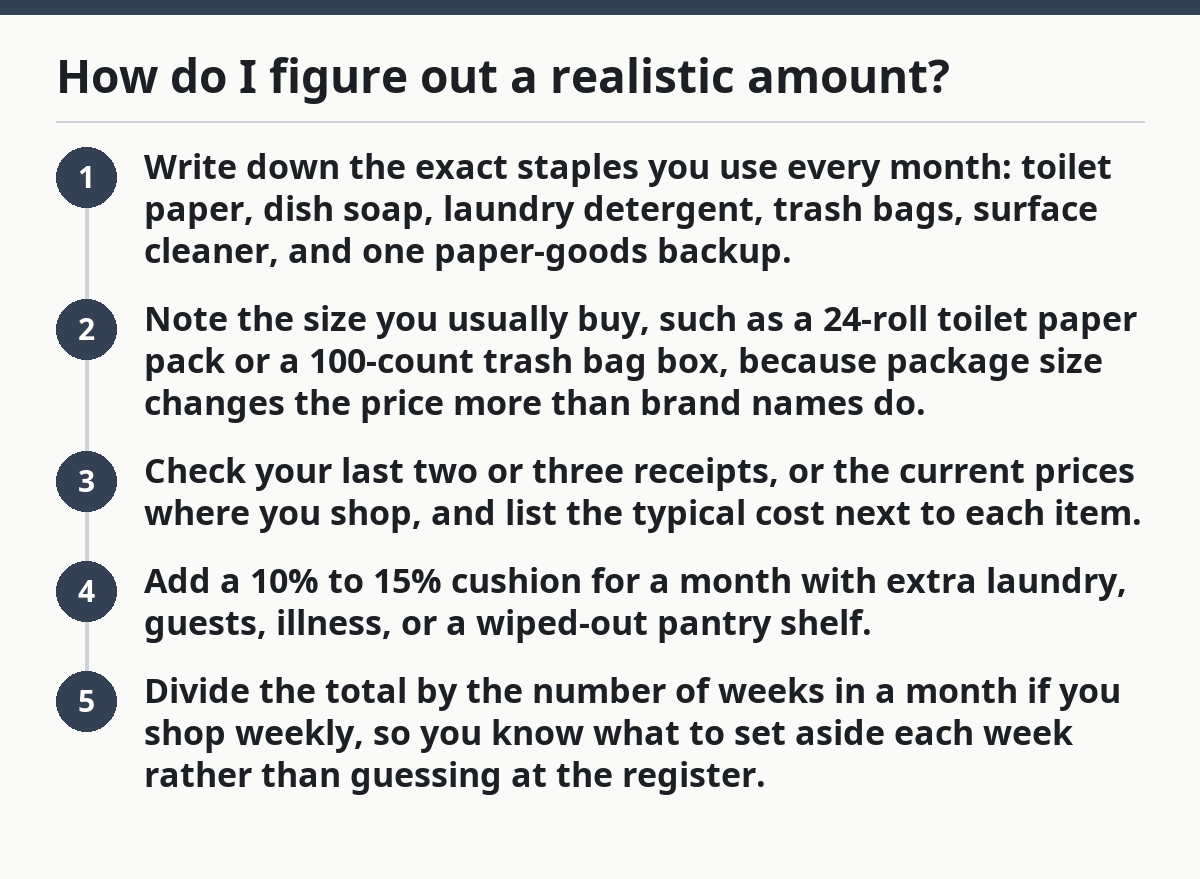
Starting from zero? Build the number from the shelf, not the spreadsheet:
- Write down the exact staples you use every month: toilet paper, dish soap, laundry detergent, trash bags, surface cleaner, and one paper-goods backup.
- Note the size you usually buy, such as a 24-roll toilet paper pack or a 100-count trash bag box, because package size changes the price more than brand names do.
- Check your last two or three receipts, or the current prices where you shop, and list the typical cost next to each item.
- Add a 10% to 15% cushion for a month with extra laundry, guests, illness, or a wiped-out pantry shelf.
- Divide the total by the number of weeks in a month if you shop weekly, so you know what to set aside each week rather than guessing at the register.
That cushion matters because household supplies are not steady. A toddler, a pet, a wet season, or a day home sick can make one month look very different from the next. I would not set the number so low that you have to borrow from food money to buy trash bags.
For a single parent, the goal is not perfection. It is a repeatable number that can help prevent surprise shortages.
Build a dedicated household supplies category, not a junk drawer

A dedicated category works better than “miscellaneous” because it forces the right kind of trade-off. If the line is empty, you know exactly what needs to be cut or postponed, and you are not pretending a problem does not exist.
The simplest setup is one category with four subgroups: paper goods, cleaning products, laundry supplies, and trash and waste. That structure fits the items most families buy every month and keeps the shelf from turning into a random pile of half-used products. It also makes restocking easier because you can see which subgroup is driving the cost.
Here is a clean way to organize it:
- Paper goods: toilet paper, paper towels, tissues, napkins.
- Cleaning products: all-purpose cleaner, bathroom cleaner, glass cleaner, disinfecting wipes.
- Laundry supplies: detergent, dryer sheets, stain remover, fabric booster if you actually use it.
- Trash and waste: trash bags, compost bags if needed, liners, small bathroom bin bags.
The benefit is control. If you see that laundry supplies are taking too much of the budget, you can switch to a concentrated detergent, stop buying separate scent boosters, or choose a larger bottle that lasts longer. If paper goods keep running out early, the issue may be usage, not price.
The drawback is discipline. A category only works if you stop raiding it for “just this once” purchases. If dish soap starts covering hand soap, car wipes, and art cleanup, the line stops teaching you anything. I’d rather see a strict category than a flexible one that means whatever is left in the wallet.
This is also where the larger expense-planning system on the single-parent budgeting hub comes in, because household supplies should be one piece of the full budget map, not a guess made in isolation.
A simple restocking cadence that prevents emergency runs
A restocking cadence is the schedule that tells you when to buy before you run out. For most single-parent households, a 2-stage cadence works better than waiting until the shelf is empty. Consumer Financial Protection Bureau
Use a weekly check for fast movers and a monthly refill for the larger buys. That usually means checking toilet paper, dish soap, laundry detergent, and trash bags once a week, then buying the bigger pack or replacing the bottle once a month or whenever the backup supply drops below one unit.
Set up your shelf or cabinet with a “working stock” and a “backup stock.” Working stock is what you use now. Backup stock is the extra roll, box, or bottle that keeps you from making a panic trip at 8 p.m. The goal is not a warehouse; it is one backup unit for the most-used items.
A good rule is to restock when you hit the last full unit, not the last few ounces. Wait too long, and you may buy on the worst possible terms—rushed, full-price, and with a child in tow. Buy too early, and you risk overstocking and tying up cash in products you do not need yet.
The cadence should match the item:
- Toilet paper: check weekly, buy in bulk when the backup pack is opened.
- Dish soap: check every 1 to 2 weeks, especially if dishes are washed daily.
- Laundry detergent: check weekly if you do 2 or more loads a week.
- Trash bags: check monthly unless you have a large household or a lot of diaper waste.
This method keeps the budget from getting ambushed by “small” purchases that happen three times in one week. A $6 bottle of dish soap, a $12 trash bag box, and a $15 detergent refill can blow up the month if they all hit at once without a plan. That math stops working fast.
Common mistakes that make the category run over budget
The biggest mistake is buying household supplies only when something runs out. Emergency shopping usually happens in the least convenient place, at the least convenient time, with no chance to compare sizes or unit prices. Federal Trade Commission
Another mistake is counting the wrong items. A lot of single parents accidentally put paper towels, bathroom cleaner, stain remover, and hand soap in different mental buckets. On paper, the category looks fine; on the receipts, it gets crushed. One bottle is cheap. Six small purchases are not.
A third mistake is choosing the smallest package every time. The smaller size can look easier at the cash register, but it often costs more per ounce, roll, or load. A 24-roll toilet paper pack may be a better fit than several smaller packs if your storage space allows it. The trade-off is cash flow: bulk buying lowers trip frequency, but it asks for more money upfront. Federal Trade Commission
Another mistake is using household supplies money as a rescue fund for everything else. That solves one week and creates a shortage the next time you need trash bags or detergent. If the category is always empty, the issue may not be the supplies line at all. It may be that the budget is too thin and the category needs a reset.
A final trap is forgetting seasonal and life-stage changes. More laundry during rainy months, a baby in the home, kids home for a break, or a guest staying over can all move the number. If your spending rises for a month or two, do not assume the budget failed. Adjust the cadence, then test the new amount for 30 days.
How to keep the budget steady from month to month
The budget stays steady when you tie spending to usage, storage, and a fixed refill rhythm. That works better than trying to guess the “right” number once and never touching it again.
Start with a shelf audit every 30 days. Pull out every household supply and check three things: what is open, what is backup, and what has not been touched in 2 months. The goal is to see whether you are overbuying one item and underbuying another. A cabinet with three spare bottles of glass cleaner and no trash bags is a clue, not a problem to ignore.
Then assign a simple rule for each item. Example: keep one backup of toilet paper, one spare bottle of dish soap, one spare detergent bottle, and one extra box of trash bags. When the backup is opened, it goes on the shopping list. That rule keeps you from making inventory decisions in the aisle.
If money is tight, prioritize the items that stop a household from backing up: trash bags, toilet paper, laundry detergent, and dish soap. Cleaners that are nice to have can wait a week. That is an honest trade-off. A home can tolerate a delayed window cleaner; it cannot tolerate no toilet paper.
The limit of this method is storage. If you have a small apartment or no closet space, you cannot buy six months of supplies at once. In that case, focus on a 2- to 4-week buffer and make the budget a rolling plan instead of a stockpile plan. The category still works; it just works on less inventory.
For the broader budget structure, this kind of category management belongs inside the larger expense planning system for single parents, where each line gets a clear job and a clear limit.
A practical starter budget you can use this week
A starter budget is a temporary number you can use now, then adjust after 2 or 3 shopping cycles. It should be simple enough to use without a calculator app, and flexible enough to survive a change in household size.
If you have no history yet, split the category into four parts:
- 40% for paper goods
- 25% for cleaning products
- 25% for laundry supplies
- 10% for trash and waste
That split is not sacred. It is a starting shape that reflects how many households actually spend: toilet paper and paper towels can take a big slice, while laundry and trash are usually smaller but steady. If you use disposable diapers, have pets, or clean heavily because of allergies, the mix will shift.
You can also use a weekly set-aside instead of a monthly number. Put aside the equivalent of one small grocery run each week specifically for household supplies. That method is easier for people whose paychecks arrive weekly or every other week. It also helps if you are rebuilding from a month of overspending and need a gentler reset.
What matters most is consistency. A category that gets a little money every week beats a category that gets skipped until the cabinet is empty. If you buy one $18 detergent bottle and two $10 packs of paper goods in the same week, you need the budget to have already made room for that pattern.
The honest limitation is that there is no universal “right” number for household supplies. A one-child apartment, a multi-child house, and a home with two bathrooms will never spend the same way. The right budget is the one that covers your real usage without raiding other necessities.
How to budget for household supplies: quick answers
What counts as household supplies in a budget?
Household supplies are the non-food items you use up to keep the home clean and usable. That usually includes toilet paper, paper towels, dish soap, laundry detergent, trash bags, surface cleaners, sponges, and similar consumables.
How much should I budget for household basics?
There is no single correct amount because usage, storage space, and household size change the number. A practical budget starts with your last 2 to 3 months of receipts, then adds a small cushion for higher-use weeks and restocking months. Consumer Financial Protection Bureau
How often should I restock household supplies?
A weekly check with a monthly refill is a practical starting point for many single-parent households. It helps you buy before you run out and reduces emergency runs. Consumer Financial Protection Bureau
What is the best way to keep household supplies from going over budget?
Track receipts, set a dedicated category, and compare unit prices before buying larger packs. That helps you spot which items are actually driving spending. Federal Trade Commission
Drafted with AI; not yet reviewed by a person.