
Last updated: November 19, 2026
Key Takeaways
- Average a full year of bills, then set aside the same utility amount each month.
- Level billing can smooth payments, though it does not reduce what you owe.
- Seasonal habits and quick leak checks can trim costs before the next bill closes.
- The lowest bill of the year is a risky budgeting baseline.
Table of Contents
- Who this applies to, and what you need first
- How do you budget for high electric bills?
- What is level billing, and does it help?
- How can you lower utility bills seasonally?
- The mistakes that make seasonal bills worse
- What if your income changes from month to month?
- How do you know the plan is working?
- FAQ
July and January can ambush a budget. Utility bills jump fast in summer and winter, and for a single parent that can throw everything else off balance. If you need a way to handle How to Budget for Utility Bills That Spike in Summer or Winter as a Single Parent, the fix is plain: spread the cost across the year, watch usage, and set aside a monthly amount for the electric bill, gas bill, and water bill before the spike hits. No guessing required.
Who this applies to, and what you need first

This guide fits anyone whose utility bills spike in summer or winter and who needs those charges to stop wrecking the rest of the month. It also fits How to Budget for Utility Bills That Spike in Summer or Winter as a Single Parent if you have recent bills, a rough monthly income figure, and access to your utility company account online or by phone.
This is information, not financial advice. A qualified adviser may be the better call if your income changes often or you are already behind on bills.
Picture the scene: you open a July or January bill and the number is far higher than the month before. What you need is a plan that works for the next 12 months, not a patch for one ugly statement.
The broader housing and utilities budget for single parents approach is where this sits. It centers on seasonal utility spikes, level billing, usage tracking, home temperature control, and budget smoothing. For billing-rule questions, check your provider and a consumer source such as the U.S. Energy Information Administration or the Consumer Financial Protection Bureau.
How do you budget for high electric bills?
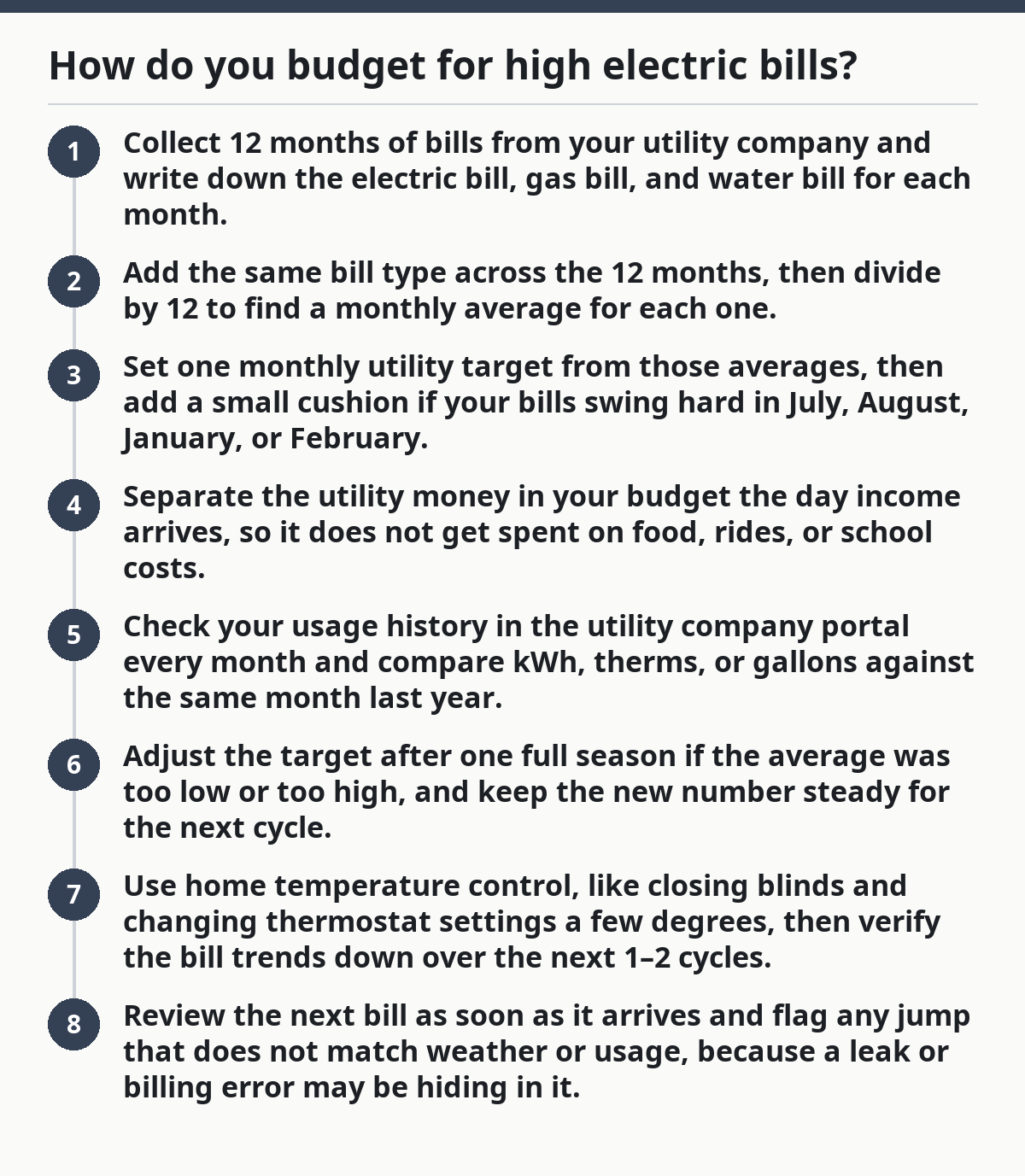
Start with the bills you already have. Then average them, pick a monthly utility target, and set aside that same amount every month. Summer and winter costs stop feeling like a punch to the gut when the money is already waiting.
- Collect 12 months of bills from your utility company and write down the electric bill, gas bill, and water bill for each month.
- Add the same bill type across the 12 months, then divide by 12 to find a monthly average for each one.
- Set one monthly utility target from those averages, then add a small cushion if your bills swing hard in July, August, January, or February.
- Separate the utility money in your budget the day income arrives, so it does not get spent on food, rides, or school costs.
- Check your usage history in the utility company portal every month and compare kWh, therms, or gallons against the same month last year.
- Adjust the target after one full season if the average was too low or too high, and keep the new number steady for the next cycle.
- Use home temperature control, like closing blinds and changing thermostat settings a few degrees, then verify the bill trends down over the next 1–2 cycles.
- Review the next bill as soon as it arrives and flag any jump that does not match weather or usage, because a leak or billing error may be hiding in it.
Treating every spike as a fresh emergency gets expensive fast. If the pattern is murky, call your utility company or a qualified adviser. Better to build the surge into the plan than to keep being surprised by it. That keeps the budget honest.
What to check before you set the monthly amount
A real baseline beats the last bill you saw. One winter statement can be inflated by cold snaps, and a summer one can be inflated by heavy air conditioning use, so a single month can send you in the wrong direction.
Match billing periods to billing periods. If your utility company bills every 28 to 31 days, compare full cycles rather than calendar months. The EIA notes that home energy use changes by season, which is why one bill rarely tells the whole story.
- Check whether your bill shows estimated or actual reads.
- Check whether the bill includes a late fee, deposit, or one-time credit.
- Check whether the unit rate changed, not just the usage.
If those items changed, the spike may not be from weather alone. Watch for that.
What is level billing, and does it help?
Level billing can help because it spreads expected utility costs into steadier monthly payments. It does not erase the bill, and it may or may not lower what you pay over the full year.
Also called an equal pay plan, level billing is a setup where your utility company estimates a smoother monthly payment based on past use. Some providers recalculate every few months; others do it once a year, so check the terms before you enroll.
You may prefer a middle-of-the-road payment each month over a huge gas bill after a cold snap. That trade-off is the whole point here.
Before you enroll, check three things:
- Whether the plan uses your actual usage history or a rough estimate.
- Whether there is a true-up month, when the company reconciles what you paid against what you used.
- Whether late payment rules change under the plan.
Predictable bills help most when your income is steady enough to handle the same amount most months. If your earnings swing around and even a stable payment is tough, the fit can be poor. For payment-plan questions, your utility’s customer service page and the CFPB are good places to start.
How to use usage tracking without making it a second job
Keep it light. You do not need a spreadsheet with 40 tabs; one note with a few numbers will do.
- Write down last month’s electric bill, gas bill, and water bill.
- Note the usage units, such as kWh, therms, or gallons.
- Compare them to the same month last year.
- Mark the days when the temperature was extreme or when kids were home all day.
A 5-minute monthly check is enough for most households. Two bills in a row with higher usage and mild weather? That is usually a clue, not a coincidence.
How can you lower utility bills seasonally?
Change the habits that hit hardest in heat or cold, and look for waste before the next bill closes. Some of the best savings come from small shifts that last all season.
Picture this: you are trying to keep the kids comfortable without running the air conditioner or furnace like it is free. Home temperature control is where the savings usually start.
Use the parts of the home that move the bill most:
- Set the thermostat to a stable range that works for your household instead of changing it all day.
- Close blinds or curtains during the hottest part of the day in summer.
- Use fans to move air so the thermostat does not have to do all the work.
- Seal obvious drafts around doors and windows in winter.
- Run laundry and dish loads in full cycles, not half loads, when possible.
A weather-driven utility bill is not always waste. Still, if the number jumps and the house feels the same, check the thing you can control first. That is the quicker fix. The Federal Trade Commission and the Department of Energy both point to weatherizing as a practical step.
When to stop and check for a different problem
Some spikes are not budget problems at all. They are billing or equipment problems, and the budget alone will not solve them.
One bill is far higher than the same month last year: This may point to a leak, a bad meter read, or a heating and cooling issue — contact the utility company and ask for a review before you assume the cost is normal.
The bill says estimated usage for more than one cycle: You may be paying on guesswork — ask when the next actual meter read will happen and whether the estimate can be corrected.
Your usage jumps but the weather is mild: Something in the home may be drawing more power or water — check for a dripping faucet, running toilet, or appliance problem.
The equal pay plan amount rises sharply: The company may be correcting an old shortfall — ask how the new amount was calculated and whether the plan will be reset after the true-up.
You cannot cover the bill even after smoothing it: The current target may be too high for your budget — speak with a qualified financial adviser or the utility company about payment options and hardship programs that may exist in your area.
The mistakes that make seasonal bills worse
Budgeting only for the lowest month of the year is the biggest slip-up. Then the next heat wave or cold snap lands, and there is no room for it.
Picture this: July arrives, the air conditioner runs harder, and the budget has no space left. The bill looks like a crisis, but the real mistake started months earlier.
- Using one month as the average: This makes the budget too low or too high. Use a 12-month average instead.
- Ignoring winter gas use or summer electric use: This leaves one season uncovered. Separate the bill types so you can see which one moves.
- Treating level billing as a discount: It is not. It only spreads the cost out, and the true-up can still sting.
- Skipping usage checks: That hides leaks, billing errors, and wasted power. Review each bill before the due date.
- Waiting until the bill arrives: By then the cost is already locked in. Build the target before the season starts.
The correction is straightforward, though not exactly pleasant: look back 12 months, not 1 month, and treat the spike as part of the budget rather than an exception. If the numbers still do not add up, consult your utility company or a qualified adviser before changing the plan.
What if your income changes from month to month?
A variable income calls for a tighter version of the same system. Base fixed bills on the lowest realistic income month, then use extra income to fill the seasonal utility gaps.
Picture this: one pay period is strong and the next is thin. If you build the utility budget from your best month, the worst month will bite back.
On a lower-income month, protect the essentials first:
- Reserve the utility amount you already know is coming.
- Keep the equal pay plan or monthly average payment current.
- Push any extra payment to the months when summer or winter bills rise.
If income swings are large, ask the utility company whether budget billing, due-date changes, or payment arrangements are available. Terms vary by provider and region, so check the rules that apply where you live.
How do you know the plan is working?
The plan is working when the bill stops taking you by surprise and your budget can absorb the seasonal rise without borrowing from groceries, rent, or transit money. That is the real test.
A good result looks like this:
- The monthly utility line stays steady for several months.
- Summer and winter peaks are less painful because money was already set aside.
- You can explain the bill change by weather or usage, not guesswork.
- The utility company account stays current, or close to current, without panic payments.
If the plan is not working after one full season, do not blame yourself. Recheck the average, the meter reads, the plan settings, and the actual household usage. The number may need a reset, not a bigger willpower push.
FAQ
How do I budget for high electric bills?
Budget for high electric bills by averaging a full year of electric bill history and paying that amount every month. The steady payment should be based on real usage, not the cheapest month. If the bill still jumps, check the utility company account for estimated reads, rate changes, or a home problem.
What is level billing?
Level billing is a payment plan that spreads expected utility costs into even monthly amounts. The utility company usually recalculates the payment after reviewing past use, and there may be a true-up later if you paid more or less than you used. It helps with predictability, not with reducing total usage.
How can I lower utility bills seasonally?
Lower utility bills seasonally by changing the habits that drive summer and winter use. Use home temperature control, close blinds, seal drafts, and compare current usage with the same month last year. If the bill spikes without a clear reason, ask the utility company to review the meter read or account details.
Drafted with AI; not yet reviewed by a person.