Last updated: November 19, 2026
Key Takeaways
- Plan before spending so cash tips do not disappear into small purchases.
- Log tips the same day, then compare the record with deposits and sales totals.
- Split cash tips immediately so the money does not vanish between shifts.
- Your split should match rent, taxes, and how often you can bank cash.
How to Budget for Cash Tips as a Single Parent starts with treating cash tips as money you split the same day: part for bills, part for taxes, part for a bank deposit. If you are unsure about the tax side, consult a professional and use IRS guidance as a starting point. The steps below show how to turn uneven tips into a budget that still holds up on a school week.
Start with a zero-based cash tip plan

How to Budget for Cash Tips as a Single Parent works best when every tip gets a job the moment it lands. Picture this: your shift ends, you have mixed bills in your pocket, and tomorrow still has daycare, gas, and groceries. You need a plan before the cash gets spent on small stuff, because cash tips disappear fast when you parent alone.
A zero-based plan gives every tip a job the moment it lands.
When it works, you can point to each dollar and say where it is going.
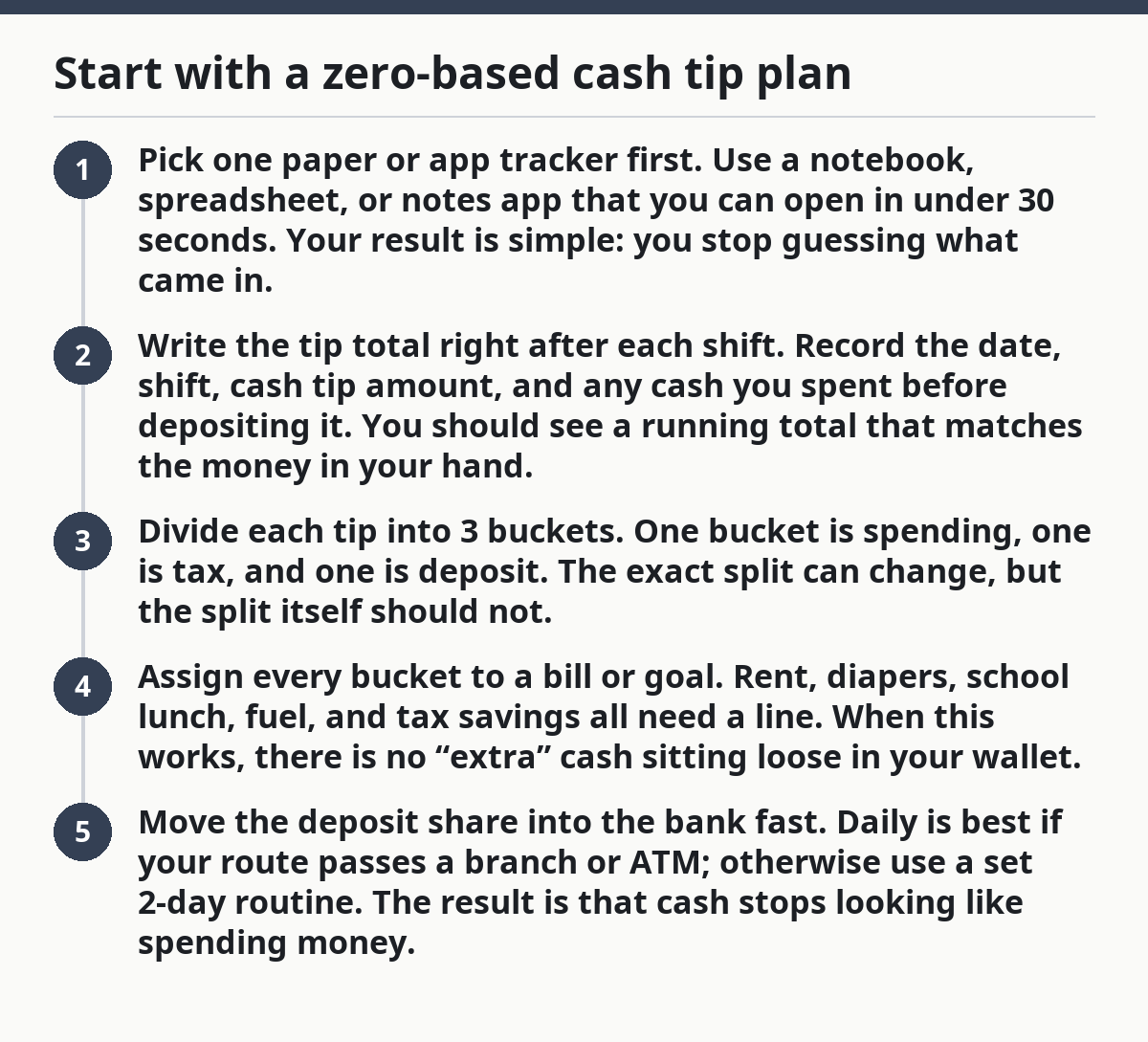
- Pick one paper or app tracker first. Use a notebook, spreadsheet, or notes app that you can open in under 30 seconds. Your result is simple: you stop guessing what came in.
- Write the tip total right after each shift. Record the date, shift, cash tip amount, and any cash you spent before depositing it. You should see a running total that matches the money in your hand.
- Divide each tip into 3 buckets. One bucket is spending, one is tax, and one is deposit. The exact split can change, but the split itself should not.
- Assign every bucket to a bill or goal. Rent, diapers, school lunch, fuel, and tax savings all need a line. When this works, there is no “extra” cash sitting loose in your wallet.
- Move the deposit share into the bank fast. Daily is best if your route passes a branch or ATM; otherwise use a set 2-day routine. The result is that cash stops looking like spending money.
The truth is, the budget only works if you use the same rule every shift. A different split every Friday turns into a mess by Tuesday.
What the plan does not buy: it does not smooth out slow weeks, cover all taxes by magic, or make tips predictable. It does make your real cash visible, which is the part most budgets miss.
How do I track cash tips for budgeting?
You track cash tips for budgeting by logging them the same day, then comparing the log to your bank deposit and daily sales record. That gives you a paper trail for money that would otherwise vanish into change, coffee runs, and impulse stops at the store.
Picture this: your shift ended, you have three $20 bills and a handful of smaller notes, and you’re too tired to remember what came in two days ago. A tip log fixes that by keeping the numbers small and current.
Use this 4-line format for each shift:
- Date
- Shift or work location
- Cash tips received
- Cash moved to deposit or tax bucket
That format gives you enough detail without turning the task into bookkeeping homework. If you want one extra line, add “cash spent before deposit” so you can spot leaks.
A daily sales record matters because it gives you a second check. If the register shows card tips or sales totals and your cash log shows something different, you can catch the gap while the shift is still fresh. For service work, that matters more than perfect memory.
A good tracking habit looks like this:
- You enter tips once a day, not once a month.
- Your deposit amount can be traced back to the log.
- Your tax estimate uses recorded numbers, not a guess from memory.
Now, you might be wondering if a receipt photo is enough. It helps, but a photo alone doesn’t sort the money into tax, spending, and deposit. The log does that part.
For tax tracking basics, the IRS self-employed resources and Schedule C instructions are useful starting points if your tip income is reported that way. If you’re unsure how tip reporting applies to your work, a tax preparer can help you match the record to your filing setup. See also the IRS pages on self-employed individuals and Schedule C.
What to do with cash tips the day you get them

You split cash tips the day you get them so the money never gets a chance to vanish between shifts. That routine is the heart of a workable cash tip income budget, especially when your calendar has school pickup, late rides, and a 10-minute grocery stop.
Picture this: you walk in the door after a busy shift and your kid needs dinner in 20 minutes. If you wait until Sunday to sort the cash, some of it is gone before it ever reaches the budget.
Use this order every time:
- Count the cash once. Do it at home or in your car before the cash mixes with other money.
- Set aside the tax share. Put it in a separate envelope or wallet pocket.
- Set aside the deposit share. That money goes to the bank, not to groceries or snacks.
- Keep the spending share small. This is the part you can use for that day’s real needs.
- Log the total before the cash moves again. Your record should match the bills in your hands.
A set routine can protect you from one common mistake: treating all tip cash like free money. That mistake costs more than it looks like, because it turns one good shift into three tight days. If your setup is confusing, consult a professional and check IRS guidance before you rely on a split.
You do not need a fancy envelope system. Two envelopes or two labeled pockets are enough. One holds taxes. One holds deposit money. If you prefer cash bands or a small lockbox, those work too.
Here’s the catch: if you work late and bank hours are closed, the deposit share still needs a home that is not your everyday wallet. A separate container buys time. It does not buy safety from temptation.
How much of cash tips should go to bills, taxes, and deposit?
You should split cash tips into bills, tax savings, and deposit money using a fixed percentage that fits your household, then keep that split steady for at least one full month. The right mix depends on your rent, your tax setup, and how often you can bank cash.
Picture this: one week you have enough tips for diapers and gas, and the next week is slow. A fixed split stops the strong week from disappearing into random spending.
A simple setup is:
- Bills share: money you plan to spend within the next 7 days
- Tax share: money reserved for estimated tax or income tax at filing time
- Deposit share: money that moves to the bank and gets mixed with your checking account
If you get paid mostly in cash tips, your deposit share should be the piece that makes regular bills easier to pay by card, transfer, or automatic draft. That is what this money does. It turns loose cash into money your normal budget can use.
What it does not do is replace a full household budget. You still need fixed numbers for rent, phone, transit, and food. Tips should feed the budget, not run it alone.
One honest limitation: if your tips swing wildly, a percentage split can feel tight in slow weeks and too loose in busy ones. That is normal. The answer is not to quit the system; it is to keep the split steady and adjust the bill line only after you have 30 days of records.
For tax tracking, the IRS guidance on tip income and self-employment records is worth reading if your job treats you as a contractor or requires you to report tips yourself. If the tax part feels unclear, a tax professional can help you set the reserve without guessing. See the IRS pages on tip income and self-employment tax.
How do I keep a cash deposit routine without wasting time?
You keep a cash deposit routine by making bank runs part of your week, not a chore you “fit in” when you remember. A 2-day or weekly deposit routine works better than waiting until you have a big stack of bills.
Picture this: you are already near a branch on your route to school pickup. That is the moment to drop the deposit money, not next Thursday when the stack is taller and the errands are worse.
Use a route you already travel. If your bank is near your grocery store or on the way to work, build the deposit into that stop. If not, choose one set day and one set errand window. A routine beats size.
A good routine has these parts:
- Same day each week for the main deposit
- Same container for cash you plan to bank
- Same check before you leave home: count, log, seal, go
- Same receipt habit so you can match the deposit later
That routine helps in two ways. First, it keeps cash out of your everyday spending pile. Second, it gives you a clean number for your tax estimate and your budget review at the end of the week.
The mistake to avoid is carrying cash for “just a few more days.” That usually means the money gets absorbed by food runs, kids’ extras, or one sudden repair. The fix is boring, but it works: bank sooner, in smaller batches.
If your bank has deposit limits, branch rules, or ATM fees, read the account terms before you rely on the machine. A deposit routine only helps if it actually clears into the account you use for bills. See your bank’s deposit policy or account agreement before you depend on it.
What mistakes break a cash tip budget?
The biggest mistakes are mixing all tip cash together, skipping the log, and underestimating taxes. Each one costs you real control, and the fix is a 5-minute habit, not a new app.
Picture this: you have $80 in tip cash, but half of it gets spent on snacks, one ride share, and a kid’s last-minute school supply. The budget did not fail because the numbers were hard. It failed because the cash had no fence around it.
Three common mistakes show up fast:
- No tip log. Cost: you cannot prove what came in. Fix: write the shift total before you do anything else.
- No tax reserve. Cost: filing season becomes a shock. Fix: move a set share of each tip into a tax envelope or account.
- No deposit routine. Cost: tip money gets absorbed by daily spending. Fix: bank on the same day or same weekly route.
A fourth mistake is using tip cash to “patch” every shortfall. That feels helpful for one week and painful the next, because the money that should cover meals or school costs has already been spent.
Who this is not for: if you need perfect, day-by-day predictability and cannot spare even 10 minutes after a shift, a cash-heavy budget will feel brittle. In that case, a wage-based budget or a fuller monthly system may fit better than a cash-first plan.
The point is not to make cash tips feel neat. The point is to make them traceable enough that rent, food, and taxes are not fighting each other.
For more on timing and income patterns, see the hub on cash flow, timing, and income patterns. This page stays with cash tips, logs, deposits, and taxes.
How do I track cash tips for budgeting?
You track cash tips for budgeting by recording each shift the same day and matching that record to your deposit. That gives you a clean count for cash that otherwise gets lost in the week. A notebook, spreadsheet, or notes app works as long as you use it every shift.
Should I budget cash tips separately?
Yes, you should budget cash tips separately from your regular pay so you can split out taxes and bank deposits before the cash gets spent. That keeps tip money from disappearing into food, gas, or small purchases. It also gives you a clearer number for bills you can actually cover.
How do I plan taxes on tip income?
You plan taxes on tip income by setting aside a fixed share of each tip and using your log to estimate what you owe. The IRS pages on tip income and Schedule C records are a good starting point if your work falls under self-employment rules. If your setup is unclear, a tax professional can help you sort the reserve.
Drafted with AI; not yet reviewed by a person.