Last updated: November 19, 2026
Key Takeaways
- Start with a work calendar, fixed bills, and one savings goal before you move any money.
- Use peak-season pay to cover bills first, then savings, then flexible spending.
- Save enough in busy months to cover slow months, plus a small cushion for surprises.
- Put payday dates, slow months, bill due dates, and child care changes on one calendar.
A seasonal job can pay well in one stretch and go quiet in the next, which is hard when you’re covering rent, food, and child care alone. Quick Answer: a seasonal income budget works best when you spend peak-season pay on purpose and protect the off-season before it starts. This guide on How to Budget for a Seasonal Job as a Single Parent shows how to build that plan without guessing.
What a seasonal income budget needs first
Because you may already know the work will slow down in 8 weeks, start with a work calendar, a basic list of fixed bills, and one savings target before you move any money. Without those three pieces, a seasonal job turns into a scramble.
Here’s the catch: you do not start with a fancy app or a full-year spreadsheet. Instead, you start with the dates you work, the dates you get paid, and the bills that do not change much from month to month. That gives you the frame for the rest of the plan.
- Mark the work season on a calendar first. Use a paper calendar, phone calendar, or wall planner and write in every work week, payday, and known gap month. When this works, you can see the busy stretch and the empty stretch at a glance.
- List your fixed monthly bills next. Put rent or mortgage, utilities, phone, transportation, child care, and minimum debt payments on one page. If a bill can’t wait, it belongs here.
- Separate your peak season money from your off-season money. Pick one checking account for spending and one savings account for the money that must last later. A separate account makes the gap harder to ignore.
- Choose your “must-pay” number for one month. Add the bills you cannot skip and the groceries, gas, and child care you need to keep life steady. That number tells you what each off-season month has to cover.
- Set a savings buffer goal based on your gap months. If your work stops for 2 months, plan for 2 months of core expenses, even if you build it in pieces. A buffer buys time; it does not buy extras.
The first setup does not need to be perfect. You need a calendar, a bill list, and a place for the extra money to sit untouched.
How do I budget around peak season income?
You budget around peak season income by assigning every dollar a job the day it lands, before the month slips away. The money from your busiest weeks has to cover current bills, next month’s bills, and the off-season, or the season will spend itself.
Because the checks are larger than usual, it can feel safe to relax the rules. That’s the trap. A seasonal job often makes one month look rich while the next month is already empty, so the real task is to stretch the high weeks into the quiet ones.
The order matters. Start with the bills that keep the lights on, then the savings buffer, then the flexible spending. If you reverse that order, the off-season will collect the leftovers, and leftovers usually disappear.
- Pay the next 30 days of core bills first. Move money for rent, utilities, child care, gas, food, and debt minimums as soon as you get paid. When this step works, the next month is already protected.
- Fund the savings buffer before you spend on extras. Put a set piece of each peak-season check into savings, even if it is a small amount at first. The transfer should happen before you shop, not after.
- Keep a weekly spending cap for flexible costs. Give yourself one number for takeout, school extras, coffee, and impulse buys. If the cap is gone, you stop spending in that category until the next paycheck.
- Hold a small reserve for job-related costs. Seasonal work can come with gas, uniforms, boots, parking, or child care schedule changes. A reserve keeps those costs from wiping out your bill money.
- Track the split for one full season. Write down what each paycheck covered and what was left. At the end of the season, you should know whether your plan covered the gap or only delayed it.
On the flip side, do not treat peak season as a reward period. According to the CFPB’s budgeting guidance, the goal is to give every dollar a job before it disappears. It is the time to build your off-season survival money. That is the whole point.
How much should I save during the busy months?
You should save enough in the busy months to cover the months when work slows, plus a small cushion for surprise costs. The exact amount depends on your bills and how long the gap lasts, not on a rule of thumb from someone else’s life.
Because a strong week can make everything feel urgent, it is easy to want to catch up on everything at once. You can still catch up, but the first job of the season is not to upgrade your life. It is to make the slow stretch survivable.
A seasonal income budget works best when you divide the buffer into pieces instead of one giant, impossible goal. That keeps the target real. It also makes the plan easier to resume after an expensive week.
Use this order:
- Core buffer first: cover the basics you must pay every month, like housing, utilities, food, transportation, and child care.
- Gap-month layer second: add money for the specific months you expect to be short.
- Small shock cushion last: keep a little extra for a tire, school fee, or medical co-pay that lands at the wrong time.
If your gap month is long, build the buffer in slices. You might send a fixed amount from every paycheck into savings, or move a set share of overtime and tips. The method matters less than the habit. The account should grow every time you get paid.
A common mistake is saving only after everything else is paid. That leaves the buffer at the mercy of groceries, school needs, and a child’s sick day. Save first, then spend what remains. According to the Consumer Financial Protection Bureau, automating savings can help money reach the right place before it gets spent.
Who this is not for: If your job changes by the week and you cannot tell when the next shift will come, this seasonal plan will be too rigid. A more flexible irregular-income system fits better, which is covered on the cash flow and timing hub.
What should my work season calendar show?
Your work season calendar should show payday dates, expected slow months, bill due dates, and child care changes in one place. That calendar is the map that keeps a seasonal job from tricking you into spending money you will need 6 weeks later.
Because your work pattern and family pattern both matter, the wall calendar should hold both. If it only shows soccer practice and birthdays, it misses the money part.
Use a simple 12-month view if you can. Put a mark on every payday, circle the months when work is strongest, and shade the months when hours usually drop. If you know the gap months, label them clearly. The goal is not design; it is visibility.
Then add the bills that hit on a fixed date. Rent on the 1st, phone on the 15th, child care on Fridays — whatever your real schedule looks like. When the calendar is full, the risk is easier to see.
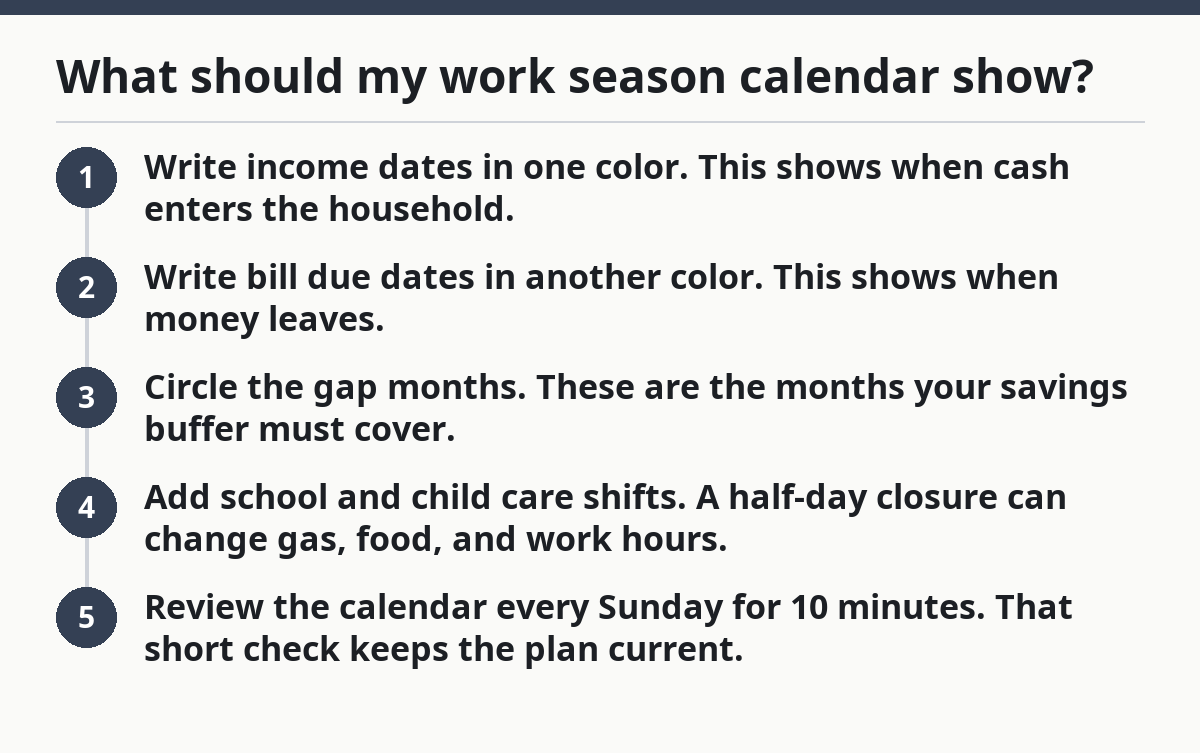
- Write income dates in one color. This shows when cash enters the household.
- Write bill due dates in another color. This shows when money leaves.
- Circle the gap months. These are the months your savings buffer must cover.
- Add school and child care shifts. A half-day closure can change gas, food, and work hours.
- Review the calendar every Sunday for 10 minutes. That short check keeps the plan current.
The truth is, a calendar will not save money by itself. It does something better: it shows you the exact weeks when you need to slow spending, push savings, or prep for lower hours. That is what keeps the budget honest.
What mistakes cost single parents the most?
The biggest mistakes are spending peak-season money too fast, forgetting about gap months, and ignoring child care changes until the bill arrives. Each mistake costs real cash, and each one is preventable with one small habit.
Because the next month can arrive with fewer shifts, it is easy to cover the visible bills and treat the family to a few extras. Then the spending pattern from the good month is still in place. That mismatch is where seasonal budgets break.
The cost is not abstract. A missed savings transfer means a later payday has to cover old spending. A forgotten school break can mean you scramble for child care at the last minute. A skipped calendar review can leave you short on gas for work.
- Mistake: spending like every month is a peak month. Cost: the buffer disappears before the off-season begins. Fix: cap flexible spending the same day the paycheck arrives.
- Mistake: saving only what is left over. Cost: the leftover is often zero. Fix: move money to savings before any nonessential purchase.
- Mistake: guessing the gap months. Cost: you underfund the slow stretch. Fix: write the slow months on the calendar, even if they are approximate.
- Mistake: forgetting school and child care schedule changes. Cost: surprise fees and missed shifts. Fix: list every known closure or shift in one place.
- Mistake: trying to handle all catch-up spending in the first busy week. Cost: your best cash month gets drained. Fix: spread catch-up expenses across the season.
A seasonal income budget does not reward hustle by itself. It rewards order. That is the hard part, and the useful part.
Which bills get priority in an off-season plan?
Your off-season plan should prioritize housing, utilities, food, transportation, child care, and minimum debt payments in that order of urgency. Those are the bills that keep the household running when hours drop or shifts disappear.
Because the due dates do not stop when income slows, you need to separate survival bills from delayable bills before the off-season starts. If everything is treated as urgent, nothing gets protected. The better move is to sort the list before the gap begins.
Use your must-pay number from the first section and compare it with the money you expect during the slow months. If the off-season income does not cover that number, the gap has to come from savings. That is what the buffer is for.
The plan changes a little when a bill can be negotiated or postponed. A utility bill might offer a payment arrangement; a streaming service does not deserve the same priority as rent. The budget should match the reality of the household, not the biller’s wish list.
- Cover the roof first. Housing comes before upgrades, gifts, and optional spending.
- Keep the lights and heat on. Utilities belong near the top because they affect daily life fast.
- Protect food and transportation. Without these, work and parenting both get harder.
- Hold child care in the core list. If child care lets you work, it is part of the budget, not an extra.
- Pay only the minimum on debt if the season is thin. That keeps accounts current while you protect cash for essentials.
Here’s the catch: a good off-season plan is not about being perfect with every bill. It is about making sure the household stays stable until the next busy season arrives.
How do I reset the budget when the season changes?
You reset the budget by checking the calendar, updating the income estimate, and moving money to the next job in line within 30 days of the change. A seasonal job changes the rules fast, so the budget has to move with it.
Because the season has flipped, the budget from last month may still assume full pay. That mismatch creates late fees, overdrawn balances, and stress. The fix is a reset, not a heroic catch-up week.
Start with the new season’s pay pattern. If the busy months are over, stop funding extras first, then protect the core bills, then use the buffer only for the gap months it was built to cover. If the busy season is starting, reverse the order: core bills, buffer, then spending.
A reset also means cleaning up the calendar. Mark the new work weeks, remove old assumptions, and check whether child care or transportation costs changed. Even one new after-school pickup can change the whole month.
- Check the next 3 paydays. That tells you what cash is actually coming, not what you hoped would come.
- Re-list the next 30 days of bills. Do not trust the old list if the season has changed.
- Move savings money only once, on purpose. One clear transfer is easier to track than many random ones.
- Cut one flexible expense immediately. This creates room before the budget gets tight.
- Review the plan with your work calendar. If the calendar and the budget disagree, the calendar wins.
That reset is what keeps a seasonal income budget from turning into a pile of old notes. The season changes. The plan should too.
FAQ
How do I stretch seasonal income through the off-season?
You stretch seasonal income through the off-season by paying the core bills first and using the savings buffer for the gap. Start with housing, utilities, food, transportation, and child care, then cut flexible spending hard until the next work stretch begins. If you have extra money, save it for the next gap, not the next splurge.
What months should I use to build a buffer?
You should use the highest-earning months to build the buffer, especially the first 1 to 3 months of peak season if that is when your hours are strongest. Put money aside as soon as the busy season starts, because the later months often come with fatigue, higher spending, or smaller checks. The strongest cash-flow months are usually the best ones for building savings, not the ones that feel easiest.
How do I plan for work gaps between seasons?
You plan for work gaps between seasons by writing the gap months on your calendar, matching them to your core bills, and saving before the slow stretch starts. That way, the next season starts with a plan instead of a scramble.
Drafted with AI; not yet reviewed by a person.