
Last updated: November 19, 2026
Key Takeaways
- Break the bill into urgent, delayable, and optional work, then shift money from the least harmful places first.
- Check whether the repair is really urgent, whether the estimate is complete, and whether one cut creates a bigger bill later.
- Free cash by trimming variable spending first and protecting the fixed bills that keep the household stable.
- Use transport backup only for the days you truly need and avoid creating another money drain.
Your car broke down and the repair can’t wait, so the problem is cash flow, not just the car. In How to Budget for a Car Repair That Can’t Wait as a Single Parent, the quickest practical response is to triage the repair, get a written estimate, cut only the least harmful expenses for 30 days, and line up a payment plan or transport backup before the bill lands. The steps below show how to make room for an emergency car repair without guessing.
What this plan assumes
This plan applies if you need to keep a car running now and you’re balancing childcare, school runs, work shifts, and a repair estimate that you did not plan for. It assumes you already have a mechanic’s diagnosis or at least a clear repair estimate, even if the amount is still changing, and it keeps the focus on How to Budget for a Car Repair That Can’t Wait as a Single Parent.
It also assumes you need practical budgeting choices, not a lecture about perfect money habits. This is information, not financial advice; if your situation is tight enough that one repair affects rent, utilities, or debt minimums, a qualified adviser or local nonprofit counselor can help you sort the broader picture.
Picture this: you’re trying to get to work on Monday, your only car won’t start, and the tow yard is already charging by the day. You need to know what to do in the next 24 hours, not next month.
That is the job here.
- Emergency car repair: handle the bill.
- Temporary cutbacks: create room fast.
- Alternate transportation: keep the household moving.
- Repair fund: start the next buffer, even if it’s tiny.
How do I budget for a car repair that can’t wait?
You budget for How to Budget for a Car Repair That Can’t Wait as a Single Parent by separating the repair into must-fix now, can-wait, and can-be-postponed, then moving money from the least damaging places first. The goal is to cover the repair without creating a second emergency in the same month.
Picture this: the mechanic has named the problem, and you have a rough estimate in hand. You’re not deciding whether the car is worth owning; you’re deciding how to make this one bill fit while the kids still need rides. The next steps keep that focus tight.
- Get the estimate in writing. Ask for the diagnosis, parts, labor, and any shop fees on paper or in a text/email. Verify whether the total includes tax, shop supplies, and disposal fees. If the estimate is only verbal, you can’t compare options or ask for a payment plan with confidence.
- Ask which repair is safety-critical. Tell the mechanic to separate the repair into “car won’t run,” “car may be unsafe,” and “nice-to-have.” Verify whether the issue is about brakes, steering, tires, cooling, or electrical starting problems. If the answer is vague, you may be paying for extras before the urgent part is handled.
- Compare the repair against one second opinion. Call one other shop with the same estimate details and ask whether the diagnosis sounds consistent. You do not need a full new teardown; you need a check on the big-ticket item. If the second shop refuses to discuss a written estimate, that’s a red flag.
- Pause nonessential spending for 30 days. Freeze restaurant meals, subscriptions, impulse buys, and any payments you can safely delay by a month without triggering a penalty that is worse than the repair. Verify the amount you can free up from this month only. If you can’t name the cut, the cut is too vague to help.
- Move money from a small, low-risk source first. Use cash on hand, a separate savings bucket, or a refund that is already due before touching anything tied to housing, food, or utilities. Verify the transfer date and how fast the money clears. If the money won’t arrive before the car is needed, it doesn’t solve the timing problem.
- Ask for a payment plan before the work starts. Ask whether the shop offers split payments, a deposit with the balance later, or a short-term plan in-house. Verify the due dates and any fee for carrying the balance. If the plan is only a vague promise, ask a professional to review it before you rely on it.
- Build a transport backup at the same time. Line up school drop-off help, a carpool, rides from family, a bus route, or a rental alternative for at least the repair window. Verify the days and hours you actually need coverage. If you wait until the car is already in the bay, you may pay extra for rushed rides.
- Reserve a small repair fund line after the fix. Start a separate savings line, even if it is just the next $10, $20, or $50 you can spare. Verify that this money is not mixed into grocery cash or general checking. If it stays in the same pool, it disappears.
This plan does not require a perfect budget. It requires a short, honest one. A repair estimate, a temporary spending cut, and one backup ride plan can carry a lot of weight.
What should I check before I cut anything else?
You should check whether the repair is truly urgent, whether the shop’s estimate is complete, and whether one cut will create a bigger bill later. That keeps you from trimming the wrong line item and then paying again a week later.
Because the repair can spill into the rest of the month, this check comes before any deeper budget moves. Picture this: you are staring at a repair total and trying to decide whether to delay a utility bill, pause a streaming service, or ask your sister for a ride. The right move depends on the timing, not the emotion attached to the bill.
- Is the car drivable at all? If the mechanic says “do not drive it,” the cost of delay may include towing or more damage.
- Is the estimate itemized? A line-by-line estimate helps you see labor, parts, and any optional work.
- Is the repair time-sensitive? A cooling problem, brake issue, or charging issue can change quickly.
- Will delaying a payment cost more than the repair? Sometimes a penalty or late fee is worse than pausing a subscription or a restaurant budget line.
- Can another adult help with rides for 2–5 days? That may buy time to move cash without panic.
- Does the shop accept a deposit? Some shops will hold the job with partial payment; others won’t.
If you can’t answer those questions, stop and get the estimate clarified first. A fuzzy repair becomes a fuzzy budget, and that is how people overcommit to the wrong bill.
How do I make room for the bill without wrecking the month?
You make room by cutting short-term, variable spending first and protecting the fixed bills that keep the household stable. The goal is not to “save money” in a general sense; it is to free enough cash for a single repair cycle.
Since the repair may already be pressing against your next payday, use a temporary budget shift rather than a total financial reset. Picture this: the month has already started, and the repair can’t wait for payday. You need a fast, temporary budget shift, not a total financial reset.
- List the next 14 to 30 days of spending. Put rent, utilities, groceries, childcare, gas, medicine, and the repair at the top. Verify which items are truly fixed and which can move.
- Pause discretionary spending immediately. Cut takeout, app purchases, entertainment subscriptions, and convenience buys for the rest of the month. Verify the dollar amount you’ve actually freed.
- Trim grocery waste, not grocery safety. Shift to cheaper meals, fewer snacks, and one store run instead of several. Verify you still have enough for a full week of food.
- Delay any nonurgent household purchase. Kids’ extras, home decor, and “while I’m at it” purchases can wait 30 days. Verify there is no fee for delaying.
- Use cash-flow timing, not just totals. Moving $100 from next week’s spending to today can solve the repair if the timing works. Verify the money clears before the shop deadline.
- Avoid turning a repair into debt you can’t carry. If a credit card or loan would create a longer problem, compare it with the shop’s own payment plan or a smaller repair scope.
- Set one post-repair deposit into a repair fund. Even a small transfer after the bill is paid starts the next buffer.
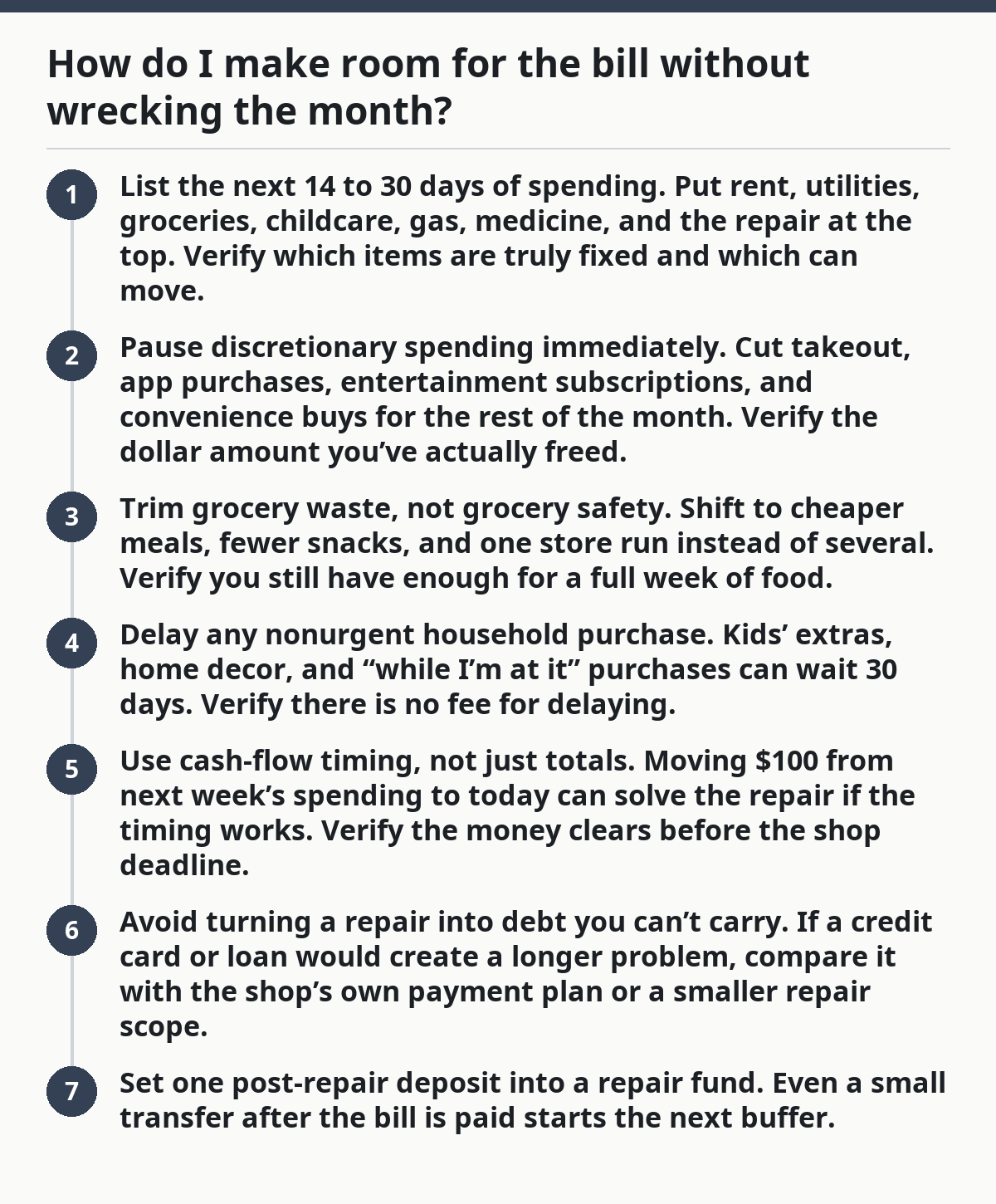
The mistake here is cutting fixed essentials first because they look big. That can create late fees, shutoffs, or stress that lasts longer than the repair.
What are the smartest transport alternatives while the car is in the shop?
The smartest alternatives are the ones that cover only the days you actually need and don’t trigger a second money leak. A short carpool, one bus pass, or a family ride plan often costs less than a full week of last-minute scrambling.
Because the repair also affects how you move through the week, the backup has to match your real schedule. Picture this: the car is in the shop, and you still have school drop-off, a shift, and a grocery run on the same day. You need a backup that matches your real schedule, not a fantasy schedule.
- Carpool with a time window. Ask one adult for a fixed pickup and drop-off time, not open-ended help.
- Use transit for one route. If your area has a bus or train line, use it for the longest daily trip and keep the short local trips for help.
- Stack errands into one trip. If a friend is already driving that day, combine school, pharmacy, and grocery stops.
- Ask the shop about turnaround time. A 2-day repair and a 7-day repair need different backup plans.
- Reserve rides for the nonnegotiable trip. Save paid rides for work or childcare handoff if that is the only place they truly matter.
- Use family help with a schedule, not vague promises. “Tuesday and Thursday at 7:30 a.m.” is better than “I’ll see what I can do.”
If the transport backup costs more than a basic repair delay, something is off. Recheck the estimate, the repair timing, or whether you need a larger temporary cutback.
When should I stop and get more help?
You should stop and get more help when the repair, the timing, or the payment terms could make the rest of your month unstable. At that point, the budget problem is no longer just about the car.
Because unstable payment terms can spread the damage beyond the repair itself, this is the point to slow down. Picture this: the estimate is bigger than expected, the shop needs money up front, and you’re already juggling bills. This is where a clean boundary matters.
The car is unsafe to drive: brake, steering, tire, or overheating problems can turn a short trip into a bigger repair or a safety issue — arrange a tow or ask the shop how to move it safely.
The estimate changes after teardown: that usually means the job is more complex than the first quote — pause and ask for the new total in writing before approving extra work.
The payment plan has fees you don’t understand: a plan that looks easy can still be expensive — ask for every due date, charge, and penalty in plain language before you sign.
The repair competes with rent, power, or child care: then the problem is no longer one bill — speak with a qualified local counselor or adviser about the wider budget before you commit to the repair balance.
You have no backup transportation at all: missing work or school may cost more than the repair itself — line up rides first, then approve the job.
The shop will not itemize the estimate: you can’t budget against a guess — ask for a line-by-line estimate or use another mechanic.
On the flip side, if the fix is small, the payment terms are clear, and you can move money from discretionary spending for 2–4 weeks, this is a manageable budget interruption. Not easy. Manageable.
The mistakes that make an emergency repair cost more
Because the biggest mistakes start with rushing and guessing, this is where costs usually rise. Each one can turn a repair into a month-long squeeze.
Picture this: you’re tired, the kids need a ride, and the mechanic wants an answer. That is exactly when people make the most expensive choice in the room.
- Approving work without a written estimate. The consequence is no clear budget target. The better move is to get the total in writing.
- Ignoring the safety-critical part. The consequence is paying for cosmetic or optional work first. The better move is to ask what keeps the car running and safe.
- Using every spare dollar on the repair. The consequence is late fees or food stress later. The better move is to protect the most time-sensitive household bills.
- Waiting too long to ask for a payment plan. The consequence is losing the chance to split the bill. The better move is to ask before the work starts.
- Forgetting transport costs. The consequence is the repair looks affordable until you add rides, transit, or missed work. The better move is to budget for both the car and the days without it.
- Not starting a repair fund afterward. The consequence is the next surprise hits just as hard. The better move is to set aside a small amount as soon as the month allows.
What a workable result looks like
A workable result is not “the repair felt cheap.” It is that you fixed the car, paid without missing the most important household obligations, and kept a small transport plan in place.
Because the goal is stability, the win is measured by what stayed intact around the repair. Picture this: the car is back, the kids got where they needed to go, and the month did not collapse under one bill. That is the real win.
A good result usually has three parts. First, the repair estimate was clear enough that you knew the number you were facing. Second, you used temporary cutbacks instead of permanent damage to the budget. Third, you ended with one small deposit or plan for a repair fund so the next problem is easier to absorb.
For more on the bigger picture, the transportation budget for single parents hub can help you build the rest of the system around this repair. For related planning, see the emergency budget checklist, childcare cost planning, how to build a small repair fund, and transportation budget for single parents. For guidance on consumer repair disputes and written estimates, see the Federal Trade Commission and the Consumer Financial Protection Bureau.
What should I do if my car breaks down and I have no savings?
Start with the estimate, the safety first, and the shortest possible transport bridge. If the plan is only a vague promise, ask a professional to review it and check local support options before you commit to a repair you cannot cover.
Drafted with AI; not yet reviewed by a person.