
Last updated: November 19, 2026
Quick Answer: for a single parent, this childcare commute budget usually starts as one monthly line item built from round-trip miles, gas, parking, and a buffer for delays.
Key Takeaways
- Turn each childcare commute into a monthly estimate, then add a small cushion for route changes and delays.
- Check the route, pickup rules, and parking setup before you lock in the budget.
- Cut miles, skip paid parking when you can, and reduce unnecessary cold-engine trips.
- Many parents miss the real total because they count one trip instead of many.
Childcare drop-off and pickup can quietly strain a single-parent budget because the childcare commute adds gas, parking, and extra miles to a trip you have to make anyway. In How to Budget for Childcare Drop-Off and Pickup Driving Costs as a Single Parent, you budget the route as a separate monthly line item, then track mileage, fuel, parking, and buffer time together. The steps below show how to build that number without guessing.
Who this applies to, and what you need first

This applies if you already know your childcare center schedule, your usual commute route, and roughly how many days a week you drive for drop-off and pickup. It also assumes you have a working car, a way to check gas prices, and a simple place to write down miles and parking fees. For your own situation, a qualified adviser can help if you need a more formal budget review.
Picture this: you’re trying to get out the door by 7:30 a.m., and one small change in the route adds a loop, a paid lot, or ten extra minutes of idling. That is where the budget gets bent. The fix is to treat the trip like any other recurring cost, with fuel costs, parking, and travel-time buffer all counted up front. You may want to consult a professional if the route is unusually complex. The U.S. Department of Transportation recommends planning for recurring travel conditions rather than relying on a single best-case trip. Source: U.S. (Source: DOT)
Many people miss the same thing: the trip is not just gas. It is also the mileage wear you create, the parking charge you pay on certain days, and the time cushion that keeps you from paying late pickup fees or rushing into bad driving habits. The amount varies by country, by neighborhood, and by the center’s rules. No universal figure fits everyone.
How do I budget for childcare commute costs?
You budget it by turning each trip into a small monthly estimate and then adding a cushion for detours, weather, and route changes. Start with mileage, then add gas, parking, and a modest buffer so the number is useful instead of brittle. If you want a local estimate, consult a professional or use your city’s current parking and fuel information before finalizing it. The IRS standard mileage rate can also help you benchmark driving costs. Source: IRS
Picture this: you’re standing in the kitchen with your calendar open, and you need one number that covers Monday through Friday without pretending every day is identical. That number comes from the route you actually drive, not the shortest route on a map. It should reflect the school gate, the daycare lot, and any stop you make between them.
- Measure your one-way route in miles or kilometers using your map app, then write down the round trip distance; verify the route is the same one you use at least 3 days a week, and flag a problem if the route changes because of school timing or one-way streets.
- Record your weekly childcare driving days, such as 5 drop-offs and 5 pickups or fewer if a co-parent handles some trips; verify the count matches your actual month, and watch for weeks with holidays, half-days, or closures.
- Estimate fuel use from your car’s usual fuel economy and current gas price, then compute monthly fuel cost from the round-trip miles; verify the gas price is local and current, and note a problem if the estimate ignores idling in pickup lines.
- Add parking fees, meter charges, or garage costs for the days they apply; verify whether the childcare center or nearby curb parking is free, and treat any day-rate or hourly charge as a separate line item.
- Include a mileage allowance for wear from the trip itself, even if you do not set aside a maintenance fund here; verify you are counting commute mileage only, and flag a problem if you are mixing this with repair savings from another budget.
- Set a travel-time buffer of 10 to 15 minutes per trip if your area has school traffic, paid parking, or a hard pickup deadline; verify the buffer is enough to keep you from rushing, and increase it if you regularly arrive late.
- Round up the total to a monthly figure and write it as a fixed budget line; verify the number still fits your cash flow, and if it does not, the problem is not the math — it is that the route cost is too high for the current plan.
Once you have that line item, you stop treating each gas stop like a surprise, and you can consult a professional if you want help stress-testing the total. You also get a cleaner view of whether a different route, a different parking choice, or a different pickup pattern would actually save money.
What costs belong in this budget?
The budget should include gas, parking, tolls if you pay them, and the extra mileage created by childcare travel. It should not include the full cost of owning a car, because that belongs in a separate transportation budget. That split keeps this page focused on the commute itself. The AAA Driving Costs study is a useful reference point for understanding how driving expenses can accumulate. Source: AAA
Use a simple monthly sheet with four columns:
- Trip cost: fuel for drop-off and pickup
- Parking cost: garage, meter, or lot fees
- Mileage count: round-trip miles or kilometers
- Buffer: extra money for route changes or school events
If you need one place to hang the whole picture, link this line item to the broader transportation budget for single parents and keep the childcare route as its own row. That keeps school travel from getting buried inside grocery runs or weekend driving.
What should I check before I set the number?

Check the route, the center’s pickup rules, and the parking setup before you lock in the budget. Those three items usually change the total more than people expect, especially near urban centers or tight school lots.
Picture this: you’re about to copy last month’s gas total into a new budget, but the center changed pickup doors, or the city changed meter hours, or your child’s schedule shifted by 30 minutes. A stale estimate can miss the real number. The route is the base; the rules around it do the damage.
Before you set the amount, check:
- Drop-off window and pickup window from the childcare center
- Parking rules at the curb, in the lot, or on the street
- Traffic pattern at the exact times you drive
- Detours from construction, school buses, or one-way roads
- Weather pattern if snow, rain, or heat changes your travel time
- Shared custody days if another adult covers some trips
A good estimate is boring in the best way. It lets you pay for the month without guessing, and it leaves room for the one-off day when the lot is full or the pickup line moves at a crawl.
How do I lower childcare commute expenses?
Cut miles, avoid paid parking when you can, and reduce the number of trips that happen with a cold engine and an empty seat. You are not trying to win every day; you are trying to remove the expensive edges.
Picture this: you’re choosing between a faster route and a cheaper one, and the difference is not just gas. It may be a meter, a garage fee, or another 8 minutes of idling in line. Small choices add up when you repeat them 20 times a month.
A few practical changes can help:
- Combine drop-off with another errand only if it does not add extra miles.
- Ask whether the center has a free curb space, a loading zone, or a short grace period.
- Keep pickup timing close to the center’s window so you are not paying for early arrival and waiting in paid parking.
- Recheck the route after school schedules change, because a 2-mile shortcut is not a shortcut if it sends you through a paid lot.
The truth is, the cheapest route is not always the one with the shortest distance. It is the one that avoids paid parking, cut-through traffic, and repeated backtracking.
The mistakes that throw off the number
People usually misjudge this budget because they count the trip once, not many times. That mistake turns a manageable cost into a month-end surprise.
Picture this: you’re looking at a gas receipt and thinking the budget is covered, but the receipt only shows one fill-up. It does not show the parking fees, the extra pickup loop, or the days you had to drive back because of an early call from the center. That gap matters.
Common mistakes:
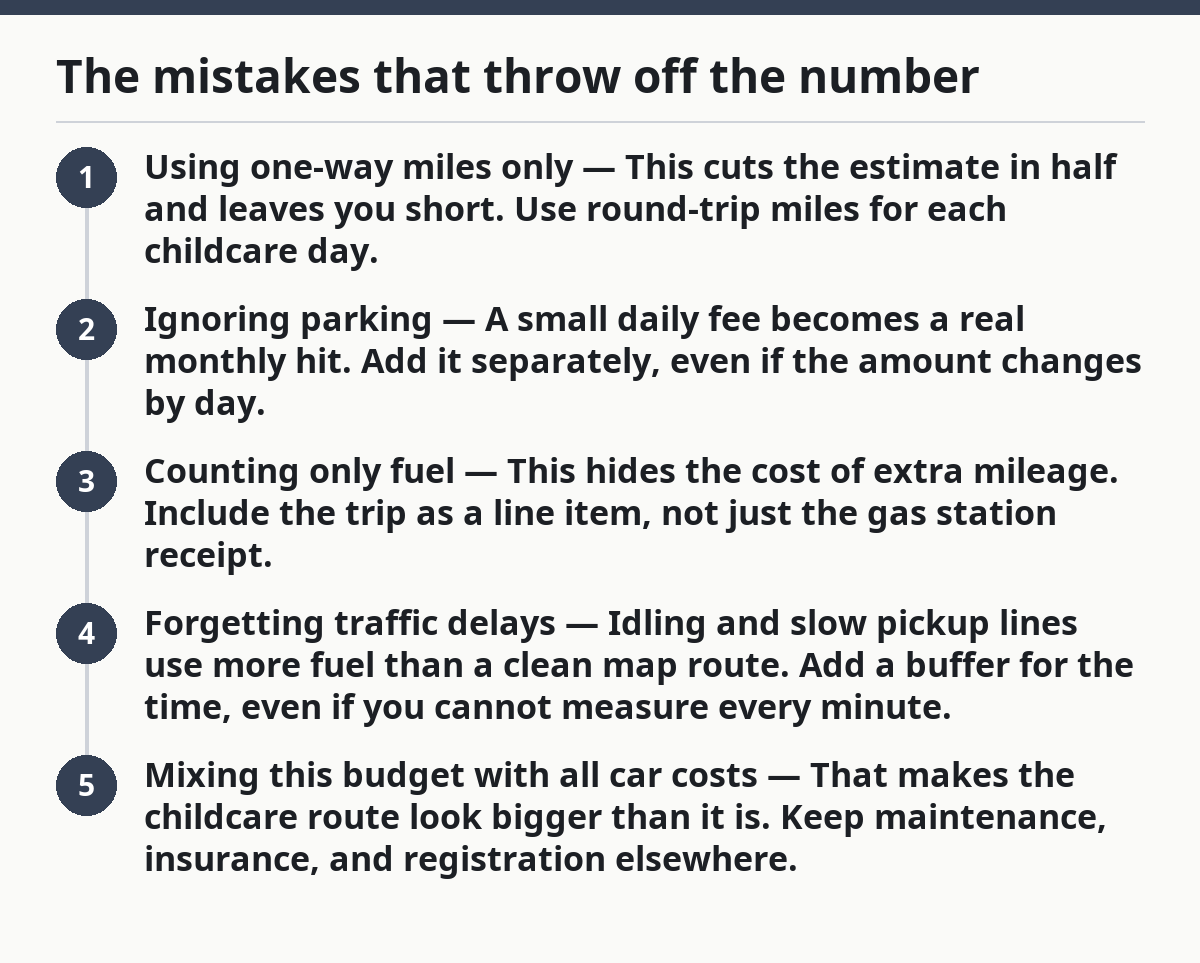
- Using one-way miles only — This cuts the estimate in half and leaves you short. Use round-trip miles for each childcare day.
- Ignoring parking — A small daily fee becomes a real monthly hit. Add it separately, even if the amount changes by day.
- Counting only fuel — This hides the cost of extra mileage. Include the trip as a line item, not just the gas station receipt.
- Forgetting traffic delays — Idling and slow pickup lines use more fuel than a clean map route. Add a buffer for the time, even if you cannot measure every minute.
- Mixing this budget with all car costs — That makes the childcare route look bigger than it is. Keep maintenance, insurance, and registration elsewhere.
If the total still feels wrong, the usual fix is not more complexity. It is a cleaner route log for 2 weeks and a second look at parking.
When does this approach stop working?
This approach stops working when the childcare commute is unstable, unusually complex, or shared across several adults in ways a simple monthly line item cannot track.
Picture this: you’re juggling split custody, rotating shifts, and a center that changes pickup gates by season. A flat estimate starts to lose meaning because the trip is no longer one trip. It is several patterns wearing the same label.
Pickup and drop-off times change every week: the route cost swings too much to estimate from one month — use a weekly average and review it every 4 weeks.
Parking is billed by the hour and you wait unpredictably: the charge may vary more than the gas — track parking separately from fuel.
Another adult covers some school runs: the budget is split across households — count only the trips you pay for.
The center is far outside your normal commute: the mileage may dominate the budget — compare the childcare route against a closer option before treating it as fixed.
You start missing pickup times because the buffer is too thin: late fees or rushed driving can cost more than the route itself — increase the buffer or change the route.
Your car uses far more gas than expected: the trip estimate is too loose for your actual vehicle — rebuild the estimate from current mileage and local gas prices.
If the route changes every week, this becomes a tracking problem, not a budgeting problem. Use a spreadsheet or notes app and average over a full month.
What a good childcare commute budget looks like
A good childcare commute budget is specific enough to match your route and flexible enough to survive one messy week. It should name gas, car mileage, parking, and travel-time buffer as separate pieces, not one vague transport guess.
Picture this: you’re opening your budget on payday and seeing one line that says “childcare commute.” That line should tell you what the route costs, what the parking costs, and what cushion you built in for traffic or school changes. If it does not, it is too vague.
A solid result has three signs:
- You can explain where the number comes from in under a minute.
- A missed school gate or a paid lot does not wreck the month.
- You know which piece drives the cost: miles, parking, or route timing.
That is what makes the budget useful. It gives you a number you can trust enough to plan around, without pretending childcare driving is ever perfectly steady.
How do I budget for extra driving for childcare?
Treat each added trip as a separate mileage and fuel cost, then fold it into the month’s total. That means you count the extra miles, any parking tied to the extra stop, and the time buffer if the stop changes your route. If the extra driving happens often, average it across 4 weeks instead of guessing.
What commute costs should I include for drop-off and pickup?
Include gas, parking, tolls if you pay them, and the extra mileage from the childcare route. If you wait in a lot or pay by the hour, include that parking charge too. If your route creates repeat detours or longer idle time, build a buffer into the budget so the number does not collapse the first time traffic backs up.
How can I lower childcare commute expenses?
Lower childcare commute expenses by cutting unnecessary miles, avoiding paid parking when possible, and tightening the route around the center’s pickup window. A shorter path is only cheaper if it does not push you into a garage fee or a long wait. Recheck the route after schedule changes, because the cheapest option can shift during the school year.
Drafted with AI; not yet reviewed by a person.