
Last updated: November 19, 2026
Quick Answer: Budgeting for Health and Family Care as a Single Parent usually works best when health and care costs are treated as fixed monthly line items, not leftovers, and the first monthly target is the amount you already spend on premiums, copays, prescriptions, child care, and backup care. The answer is to budget for health and care as fixed monthly costs, not leftovers. The sections below show how to sort expenses, build a care buffer, and keep the plan working when income changes.
Key Takeaways
- Put health costs in the budget before non-essentials, because they fail on a different schedule.
- Separate routine care from surprise care so one dental bill does not wipe out rent money.
- Build a small “care buffer” for co-pays, prescriptions, school absences, and backup child care.
- Use benefit rules, employer plans, and local programs together; one source rarely covers everything.
- Review the plan after any job change, insurance change, move, diagnosis, or custody shift.
This is information, not financial advice. Rates, limits, and program rules vary by country and change often, so a qualified adviser or benefits specialist should review your own situation. For planning support, see the Consumer Financial Protection Bureau and the Kaiser Family Foundation.
What a single-parent health and care budget needs to cover
A single-parent health and care budget covers routine medical costs, child care, backup care, and the hidden costs around both. If you only budget for rent, food, and transport, the first sick day turns into debt.
Picture this: you’re filling out a monthly budget on a Sunday night, and the numbers look fine until you remember a therapy copay, an inhaler refill, and the sitter you need for a follow-up appointment. That is the gap this budget has to close. It should catch the expected bills and the messy ones.
A practical budget usually has these lines:
- Monthly insurance premium, if you pay one
- Doctor, specialist, therapy, and dental copays
- Prescription costs and over-the-counter medicine
- Child care, school holiday care, and after-school care
- Backup child care for illness, work shifts, or appointments
- Transportation to medical visits
- Glucose strips, braces, medical devices, or other condition-specific supplies
- A small emergency amount for urgent care, missed work, or a family member’s sudden help need
The truth is, health and care costs are not evenly spaced. One month may be quiet. The next month can bring a flu test, a new pair of glasses, and two days of missed child care all at once.
How do I separate health costs from regular spending?

You separate them by making health and care its own category with its own monthly target, then tracking actual spending inside that category. That keeps a prescription refill from disappearing inside “miscellaneous.”
Picture this: your main budget already has groceries, rent, transport, and school costs. Now you add a line called Health and Care and split it into smaller parts so you can see what keeps repeating. This matters because a single-parent budget often fails from small leaks, not giant shocks.
A clean split helps in three ways:
- It shows which costs are predictable and which are not.
- It tells you whether insurance or benefits are doing enough.
- It keeps you from raiding emergency savings for routine care.
A simple structure works well:
- Routine care: checkups, preventive visits, dental cleanings, eye exams
- Ongoing care: therapy, medication, asthma supplies, braces, specialist visits
- Child care: regular care, school wraparound care, holiday care
- Backup care: short-notice sitter, emergency pickup, relative support
- Travel and access: transit, parking, ride service, tolls, missed-work transport
If your income is irregular, assign each category a minimum and a target. The minimum keeps the lights on in the budget; the target covers the real month. On the flip side, if your employer or public benefits already cover part of a cost, write down the gap only, not the full charge.
The budget categories that matter most
The categories that matter most are the ones that are both recurring and easy to overlook: prescriptions, copays, child care, and backup care. Those four often decide whether the rest of the month stays stable.
Picture this: your child gets sick on a Tuesday, your work shift starts at 8 a.m., and your regular sitter is unavailable. That one event can trigger a pharmacy stop, a care payment, and a lost hour of pay. A useful budget treats that chain reaction as normal, not rare, and a qualified financial or benefits professional can help you decide how much to set aside for it.
Start with these categories:
- Insurance premium: if you pay one each month
- Copays and coinsurance: expected visits, therapy, specialist care
- Prescriptions: chronic meds, short courses, refill timing
- Dental and vision: often forgotten until the bill hits
- Child care: regular days, school breaks, before/after school care
- Backup care: last-minute coverage when work or illness collides
- Transportation: bus fares, gas, parking, rides
- Supplies: bandages, thermometers, spacers, testing strips, diapers for a younger child if relevant
If your child has an ongoing condition, add a separate line for supplies and follow-up care. If you have your own condition, do the same. Don’t hide adult health costs inside child care or vice versa; that makes the budget unreadable when you need it most.
The best part is that once each category has a number beside it, you can see what really needs protection. Often it is not the obvious medical bill. It is the missed shift, the school pickup fee, or the refill you forgot to include.
How much should you set aside each month?

You should set aside enough to cover your average recurring health and care costs, plus a small buffer for a surprise bill, using your own bills rather than a national rule. There is no universal number that fits every country, plan, or household.
Picture this: you have insurance, but the deductible, copays, and non-covered items still show up. You also pay for one dependable child-care slot and one backup option. The goal is not perfection. It is to keep those costs from landing as emergency debt.
A good process looks like this:
- List the last 3 to 6 months of health and care spending.
- Average the recurring items.
- Add one-off costs you can predict, such as annual dental visits or school break care.
- Add a small cushion for the month that goes sideways.
- Recheck the amount after any policy, job, or family change.
If your spending history is thin, start with what you can document today:
- current premium
- current copays
- current prescription cost
- current care fee
- known appointments in the next 60 to 90 days
Then build upward slowly. A budget that starts too high often collapses. A budget that starts small and gets reviewed survives longer. For many families, the first workable target is simply the sum of the current monthly premium, current child-care fee, and the most recent refill cost, with a small cushion added after a qualified adviser or benefits specialist reviews it.
What do I do when income is irregular?
You budget from your lowest dependable income first and treat extra income as a repair tool, not spending money. That keeps the plan standing in the leanest week, and a professional can help you choose the safest baseline if your pay varies too much to estimate cleanly.
Picture this: one month has extra shifts, the next month has a slow schedule and a sick day. Health and care expenses do not care that your paycheck moved around. The budget has to work in the bad month first.
Use a three-part method:
- Base plan: cover rent, food, utilities, transport, and the minimum health and care line
- Stability fund: build one small buffer for care costs and timing gaps
- Catch-up plan: send extra income to the category most likely to break next
On the flip side, if your income drops for a month, cut flexible spending before you cut care that prevents a bigger cost later. That usually means trimming restaurants, impulse buys, and non-urgent extras before you touch medicine or child care needed for work.
A zero-based budget can help here, because every dollar gets a job. If your pay is unpredictable, use the lowest safe number from recent months, not the best month you remember, and check that assumption with a qualified adviser if the difference is large.
The biggest budgeting mistakes single parents make
The biggest mistakes are undercounting small health costs, mixing backup care into regular spending, and waiting for a crisis before planning. Those errors are common because each bill looks harmless on its own.
Picture this: you think the budget is fine because no one has had a major procedure, but the real drain is four prescription refills, two school closures, and one urgent care visit. That is how a “normal” month turns into a scramble. The fix is simple, but not easy: track the pattern before it becomes pain.
Common mistakes include:
- Using savings for routine care and then having nothing left for true emergencies, so a qualified adviser can help you separate short-term cash flow from long-term reserves
- Treating co-pays as tiny even when they repeat every month
- Ignoring dental and vision until the invoice lands
- Leaving backup care out entirely
- Budgeting for child care only during work hours and forgetting school breaks, sick days, and appointment days
- Assuming benefits will cover the full bill without checking the exact terms
The most expensive mistake is waiting. A plan made after the bill arrives is always tighter than a plan made before.
What if I have debt, benefits, or insurance already?
You still need a care budget, because insurance, benefits, and debt payments solve different problems. Coverage changes what you owe; it does not erase the need to plan for what remains.
Picture this: you have a health plan through work, a child-care subsidy, or some public support, but each one has rules, limits, or paperwork. That can help a lot, yet it also means your out-of-pocket costs can shift from month to month. The budget has to track the gap, not the brochure.
Here is the practical order:
- Write down what your plan or program actually pays.
- Write down what you still pay yourself.
- Separate billed costs from paid costs.
- Add deadlines so you do not miss a claim, renewal, or re-certification.
- Put debt payments after the care costs that keep work and family life moving.
If you already have medical debt, do not bury new care expenses inside old balances. Keep the current month visible. That makes it easier to see whether the debt is growing because of old bills or because the present budget is too thin. For help interpreting coverage terms, use an insurer summary, a benefits office, or an outside adviser rather than guessing from the premium alone.
How to build a care buffer that actually gets used
A care buffer works when it has a clear job: cover predictable but uneven costs before they turn into debt. It should not sit in a vague savings bucket.
Picture this: your kid wakes up with a fever, the sitter cancels, and the pharmacy charge is due the same day. Without a separate buffer, that problem lands on your credit card or your rent money. With one, you can absorb the hit and rebuild later.
Set up the buffer with rules:
- use it only for health or care costs
- refill it after use
- keep it separate from regular spending
- track every withdrawal by category
A buffer can cover:
- urgent care
- same-day child care
- medical transport
- copays during a bad month
- prescription timing gaps
- a replacement of basic supplies
If you can only save a little, that still helps. A small buffer used consistently is better than a large plan that never starts.
What should I review every month?
You should review the budget every month and after any change in work, coverage, child care, or health needs. A short review catches drift before it becomes damage.
Picture this: a month ends, and you think you stayed on track, but the numbers tell a different story. A refill cost more than expected. Child care was used twice outside the normal schedule. One appointment needed parking and missing work. Those details matter because they repeat.
Use the same monthly check:
- compare planned versus actual spending
- note any health or care cost that came out of another category
- flag anything likely to repeat next month
- update the buffer target
- check dates for renewals, authorizations, and school calendar changes
If you prefer paper, one notebook page works. If you use an app or spreadsheet, keep the same categories every month so trends are easy to spot. Consistency matters more than the tool. Keep the review tied to one date each month so the check happens before bills roll into the next cycle.
Before and after: a simple budget structure
A clearer structure turns scattered costs into visible lines, which makes the plan easier to defend when money is tight. The change is not fancy; it is mechanical.
| Metric | Before | After | Change | Timeline |
|---|---|---|---|---|
| Health costs | Rolled into “miscellaneous” | Split into copays, prescriptions, dental, vision | Easier tracking | First month |
| Child care | One broad line | Regular care + backup care | Clearer cash flow | First review |
| Surprise bills | Paid from savings | Paid from care buffer | Less disruption | Ongoing |
| Refill timing | Missed or late | Calendar reminder | Fewer shortages | Monthly |
| Budget review | Irregular | Monthly check | Faster corrections | Every month |
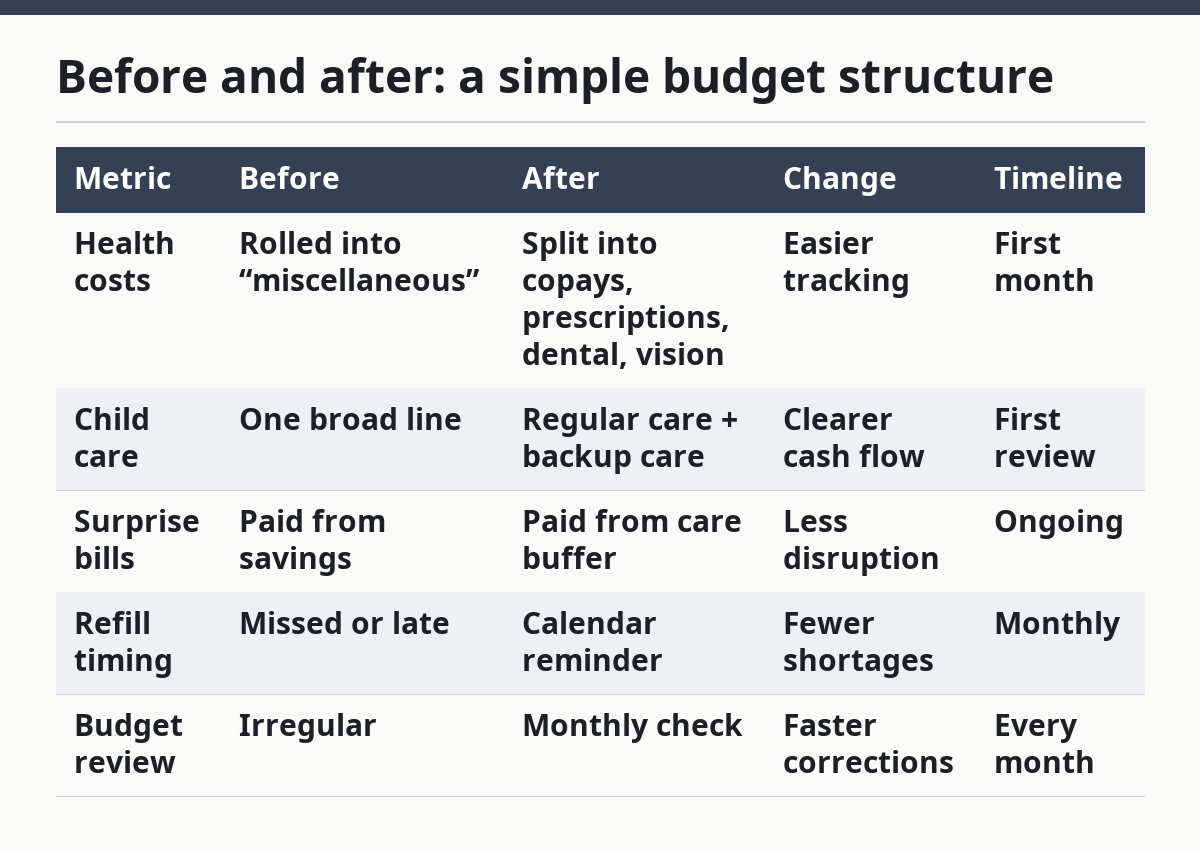
A table like this does not solve the money problem by itself. It shows you where the money problem actually is.
FAQ
How do I budget if I don’t know what health costs will come up?
Start with the costs you already know and build from the last few months of bills. If you do not have enough history, use current premiums, known prescriptions, expected appointments, and any scheduled child care first. Then add a small buffer for the unknown part. For a more precise estimate, a benefits specialist or qualified adviser can review the plan details with you.
Should I save for health care and child care together or separately?
Separate them if you can, because they fail on different timelines. Child care usually affects work income right away, while medical costs can arrive in bursts. Separate buckets make it easier to see which problem is growing.
What if my insurance changes during the year?
Update the budget as soon as the change is confirmed, not after the first new bill arrives. Premiums, copays, networks, and covered services can change together, and the budget has to follow the new rules. A benefits office or qualified adviser can help interpret the details.
Is it better to pay a small medical bill with savings or put it on a card?
That depends on your full cash flow, existing debt, and whether paying it now would break the rest of the month. The safer habit is to decide before the bill is overdue. If the choice is unclear, a qualified financial adviser can help you weigh the trade-off for your own situation.
What is the first thing to cut if money gets tight?
Cut flexible spending before you cut medicine, preventive care, or child care tied to work. Those costs can prevent bigger losses later. If you need to make a hard cut, review it with a benefits specialist or financial adviser who knows your actual plan and income pattern.
Drafted with AI; not yet reviewed by a person.