
Last updated: November 19, 2026
Key Takeaways
- Match copays to expected visits, then fund a separate bucket before the appointment date.
- Check plan rules first; the same visit can cost differently by timing and benefit tier.
- Protect therapy as a fixed bill, with a buffer for changes.
- Budgets fail when the cost pattern changes, not just the amount.
Therapy copays can knock a monthly budget sideways when your child’s schedule shifts and your own appointment lands in the same week. Budgeting for therapy copays as a single parent works best when you build a separate line for visits, match it to your session pattern, and keep a small cushion for insurance plan changes or extra visits. The steps below show how to make that budget work without guessing. The Consumer Financial Protection Bureau explains that out-of-pocket costs are what you pay after insurance steps in, and HealthCare.gov defines the out-of-pocket maximum as the most you pay for covered services in a year.
Who this applies to, and what you need in hand
This applies if you’re a single parent paying for a therapist, a copay, or both through an insurance plan that covers part of the visit. It assumes you already know the basics of your plan: the copay for a mental health appointment, whether visits count toward an out-of-pocket cap, and how often you usually go. For mental health coverage rules, the Kaiser Family Foundation and HealthCare.gov both outline how plans may handle behavioral health benefits differently.
If your therapist bills outside insurance, or if your child’s care and your own care are tied to the same limited cash flow, the pressure rises fast. Speak to a qualified professional about your own situation if you’re unsure how your plan treats behavioral health claims, because plan rules vary and the math changes fast. The National Alliance on Mental Illness also notes that network and coverage rules can affect what you pay.
The Consumer Financial Protection Bureau and HealthCare.gov both explain that out-of-pocket costs are the amount you pay after insurance steps in. That simple detail drives the whole budget. Not the headline premium.
How do I budget for therapy copays?
Set up a sinking fund for therapy copays as a single parent, then tie it to the real appointment pattern. A sinking fund is money you set aside now for a bill that shows up later. That keeps one 45-minute session from blowing up rent week. Twenty minutes, not two.
Start with the copay amount listed on your insurance card or benefit summary. Then add any fee your therapist may charge for late cancellations, intake visits, or longer sessions if those apply. If your plan uses coinsurance instead of a flat copay, use the estimated share you pay per visit until you hit the out-of-pocket cap.
- List your mental health appointment details in one place: therapist name, visit type, session length, and copay amount.
- Count the number of visits you usually need in a month, quarter, or school term.
- Multiply the copay by that visit count to find the base therapy line.
- Add any known extra charge, such as an intake visit or a late-cancel fee, if your provider uses one.
- Compare that total with your insurance plan’s out-of-pocket cap so you know when costs may drop or stop.
- Divide the yearly total by 12 if visits are uneven, so one expensive month doesn’t ambush you.
- Set the money aside in a separate budget line or savings bucket before the appointment date.
- Verify after each claim that the copay charged matches the explanation of benefits; if it doesn’t, flag it.
- Adjust the next month’s set-aside if session frequency changes by even one visit.
If the amount you set aside never lines up with the claims coming back from insurance, something is off. Usually, the culprit is a wrong billing code, a deductible that still applies, or a session count that changed without your budget changing with it.
What should I check before I book the next session?
Check the insurance plan rules before you schedule; the same therapy visit can cost different amounts depending on timing and benefit tier. A 50-minute appointment may be covered one way, while an intake visit, telehealth session, or family session is processed differently.
A quick plan check can spare you a nasty surprise. That tiny pause often saves a month of stress later.
- Copay amount: confirm the exact dollar amount for mental health visits, not the general office visit copay.
- Out-of-pocket cap: confirm what counts toward it and whether behavioral health shares the same cap as other medical care.
- Session frequency: ask whether your therapist recommends weekly, biweekly, or monthly visits so your budget can match reality.
- Appointment scheduling: check whether your provider charges for missed visits or short-notice cancellations, often within 24 hours.
- Coverage tier: confirm whether the therapist is in-network, out-of-network, or requires a referral.
If you can’t get these facts before the appointment, budget as if the visit will cost the higher amount. That is safer than hoping the claim will land in your favor.
How do I keep mental health care in the budget?
Keep mental health care in the budget by treating it like a fixed bill and the changes as planned, not random. A lot of single parents trip here: they pay the therapist only after groceries, school costs, and kid activities, then cancel care when money runs thin.
Picture this: you’re staring at a calendar with school pickup, work hours, and a Thursday 4 p.m. mental health appointment. Your budget needs to fit that real-life timing, not an ideal month with no emergencies and no late fees.
Use a 3-part structure:
- Base line: the regular copay for each session.
- Buffer line: extra money for one more visit, a higher bill, or a claim delay.
- Priority line: the month’s minimum number of appointments you want to protect first.
If you can only fund part of the month, fund the next appointment first. That choice keeps the schedule stable. A missed visit can create a bigger gap than the money saved, and rescheduling often makes the cost problem harder, not easier. The numbers turn crabby fast.
A simple rule helps: if a session happens every 2 weeks, set aside for 2 visits per month, not 1. That keeps the budget honest in the months with a fifth week or a holiday closure.
When does the standard plan stop working?
The standard plan stops working when the cost shape changes, not just the amount. If your therapist changes visit frequency, if your insurance plan resets, or if your child’s schedule forces appointment shifts, the old budget can fail in a single month.
Here are the main break points:
Your copay changes midyear: this usually means a benefit update, plan switch, or billing rule changed — recalculate the therapy line before the next visit.
Your therapist moves to out-of-network: your out-of-pocket cost may rise sharply — ask for the new rate and check whether the plan still gives any partial coverage.
Your sessions become more frequent: weekly visits cost about twice as much as biweekly visits — update the budget the same week the schedule changes.
Your claims hit the out-of-pocket cap: your share may drop after the cap is met — watch the explanation of benefits, not your memory.
Your budget keeps missing by one visit: the issue is usually planning, not spending — switch to a monthly set-aside based on the highest likely visit count.
If the budget fails because you’re skipping food, rent, or utilities to keep therapy going, stop and reassess the whole month. Mental health care matters, but a budget that breaks housing or heat is not a stable plan.
What mistakes cost the most?
The priciest mistake is budgeting for the copay you wish you had instead of the one on the plan. That gap can look small on paper and still become a real problem after 4 or 5 visits.
Another common miss is ignoring how appointment scheduling affects cost. A last-minute cancellation fee, a missed intake, or an extra check-in can change the month without warning. The bill is real even if the calendar looked clean.
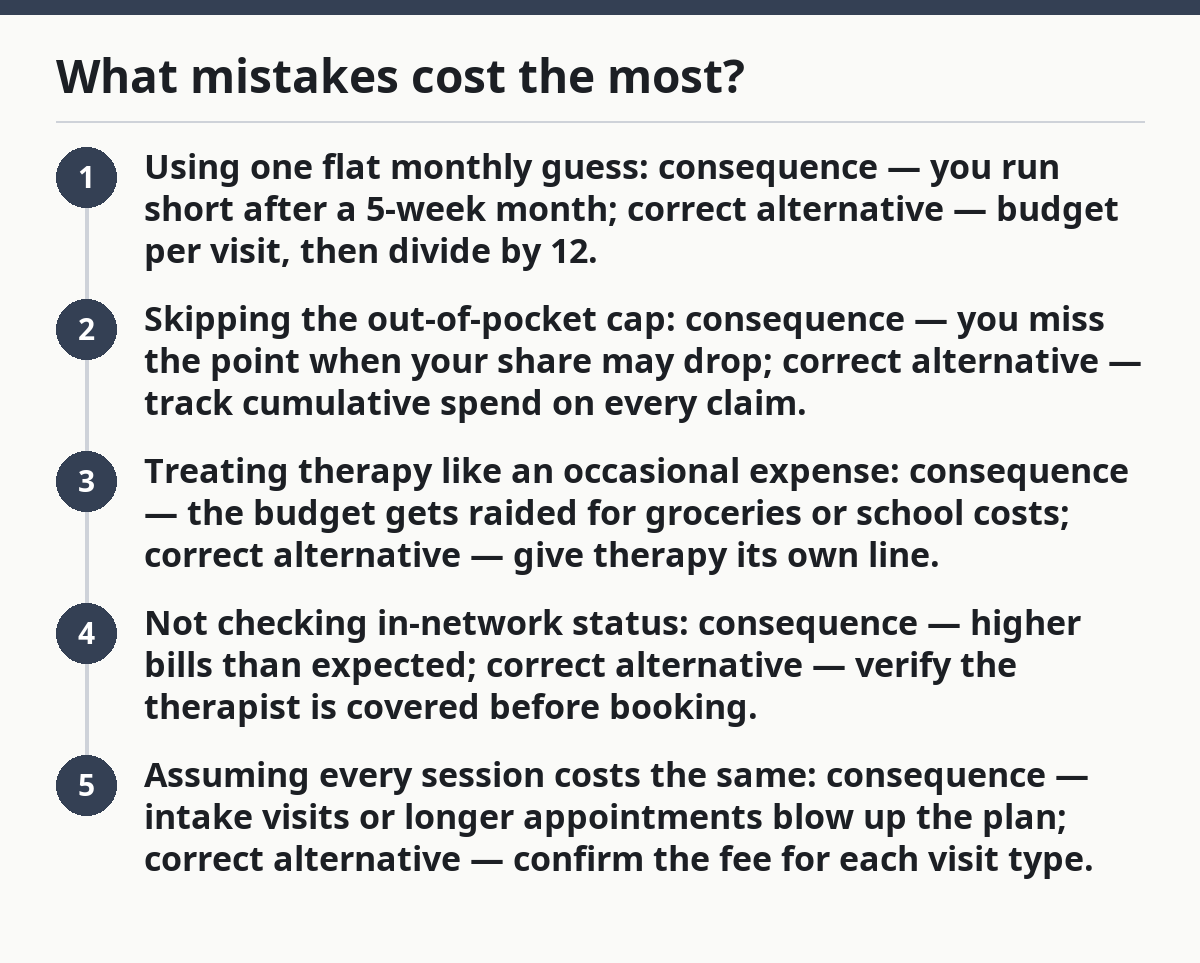
- Using one flat monthly guess: consequence — you run short after a 5-week month; correct alternative — budget per visit, then divide by 12.
- Skipping the out-of-pocket cap: consequence — you miss the point when your share may drop; correct alternative — track cumulative spend on every claim.
- Treating therapy like an occasional expense: consequence — the budget gets raided for groceries or school costs; correct alternative — give therapy its own line.
- Not checking in-network status: consequence — higher bills than expected; correct alternative — verify the therapist is covered before booking.
- Assuming every session costs the same: consequence — intake visits or longer appointments blow up the plan; correct alternative — confirm the fee for each visit type.
If the mistake is already baked into the current month, fix next month’s set-aside first. Chasing this month’s numbers usually creates a second problem.
What if my insurance only covers part of therapy costs?
Partial coverage means you should budget for both the copay and the portion insurance does not pay. That unpaid share can come from a deductible, coinsurance, or a plan limit, and each one behaves differently.
Deductible means you pay the allowed cost until your plan starts sharing more. Coinsurance means you pay a percentage of the allowed amount. A plan limit means the covered visits may stop after a set number, which can leave you paying the full price.
Check the explanation of benefits after each claim so you know what part is yours. If the bill says one thing and the claim says another, call the therapist’s billing office and the insurer. Billing errors happen, and a wrong code can make a covered visit look expensive.
For readers who want a broader framework for family care costs, the hub on health and family care budget for single parents can help you place this line next to the rest of the month’s spending without mixing it up with other care bills.
What does a workable result look like?
A workable result looks boring in a practical way: the therapist copay is already funded, the next appointment is on the calendar, and the month does not need a rescue transfer. The budget may still be tight, but it is predictable.
You know it’s working when three things line up: you can name the next payment, you know what insurance will likely cover, and you have a plan for a higher month. A 2-visit month, a 3-visit month, and a claim delay should all fit without panic.
If you get there, keep the system simple. One budget line, one claim tracker, one monthly review. That’s enough for most single-parent schedules.
How do I budget for therapy?
Budget for therapy by setting aside the copay for each expected session and adding a small cushion for claim delays or extra visits. The cleanest method is to count likely appointments for the month, multiply by the copay, and reserve that amount before the first session. If your schedule changes often, budget on the high side and adjust after the explanation of benefits arrives.
What if my insurance only covers part of therapy costs?
If insurance only covers part of therapy costs, budget for the part you still owe after the claim processes. That could be a copay, coinsurance, deductible, or a noncovered visit type, and each one can hit at a different time. Check the plan details and the provider’s billing notes so you’re not surprised by a bill that lands two weeks later.
How do I keep mental health care in the budget?
Keep mental health care in the budget by treating it as a protected expense, not a leftover. Set money aside for the next appointment first, then build in one extra visit’s worth if your month is unstable. If that still leaves you short, review session frequency and timing with the therapist’s office so the schedule fits your real cash flow better.
Drafted with AI; not yet reviewed by a person.