Last updated: November 19, 2026
Quick Answer: For How to Budget for Moving Truck Rental as a Single Parent, start with three numbers: the truck rate, the mileage fee, and the fuel cost. Then add rental insurance and any one-way fee if you are not returning the truck to the same location. Moving truck rental can wreck a tight budget if you miss the extras: mileage fees, fuel, rental insurance, and return charges.
This guide breaks down what to price first, what to put in the rental contract, and what to do before pickup so the bill does not jump on moving day.
What to price first in your moving truck rental budget
Picture this: you have one child in the car, a pile of boxes by the door, and a rental counter asking about add-ons you did not plan for. Start with the truck, then add the costs tied to how far you drive, how long you keep it, and how full the tank needs to be.
The cleanest budget starts with three numbers: the truck rate, the mileage fee, and the fuel cost. After that, add rental insurance and any one-way rental fee if you are not returning the truck to the same location. That order helps you avoid treating a cheap base rate like a cheap trip; if anything is unclear, consult a professional or the rental company before you sign. The Consumer Financial Protection Bureau and the Federal Trade Commission both publish consumer guidance on reading fee-heavy contracts.
Use this short list before you book:
- Truck rate: the base price for the size you rent.
- Mileage fee: what you pay per mile or kilometer driven.
- Fuel surcharge or refill cost: what you owe if the tank comes back under the contract level.
- Rental insurance: collision, damage, or liability coverage sold by the rental company.
- One-way fee: the charge for dropping the truck off somewhere else.
- Return conditions: late fees, cleaning rules, and fuel rules in the rental contract.
Once these six items are on paper, the “cheap” offer and the real offer stop looking the same.
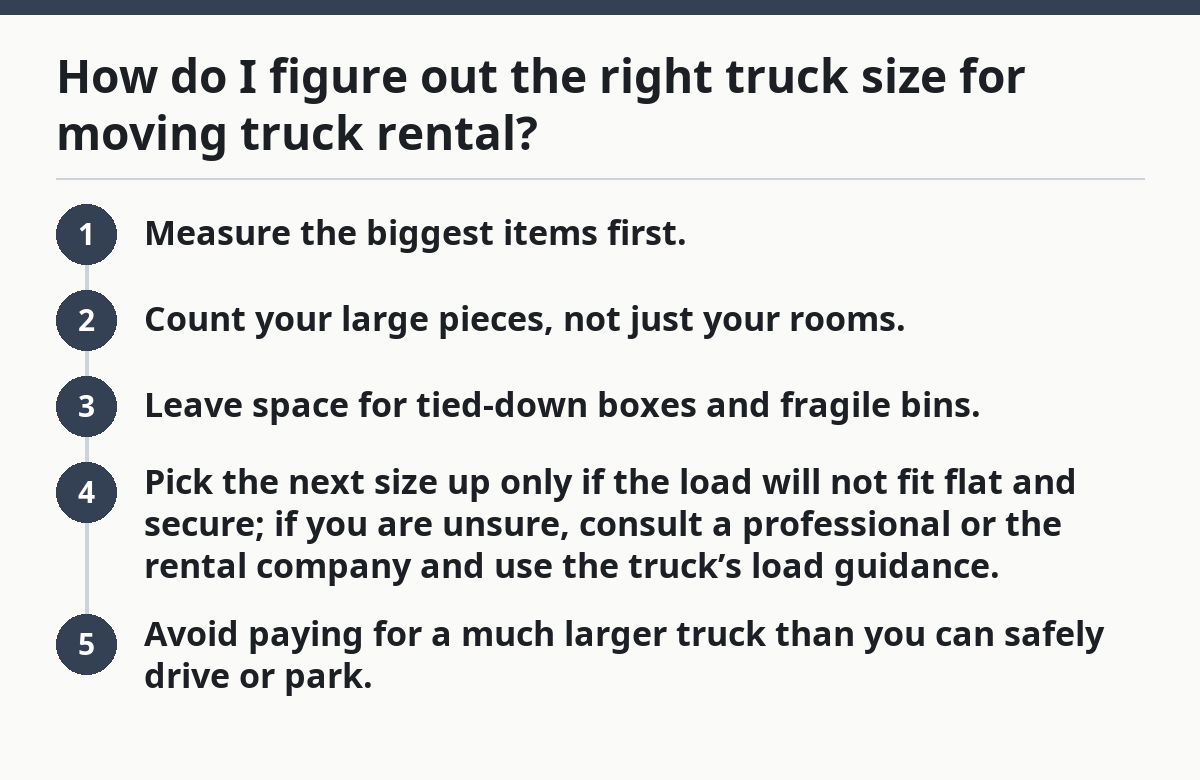
How do I figure out the right truck size for moving truck rental?
The right truck size is the smallest one that fits your furniture without forcing a second trip. A single parent usually has to balance packing time, childcare, and driving time, so a truck that is too small costs more than money.
Start by grouping what must go in the truck: beds, mattress sets, couch, table, boxes, washer or dryer, and any large kid gear like a crib or bunk bed. Then match the load to the smallest truck that fits those items with a little room left. A full truck is fine; a crushed box stack is not.
Use this rule of thumb:
- Measure the biggest items first.
- Count your large pieces, not just your rooms.
- Leave space for tied-down boxes and fragile bins.
- Pick the next size up only if the load will not fit flat and secure; if you are unsure, consult a professional or the rental company and use the truck’s load guidance.
- Avoid paying for a much larger truck than you can safely drive or park.
Here’s the catch: a bigger truck may mean more fuel use, harder parking, and a higher rental rate. A smaller truck may force a second round trip, which can double mileage charges. That trade-off matters more than most first-time renters expect.
If you are moving from a studio or one-bedroom setup, the budget often swings on whether you need one medium truck or two smaller runs. The second option sounds cheaper until the mileage fee shows up twice.
What costs are included in a moving truck rental?
A moving truck rental usually includes the truck itself, but the contract often adds several line items that change the final bill. The bill is not just “truck for the day.” It is truck, miles, fuel, time, and risk.
Read the rental contract line by line before you sign. The terms that matter most are the rate structure, mileage charge, fuel policy, insurance choices, pickup and return windows, and any penalty for late return. Many renters miss the fuel rule until the truck is back at the lot and the surcharge is already on the invoice.
Watch for these common charges:
- Base rental rate: the starting price for the truck.
- Mileage fee: charged by the mile or kilometer.
- Fuel cost: either a refill charge or a surcharge if the tank is low.
- Rental insurance: often optional, but sometimes strongly recommended by the company.
- One-way rental fee: common when the drop-off point is different from pickup.
- Late return fee: can show up after the grace period ends.
- Cleaning or damage fee: used when the truck comes back dirty or damaged.
- Equipment rental: dollies, moving pads, or straps, if you rent them.
The truth is, the base rate is only one piece of the price. A lower daily rate with high mileage charges can cost more than a higher daily rate with a lower mileage fee if your route is long.
For a plain-English reference on consumer price terms, the Consumer Financial Protection Bureau has clear guidance on reading fee-heavy contracts. The Federal Trade Commission also publishes consumer advice on rental and service charges that can hide in the fine print.
How to budget for fuel, mileage, and one-way fees
Fuel, mileage, and one-way fees usually decide whether the rental stays close to plan or blows past it. These are the costs that rise with distance, traffic, detours, and the number of times you circle a neighborhood looking for parking.
Build the travel part of the budget in this order:
- Estimate the total miles for pickup, loading, the move, and return.
- Check whether the contract charges for every mile or gives a mileage bundle.
- Add fuel for the full round trip, not just the map distance.
- Add a one-way fee if you will drop the truck elsewhere.
- Add a small buffer for traffic, missed exits, and a longer route to fit a truck.
If the move is local, the mileage fee may stay manageable. If the move crosses town or crosses a state line, the same truck can become much more expensive because distance eats the budget one mile at a time.
On the flip side, a one-way rental can save time and child-care stress if you would otherwise drive back and forth. It costs more up front in many cases, but it may save a second day of errands, gas, and fatigue.
Fuel policy matters too. Some contracts expect the truck back at the same fuel level it left with. Others use a refill charge if it comes back below a stated level. That means you need to plan the tank, not guess at it on the last block.
How should a single parent build the rental budget step by step?
A single parent should budget for a moving truck rental by listing every contract charge, then padding the total for distance, fuel, and time. That keeps the move from crowding out groceries, child care, or the next rent payment.
Use this procedure before you reserve anything:
- Choose the smallest truck that fits the largest items, because size changes the base rate and sometimes the fuel use.
- Write down the trip distance in miles or kilometers, including pickup and return, so the mileage fee has a real number behind it.
- Add the expected fuel cost using the route length and the truck’s fuel policy, then leave room for traffic or detours.
- Check the rental contract for one-way fees, late-return charges, and cleaning rules, because those can hit after the move ends.
- Decide whether rental insurance is worth the added cost, especially if you are driving alone or in an unfamiliar truck.
- Set aside a cash buffer for surprise charges so the bill does not force a choice between the move and the week’s essentials.
The exact buffer is your judgment call, but the idea is simple: if the rental counter gives you a quote, do not treat it as the final number unless the contract says all fees are included. If that is unclear, consult a professional or call the rental company before you pay.
A single parent also has to budget for time, not just money. If the moving day timeline is cramped, you may need a longer rental window to avoid late fees. A 4 p.m. return time that looks fine on paper can turn ugly when loading runs long and a child needs a break.
What return rules and insurance details can raise the bill?
Return rules and insurance details can raise the bill fast because they sit in the rental contract, not the headline price. They are easy to skip and expensive to miss.
Start with the return checklist. Ask what fuel level is required, what counts as “clean,” what happens if the truck is returned after hours, and whether the odometer or mileage is recorded at pickup and drop-off. If the contract uses photo proof, take your own pictures before leaving the lot and again before you hand over the keys.
Insurance is the other piece that changes the total. Rental insurance can cover damage, theft, or liability in different ways, and the names vary by company. If you already have coverage through an auto policy or credit card, read the terms carefully before paying for duplicate protection. If you do not know, call the insurer before pickup.
Use this checklist at the counter:
- Ask whether the fuel policy is full-to-full, same-level, or refill-based.
- Ask whether there is a cleaning standard or fee.
- Ask what happens if you return the truck after the cutoff time.
- Ask whether rental insurance is optional or bundled.
- Ask how mileage is counted and rounded.
- Ask whether one-way fees change if the drop-off time shifts.
The catch is that return fees often feel small until they stack. A low fuel level, a late return, and a cleaning charge can turn a decent quote into a painful one. That is why the contract matters as much as the truck itself.
For consumer protection basics on fees and contract terms, the Federal Trade Commission’s consumer guidance is a solid starting point. The Consumer Financial Protection Bureau also has plain-language material on reading service agreements and spotting cost traps before you sign.
A moving day timeline that keeps costs under control
A moving day timeline keeps the truck from turning into an all-day leak in your budget. The goal is not speed for its own sake. The goal is to return the truck on time, with the fuel policy met and the mileage kept where you expected it.
Use a simple 4-part plan:
- The day before: confirm pickup time, review the contract, and stage boxes near the door.
- Pickup morning: inspect the truck, photograph damage, and check fuel level and mileage.
- Loading window: keep heavy items first, then boxes, then loose items so loading does not drag.
- Return window: refuel to the contract level, sweep out debris, and drop the truck before the cutoff time.
A tighter timeline helps with childcare too. If you know the truck needs to be back by evening, you can line up lunch, naps, or a sitter around that cutoff. A move that runs 2 hours long can mean a late fee; a move that starts 2 hours early can mean you make it.
If loading takes longer than expected, know whether you can extend the rental by an hour or a half day. If the contract does not allow that, build in more time before you pick up the truck. This is also where a single parent can protect energy.
Key Takeaways
- Price the truck, miles, fuel, insurance, and return terms before you book.
- A smaller truck can save money, but not if it forces a second trip.
- The rental contract matters as much as the advertised rate.
- One-way moves, late returns, and low fuel can all add charges.
- A simple timeline keeps the move on budget and reduces last-minute fees.
FAQ
How much moving truck should I rent?
Rent the smallest truck that safely fits your largest furniture and the number of boxes you have. A truck that is too small can force a second trip, which raises mileage and fuel costs. A truck that is too large can cost more up front and be harder to drive or park.
What costs are included in a moving truck rental?
A moving truck rental usually includes a base rate, then adds mileage fees, fuel costs, rental insurance, and sometimes a one-way fee. Late-return charges, cleaning fees, and equipment rentals can also appear in the rental contract. Read the contract before pickup so the final bill does not surprise you.
How do I avoid surprise moving truck charges?
Read the rental contract before you sign, ask about mileage and fuel policy, and take photos of the truck at pickup and drop-off. Return it on time, with the fuel level required in the agreement, and sweep out debris before handing it back. Those steps prevent many of the most common extra charges.
Drafted with AI; not yet reviewed by a person.