Last updated: November 20, 2026
Quick answer: plan on at least 30 to 90 days of cash flow coverage for the first stage of single-parent legal and family transition costs, because the first filing is rarely the whole bill. Single-parent legal and family transition costs are the one-time and ongoing costs that show up when a family changes form: filing fees, lawyer time, child support setup, custody paperwork, housing changes, childcare shifts, school transfers, and the hidden costs of time off work. This guide to Single-Parent Legal and Family Transition Costs — The Complete Guide keeps the focus on the legal and family transition costs that can come with separation, divorce, custody changes, child support, relocation, or a shift in caregiving. They vary by jurisdiction, case complexity, and how much the parents agree on already. This is general information, not legal advice; a qualified lawyer should be consulted about any specific case. For official process details, check the relevant court or legal aid source, such as your local court’s family-law pages or a public legal information service like LawHelp.org or Justice Canada’s family law resources.
Key takeaways
- Legal transition costs are rarely just court fees; the bigger bill is often document work, conflict, and lost time.
- The same family change can be cheap in one jurisdiction and expensive in another because court rules, mediation steps, and filing systems differ.
- The fastest way to miss costs is often to budget only for the filing and forget housing, transport, childcare, and missed hours at work.
- A written plan matters because cash flow problems hit harder when income is irregular.
- A budget that keeps the household stable for 3 to 6 months is often more useful than one that only covers the first filing.
Who this applies to
This applies to a parent who is moving into, already living in, or planning for a single-parent household and needs to understand the legal and family transition costs that can come with separation, divorce, custody changes, child support, relocation, or a shift in caregiving. It assumes the reader already knows the family situation is changing and wants a practical map of the costs, not a theory lesson.
These costs matter most when money is already tight, pay is irregular, or child care depends on one adult making most of the decisions. They are usually highest when parents disagree on where the child lives, who pays for what, or how often the child moves between homes. If the situation includes violence, threats, hidden assets, removal of documents, or urgent safety concerns, the standard paper-first approach may not fit and qualified legal help should be used early.
The exact rules vary by jurisdiction, and that is not a minor detail. In some places, filing fees are modest but required mediation adds time and cost; in others, court forms are simpler but lawyer time is still expensive because the process is technical. A person comparing costs across countries, states, provinces, or courts should treat every number as local until checked against the right court or legal aid source, and should consult a qualified professional or local legal aid office before relying on any estimate. See, for example, the U.S. Office of Child Support Enforcement for program-level information and the European e-Justice Portal for cross-border court references.
What counts as a transition cost?
Transition costs are the direct and indirect expenses tied to changing a family structure, not just the court bill. Direct costs include filing fees, service of process, copying, certified records, mediation, and legal advice. Indirect costs include transport, childcare during meetings, moving costs, new furniture, and the loss of work time needed to attend hearings or gather records.
The easiest mistake is to think in one category only. A court fee might be small, while the real strain comes from three half-days off work, a new school uniform, and a deposit for a different rental. For a single parent, that combination can hit the same month three times over: cash out, less income, and higher day-to-day spending.
A useful way to sort the costs is by timing. Some costs happen before any filing, such as document gathering and advice. Some happen during the legal process, such as filing and mediation. Some happen after the legal process, such as child support enforcement, moving, or adjusting child care. That timing matters because a family with irregular paychecks needs to know which costs cannot wait and which can be spread across 2 or 3 pay periods.
What are the main legal costs?
The main legal costs are filing, representation, and compliance costs, and each one can appear even in a simple case. Filing fees are paid to the court or similar authority when a case begins or when a later request is made. Representation costs are what a lawyer, legal aid clinic, or adviser may charge for review, drafting, negotiation, or hearings. Compliance costs come from doing what the process requires, such as obtaining copies, notarization where used, or serving papers.
A simple comparison helps show why the total often surprises people, and the safest way to read it is as a rough planning aid rather than a universal cost table:
| Cost type | What it covers | When it usually appears | Common problem |
|---|---|---|---|
| Filing fee | Starting or changing a case | At filing | Budgeting for only one filing and missing later applications |
| Lawyer time | Advice, drafting, negotiation, hearing prep | Before and during the case | A short dispute turning into many billed hours |
| Mediation | Structured settlement talks | Before or during court | Paying twice if mediation fails and the case still goes forward |
| Service or notice | Official delivery of papers | Early in the case | Re-doing service because the first attempt was improper |
| Records and copies | Certificates, transcripts, documents | Throughout | Small fees stacking up across several documents |
| Travel and time off work | Transport and lost pay | Throughout | Treating this as optional when it affects attendance |
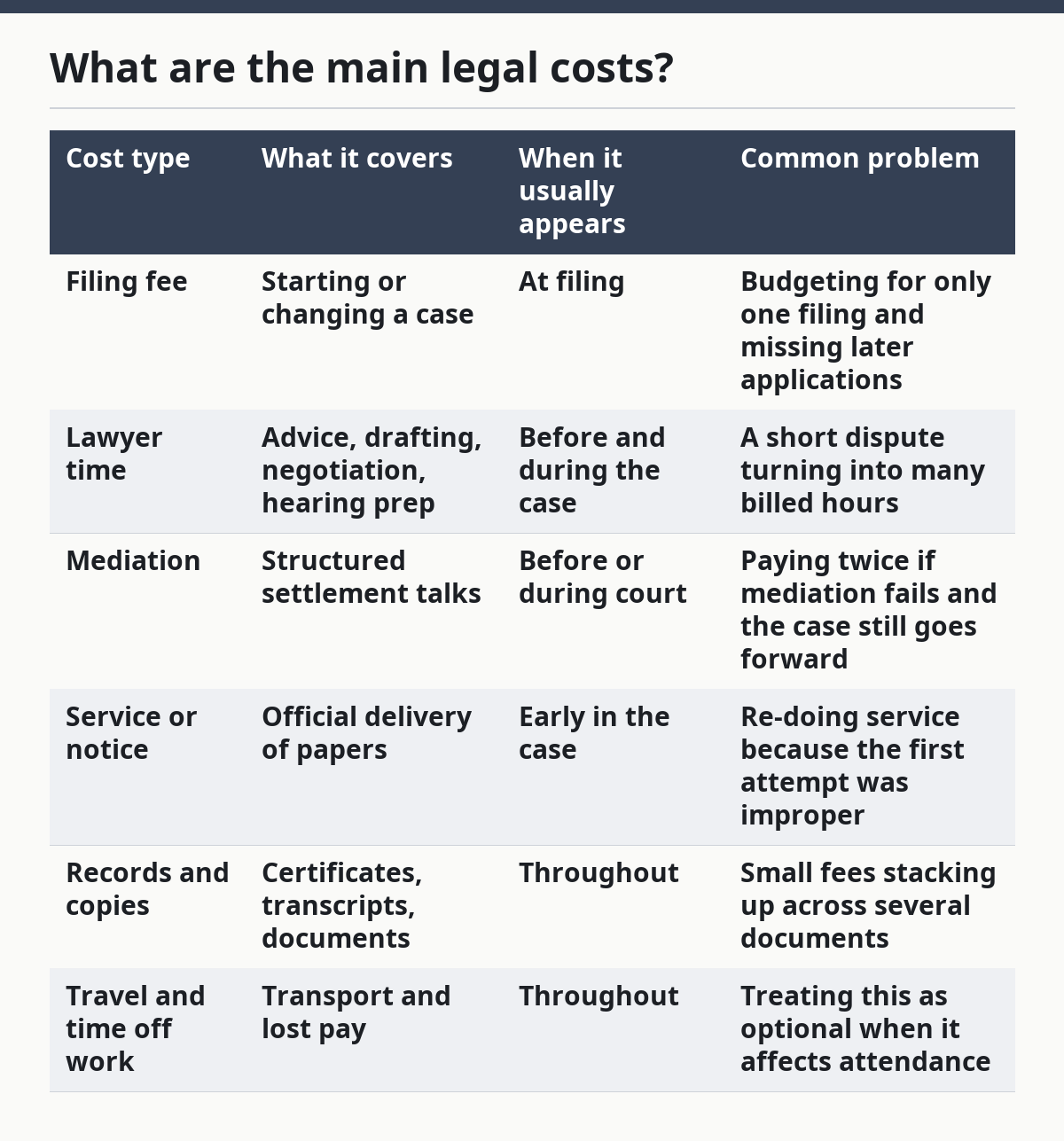
The largest cost driver is usually conflict, not paperwork. A fully agreed case can stay relatively contained because fewer drafts, hearings, and follow-ups are needed. A contested case can multiply cost quickly because every disagreement creates another document, another meeting, or another court date.
A reader should also expect that some systems require separate steps for child support, parenting time, property, and protection orders. These are not always bundled. That means one family transition can create 2 or 4 different cost tracks, each with its own forms and time line.
How do these costs usually happen?
These costs usually happen in a predictable sequence: information gathering, filing or initiating a process, negotiation or mediation, court or administrative review, and then post-order adjustments. The shape differs by jurisdiction, but the logic is similar. The more agreement there is at the start, the fewer steps usually become expensive.
- Collect identity and family records. Gather 3 to 5 core documents first: identification, the child’s records, proof of address, income records, and any prior court papers. Verify that names and dates match across documents. A problem is missing pages, conflicting addresses, or unsigned forms, which often delays the next step.
- Map the legal issues into separate buckets. List the issues as custody or parenting arrangements, child support, property, housing, and safety. Check whether each issue belongs in the same court or a different office. A problem is assuming one filing covers everything when the local process splits them apart.
- Check the local filing path. Find the court, agency, or tribunal that handles the issue and note the required form set, fee schedule, and service rules. Verify the current procedure from the official court or government source, not a forum post. A problem is using an old form version or filing in the wrong place, which can waste days or weeks.
- Estimate the legal spend by task, not by guess. Break costs into filing fees, document copies, advice time, mediation, and hearing time. Use a 3-column list: must-pay, likely-pay, and possible-pay. A problem is leaving out later applications, because many cases need more than one filing.
- Build a cash-flow buffer around pay dates. Set aside money for the next 30 to 90 days rather than the whole case if income is uneven. Verify that essential bills still fit after the legal payment is made. A problem is draining the rent or food budget to pay a single upfront cost.
- Decide which tasks need professional help. Use a lawyer or legal aid for the parts that affect rights, deadlines, or safety, especially where there are children or contested facts. Verify the person is licensed in the relevant jurisdiction. A problem is trying to save money by skipping advice on a high-stakes step and then paying more to fix it later.
- Track every extra cost as it appears. Record transport, childcare, printing, new school items, and time off work in the same list as legal fees. Check the total after each step, not just at the end. A problem is undercounting small purchases, which can distort the budget by a meaningful amount over 1 or 2 months.
- Review what changes after the order or agreement. Recheck housing, child care, support payments, and school logistics once the legal step is done. Verify that the household can function on the new routine. A problem is treating the case as finished when the family still needs a workable monthly plan, so it is wise to review that plan with a qualified professional if anything looks unstable.
That sequence sounds simple, but it is where many budgets fail. The issue is not usually the first filing fee. It is the chain reaction of paperwork, scheduling, and daily-life changes that follow.
How much money should be set aside?
The amount should be set aside according to the local process and the likely level of conflict, not by a universal rule. In one place, a simple agreement may need only modest filing and document costs; in another, the same family change may require mediation, repeated filings, or attorney time that multiplies the bill. A safer method is to budget for the most likely path and keep a separate reserve for the step that turns out to be harder than expected.
A practical budget splits the money into four parts: immediate legal costs, short-term household costs, transition costs for the child, and an emergency reserve. Immediate legal costs are the fees needed to start or respond. Household costs include rent, utilities, and food during the transition. Child costs include school, transport, clothing, and child care changes. The reserve should cover one unexpected filing, one extra meeting, or one missed work shift, because any of those can happen without warning.
Irregular paychecks change the math. A person paid weekly, by shift, by contract, or by commission often cannot safely wait until the end of the process to pay everything at once. The better approach is to match each cost to the next 1 or 2 paychecks and to keep the reserve separate from daily spending money. That is less about discipline than about timing.
The result to aim for is not perfection. It is a budget that keeps the home stable while the legal process moves forward. If the plan depends on every payment arriving exactly on time, it is too thin for a single-parent household with legal costs attached.
When should the standard approach stop?
The standard document-and-budget approach should stop when safety, urgency, or complexity makes delay more expensive than getting qualified help. In legal matters, “do it yourself” has limits, and the limit is not only the amount of money involved. It is also the risk of missing a deadline, giving up a right, or creating a record that hurts the case later.
There is violence, coercion, or stalking: this changes the risk profile and the paper trail — use local domestic violence services, legal aid, or a lawyer early, because ordinary negotiation may not be safe or useful.
Child removal, concealment, or travel risk is involved: this can become urgent — seek immediate qualified help in the relevant jurisdiction, because timing can change the legal options.
There is a court deadline within days, not weeks: missed deadlines can close off options — get professional help with filing and service rather than waiting to “figure it out.”
Income, property, or support facts are disputed: the process may require sworn statements, records, or formal disclosure — get advice before submitting anything inconsistent or incomplete.
The case crosses jurisdictions: rules may differ between countries, states, provinces, or courts — use someone who knows the proper forum, because the wrong filing place can waste time and money.
There are existing orders that may be changed or enforced: the old order still matters — get legal guidance before acting on informal agreements, since a new arrangement may not replace the old one automatically.
The consequence of ignoring these stop signs is not always a lost case, but it is often avoidable cost. That can mean a second filing fee, a missed hearing, a delayed support order, or a document record that is harder to fix than the original problem.
What mistakes raise the bill?
The mistakes that raise the bill are usually small at first and expensive by the end. They do not look dramatic on day one, which is why they keep happening. A single missed step can turn a low-friction process into a longer one.
-
Budgeting only for court fees. The consequence is a plan that collapses when transport, copies, or child care appear. The better alternative is a full transition budget that includes at least one month of household spillover costs.
-
Treating every issue as one issue. The consequence is filing in the wrong place or using the wrong form set. The better alternative is to separate custody, support, property, and safety into different buckets before spending money.
-
Using unofficial advice as if it were local law. The consequence is delay, rework, or a rejected filing. The better alternative is to confirm the procedure with the official court, government, or legal aid source for that jurisdiction.
-
Waiting until cash is gone before asking for help. The consequence is rushed decisions and limited options. The better alternative is to ask for help when the process first becomes unclear, not after a deadline is near.
-
Ignoring the cost of time off work. The consequence is hidden income loss that can exceed the filing fee. The better alternative is to count every half-day or full day away from paid work as part of the legal budget.
-
Assuming an agreement ends all costs immediately. The consequence is surprise expenses after the order or agreement, such as revised child care, transfer costs, or follow-up filings. The better alternative is to budget for 30 to 90 days after the main step is done.
These mistakes are common because they are boring, not because they are rare. A family under strain tends to focus on the visible court step and miss the smaller costs that follow it.
What changes in harder cases?
Harder cases change the cost picture because they add uncertainty, more steps, or stricter proof requirements. A case becomes harder when the parents disagree on facts, the child’s schedule is unstable, or there are cross-border issues, safety issues, or property disputes that need separate handling. In those cases, the legal process is not just longer; it is more expensive to get wrong.
One edge case is an informal family arrangement that has worked for months or years. That can look cheap because no one has filed anything, but the cost can surface later if the arrangement breaks and the family has no written record. Another edge case is a move to a new area or country. That can change which court has authority, which papers are needed, and what support rules apply.
A third edge case is a case with irregular income on one side or both sides. The amount owed or expected may need to be described in a way that matches variable pay, not a steady salary. That can affect both budgeting and the kind of records that matter. A fourth edge case is when one parent is self-employed, paid in cash, or paid through multiple accounts. That often means more records and more dispute about what counts as income.
The cost implication is simple: the less standard the facts, the more likely it is that a quick budget will be wrong. That does not mean the process cannot be managed. It means the margin for error is smaller, and the price of a mistake is higher.
How do you compare the main options?
The main options differ by cost, control, and risk, and no single route is cheapest in every case. A low-cost route can become expensive if it fails, while a more formal route can save time if the facts are already clear. The right comparison is not “cheap versus expensive”; it is “what does this case need, and what does each path make more likely?”
| Option | Typical use | Cost profile | Main strength | Main drawback |
|---|---|---|---|---|
| Self-managed process | Simple, agreed cases | Lowest cash outlay at the start | Saves lawyer fees | Higher risk of missed steps |
| Legal aid or clinic | Lower-income households, eligible matters | Reduced or no fee, depending on eligibility | Access to advice | Limited availability and scope |
| Limited-scope lawyer help | One-off review, drafting, or hearing prep | Moderate and targeted | Helps on the hardest step | Still requires the parent to do some work |
| Full representation | Contested, urgent, or complex cases | Highest upfront cost | Hands-off support through the process | Can be expensive in a long dispute |
| Mediation first | Cases with room for agreement | Moderate, sometimes lower than full litigation | Can reduce conflict | Not suitable where safety or urgency is a problem |
This is why “cheapest” is not always the best label. If a parent has one clear issue and the other side agrees, the lower-cost route may make sense. If the case has deadlines, contested facts, or safety issues, a more structured path can be cheaper in the long run because it reduces mistakes.
What should a single parent do first?
A single parent should start with a written list of the legal issue, the local process, and the next 30 to 90 days of cash needs. That first page of notes should include the court or agency name, the forms or steps required, any fee that is visible on the official source, and the dates that matter. It should also include rent, food, child care, transport, and one backup plan for a missed paycheck.
That list does two things at once. It turns a stressful change into separate tasks, and it shows where the money pressure will land. A parent who can see the timing is in a better position to avoid a last-minute scramble for cash, transport, or time off work.
The best next move is usually not to do everything. It is to do the first step that clarifies the rest. In many cases, that means gathering the right records and checking the official local process before spending on anything else.
What questions still come up?
How do legal and family transition costs differ from normal household costs?
Legal and family transition costs are tied to the change itself, while normal household costs are the regular bills a family pays every month. The transition costs often happen in bursts, such as a filing, a move, or a hearing, and those bursts can force the household budget to change fast. That is why they need a separate line in the budget rather than being hidden inside groceries or rent.
Are these costs the same in every country?
No, they are not the same in every country, state, or province. Filing rules, court structure, support systems, and access to legal aid can change the total by a lot. Anyone comparing costs across borders should treat local court or government information as the only reliable starting point, and should check with a qualified professional for the specific forum involved.
What if there is not enough money for a lawyer?
A lack of money does not automatically mean there are no options, but it does change the path. Legal aid, clinics, limited-scope help, and self-managed paperwork may exist depending on the jurisdiction and the issue. The important part is to check which steps are time-sensitive and which can be done with lower-cost support.
Why do some simple cases still get expensive?
Simple cases can still get expensive when the process is split across several steps, when documents need to be redone, or when one small disagreement creates more work. A case can look simple on paper and still require copies, travel, child care, and time off work. The legal fee is only one piece of the full cost.
What is the biggest mistake to avoid?
The biggest mistake is budgeting only for the first filing or only for the visible legal step. That misses the follow-on costs that hit a single parent hardest: lost pay, transport, child care, and the need to keep the home stable while the process is still open. A better plan is to budget for the next 30 to 90 days, not just the first form.
Drafted with AI; not yet reviewed by a person.