
Last updated: November 20, 2026
Quick Answer: For a 12-month plan year, start with your total known eligible childcare costs for the year and spread that amount across your 26 paychecks if that is your pay schedule. For How to Budget for a Dependent Care FSA as a Single Parent, the safest approach is to match the election to care you already expect to use, then check your employer plan and IRS rules before you rely on the number.

Budget it as three separate pieces: your annual election amount, your payroll deductions, and the months when childcare bills arrive before reimbursement. A dependent care FSA can help a single parent smooth childcare costs, but only if the money you set aside matches your real care schedule and the IRS rules for eligible expenses. If you miss the timing, the account can leave you with unused funds.
Key takeaways
- Treat the account like a cash-flow tool, not a savings account; if you are unsure how it fits your tax situation, consult a tax professional or benefits administrator and check IRS Publication 503.
- Match your election to the care you will actually buy, not to a guess.
- Build your paycheck plan around when the deduction happens and when reimbursement comes back.
- Do not overfund the account if your childcare changes during the year.
- Check eligible expenses against IRS rules before you count a bill as covered.
How do I budget for a Dependent Care FSA as a single parent?

Budgeting for a dependent care FSA as a single parent means matching one year of childcare spending to paycheck deductions you can actually afford. The goal is to choose an annual election amount that fits your care pattern, then spread that amount across your pay periods so your take-home pay does not get squeezed all at once.
Start with the care you already know you need. If your child is in daycare, after-school care, summer camp that qualifies under IRS rules, or a nanny arrangement that meets the plan rules, list the months and the bills you expect to pay. Then compare that list with your paycheck schedule so you know when the FSA deduction will hit.
A dependent care flexible spending account only works well when your cash flow can handle the gap between paying the provider and getting reimbursed. That gap matters more for a single parent because there is no second paycheck to absorb a surprise shortfall. In contrast, the account can help when your childcare costs are steady and your budget already has room for the deduction.
The IRS explains the general framework in Publication 503 and in its dependent care assistance guidance on IRS.gov. Those rules matter because a wrong assumption about eligible childcare expenses can leave you with a balance you cannot use the way you planned. For the current rules, see IRS Publication 503 and IRS dependent care assistance guidance.
What number should I pick for my annual election amount?
Your annual election amount should be the lowest amount that still covers the childcare you expect to buy during the plan year. If you choose too little, you leave money on the table and still pay out of pocket for uncovered care. If you choose too much, you risk use-it-or-lose-it pressure at the end of the plan year.
A clean way to set the number is to work backward from a full year of eligible childcare expenses. Use the bills you know about first, such as weekly daycare or after-school care, then add only the care you are reasonably sure will happen. Do not count expenses you have not lined up yet, such as a future camp or a backup sitter, unless your plan rules clearly treat them as eligible and you can reasonably expect to use them; if you are unsure, consult your plan administrator or a tax professional.
Here is the decision point:
| Budget choice | What it does | Main risk |
|---|---|---|
| Lower annual election | Reduces the chance of unused funds | You may still owe more childcare costs after the account runs out |
| Higher annual election | Lets you shelter more eligible spending | You may lose leftover money if you do not spend it in time |
| Exact match to known care | Keeps the account tied to real bills | You need a decent handle on your monthly schedule |
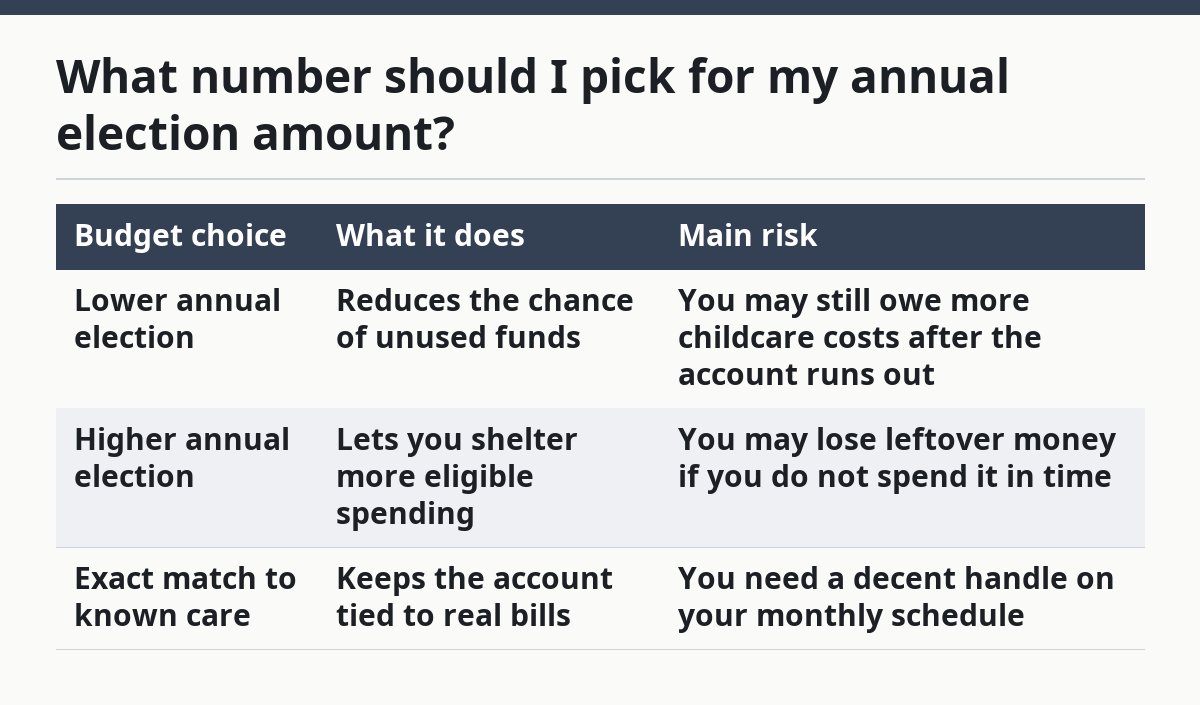
For a single parent, the safest choice is usually the exact match to known care, not the biggest number the plan allows. A single surprise change in work hours, a school closure, or a shift in custody schedule can make an aggressive election too large fast.
How should paycheck deductions fit the budget?
Your paycheck deductions should be treated as a fixed monthly hit to take-home pay, even when the FSA is funded through each pay period automatically; if you want a rule-of-thumb check, confirm it with your benefits team or tax professional. That is the part many people miss. The account may feel like a benefit, but the deduction comes out before the money is available for rent, gas, food, or school costs.
Set your budget by paycheck, not by the calendar month alone. If your employer spreads the election over 26 paychecks, for example, the deduction will arrive in smaller pieces than if it is spread over 12 monthly checks. Therefore, the effect is the same: your net pay is lower, and the rest of your budget has to absorb that cut.
The easiest way to protect your budget is to mark the deduction as a fixed expense on the date it actually comes out. Then line up the remaining cash against your highest-priority bills in this order: housing, utilities, food, transportation, and childcare. If the deduction makes one of those categories too tight, lower the election before the plan year starts.
The mistake to avoid is budgeting from gross pay and pretending the deduction is optional. It is not. Once you elect the amount, the payroll deduction is part of your spending plan, and changing that plan midyear may not be easy. That is why a dependent care FSA works best for a single parent who has steady childcare costs and enough room in the paycheck to handle the reduction.
When does reimbursement money come back?
Reimbursement money comes back after you submit a claim and the plan processes it, so you should not count on same-day cash. That timing can make or break your budget if you pay the provider before the reimbursement lands.
Plan for a gap. A single parent often pays childcare first and waits for the account to repay eligible costs later, which means the account does not solve a short-term cash crunch unless there is enough money already in the checking account to cover the bill. If your provider bills weekly, that timing can feel tight even when the annual election is accurate.
This is why reimbursement timing belongs in the budget line item itself. Set aside a small cushion in another part of the budget if your bank balance tends to run close to zero before payday. Without that cushion, you can end up with a correct FSA election and still struggle to pay the provider on time.
The cleanest habit is to file reimbursement claims as soon as you have the documentation your plan requires. The faster the claim goes in, the sooner the money can come back. That does not remove the wait, but it keeps the wait from stretching longer than it has to.
Which childcare expenses can I count?
Only eligible childcare expenses that meet IRS rules and your plan rules should be counted toward your dependent care FSA budget. That usually means care that lets you work, look for work, or attend school, not general family spending that happens to involve a child.
The details matter. Daycare, preschool care, before-school and after-school care, and some summer day camp costs may fit if they are tied to care rather than education. Overnight camp, tuition for school above kindergarten, clothing, meals not bundled into care, and medical costs do not belong in the budget for this account. IRS Publication 503 is the place to check the boundaries before you make your election.
A single parent should be strict here. If a bill is partly eligible and partly not, do not budget the whole invoice as if every dollar can be reimbursed. That mistake creates a false sense of breathing room and usually shows up later as an overestimate.
Use the table below to separate what belongs in the account from what does not.
| Likely eligible under plan and IRS rules | Usually not eligible |
|---|---|
| Daycare for a child under the plan rules | School tuition |
| Before-school care | Clothing |
| After-school care | Medical bills |
| Summer day camp tied to care | Overnight camp |
| Provider fees that qualify under the plan | Meals not tied to care |
That table is the whole game for budgeting. If a charge does not fit the account, leave it out of the election amount and cover it somewhere else in your budget.
What happens if I overestimate or change plans midyear?
Overestimating your dependent care FSA can leave you with money you cannot recover, while changing your care schedule can make your election too high or too low. That is the main trade-off, and it is why this account is useful only when your childcare pattern is fairly predictable.
The use-it-or-lose-it rule is the risk you need to plan around. If your plan year ends and the money is still sitting there, you may not get to carry it forward. Some plans have grace periods or carryover features, but you should not assume yours does unless your employer confirms it in writing. The safer move is to elect only what you can realistically spend on eligible care.
A single parent is more exposed to this risk because care needs can shift fast. A new school schedule, a custody change, or a provider closing for a week can all change the amount you use. If that happens, adjust your next election during open enrollment instead of trying to make the current year do a job it cannot do.
This is the point where the dependent care FSA stops being a pure budgeting win and becomes a timing tool. It helps most when your childcare costs are steady and your paycheck can handle the deduction. It helps least when your schedule changes often, your cash buffer is thin, or you expect to guess your annual care costs from memory alone.
How do I keep the budget organized all year?
You keep the budget organized by tracking three numbers every month: payroll deductions, eligible childcare spending, and remaining balance. That one habit makes the account much easier to use without guesswork.
Start with a simple list for the year. Put the annual election at the top, then divide it by the number of pay periods so you know how much is leaving each check. Next, log every eligible childcare expense with the date, provider, and amount, so reimbursement claims are easy to file when needed.
A 12-month review helps more than a once-a-year check. If your care pattern changes in June, you want to see it in June, not at the end of the year when the money may already be gone or stuck unused. Keep the record short and plain. A note app, spreadsheet, or paper list works if it shows the same three figures every month.
This page sits under the single-parent income protection and benefit planning hub because the account is part of a larger cash-flow system, not a standalone trick. The more your tracking matches real pay dates and real childcare bills, the less likely you are to overfund the account or miss a reimbursement claim.
FAQ
What childcare costs can a dependent care FSA cover?
A dependent care FSA can cover eligible childcare expenses that let you work, look for work, or attend school, if your plan and IRS rules allow them. Daycare, before-school care, after-school care, and some day camp costs are common examples. Tuition, clothing, and medical bills do not belong in this account.
How much should a single parent contribute to a dependent care FSA?
A single parent should contribute only the amount needed for eligible care that is likely to happen during the plan year. The best target is the smallest number that still covers your known childcare bills and leaves room for payroll deductions in your budget. A higher election can help only if you are confident you will spend it.
What happens if I don’t use all my dependent care FSA money?
Unused dependent care FSA money can be lost if your plan uses a use-it-or-lose-it rule. Some plans may offer a grace period or carryover feature, but you should not count on that without checking the plan documents. The safest budget is one based on care you are very likely to use.
When do dependent care FSA reimbursements arrive?
Dependent care FSA reimbursements arrive after the claim is submitted and processed, so the timing is not immediate. You should budget for a gap between paying the provider and receiving the money back. Filing claims quickly helps reduce the wait, but it does not remove it.
Sources
- IRS Publication 503, Child and Dependent Care Expenses: https://www.irs.gov/publications/p503
- IRS dependent care assistance guidance: https://www.irs.gov/government-entities/federal-state-local-governments/dependent-care-assistance-programs
Drafted with AI; not yet reviewed by a person.