Last updated: November 20, 2026
Quick Answer: budget for at least 1 month of health insurance premiums first, then build a cushion equal to 1 premium cycle if your income changes from week to week. In How to Budget for Health Insurance Premiums as a Single Parent, the premium is the fixed cost that can break a budget when income is irregular, so the goal is to make that bill visible before anything else gets spent. If you need help with your own income or plan rules, a qualified adviser can review the details with you.
Key takeaways
- Put the premium into your monthly budget as a non-optional bill, not a leftover expense.
- Match the due date to your pay schedule so the money is set aside before it can disappear.
- Recheck the premium whenever enrollment changes, because paycheck deductions and marketplace premiums do not stay still.
- A deductible affects cash flow too, so the premium is not the only health-care number in the plan.
- If the budget only works on one “good” month, the plan is too tight and needs a buffer.
- The HealthCare.gov income estimate page and the IRS premium tax credit page are useful references for marketplace coverage: https://www.healthcare.gov/how-to-estimate-income/ and https://www.irs.gov/credits-deductions/premium-tax-credit.
This is information, not financial advice. A qualified adviser can help with your own income, tax situation, and health-plan rules, which differ by country and change over time.
Who is this budgeting method for?
This method is for a single parent who pays health insurance premiums out of a monthly or uneven income and needs a way to keep coverage active without guessing. It assumes you already know your plan type, your premium amount, and when the bill or paycheck deduction hits.
For How to Budget for Health Insurance Premiums as a Single Parent, this approach fits both an employer plan and a marketplace plan, since both can pull money on a schedule that does not match rent, food, or child care. It also assumes you can read a pay stub and find the premium line, or check your marketplace account for the monthly amount.
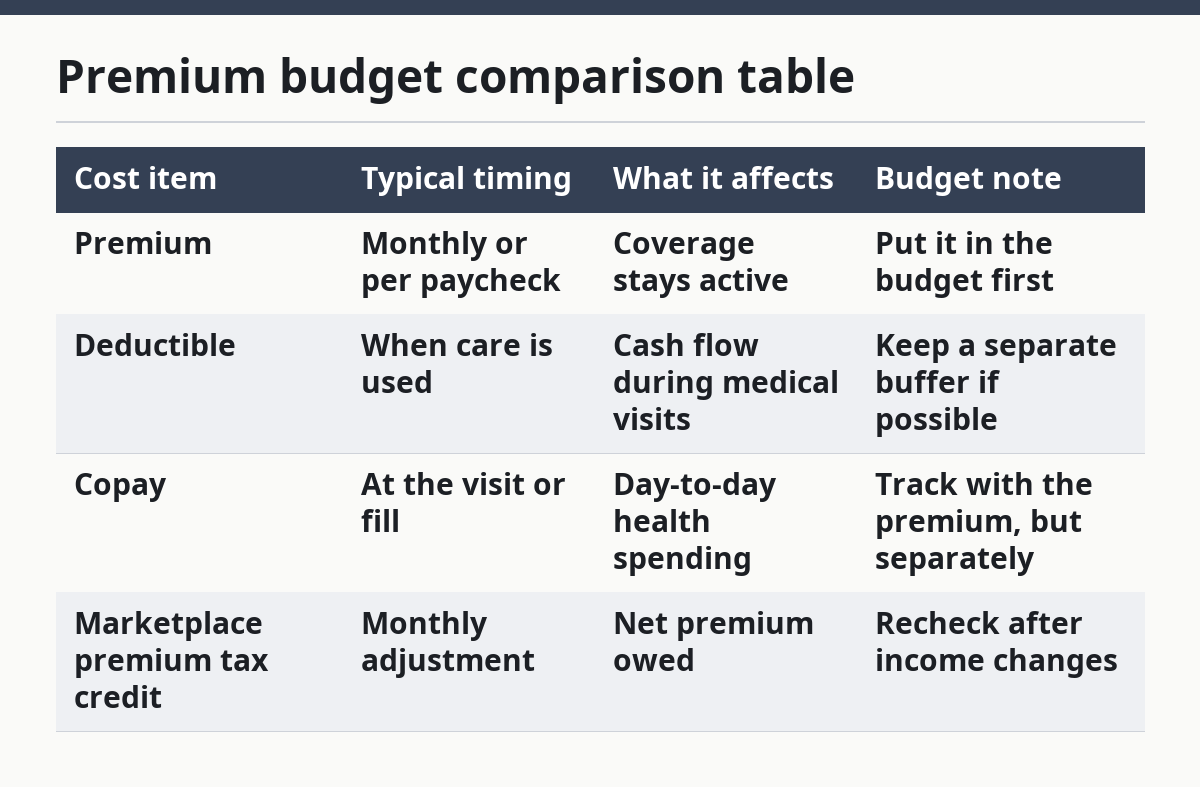
This is not the right approach if you do not know whether your premium is taken from pay or billed separately, because the cash-flow timing is different. It is also not enough if you are trying to budget for every medical cost at once; that belongs in a separate plan for deductibles, copays, prescriptions, and care visits. See the comparison table below for the main cost differences.
How do you budget for health insurance premiums as a single parent?
You budget for health insurance premiums by treating the premium as a fixed bill, lining it up with income dates, and setting aside part of each paycheck before other spending starts. The basic tool is a monthly budget, but the working tool is the calendar.
-
List the premium on a 1-month budget sheet and write the exact billing method next to it: paycheck deduction, monthly invoice, or marketplace autopay. Verify the amount from the current benefits notice, pay stub, or plan account. If the premium is missing from the budget, the bill will get covered by accident instead of by plan.
-
Mark the due date on a calendar for every month and place it 3 to 5 days before the actual withdrawal or bill date if your income is uneven. Verify that the money will be available early, not just on the due day. If the premium lands after other bills, the plan is vulnerable to overdraft or late payment.
-
Split the premium across paychecks by dividing the monthly amount into equal pieces for each paycheck you expect in that month. Verify that each piece fits your real net pay, not gross pay. If one paycheck is larger than the others, a problem shows up when the smaller check arrives and the premium has not been fully covered.
-
Build a premium cushion in a separate savings bucket equal to at least one premium cycle if your income changes from week to week. Verify that the cushion is not mixed with grocery or gas money. If the cushion disappears for normal spending, the budget is too thin to protect coverage.
-
Check your paycheck deductions every time a new benefit year starts or a job changes. Verify the premium line on the pay stub against the plan notice, since employer deductions can change without much warning. If the deduction is higher than expected, the gap has to come out of take-home pay somewhere else.
-
Compare the premium with the deductible so the budget reflects both fixed and variable costs. Verify the deductible from the plan summary, then note that a lower premium often comes with a higher deductible. If the premium feels manageable only because the deductible is large, the health budget is incomplete. For a practical check, compare the monthly premium and the deductible side by side in the comparison table.
-
Recheck at open enrollment before choosing or renewing coverage. Verify any new premium, new deduction timing, and any change in the deductible or plan year start date. If the new plan only looks cheaper on the premium line, the rest of the cost structure may have shifted.
-
Track changes in income immediately and revise the premium line the same week if hours drop, overtime stops, or child support timing changes. Verify whether the premium still fits the current month, not last month. If you wait until the next statement, the budget may already be in trouble.
For marketplace coverage, the HealthCare.gov pages on income estimates and premium tax credits are useful starting points: https://www.healthcare.gov/how-to-estimate-income/ and https://www.irs.gov/credits-deductions/premium-tax-credit. For broader plan rules, the CMS coverage pages can also help: https://www.cms.gov/health-insurance-marketplace. If the plan is employer-based, the benefits office or summary plan description is the document to check.
What should you check before the premium comes out?
You should check the payment source, the date, and the fallback money before the premium comes out. Those three things tell you whether the bill is protected or likely to bounce.
The first check is the source. Employer plans often take premiums from pay before you see the money, while marketplace plans usually need a payment outside payroll. The second check is the timing. A premium due on the 1st behaves differently from one deducted after each paycheck.
The third check is the backup. A budget with no buffer is fragile when a shift gets cut, a paycheck is late, or a tax credit changes. The fourth check is the family calendar, because a premium due during school costs or child care spikes can squeeze the rest of the month harder than expected. A 30-day calendar review is enough to catch most timing problems.
A good result looks boring: the premium comes out when planned, the account stays above zero, and the rest of the month does not depend on borrowing from groceries or transport. A bad sign is a budget that only works after moving money around every month.
What happens when premiums change?
A premium change means the budget has to change right away, because the old monthly amount is no longer the right number. Even a small increase can matter when the budget is already tight.
If the premium rises on an employer plan, the paycheck deduction usually changes automatically, so take-home pay drops without much room to react. If the premium rises on a marketplace plan, the bill may change at the start of a new plan year or after an income update, which can alter what you owe each month. Rates, subsidies, and eligibility rules differ by country and plan type, so the notice matters more than a guess.
The right move is to replace the old number in the budget the day the new notice arrives and then check the deductible at the same time. A premium increase with a lower deductible may feel different from a premium increase with a higher deductible, but both affect cash flow. If the new premium no longer fits, the budget needs revision before the next billing cycle, not after. For premium changes, keep the monthly figure and deductible side by side in your budget sheet.
When should you stop and get help with the plan?
You should stop using a DIY budget and get qualified help when the premium, tax credit, or payroll deduction no longer matches the notice in front of you. That mismatch can cause missed payments or coverage problems.
The deduction is different from the plan notice: payroll or billing records do not match the premium amount — contact the employer benefits office or the marketplace before the next due date.
You missed a payment once already: the budget is not absorbing the timing gap — ask for a review of the payment method and due date before coverage is interrupted.
Your income changed in a way that affects eligibility: a new earnings level can change a marketplace premium or credit — update the estimate and confirm the new amount quickly.
The deductible is so high that the monthly plan feels cheap but unusable: the premium alone is not showing the real strain — get help comparing the full annual cost picture.
You do not know whether the plan is employer-based or marketplace-based: the budgeting method depends on where the premium is coming from — identify the source first, then build the budget.
The plan year is starting or ending within 30 days: timing changes often happen around open enrollment — review the new notice before the old one rolls off.
What mistakes do single parents make with premium budgets?
The most common mistake is budgeting for the premium after food, gas, and child care. That turns coverage into a leftover expense, and leftovers disappear fast in a tight month.
Another mistake is using gross pay instead of take-home pay. The premium has to come from the money that actually lands in the account, not the larger number on the offer letter. A third mistake is forgetting that paycheck deductions and monthly bills do not land on the same date, which can make a budget look fine on paper and fail in the account.
A fourth mistake is ignoring the deductible. A plan with a manageable premium can still pressure the budget later if care is needed and the deductible is high. A fifth mistake is failing to update the budget during open enrollment, when the premium or deduction can shift for the next plan year.
The correct alternative is to budget from net pay, set the premium aside first, and review the plan notice every time the month changes or the job changes. That sounds simple because it is simple, but it has to be repeated with each new notice.
What if your paycheck does not arrive evenly?
Irregular pay makes premium budgeting harder, and the fix is to budget by paycheck, not by hope. A parent with weekly, biweekly, or seasonal income cannot rely on a single “normal” month.
The practical method is to assign a portion of each paycheck to the premium until the full monthly amount is covered. If one month has three paychecks and another has two, the premium still needs to be covered in both months. The exact split depends on the pay calendar and the premium due date, so the budget has to be written against dates, not feelings.
A second adjustment is to hold the premium money in a separate place until the bill date. That stops the premium from getting absorbed into a busy week of school fees, fuel, or household repairs. If the money keeps getting borrowed for other costs, the budget needs a tighter envelope or a different payment rhythm. That is especially important in How to Budget for Health Insurance Premiums as a Single Parent, because one missed premium can disrupt coverage.
How does this fit with the rest of a single-parent budget?
It fits as the first health cost, not the only health cost, and it belongs in the same monthly plan as rent, food, child care, and transport. The hub for single-parent income protection and benefit planning sits above this topic, but the premium line here is the piece that keeps coverage active month by month.
A useful check is to compare the premium against the rest of the fixed bills in one 30-day window. If the premium and housing cost together take most of take-home pay, the budget may need a stronger cushion or a different plan year strategy. If the premium is stable but the deductible is large, the monthly budget still needs room for later care costs.
The main point is simple: premium budgeting works when the bill is treated like rent, not like a variable want. That mindset keeps coverage from being the one bill that gets pushed aside when the month gets hard. The same rule applies whether you use an employer plan or a marketplace plan.
Premium budget comparison table
| Cost item | Typical timing | What it affects | Budget note |
|---|---|---|---|
| Premium | Monthly or per paycheck | Coverage stays active | Put it in the budget first |
| Deductible | When care is used | Cash flow during medical visits | Keep a separate buffer if possible |
| Copay | At the visit or fill | Day-to-day health spending | Track with the premium, but separately |
| Marketplace premium tax credit | Monthly adjustment | Net premium owed | Recheck after income changes |
How do I set aside money for health insurance premiums?
Set the premium aside on the same day you get paid, before you spend on anything flexible. If the premium is billed monthly, divide that amount across your paychecks and move each share to a separate account or envelope. The budget works when the money is out of reach long before the due date. If your income changes, review the split with a qualified adviser or with the plan notice in hand.
What happens to my budget if premiums go up?
Your budget has less room for other bills, so the premium line has to be updated right away. If the plan is tied to payroll, your take-home pay may fall without warning; if it is a marketplace plan, the bill may rise at renewal or after an income update. In both cases, the premium change should be checked against the deductible and your current net pay. A $20 increase can matter just as much as a larger change when your margin is already thin.
Drafted with AI; not yet reviewed by a person.