
Last updated: November 18, 2026
Quick Answer: When money is tight, a single parent budget priority order usually starts with housing, food, core utilities, childcare, and minimum debt payments, then moves to transportation and everything else. This guide on How to Set Budget Priorities When Money Is Tight as a Single Parent focuses on the bills that keep the household stable first, using the priority approach recommended by the CFPB and similar consumer guidance. When money is tight, set your budget priorities by protecting housing, food, utilities, childcare, and the minimum debt payments that keep you stable. The right budget priority order is not about being perfect; it is about choosing what prevents the next crisis first, and when the situation is unusually complex, consult a qualified professional or local nonprofit counselor.
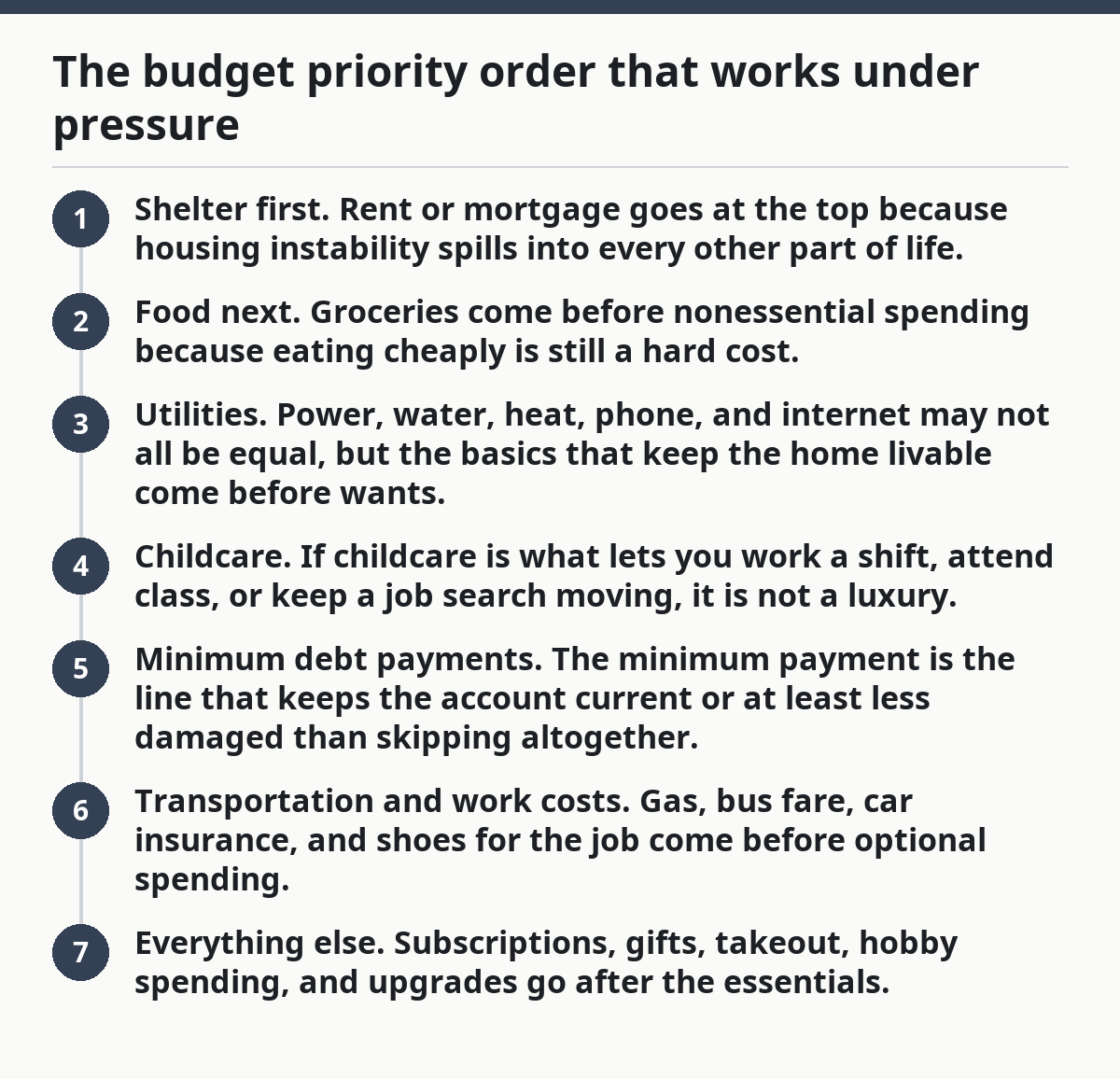
The budget priority order that works under pressure
The budget priority order is the order in which money gets assigned when there is not enough for everything. For a single parent, How to Set Budget Priorities When Money Is Tight as a Single Parent usually starts with rent or mortgage, groceries, utilities, childcare, and minimum debt payments, then moves to everything else.
That order is not arbitrary. It reflects what keeps a roof overhead, food in the house, power on, and a child supervised while you work or look for work. It also protects the parts of your financial life that can snowball fast if ignored, especially debt payments with late fees or collection risk. If you want a broader map of the money system behind this page, the hub on [single-parent budget foundations] can sit alongside this guide, and the CFPB’s budgeting resources provide a useful outside reference.
A useful way to think about the order is this:
- Shelter first. Rent or mortgage goes at the top because housing instability spills into every other part of life.
- Food next. Groceries come before nonessential spending because eating cheaply is still a hard cost.
- Utilities. Power, water, heat, phone, and internet may not all be equal, but the basics that keep the home livable come before wants.
- Childcare. If childcare is what lets you work a shift, attend class, or keep a job search moving, it is not a luxury.
- Minimum debt payments. The minimum payment is the line that keeps the account current or at least less damaged than skipping altogether.
- Transportation and work costs. Gas, bus fare, car insurance, and shoes for the job come before optional spending.
- Everything else. Subscriptions, gifts, takeout, hobby spending, and upgrades go after the essentials.
Who this is not for: if your income is variable and your bills are already behind, a category-by-category budget alone will not solve the problem. You need triage, not a prettier spreadsheet, and a HUD-approved housing counselor or other nonprofit adviser can help if the stakes are high.
How do I decide what gets cut first?
Cut the spending that is easiest to pause, easiest to replace, and least likely to create a new problem within 30 days. In How to Set Budget Priorities When Money Is Tight as a Single Parent, the best cuts are usually the ones that do not threaten housing, safety, your ability to work, or your child’s basic care.
A simple test helps:
- Can I stop this for 1 month without causing a crisis? That makes it a real candidate.
- Can I replace it for free or cheaper? That points to a quick cut.
- Does this protect a bigger bill? If it does, keep it.
- Does this help me earn money or keep the home running? If yes, it belongs higher than a want.
In practice, wants fall away first. Streaming bundles, app subscriptions, premium toiletries, restaurant meals, impulse clothes, and convenience purchases are easier to trim than rent or groceries. Even a 1-month pause can buy room to catch up, and the FTC’s consumer advice on budgeting and bill payment backs up that kind of triage.
The trap is cutting the wrong thing because it is visible. A child’s school lunch money, medication, or childcare because “it feels optional” can cost more later than the cash saved today. A missed utility bill can trigger reconnection fees. Skipping a minimum debt payment can add late fees and damage credit. A budget cut should lower pressure, not create a second emergency.
A good cut is one that frees money without destabilizing the household. If a subscription is $15 and it saves your evening because you have no other wind-down option, that is a comfort choice. If an online order for diapers, snacks, or convenience food is draining $40 a week, that is usually the better cut because the same need can often be met another way.
Use this 4-step triage when the month is short
Use a 4-step triage when your income cannot cover the full month and you need a decision order in under 30 minutes. This is the part that turns a messy list of bills into a plan.
-
List every essential bill and expense for the month.
Write rent, groceries, utilities, childcare, debt minimums, transportation, and any work-related costs on one page. Seeing the full list at once keeps you from treating a smaller bill as if it were more urgent than housing, and a nonprofit credit counselor can help you sort the list if it is hard to judge on your own. -
Mark what creates the fastest harm if unpaid.
Put a star next to housing, power, water, childcare tied to work hours, and any debt payment that has an immediate late-fee date. The point is to find the bills with the shortest fuse, not just the largest balance. -
Separate needs from wants using the next 30 days.
Ask, “If I do not pay this now, what breaks in the next month?” Groceries, a bus pass, and childcare may all stay. A birthday gift fund, a subscription box, or a repair upgrade may not. -
Assign the last dollars to the highest-risk gap.
Put the remaining money where the next crisis would be most expensive. If rent is short, fill that first. If childcare is what protects your work shift, keep that funded before a nonessential debt extra payment.
This triage is not the same as a full budget. It is a short-term ranking tool for a hard month. The result should be a clear order, even if the order is painful.
The trade-off is obvious: triage can delay some obligations. That is better than pretending every bill is equal and running out of cash on the 20th. Still, if the gap is large or repeated, this framework will only tell you what to protect first, not how to make the numbers work longer term.
Should debt payments ever outrank groceries or childcare?
Usually no, because groceries and childcare keep daily life functioning, while debt can often be negotiated or paid at the minimum for a while. The exception is when a debt payment protects something you cannot afford to lose, such as a car needed for work or a secured loan tied to essential property, and a consumer-credit professional can help you assess that trade-off.
Minimum payments matter because they are the line between “current enough” and “falling behind fast.” On many debts, missing even one payment can trigger fees, interest, or a damaged account. But that does not mean every extra dollar should go to debt before food or supervision for your child. A debt snowball idea belongs elsewhere; this page is about priority order when cash is scarce.
A practical rule: pay the minimums you can, then stop there until essentials are covered. Extra debt payoff can wait. If your rent is short by $200 and your credit card minimum is $45, the rent gap usually wins. If you are choosing between the minimum on a small unsecured card and groceries for the week, groceries win, though you may still want a credit counselor to review the long-term cost.
There is one honest downside to this choice. Focusing on essentials can let debt balances linger longer, which means more interest over time. That is the trade-off. It is still the correct trade-off when the alternative is an empty pantry or a missed childcare payment that costs you work hours.
If the debt is tied to a vehicle, a secured loan, or a court-ordered obligation, the ranking may change. Those cases deserve a careful review with the creditor terms in front of you, and a professional who can explain the consequences if the payment is missed.
How to rank rent, utilities, groceries, and childcare without guessing
Rank rent, utilities, groceries, and childcare by asking which one creates the most immediate damage if you skip it for 30 days. The answer is usually rent first, then the utilities that keep the home livable, then groceries, then childcare tied to work or school.
Use this lens:
- Rent or mortgage: If this is missed, housing stability is at risk. That makes it the first line item in the order.
- Groceries: Food is nonnegotiable, but you may have room to stretch by cooking from staples, using school meals if available, or leaning on low-cost pantry items.
- Utilities: Not every utility is equal. Heat, water, and electricity are usually core. A premium internet plan is not the same as basic service needed for school, job applications, or work shifts.
- Childcare: Childcare is often a working expense, not a lifestyle expense. If it is the only thing allowing you to keep a paycheck, it rises in the ranking fast.
A mistake I see often is treating utility bills as interchangeable. A cell plan, a streaming bundle, and electricity are all “bills,” but they do not belong on the same tier. Another mistake is undercounting groceries because a pantry feels full today. A 7-day meal plan looks different from a 30-day month, so the priorities need to match the calendar.
If the list feels tangled, use a plain test: which bill protects four things at once? A rent payment protects shelter, storage for your belongings, routines for your child, and your ability to keep other bills organized. That is why it sits above most other expenses.
The priority order changes when your situation changes
The priority order changes when your income changes, your childcare changes, or an essential bill can no longer be delayed. A stable month and a crisis month do not use the same ranking.
Three common shifts matter:
- New job or extra shift: Childcare and transportation may move up because they protect earned income.
- Reduced hours: Debt extras and nonessential spending move down quickly so food and housing stay funded.
- One-time emergency: A car repair, medical copay, or school need may temporarily outrank a routine line item if it blocks work or child care.
That is why rigid rules fail. A single parent does not get to budget in a vacuum. The right order is flexible, but the logic behind it stays the same: protect the bills that keep the home stable and the household functioning.
A good monthly reset takes about 15 minutes. Re-rank the list when a paycheck changes, a bill jumps, or a child-care schedule shifts. Do not wait for the end of the month to admit the priority order moved.
This is also where a common mistake shows up: spending the same way in a low-income month that you spend in a normal month. That costs you because last month’s priorities may no longer fit this month’s reality. The fix is to re-rank, not to hope the old plan still fits, and that is one reason How to Set Budget Priorities When Money Is Tight as a Single Parent works best as a month-by-month process.
Key Takeaways
- The first job is to protect the bills that keep the home stable and the child cared for.
- Shelter, food, utilities, childcare, and minimum debt payments belong near the top.
- Wants are the first place to cut because they are the least likely to create a new crisis within 30 days.
- Debt extras wait until essentials are covered, unless the debt protects housing, a vehicle, or another must-have.
- The right order changes when work hours, childcare, or essential bills change.
What should I pay first when money is tight?
Pay first what keeps you housed, fed, and able to care for your child. In most cases, that means rent, groceries, core utilities, childcare, and minimum debt payments before anything discretionary. If one payment protects your ability to work, it may move ahead of another line item.
How do I decide what gets cut from the budget?
Cut the spending that can pause for 30 days without causing a bigger problem. Subscriptions, takeout, impulse purchases, and upgrades are usually easier to cut than housing, food, utilities, or childcare. If a cut would disrupt work, safety, or your child’s basic needs, it is probably not the right cut.
What counts as a budget priority?
A budget priority is any expense that prevents a larger problem if you pay it now. Rent, groceries, utilities, childcare, and minimum debt payments usually qualify because they protect the household’s stability. A priority is not whatever feels urgent in the moment; it is what creates the most harm if ignored.
Drafted with AI; not yet reviewed by a person.