
Last updated: November 20, 2026
Quick Answer: Set aside for 3 cost buckets — notarization, copies, and delivery — before you print. For How to Budget for Notarization and Document Copies as a Single Parent, the practical way to budget is to price the notary public fee, the number of pages to copy, and any mailing or courier service before the deadline lands. Rules vary by jurisdiction, and this is general information, not legal advice; a qualified lawyer should be consulted for your own matter, especially if the office’s instructions are unclear.
Key takeaways
- Notarization, copies, and mailing are usually modest on their own, but they add up fast when a packet needs several versions.
- The biggest mistake is budgeting for the form and forgetting the paper trail around it.
- A certified copy is not the same as a regular photocopy, and the cost can differ.
- The right budget is built from countable items: signatures, pages, sets, and delivery method.
- If the paperwork affects custody, immigration, benefits, or court deadlines, check the local rule before paying for extras.
Who does this budget plan fit?

This budget plan fits a single parent who needs to prepare paperwork that may require notarization, photocopies, certified copies, postage, or a courier service. It assumes you already know which document you are preparing and roughly how many pages it has, but not the exact fee total yet.
This is not the right method if your situation depends on a local filing rule you have not checked, or if a deadline is close enough that a rejected form would cause harm. In those cases, a lawyer, legal aid office, or the office that will receive the document should confirm the requirement first. A 10-minute check can save a wasted trip, a second set of copies, or a missed mailing window.
The budget is also different if you only need one signature on a single page versus a packet with multiple attachments. A one-page affidavit and a 20-page family packet create very different paper costs, even before postage enters the picture. The point is to price the process, not just the signature.
For the wider planning picture, this topic sits under the hub on Single-Parent Legal and Family Transition Costs, where the recurring admin costs are grouped by type.
What costs show up?
These costs usually come from four places: the notary public fee, copy charges, certified copy fees, and mailing or courier service costs. The notary fee covers the act of witnessing a signature or administering an oath, while copy charges cover duplication of paper pages. A certified copy is an official copy marked by the issuing office, and it usually costs more than a regular photocopy.
The number that matters is not one fee but the full packet total. A document with 3 pages and 2 required sets can turn into 6 copies, plus one or more notary stamps, plus postage. If a recipient asks for both originals and copies, the budget needs to reflect both paths.
Mailing often gets missed because it feels minor. Standard postage may be enough for a flat packet, but a heavier envelope, tracking, or courier service changes the total. If your packet must arrive by a deadline, price the delivery method before you print the pages. The USPS Postal Explorer and postage calculator are useful reference points for mail pricing, and the United States Postal Service is the body that sets those rates in the United States.
How do I build the budget step by step?

Use one simple rule: count every required action once, then total the paper trail before you buy or print anything. A worksheet or phone notes app is enough if you list the items in the order they happen.
- Gather the document, attachment list, and delivery instructions before you spend anything.
- Count the pages, signatures, and required copies so you know the exact volume.
- Price the notary public fee, asking whether the charge is per signature, per stamp, or per appointment.
- Estimate the copying cost by multiplying the page count by the number of sets needed.
- Check whether a certified copy is required instead of a regular photocopy.
- Add postage or courier service costs for every envelope or package you expect to send.
- Verify the receiving office’s format rules so you do not pay for the wrong version.
- Set a small buffer for reprints or an extra set of copies if one page is rejected or spoiled.
Each step should end with a yes-or-no check. If the answer is “I don’t know,” the budget is not ready yet. A missing page count, unclear signature count, or vague delivery rule means the total will be off.
A simple example helps. If one packet needs a notarized signature, 8 pages copied in duplicate, and mailed once, your total has 3 cost buckets, not one. If the packet also needs a certified copy from the issuing office, that adds another line item and another trip or mailing. The right budget names each bucket separately instead of guessing a single lump sum.
How much should I set aside for notarization and copies?
Set aside enough for the notary public fee, the copying charge for every page set, and the delivery cost, then add a buffer for a second set of copies. That buffer matters because paper gets smudged, pages get printed on the wrong side, and offices sometimes ask for an extra copy after the first submission.
The exact amount depends on jurisdiction and the receiving office’s rules, so a universal price would be misleading. A local bank, shipping store, law office, library, or independent notary may charge differently, and some places bundle copying while others do not. The budget should be built from local prices, not from an online average.
If you are choosing between mailing and a courier service, compare the total, not just the postage line. A courier service can cost more than regular mail, but it may be the better fit if the document has a hard deadline or must arrive in one piece with tracking. If the document does not need speed, standard mail may be enough and cheaper.
The best practice is to keep these lines separate in your notes:
| Cost item | What it covers | Budget check |
|---|---|---|
| Notary public fee | Witnessing or oath service | Is it per signature or per visit? |
| Copying cost | Photocopies or printouts | How many pages in each set? |
| Certified copy | Official copy from the issuing office | Is it required, or only a regular copy? |
| Mailing or courier service | Postage, tracking, or delivery | Does the deadline justify the faster option? |
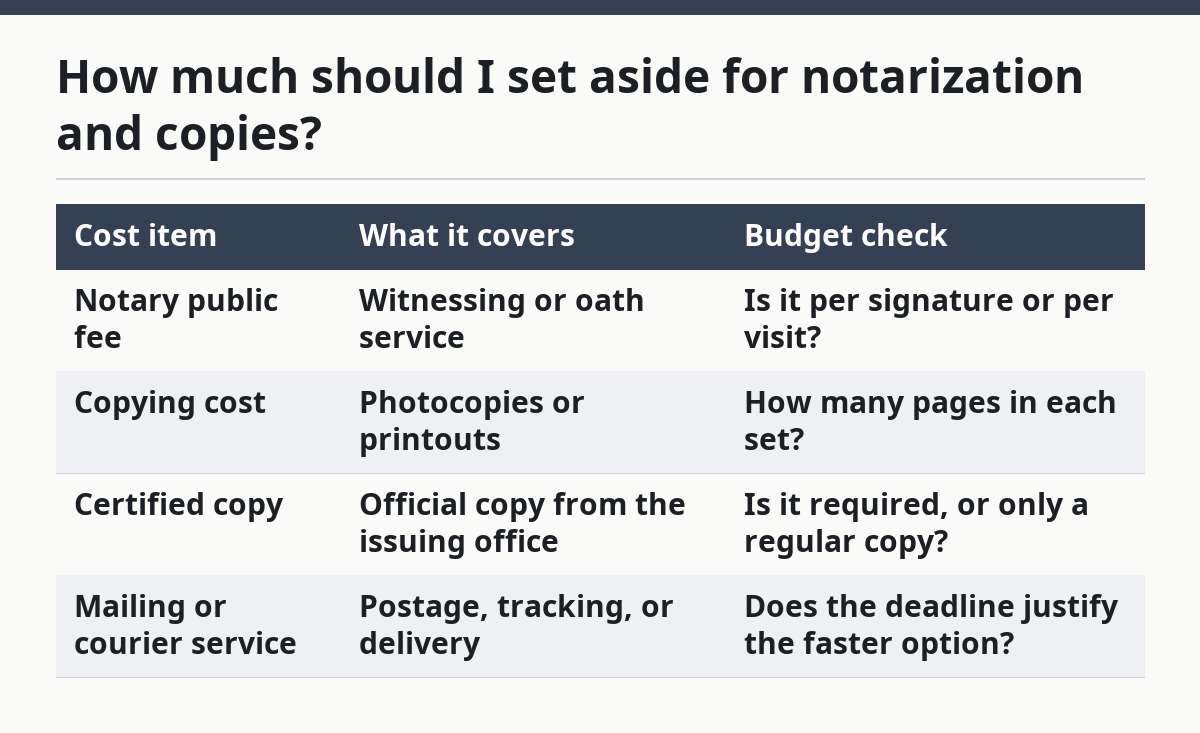
That table helps because many people think of “paperwork” as one cost. It is not. It is several smaller costs that tend to show up at the same time.
What should I check before I pay?
Check the receiving office’s instructions, because the wrong version can waste both money and time. A form that needs a certified copy is not satisfied by a regular photocopy, and a document that needs notarization is not satisfied by a printout with no notary public seal.
The first thing to verify is the document type. Some papers need only copies, some need notarized signatures, and some need a certified copy from the issuing office rather than a home copy. The second thing to verify is quantity: one original, one copy, or multiple sets. The third is delivery: hand delivery, standard mail, tracked mail, or courier service.
If the rules are written, follow the written version. If they are not, ask the office that will receive the packet what it accepts and keep the answer in writing if possible. That small step can prevent paying for extra pages, repeated postage, or another trip to a notary public.
When does this budgeting method stop working?
This budgeting method stops working when the paperwork has a moving deadline, a strict format rule, or a consequence for getting the wrong version. In those cases, the cost estimate matters, but the first job is confirming the rule.
You do not know whether a certified copy is required: a regular copy may be useless — check the receiving office before printing more pages.
The document needs more than one notarized signature: the fee can multiply by signer — count each signature separately and confirm the notary’s pricing structure.
The packet must arrive by a fixed date: postage may not be enough — compare standard mail with a courier service that offers tracking or faster delivery.
The office wants originals back and also keeps copies: you may need two versions — budget for duplicate sets and label them clearly.
Your local notary pricing is unclear: the total could be much higher or lower than expected — call ahead and ask how the fee is charged.
The document is part of a legal matter with consequences if filed wrong: cost is not the only issue — pause and get qualified legal help before spending on copies that may not be accepted.
A single parent is often trying to manage this around work hours, school pickup, and limited cash on hand. That makes surprise reprints especially painful. The safer approach is to verify the required format first, then print and pay once.
What mistakes cost the most?
The most expensive mistake is printing the wrong number of pages and then paying again to fix it. A second round of copies, another notary visit, or a new envelope can turn a small task into 3 separate expenses.
Another common mistake is assuming every copy is equal. A certified copy and a photocopy are not interchangeable, and a notary stamp does not replace an official certified copy. If you confuse the terms, you may pay for the wrong thing and still have to start over.
People also undercount mailing. A flat envelope can be cheap, but a thicker packet, tracking, or courier service changes the total. If the packet has attachments, staples, or multiple signatures, the mail piece may be larger than it first appears.
A fourth mistake is forgetting the buffer. Paper jams, misprints, and smudges are ordinary, not rare, and a one-copy budget leaves no room for them. One spare set of pages is usually cheaper than a last-minute store run under deadline pressure.
What if the standard approach does not fit?
The standard approach needs adjustment when the recipient has special proof rules, when the packet is unusually large, or when the only available notary public charges by visit rather than by signature. In those cases, the budget should be built around the exception, not the default.
If the document is long, copying can become the largest paper cost. A 2-page form and a 25-page packet do not belong in the same estimate. If the packet is going to a government office, a school, or a private company with its own checklist, use that checklist as the source of truth.
If you cannot reach a notary during your work hours, the timing matters as much as the fee. A slightly higher charge may still be cheaper than missing a deadline or paying for overnight courier service at the last minute. The cheapest option on paper is not always the cheapest option overall.
How do I keep this from becoming a monthly drain?
Keep a running “paperwork fund” so notarization and copies do not blow up a week’s cash flow. Even a small earmark helps because these costs arrive in bursts, not on a neat schedule.
Track 3 numbers over time: how many notarized forms you need, how many page sets you usually copy, and how often you mail or courier documents. After a few rounds, the pattern is easier to predict. That matters for a single parent with irregular paychecks, because the goal is not perfection; it is avoiding a surprise bill on the same day as groceries or rent.
The cleanest habit is to store one note with the office name, the required format, the page count, and the delivery method. Then the next time a similar form comes up, the budget starts from facts instead of memory. For more on the larger budget picture, the hub on Single-Parent Legal and Family Transition Costs groups the other recurring admin expenses in one place.
Do I need certified copies for custody paperwork?
Sometimes, but not always. The answer depends on the court or office that asked for the document, and rules vary by jurisdiction. A certified copy is an official copy issued by the record holder, while a regular photocopy is not the same thing.
How much does notarization usually cost?
There is no single universal price. Notary public fees depend on the jurisdiction, the provider, and whether the charge is per signature, per stamp, or per appointment. Ask the office before you book so the cost matches the number of signatures on the page.
How can I avoid paying twice for the same packet?
Verify the receiving office’s format rules before you print. When the requirement is confirmed in writing, you are less likely to pay for the wrong version, and you can budget for only the copies you actually need.
What should I ask a notary before I go?
Ask whether the fee is per signature or per visit, whether they can handle multiple signatures in one appointment, and whether they charge extra for copies or travel. Those 3 questions cover the main cost drivers in a single trip.
When should I ask for legal help instead of budgeting on my own?
Ask for legal help when the document could affect custody, immigration, benefits, or a court deadline, or when the office’s instruction is unclear. In those situations, the issue is not only cost; it is whether the document will be accepted.
Drafted with AI; not yet reviewed by a person.