Last updated: November 19, 2026
Key Takeaways
- A cleaning supplies budget covers the items you replace regularly, not the whole household bill.
- Track 1 to 2 months of use, then set a monthly amount from actual restocks instead of guesswork.
- Keep the list short: dish soap, laundry detergent, toilet paper, paper towels, disinfectant, and the tools that make them work.
- Restock on a schedule tied to use, often weekly for paper goods and every few weeks for liquids, to avoid panic trips.
A cleaning supplies budget for a single-parent household keeps dish soap, laundry detergent, paper towels, toilet paper, and disinfectant from turning into surprise expenses. How to Budget for Cleaning Supplies as a Single Parent starts with what you already use, then sets a restocking rhythm you can actually keep. The steps below settle what to count, how to space purchases, and where bulk refills help instead of hurt.
What a cleaning supplies budget has to cover
A cleaning supplies budget covers the items you burn through on purpose, not the whole household bill. It should include the basics you restock on a loop: dish soap, laundry detergent, paper towels, toilet paper, disinfectant, trash bags, sponges, and whatever you use for floors or counters.
Picture this: you’re trying to make a month’s money last, and the house still needs to function every day. You do not need a perfect system. You need a short list, a rough restock cycle, and a limit that keeps you out of emergency buys. That’s the job.
A good starting rule is to separate daily-use items from slow-burn items. Daily-use items run out fast and need more frequent checks. Slow-burn items, like a mop head or a scrub brush, last longer and belong in a different line of your budget.
Use a separate line for this category in your budget app, notebook, or spreadsheet. If you mix it with snacks, school items, and laundry, you lose track fast. One line. One job. Clean enough to read later.
For general household budgeting structure, the hub on single-parent budgeting for household operations and maintenance should sit next to this page.
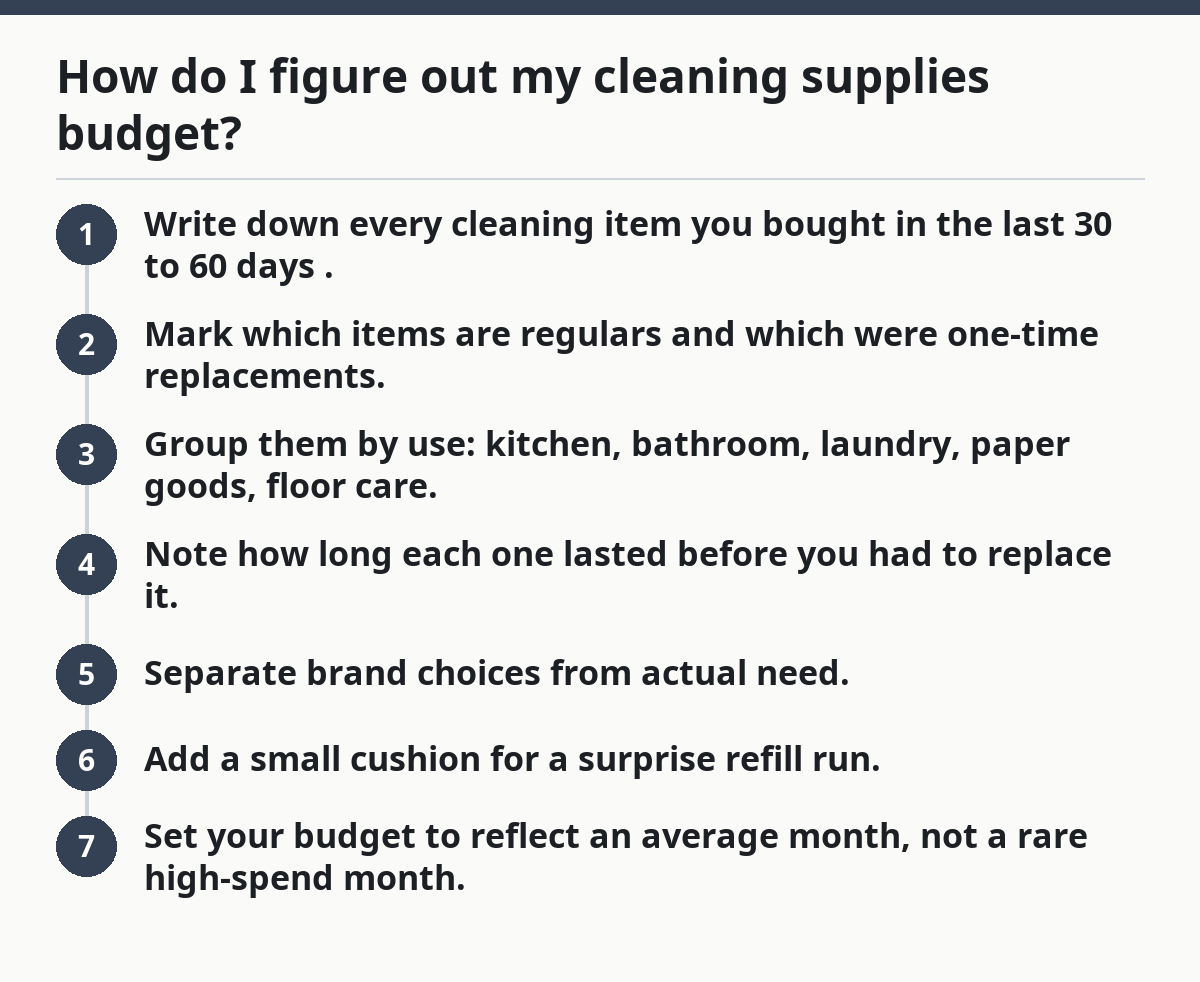
How do I figure out my cleaning supplies budget?
You figure it out by tracking 1 to 2 months of use, then setting a monthly amount based on actual restocks, not guesswork. That is the simplest honest method, and it works better than copying someone else’s spending.
Picture this: you’ve got a half-full bottle of dish soap under the sink, an almost-empty pack of toilet paper, and a laundry jug that seems to vanish overnight. You already have the raw data. The task is to turn that into a repeatable number.
Start with the items you buy most often:
- Write down every cleaning item you bought in the last 30 to 60 days.
- Mark which items are regulars and which were one-time replacements.
- Group them by use: kitchen, bathroom, laundry, paper goods, floor care.
- Note how long each one lasted before you had to replace it.
- Separate brand choices from actual need.
- Add a small cushion for a surprise refill run.
- Set your budget to reflect an average month, not a rare high-spend month.
That cushion matters. Without it, one extra spill or illness week can throw the whole month off. Too much cushion, though, and the budget grows lazy. If your “cleaning” line keeps staying far below target, trim it the next month.
A simple record can be a list in your phone:
- Dish soap: bought, used, restocked
- Laundry detergent: date and amount
- Toilet paper: date and pack size
- Paper towels: date and pack size
- Disinfectant: date and frequency
If a category changes every month, the problem may be shopping style, not usage. Bulk packs, impulse upgrades, and duplicate bottles in different rooms can hide the real pattern. That’s where the budget gets foggy.
What should be in the list, and what can wait?
The essential list is short: dish soap, laundry detergent, toilet paper, paper towels, disinfectant, and the tools that let those products work. Anything beyond that belongs in a second tier unless you use it often.
Picture this: you’re standing in the aisle and trying to decide between the item you need and the item that promises a shinier result. This is where budgets get broken. The fix is to sort supplies into “must keep on hand” and “nice to have if money allows.”
Use this split:
- Must keep on hand: dish soap, laundry detergent, toilet paper, paper towels, disinfectant, sponge, trash bags
- Use only if needed: glass cleaner, specialty stain remover, oven cleaner, appliance wipes
- Buy rarely: mop pads, scrub brushes, replacement heads, storage bins
The truth is, many homes can run on fewer products than the aisle suggests. A multipurpose cleaner can reduce clutter, but only if it truly fits the surfaces in your home. If you need special products for stainless steel, baby items, or sensitive surfaces, budget for those separately.
Don’t forget laundry items in the cleaning budget if you use them for the same running household system. Laundry detergent is not optional for most families. It may be a large part of the line, and that’s normal.
Here’s the catch: if you keep buying “backup” bottles before the first bottle is empty, you can’t see how much you really spend. Duplicate stock is money sitting under the sink.
How often should I restock supplies?
You should restock on a schedule tied to use, usually weekly for paper goods and every few weeks for liquids, so you don’t pay for panic trips. A restock schedule beats waiting until something is gone.
Picture this: it’s Saturday night, the last roll is in use, and the nearest store is not cheap. That kind of trip costs more than the product itself once you add stress, time, and whatever else gets picked up at the register.
Set three checks:
- Weekly check: toilet paper, paper towels, dish soap
- Every 2 to 4 weeks: laundry detergent, disinfectant, trash bags
- Monthly check: sponge supply, brush wear, floor cleaner, refills
The exact timing depends on home size, kids’ ages, and how often you clean. A home with shared bathrooms will burn through toilet paper faster than a one-bath apartment. A parent with a toddler may use more paper towels and disinfectant than someone cleaning once a week.
If your checks are random, your spending will be random too. Pick one day. Same day each week. It can be tied to grocery planning, payday, or trash day. The day matters less than the habit.
A restock list helps here:
- 1 bottle dish soap
- 1 container laundry detergent
- 1 pack toilet paper
- 1 pack paper towels
- 1 disinfectant refill or spray
- 1 sponge or scrubber if the current one is worn
If you’re always buying too early, you may have too much storage space and not enough tracking. If you’re buying too late often, the list may be too loose. Tighten it.
Should I buy in bulk or as I go?
Bulk refills can save trips and smooth out spending, but only when the item is used fast enough and storage stays dry and organized. Buying larger packs just because they look cheaper can backfire.
Picture this: you see a warehouse-size pack of paper towels and think you’ve solved the problem. Then the closet fills up, the house gets crowded, and the “cheap” purchase becomes clutter. That’s not savings. That’s inventory.
Bulk works best for products you use predictably:
- Toilet paper in homes with steady use
- Laundry detergent if you can store it safely
- Dish soap refills if you refill from one bottle
- Disinfectant refills if the same product is used across rooms
Bulk is weaker when:
- The product is used slowly
- The house has very little storage
- The item can dry out, leak, or get damaged
- You change brands often because of skin sensitivity, scent, or surface needs
A refill bottle can be better than several small bottles because it cuts packaging and can reduce how often you shop. Still, a refill only helps if you pour it into a clean container and keep the cap tight. A leaky bottle ruins the savings fast.
Check the unit size, not the shelf label. A bigger package is not automatically the better value. If the item lasts too long, the money sits unused. If it spoils, leaks, or gets forgotten behind other supplies, the bargain disappears.
The mistakes that make cleaning budgets go off track
Cleaning budgets go off track when people buy by habit, not by count. The fix is to match each purchase to a real use case and a real restock date.
Picture this: you have three half-used bottles in different rooms and no clear idea which one needs replacing. That is how a small household expense gets messy. The good news is the mistakes are common and fixable.
Common errors:
- Buying duplicates: You already have the item, but you forgot. The result is wasted money and crowded storage. Use one list for the whole house.
- Treating paper goods like extras: Toilet paper and paper towels are not bonus items. When they’re not budgeted, the rest of the month gets squeezed. Put them in the base plan.
- Chasing sales without a plan: A “deal” on the wrong product is still a bad purchase. Compare it to your actual monthly use.
- Ignoring the cleaning tools: Sponges, brushes, and mop heads wear out. If you ignore them, you end up replacing more at once.
- Overbuying specialty products: Specialty cleaners can crowd out the basics. Keep them only if they solve a problem you really have.
- Not tracking restocks: If you can’t say when you bought the last bottle, you can’t budget it well.
The correction is usually boring: track what runs out, set a repeat date, and buy the same core items until your pattern is stable. Then adjust one category at a time.
If a product sits untouched for months, it may not belong in the budget at all. Let it run out before replacing it unless you know it’s part of a regular routine.
What changes when the house runs hot, cold, or crowded?
A bigger household, shared bathrooms, pets, illness, or heavy cooking means the budget needs more frequent restocks, not a completely different system. The method stays the same; the timing changes.
Picture this: the house is full after school, dinner is messy, and the bathroom gets used all day. That kind of traffic changes consumption fast. If you ignore it, you’ll keep under-budgeting the same items.
Adjust the plan based on use:
- More people: raise toilet paper and paper towel allowances first
- Frequent laundry: shorten the detergent check cycle
- Shared bathrooms: increase disinfectant and paper towel checks
- Pets: add cleaner and wipes if accidents are common
- Sensitive skin or allergies: budget for the exact product that works, not the cheapest one
If space is tight, choose smaller packages more often instead of a giant stockpile. That can cost a little more in trips, but it may fit better in a small apartment or a crowded closet. Budgeting is not only about price. It’s also about what the house can hold.
The truth is, the right amount of supply is the amount you can store, use, and replace without stress. If your stockpile becomes a pile, it’s too much.
When does this approach stop working?
This approach stops working when your spending swings too hard from month to month, the same item keeps getting overbought, or storage is so tight that supplies get damaged or forgotten. At that point, the budget needs a different setup.
Picture this: you’ve built a cleaning line, but every month still feels random. That usually means the problem is not the category. It’s the structure. Here’s where to change course.
Storage space is too small: Bulk buying creates clutter and forgotten stock — switch to smaller, more frequent purchases.
Skin irritation or allergies are common: Generic product choices may not work for everyone in the house — budget for the specific formula that avoids repeat problems.
Usage changes every week: A fixed monthly amount becomes inaccurate — move to a weekly refill plan.
You keep missing essentials: The budget exists, but the system doesn’t — use a written checklist and one shopping day.
The product is wasted before use: Packaging or storage is failing — buy smaller sizes or different containers.
Cleaning costs keep crowding out basics: The category is too broad — split paper goods, laundry, and cleaners into separate lines.
This is also the point where a broader household budget review helps. If a cleaning line keeps dragging money around, the problem may be elsewhere in the household plan. The linked hub on single-parent budgeting for household operations and maintenance is the right place to widen the view.
FAQ
What cleaning items should I budget for?
Budget for the items you replace on purpose and on schedule: dish soap, laundry detergent, toilet paper, paper towels, disinfectant, sponges, trash bags, and a few cleaning tools. Start with the products you use every week, then add specialty items only if they are part of your normal routine. That keeps the list useful instead of crowded.
How often should I restock supplies?
Restock based on how fast each item runs out, not on a fixed guess. Many households check toilet paper and paper towels weekly, then review laundry detergent and disinfectant every few weeks. If you keep buying too late, shorten the check cycle. If you always have leftovers, lengthen it.
How do I avoid overspending on cleaning products?
Avoid overspending by tracking what you use, shopping from a list, and skipping duplicate or specialty items you do not need. Compare package sizes by use, not by shelf appeal, and be careful with bulk buys that take months to finish. A small list with regular checks usually beats random sale shopping.
Drafted with AI; not yet reviewed by a person.