Last updated: November 20, 2026
Quick answer: budget at least $25 to $50 for a lost debit card or checkbook if you may need expedited help, then add a small buffer for a temporary card, shipping, or a short cash gap. For a single parent, the real cost is not just the card or checkbook; it is the shipping fee, any expedited card shipping, and the cash gap while access is down. In this guide to How to Budget for Replacing a Lost Debit Card or Checkbook as a Single Parent, the goal is to plan for a one-time bank account disruption, not a monthly bill.
Key takeaways
- A replacement is usually a small one-time hit, but the timing can hurt more than the price.
- The cost can rise if you need a temporary card or faster shipping.
- A tiny buffer in your bank account can keep one lost card from turning into a week of stress.
- Checkbook costs matter only if you still use checks for rent, school, or childcare.
- A safer budget plan is to prepare before the card or checkbook goes missing, not after.
What should I budget for first?
Therefore, budget for the replacement debit card first, then add the extra costs that can show up with it. The main line items are the bank card replacement fee, any shipping fee, and the gap in access time before the new card arrives. If you still use checks, add check reorder fees too, since a new checkbook can be a separate charge.
Start with the possibility that the bank may charge for a replacement, even when the card itself is the only thing lost. Then ask whether you may need a temporary card or expedited card shipping. Those fast options can cost more, but they can also save you from late fees, missed grocery trips, or having to find another payment method for 3 to 7 days.
For a single parent, the question is not “What does one item cost?” It is “What does this loss interrupt?” A replacement debit card that arrives in a few business days may be enough if you still have another payment method. If you do not, the budget needs room for speed, not just the card itself.
How do I build the budget in 4 steps?
Since this is a short emergency expense, build the budget by treating the lost item like a short emergency expense, not a monthly bill, and consider checking a qualified financial counselor or your bank’s consumer-help resources if your budget is already tight. Use the bank account you already have, then assign money to the replacement before the card or checkbook is gone. A simple plan works better than a perfect one when you are juggling childcare, groceries, and school costs. The CFPB’s budgeting and banking guidance can help you compare options at https://www.consumerfinance.gov/consumer-tools/budgeting/ and https://www.consumerfinance.gov/consumer-tools/debit-cards/.
- Check the bank account fees for debit card replacement and any expedited card shipping.
- Add the checkbook reorder fee if you still need paper checks for rent or school payments.
- Set aside a small buffer in the bank account for a temporary card or faster access.
- Track the replacement cost as a one-time expense so the next loss does not hit the same month twice.
Because these costs often land together, a clear budget line helps. If the card is lost on a Friday, the shipping fee may matter more than the replacement fee. If the checkbook is lost too, the total can become two separate charges, even though the problem feels like one event.
One useful rule is to keep the replacement fund separate from your spending money. Even a small amount in the bank account can cover the kind of surprise that happens on a school pickup day, not a payday. That buffer is not for regular bills; it is for the short, annoying gap between loss and replacement. For more on keeping money separated by purpose, see related guidance on building a small emergency fund and bank-fee basics.
What does the card replacement timing change?
Therefore, card replacement timing changes how much cash you need right now, even if the fee itself stays small. A standard replacement debit card may be enough if you can wait a few business days, but that delay can be a problem if the lost card was your main way to buy gas, groceries, or prescriptions.
If your bank offers a temporary card, budget for it as a bridge, not a bonus. A temporary card can keep spending moving while the permanent bank card is in transit, but it may not work everywhere and may have limits. That means the real question is not only cost; it is whether the card works for the places you need most.
The timing issue is why a replacement fund should be slightly larger than the plain fee. A parent who can wait 5 business days has a different budget need from a parent who needs access by tomorrow. The first may only need the bank charge and shipping fee. The second may need enough to cover a stopgap payment method too.
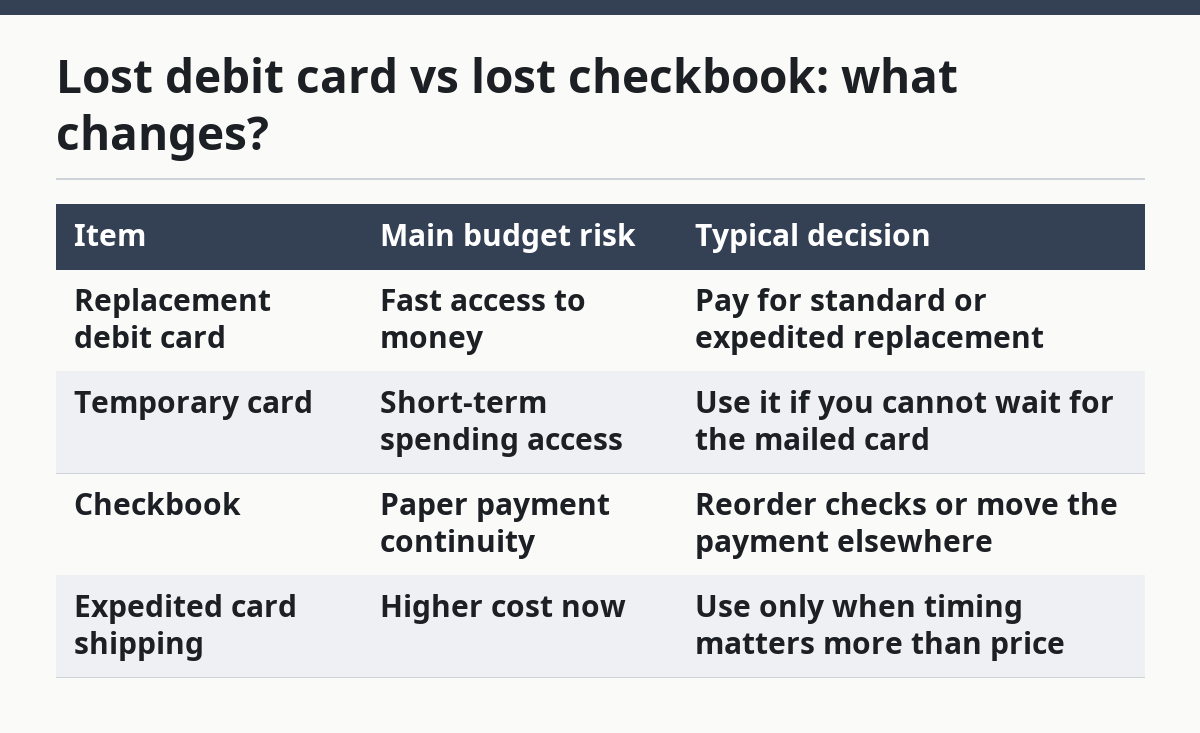
Lost debit card vs lost checkbook: what changes?
However, a lost debit card usually creates a speed problem, while a lost checkbook often creates a paper-use problem. The debit card can cut off direct access to the bank account almost immediately, but a checkbook mainly affects the few payments that still rely on paper checks, such as some rent or school-related payments.
This difference changes the budget. A replacement debit card budget should focus on access speed, fraud concerns, and shipping fees. A checkbook budget should focus on check reorder fees and whether you need to switch a payment to another method while you wait for new checks.
| Item | Main budget risk | Typical decision |
|---|---|---|
| Replacement debit card | Fast access to money | Pay for standard or expedited replacement |
| Temporary card | Short-term spending access | Use it if you cannot wait for the mailed card |
| Checkbook | Paper payment continuity | Reorder checks or move the payment elsewhere |
| Expedited card shipping | Higher cost now | Use only when timing matters more than price |
The honest trade-off is simple: a faster fix costs more. That does not make speed a bad choice. It just means the budget should match the week you are in, not the ideal week you wish you had.
How do fraud costs fit into the budget?
Because a lost debit card is not only an inconvenience, fraud-related replacement costs fit into the budget as a possible security issue. If the card may have been stolen or used without permission, the replacement may move faster, and you may need to watch the bank account more closely for unfamiliar charges.
The money risk here is indirect. The bank may replace the card, but you may still spend time reporting the loss, changing payment details, and checking whether any automatic payments were tied to that card. That time can matter as much as the fee if you are a single parent with no extra hour built into the day.
A good budget leaves room for the possibility that the lost card is also a fraud problem. That means you do not spend every spare dollar on the card replacement itself. A small reserve for the temporary fallout is smarter than planning for the fee alone. For debit card rights and reporting basics, the Consumer Financial Protection Bureau has consumer material on debit cards at https://www.consumerfinance.gov/consumer-tools/debit-cards/, and the FDIC has deposit-account consumer information at https://www.fdic.gov/resources/consumers/consumer-news/.
What mistakes make this cost bigger?
The biggest mistake is waiting until the card is already missing to decide where the money will come from. That can turn a small replacement fee into a budget scramble because you have to move grocery money, gas money, or childcare money to cover it. If the bank card needs faster shipping, the surprise gets larger.
A second mistake is budgeting only for the replacement debit card and forgetting the checkbook. That can be a problem if you still need paper checks for rent or a school fee. Reorder fees are easy to miss because they feel less urgent than a card, but they still hit the bank account.
A third mistake is assuming every replacement works the same way. Some options give faster access, while others save money but take longer. If you pick the cheaper path without checking timing, you may still spend more later on a temporary workaround. The better move is to decide what matters most in that week: low cost, speed, or both. For comparison, the CFPB also offers general consumer guidance on avoiding costly payment mistakes at https://www.consumerfinance.gov/consumer-tools/credit-cards/ and related banking topics.
If you want one simple rule, use this: replace access first, then tidy up the payment method later. That keeps the budget focused on the thing you actually lost, which is not plastic or paper. It is access to your bank account.
How much should I keep ready each month?
Overall, keep enough ready to cover a small replacement plus one fast fix, not a full month of banking costs. For most single parents, that means a modest buffer in the bank account that can absorb a debit card replacement, a shipping fee, or a checkbook reorder without forcing another bill out of place.
The amount should be tied to your own payment habits. If you rarely use checks, a smaller checkbook line makes sense. If your debit card is your main way to pay for fuel, groceries, and online orders, the buffer should be larger because a delay hurts more.
This is not a fund for every bank fee on the account. It is a narrow cushion for the specific loss of a card or checkbook. That matters because a budget works better when each dollar has one job. A too-large “miscellaneous” pile is easy to raid for dinner, and then it is gone when the card disappears.
The goal is not perfection. The goal is to make one missing card feel like a nuisance, not a crisis.
How much does a replacement debit card cost?
Therefore, the cost depends on your bank and the kind of replacement you choose. A standard replacement debit card may be charged differently from expedited card shipping, and a temporary card can come with its own rules. The safest budget is one that assumes there may be a fee and leaves room for a faster option if you need it.
Should I keep a small buffer for card replacements?
Yes, because a small buffer is the easiest way to handle a card loss without stealing from groceries or gas. A buffer in the bank account turns a surprise into a planned category, which is much easier to manage when payday is already spoken for. It also helps if you need a temporary card or faster shipping.
What happens if I need an expedited replacement card?
However, you may pay more, but you get faster access to your money. That trade-off is worth it when the lost debit card is your main payment tool and you cannot wait for standard shipping. If you choose this route, budget for the fee and for a short backup plan while the card is in transit.
Drafted with AI; not yet reviewed by a person.