Last updated: November 20, 2026
Quick answer: for How to Budget for Court Filing Fees as a Single Parent, set aside the filing fee, plus copies and service, and try to keep 1 to 2 weeks of court money ready before the deadline. Budget for court filing fees by treating them as a short, legal-cost project: identify the fee, add the extra charges tied to the filing, set aside cash before the deadline, and ask the family court clerk about a fee waiver if the total does not fit your budget. This is general information, not legal advice, and a qualified lawyer should be consulted about your own case. For the federal fee-waiver process, see the U.S. Courts explanation of in forma pauperis requests: https://www.uscourts.gov/services-forms/fees/frequently-asked-questions/fee-waivers.
Key takeaways
- Court filing fees are often only one part of the total cost. Copies, certification, and service can add more out-of-pocket charges.
- A fee waiver can lower or remove the filing fee in some courts, but the form and proof rules vary by jurisdiction.
- Cash for deadlines matters. If the filing date is close, a safer budget keeps money ready before the court closes.
- A clean budget for this cost should separate filing, copies, and service so one surprise does not wipe out rent or grocery money.
- The best plan is usually the one that matches the local court rules, not a generic family-law checklist.
What counts as a filing cost?
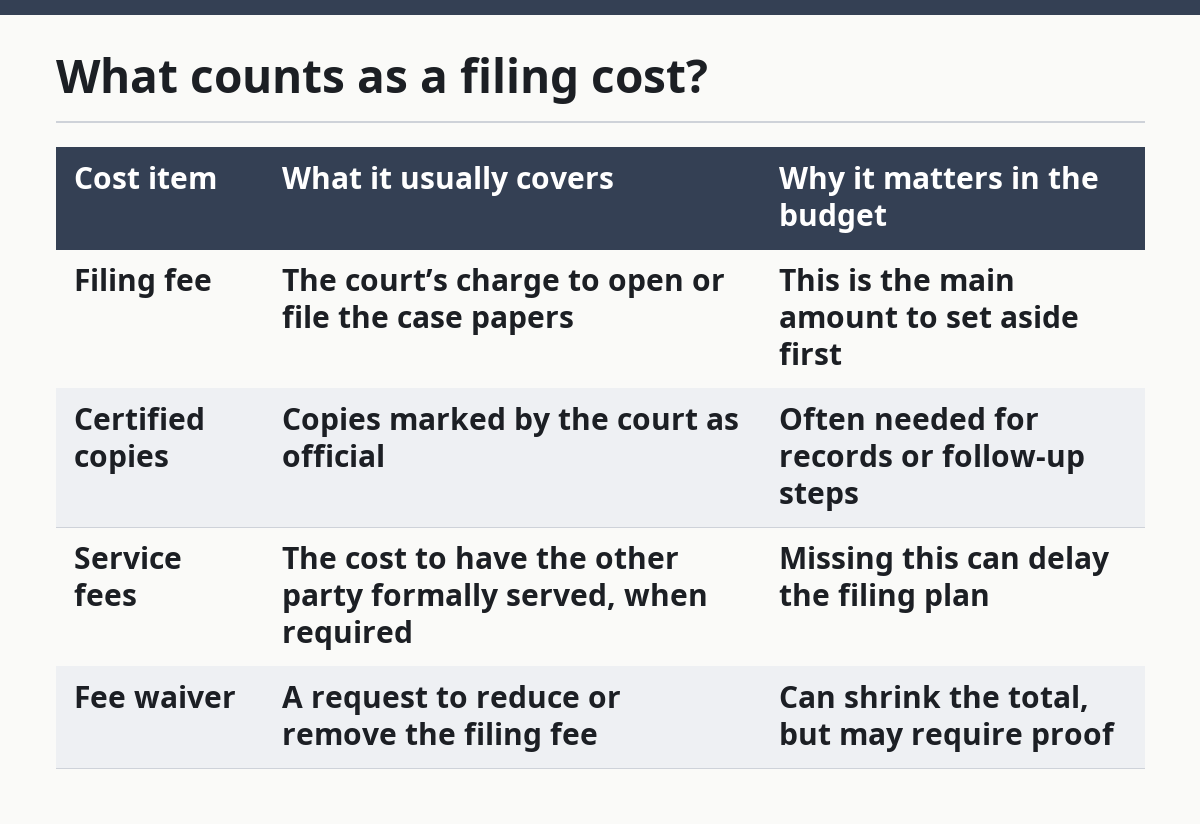
Court filing costs include the filing fee itself plus the small charges that travel with the paperwork. In family court, that usually means the fee to file the court documents, the cost of certified copies, and the charge to have papers served if service is required in your jurisdiction.
A generic budget fails when it only counts the headline fee. A parent may think the case costs one amount, then learn that the clerk wants extra copies, or that a certified copy is needed for a bank, school, or another court. Those extra charges are often smaller than the filing fee, but they are the ones that break a tight weekly budget.
The family court clerk is the first place to check for the local fee list and the rules on fee waiver forms. Some courts post fees on a website; others expect a call or a visit. If the court says a fee waiver exists, that can change the budget from “save enough cash” to “save for copies and service only.” For background on fee-waiver requests in federal court, see the U.S. Courts page linked above, and check your local court’s own instructions for the controlling rules.
This page fits the larger single-parent legal and family transition costs guide, where the same budgeting method can be used for other court-related expenses without mixing them into one pile. See also the related guide sections on court paperwork, fee waivers, and service of process.
| Cost item | What it usually covers | Why it matters in the budget |
|---|---|---|
| Filing fee | The court’s charge to open or file the case papers | This is the main amount to set aside first |
| Certified copies | Copies marked by the court as official | Often needed for records or follow-up steps |
| Service fees | The cost to have the other party formally served, when required | Missing this can delay the filing plan |
| Fee waiver | A request to reduce or remove the filing fee | Can shrink the total, but may require proof |
How do I budget for court filing fees?
You budget for court filing fees by breaking the total into four buckets and funding the deadline first. Use a simple order: fee, copies, service, then a small reserve for mistakes or repeat printing.
- Check the family court clerk’s fee list before you set the budget, and note the filing fee, copy charge, and any service-related cost. Verify that you are looking at the correct court and document type; a problem is using the wrong fee schedule.
- List every court document you expect to file, including any attachment that may need a separate copy or certification. Verify that the list matches the clerk’s instructions; a problem is budgeting for one form and missing another.
- Ask whether a fee waiver applies and what proof the court wants, such as income or benefit paperwork. Verify the form name and the filing method; a problem is waiting until the last day and finding out you lack the required document.
- Set a cash envelope or separate account for the filing fee first, then add the copy and certification costs. Verify that the money stays separate from groceries, gas, or school expenses, and consult the clerk or a lawyer if you are unsure how to protect the funds; a problem is treating court money like general spending money.
- Reserve enough for service fees if the court requires service of process. Verify the service method and who is allowed to do it; a problem is assuming service is free or informal when the court requires formal proof.
- Build a 1-week or 2-week buffer for deadline money so the fee is ready before the court closes. Verify the deadline time and the clerk’s filing hours; a problem is having the money after the deadline passes.
- Keep a small backup amount for extra copies, reprints, or a corrected form. Verify that your reserve still covers the main fee; a problem is spending the last dollar on a second set of copies and coming up short at filing.
- Confirm the final total with the clerk the same day you file, especially if the court accepts cash, card, money order, or exact change only. Verify the payment method before you leave; a problem is arriving with the wrong form of payment and missing the filing window.
That order matters because a court filing fee is a deadline cost, not a monthly bill. A parent with irregular paychecks often does better by protecting one small court fund than by trying to absorb the cost from the next paycheck. If the date is close, the budget should favor certainty over convenience.
What extra costs get missed?
The extra costs that get missed most often are copies, certification, and service fees. These are small line items, but they can add enough pressure to force a parent to choose between court and basic household costs.
Certified copies are official copies marked by the court. They are not the same as a regular photocopy, and they may be needed when another office wants proof from the file. A parent who budgets only for the filing fee may still be short if the court charges per copy or per certification stamp.
Service fees are another common blind spot. In many family-law matters, the other party must be formally served, which means the papers are delivered in a way the court accepts as proof. That can create a charge for a process server, sheriff, or other approved method. The exact method varies by jurisdiction, so the clerk’s instructions matter more than guesswork.
The cleanest approach is to separate these costs into three lines on paper: filing, copies, service. If one line is unknown, mark it as unknown and call the clerk rather than filling the gap with a guess. A guessed number is how a tight budget gets broken on filing day.
Can court filing fees be waived?
Court filing fees can sometimes be waived, but the rule and the form depend on the court. Many courts use a fee waiver request that asks for income or benefit information, and the clerk can explain where to get the form and how it must be filed.
A fee waiver may remove the biggest single cost, but it does not always remove every cost. A parent may still need money for copies, service, or a certified copy later. That means the budget should never assume “free court” unless the clerk or the court’s written instructions say so for that jurisdiction.
The practical test is simple. If the filing fee is the amount that prevents filing, ask about the waiver before you spend cash on extras. If the court approves the waiver, the budget can shift to the remaining out-of-pocket items. If the court denies it, the same budget plan still helps because the money for filing has already been set aside.
For U.S. federal courts, the U.S. Courts page on fee waivers explains the in forma pauperis process: https://www.uscourts.gov/services-forms/fees/frequently-asked-questions/fee-waivers. For local procedures, the court that will hear the case is the source that controls.
When should I stop and get help?
You should stop the do-it-yourself budgeting approach and get qualified help when the paperwork, timing, or payment rules become unclear. In law, a small filing mistake can mean a delay, a rejected document, or a missed deadline.
The court says the fee waiver needs proof you do not have ready: that means the filing may depend on documents you cannot produce quickly — ask the family court clerk or a lawyer how the court wants proof handled.
The deadline is within 48 hours and the fee is still not covered: that means the plan is too tight for a cash-based deadline — contact the clerk immediately and ask about filing hours and accepted payment methods.
The case needs service and you do not know who can do it: that means the service cost and method are still unknown — get the clerk’s instructions before spending on copies or postage.
The court uses a local form you have not seen before: that means the process is jurisdiction-specific — use the court’s own instructions, not a general internet form.
You have only enough money for the filing fee, not for copies or certification: that means the budget is incomplete — postpone nonessential printing and hold cash for the required filing step first.
The matter affects custody, support, or another family-rights issue with filing deadlines: that means the stakes are too high for guesswork — a lawyer or legal aid office can help you avoid a filing error that costs time.
A budget plan is useful only if it matches the local court’s rules. If the process starts to feel uncertain, the safest move is to pause and get the right instructions before money leaves your hands.
What mistakes cost single parents the most?
The most expensive mistakes are the ones that waste both cash and time. A filing fee that is paid too early, in the wrong form, or without the required extra papers can create a second trip and a second round of expense.
One common mistake is budgeting for the filing fee alone. The consequence is a shortfall when the clerk asks for copies or certification. The better alternative is to budget for the filing fee, then add a separate line for each expected add-on.
Another mistake is using irregular paydays as if they were regular ones. The consequence is that the money may not be there on filing day, even if the total monthly income looks sufficient. The better alternative is to set aside the court money as soon as it arrives, before bills and groceries absorb it.
A third mistake is assuming a fee waiver is automatic. The consequence is a missed deadline or a rejected filing if the waiver form is incomplete. The better alternative is to ask the clerk what proof is required and to treat the waiver as a separate step, not a promise.
A fourth mistake is forgetting the payment method. The consequence is a wasted trip when the court takes only certain forms of payment. The better alternative is to confirm whether the court wants cash, card, exact change, or money order before you leave.
A fifth mistake is not keeping a reserve for a corrected page or extra certified copy. The consequence is having to return later and pay again, which is harder for a single parent with limited child-care time. The better alternative is to leave a small buffer in the court fund until the papers are accepted.
How do I keep money ready for deadlines?
You keep money ready for deadlines by treating the court fee as a protected envelope, not as part of normal weekly spending. For a single parent, that means the filing money should stay available even when rent, food, and school costs press in the same week.
A simple method works best: put the court amount aside as soon as you know the filing date, then leave it alone until you pay the clerk. If the filing date is not fixed yet, the money still belongs in a separate place where it cannot be spent on groceries by accident. A 1-week reserve is useful when the deadline is close; a 2-week reserve is safer when the fee is large relative to the household budget.
The reserve also helps with the hidden costs that show up at the last minute. If the court wants an extra certified copy, or if the service cost is higher than expected, the reserve can absorb the difference without forcing a delay. That matters because a late filing can cost more than the fee itself in time, transport, and child-care disruptions.
This approach is not right for every case. If the fee is far beyond what the household can set aside in time, the answer is not to squeeze harder; it is to check whether a fee waiver is available or whether the court clerk can explain the next lawful step. Money ready on deadline day is the goal, but only when the court’s own rules are clear.
What counts as a court filing fee?
A court filing fee is the charge the court asks for to accept and process certain papers. In family court, that fee is often separate from the cost of copies, certification, and service, so the full out-of-pocket amount can be higher than the headline fee.
Can court filing fees be waived?
Sometimes, yes. Many courts have a fee waiver process, but the form, proof, and timing vary by jurisdiction and by court.
A waiver may reduce or remove the filing fee, yet it may not cover every related cost. A parent should still budget for copies, service, or later certified copies unless the court says otherwise in writing.
FAQ
What is the safest starting budget for court filing fees?
A safe starting budget is the filing fee plus copies and service, with 1 to 2 weeks of money kept ready before the deadline. The clerk’s fee list controls the exact total.
Should I budget for copies even if I plan to file once?
Yes. Courts often charge for certified copies or extra copies, and those charges can still apply after the filing fee is paid.
Does a fee waiver mean I owe nothing?
Not always. A waiver may reduce or remove the filing fee, but you may still have to pay for copies, service, or later certified copies.
Who should I ask if the budget is still unclear?
Ask the family court clerk first, and then consult a qualified lawyer or legal aid office if the case is time-sensitive or involves custody, support, or another family-rights issue.
Drafted with AI; not yet reviewed by a person.