Last updated: November 20, 2026
Quick Answer: For How to Budget for Employer Benefit Deductions as a Single Parent, start with the net number on your paystub, map each deduction to its due date, and keep a small buffer for the first paycheck after enrollment. Start by reading your paystub, then map every deduction to your benefits enrollment choices and adjust your budget before the next payroll cycle.
Key takeaways
- Employer benefit deductions reduce the cash that lands in your account, so gross pay is the wrong number to build a budget around.
- Your paystub shows which deductions are pre-tax and which ones come out after tax, and that difference changes take-home pay.
- A single parent needs a buffer for the first paycheck after enrollment because the deduction can hit before the budget is updated.
- Budgeting from the net number on the paystub is often the most practical starting point, then assign each dollar to fixed bills, groceries, and child costs.
- If the benefit menu is confusing, the hr department can confirm how a plan works before the deadline closes.
What are employer benefit deductions?
Employer benefit deductions are the amounts your employer withholds from each paycheck for benefits you chose during benefits enrollment. They lower take-home pay, which is the amount that actually reaches your bank account, so they must be built into the budget before the money arrives.
A generic budget often starts with gross salary and then fails the first time benefits kick in. That mistake is costly because rent, utilities, and child care do not wait for your payroll cycle to catch up. The fix is simple: use the net number from your paystub as the starting point, not the bigger salary figure in your offer letter.
Some deductions are pre-tax deductions, which can reduce the income that gets taxed; the IRS explains employee benefit treatment in Publication 15-B, and a payroll or tax professional can help you confirm how your plan is handled. Others are taken after tax. The difference matters because two deductions with the same dollar amount can affect your take-home pay in different ways, and that can change how much you have left for groceries, gas, or school expenses. See the IRS Publication 15-B and the U.S. Department of Labor benefits page for general guidance.
This topic is not about choosing one benefit over another. It is about making room for the deduction you already elected so your budget does not collapse halfway through the month. If you are trying to budget monthly pay as a single parent, that is a different page in this site’s plan. For this one, the task is narrower: turn benefit deductions into a budget line you can actually live with.
How do I read the paystub first?
You read the paystub first by finding the deduction lines, checking whether they are pre-tax, and then using the net pay line as your budget base. That gives you the real number available after employer benefit deductions.
Start with the pay period date and the current paycheck amount. Then look for separate lines that name health, dental, vision, retirement, or other workplace benefits. If the stub shows “before tax,” “pre-tax,” or a similar label, note that beside the deduction. If the label is unclear, use the hr department to confirm it before the next payroll run.
A useful habit is to compare two paystubs: one before benefits start and one after the deduction appears. Even one pay period can show the exact drop in take-home pay. That matters because a $20 or $50 difference per paycheck can quietly erase the margin you planned to use for diapers, lunch money, or gas.
Keep the paystub with your budget notes for at least one full month. If a deduction changes later, the paystub is the paper trail that shows what moved and when. For a single parent, that is more useful than guessing from memory.
How do I build the budget around the deduction?
You build the budget around the deduction by using take-home pay as your starting point, listing fixed bills first, and then setting the rest of the money into short buckets that match your pay schedule. That keeps employer benefit deductions from sneaking up on you.
- Use your paystub to write down net pay for one paycheck, then use that number as the starting point for the budget.
- Use a notebook or budget app to list fixed bills due before the next payday, such as rent, child care, utilities, and transit.
- Use the benefits enrollment summary to record each deduction amount, so you can see what has already been removed from pay.
- Use a calendar to match each paycheck date to each bill due date, so the same dollar is not promised twice.
- Use a buffer line for the first month after enrollment, so one unexpected drop in take-home pay does not break the plan.
The point is not to build a perfect spreadsheet. The point is to keep one deduction from spilling into another bill. If your paycheck lands twice a month, split your fixed expenses across those two deposits instead of trying to stretch the whole month from memory.
A good rule is to leave the benefit deduction in the budget as its own line, not hide it inside “miscellaneous.” That way you can see the real cost of working benefits and decide where the rest of the spending must tighten. A vague budget looks flexible until the bank balance says otherwise.
Which deductions change take-home pay the most?
The deductions that change take-home pay the most are usually the ones that come out every pay period and the ones tied to pre-tax treatment, because both affect the amount you can spend right away. The size of the line on the paystub matters more than the category name, and a payroll or benefits professional can help you confirm the effect on your specific plan.
| Deduction type | What it does to pay | Budget effect | What to check |
|---|---|---|---|
| Pre-tax deduction | Lowers taxable income before some taxes are calculated | Can reduce take-home pay less than an equal after-tax deduction | Confirm the label on the paystub and ask payroll if needed |
| After-tax deduction | Comes out after taxes | Reduces cash in hand dollar for dollar | Check the exact amount per paycheck |
| One-time enrollment change | Starts or stops with a new election | Can shift a budget in one payroll cycle | Watch the first stub after the change |
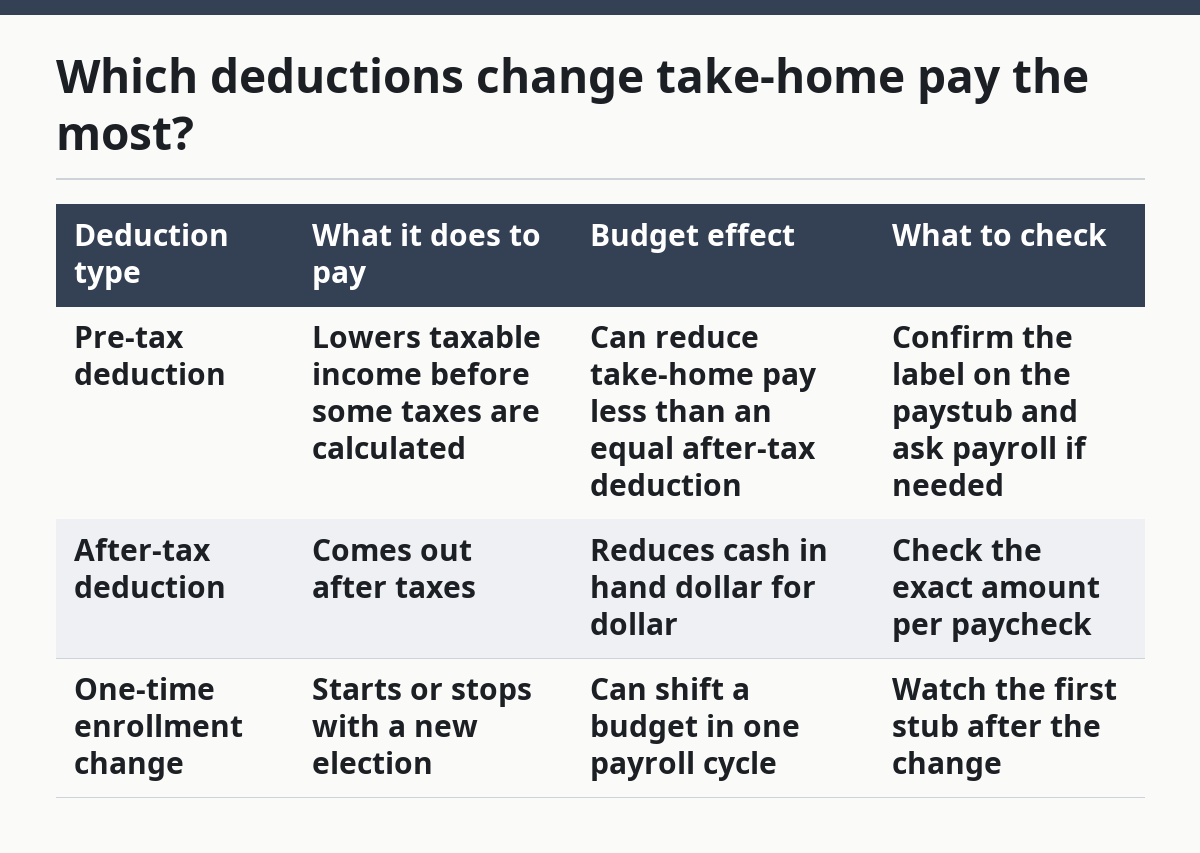
This table is a quick way to sort the lines, not a replacement for reading the full benefits notice. A parent who budgets from the gross number may miss the way a pre-tax deduction changes the net number on the paystub, so it helps to check with HR or a payroll professional if the wording is unclear. That is the trap.
The most useful habit is to ask: “What number hits my checking account?” Not “What is my salary?” That question cuts through the confusion in 10 seconds. It also keeps the budget tied to cash, which is what pays for school fees and dinner tonight.
What should I do before benefits enrollment closes?
You should compare the deduction amounts, confirm the start date, and ask hr how the change will show up on the first paystub before benefits enrollment closes. That prevents a surprise drop in take-home pay after the election is already locked in.
Write down three things for every benefit you are considering: the paycheck amount, whether it is pre-tax or after-tax, and the first pay period it will affect. If a plan summary gives you the annual cost, divide it by the number of pay periods only if the payroll office uses that structure. If you are unsure, ask for the amount per paycheck instead of guessing.
It also helps to compare the deduction against the next 30 days of bills. If the change lands right before rent, child care, or a utility due date, the budget may need a temporary cut elsewhere. That does not mean the benefit is wrong; it means the timing needs a plan.
Here is the hard part: some elections are a poor fit for a tight single-parent budget even when they look reasonable on paper. A deduction that seems small can still crowd out a grocery run when the month already has no slack. The right choice is the one the household can carry without missed payments.
If you want the bigger planning picture, this page sits inside the site’s Single-Parent Income Protection and Benefit Planning hub, which is where the rest of the benefit decisions belong.
What mistakes should a single parent avoid?
A single parent should avoid budgeting from gross pay, ignoring the first deduction cycle, and treating every benefit as if it comes out the same way. Those mistakes cost cash in the 1st month, not later.
The first mistake is building the budget from salary instead of take-home pay. That leaves a paper budget that looks healthy but runs short the moment payroll hits. The cure is simple: use the paystub’s net number every time.
The second mistake is forgetting the timing. If benefits start on the next paycheck, the budget can be off by one full pay period. For a family running close to the edge, that can mean an overdraft fee, a late payment, or a grocery run put on hold.
The third mistake is not checking the label on the deduction. Pre-tax and after-tax are not the same thing, and the difference matters when money is tight. If the line is unclear, the hr department can explain it before the deadline, not after.
The fourth mistake is leaving no cushion for small changes. Even a modest shift in deductions can force a cut in another line. A better plan is to hold a small gap between expected spending and the net paycheck, then adjust after one full cycle.
Where do I get help if the numbers do not match?
You get help by taking the paystub, the benefits election, and the deduction question to hr and asking them to line up the three numbers. That is the fastest way to find a mismatch between what you chose and what showed up on take-home pay.
If the deduction seems too high or the label does not match the plan summary, ask for the exact per-pay-period amount and the date it started. Keep the answer in writing if possible. A 1-page note or email trail can save a lot of confusion during the next pay cycle.
Two official resources can help with the terms used on the forms: the IRS page for Publication 15-B on employer-provided benefits and the U.S. Department of Labor’s employee benefits materials. Those pages are useful when the wording on a plan notice is hard to read, but the payroll office still has to confirm what was taken from your check. See the IRS Publication 15-B and the U.S. Department of Labor benefits page.
A budget only works when the deduction amount on paper matches the deduction amount in real life. If it does not, fix the mismatch first, then rebuild the month around the corrected net pay.
How do benefit deductions affect my budget?
Benefit deductions affect your budget by lowering the money you can spend right now, which means the plan must start with take-home pay instead of gross pay. A deduction that looks small on paper can still change which bills get paid first in a 2-paycheck month.
The practical effect is a tighter cash flow, not a smaller salary. That is why the paystub matters more than the offer letter for day-to-day planning. If the deduction is pre-tax, the tax treatment may soften the hit, but it still reduces what lands in your account.
What should I check before enrolling in employer benefits?
You should check the amount per paycheck, the first date the deduction starts, and whether the plan is pre-tax or after-tax before you enroll in employer benefits. Those three items tell you how much cash leaves your budget and when it leaves.
It also helps to compare that amount with the next 30 days of bills, especially if you are a single parent with little room for error. If the deduction pushes a needed bill out of reach, ask hr whether a different election or start date is available.
FAQ
How do I know if a deduction is pre-tax or after-tax?
Check the paystub and the benefits summary first. If the wording is unclear, ask payroll or HR to confirm whether the deduction is pre-tax or after-tax before you build the month’s budget.
Should I budget from gross pay or net pay?
Budget from net pay. That is the amount that actually reaches your checking account after employer benefit deductions and taxes.
What if my first paycheck after enrollment is smaller than expected?
Compare the new paystub with the benefits election and ask HR to verify the start date and deduction amount. Then adjust the budget for that pay cycle and use the corrected net pay going forward.
What if the deduction amount changes later?
Treat it as a budget update, not a surprise. Recheck the paystub, confirm the new amount with payroll, and revise the fixed-bill lines before the next payday.
Who can help if I still do not understand the deduction?
HR or payroll can explain how the deduction appears on your paystub, and the IRS Publication 15-B can help with general tax treatment questions. If the issue affects taxes or benefits eligibility, a qualified professional can help you interpret the rules.
Drafted with AI; not yet reviewed by a person.