Last updated: November 20, 2026
Quick Answer: Budget for supervised visitation as a single parent by treating it like a required monthly bill: separate the supervision fee, transportation, and incidental costs, then match those amounts to the dates in the court order. Rules vary by jurisdiction, so this is general information and not legal advice; a qualified lawyer should be consulted about any live case. For a basic money-planning framework, see the Consumer Financial Protection Bureau’s budgeting guidance, and review the U.S. Courts’ information on court orders and the Legal Services Corporation for help finding legal aid.
Key takeaways
- Supervised visitation usually costs more than one line item. The main pieces are the visitation center or supervisor fee, the trip there and back, and small extras tied to each session.
- A court order controls the schedule, so the dates matter as much as the dollar amount.
- A budget works better when it is built per visit first, then converted to a monthly total.
- If the order changes often, a simple fixed monthly estimate can fail fast.
- The wrong budget choice can leave a parent short on gas, late for sessions, or unable to cover a surprise reschedule.
Who is this budget for?

This budget is for a single parent who has a court order for supervised visitation and needs to plan for the costs without guessing. It assumes you already know the visitation center, the supervisor arrangement, and the basic schedule in the order, even if the exact totals are still unclear.
It is not a fit for someone who is still arguing over whether supervision is required, because that turns on the court process, not budgeting. It is also not a good fit when the other parent pays all costs through a separate order or agreement, because then the main task is tracking reimbursement, not building the full bill.
How do you build the budget?
You build the budget by pricing one supervised visit, then multiplying by the number of visits in the month and adding a small buffer for travel and changes. The cleanest method is often to treat each visit like a separate transaction rather than one vague custody expense, but a lawyer or budget professional can help if the order or billing setup is unusual.
- Read the court order and pull out the visit length, location, and whether a visitation center or outside supervisor is named; verify the exact session count for the month, and flag any problem if the order says “as arranged,” because that makes the cost variable.
- List the supervision fee from the center or supervisor, using the price for the exact session length if the fee changes by hour; verify whether the rate is per hour, per visit, or per parent, and consult the center or a lawyer if the pricing is unclear, because unclear pricing is a risk until it is confirmed. See the CFPB budgeting guide for a simple bill-tracking method.
- Map the transportation cost for one round trip to the visit site, including fuel, tolls, parking, or transit fare; verify the round-trip distance and the day’s travel time, and mark a problem if the trip makes the session cost jump because of a long drive.
- Set an incidental line for small costs tied to the session, such as printing paperwork, phone minutes, snacks for the wait, or a replacement outfit; verify that the line is small and specific, and avoid padding it into a catch-all fund that hides the real total.
- Multiply the per-visit total by the number of scheduled sessions in the month, using the calendar dates in the order; verify the total against the real schedule, and watch for months with 5 visits instead of 4 if the order runs weekly.
- Add a reschedule buffer for one extra trip or a late notice change, then cap it at a level you can actually carry; verify that the buffer does not crowd out rent, groceries, or medication, and consult a lawyer or financial counselor if repeated changes keep pushing the estimate too low. See the Legal Services Corporation if you need help finding free legal aid.
- Match the total to your pay cycle by dividing it across each paycheck instead of waiting until the end of the month; verify that the due dates fit the order and your pay dates, and note a problem if the cost lands on the same week as another fixed bill.
- Review receipts monthly and compare the estimate to what was paid, including cash fares and any center invoices; verify the gap is small enough to absorb next month, and revise the budget if the actual total keeps missing by a full visit or more.
What costs should you track?

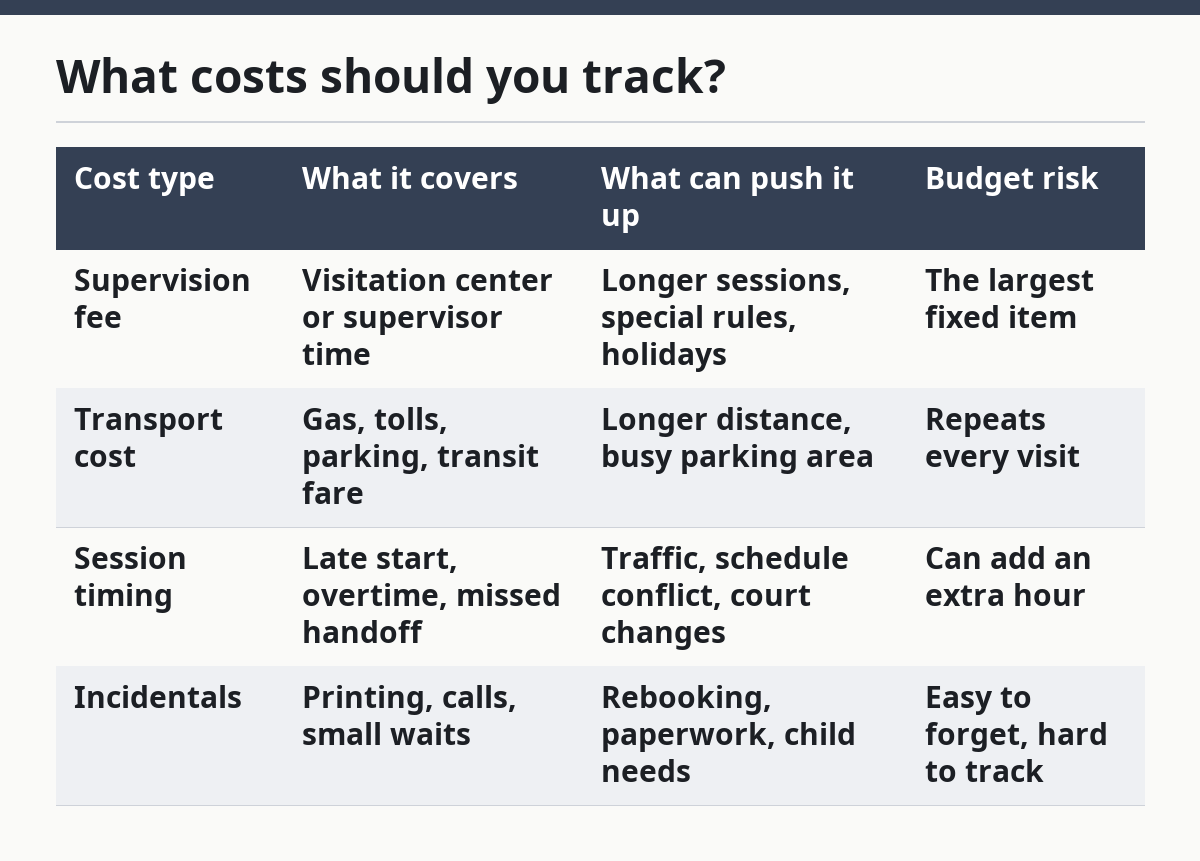
You should track supervision fees, transportation costs, session timing, and incidental expenses as four separate lines. This matters because each line moves for a different reason, and a change in one does not automatically mean the other changes too.
A visitation center fee is the most obvious number, but it is not the whole picture. A parent may also face a supervisor fee, parking, tolls, transit fare, or a longer drive if the location is 20 or 30 minutes farther than expected. A session that looks cheap on paper can become expensive once the trip is repeated every week.
The easiest way to stay honest is to give every visit a worksheet with four boxes: supervision, transport, incidentals, and total. If the order allows both a center and an outside supervisor, compare them on total cost, not on headline price alone. For a fuller family budget view, the [Single-Parent Legal and Family Transition Costs] hub can help you compare related expenses.
| Cost type | What it covers | What can push it up | Budget risk |
|---|---|---|---|
| Supervision fee | Visitation center or supervisor time | Longer sessions, special rules, holidays | The largest fixed item |
| Transport cost | Gas, tolls, parking, transit fare | Longer distance, busy parking area | Repeats every visit |
| Session timing | Late start, overtime, missed handoff | Traffic, schedule conflict, court changes | Can add an extra hour |
| Incidentals | Printing, calls, small waits | Rebooking, paperwork, child needs | Easy to forget, hard to track |
If a source lists rates by the hour, do not budget as if every session costs the same. A 90-minute visit and a 2-hour visit can land in different pricing bands, and that difference matters when the calendar fills up.
When should you stop using a basic budget?
You should stop using a basic budget when the order, the travel, or the payment pattern is too irregular for a simple monthly estimate. In those cases, the problem is not discipline; it is that the tool is too blunt.
The schedule changes every week: The month no longer has a stable visit count — Switch from a monthly total to a per-visit tracker so one reschedule does not throw off the whole plan.
The center bills after the visit: The timing of payment is not the same as the date of the session — Keep a separate invoice reserve so the bill does not hit after the money has already been spent elsewhere.
The trip takes more than 1 hour each way: Travel starts to shape the whole budget — Build a transport line first, because gas, parking, or transit can rival the supervision fee.
The court order is unclear about who pays: The budget cannot solve a payment dispute — Pause the estimate and get the payment term clarified through the order or qualified legal help.
The actual cost keeps missing the estimate by one full session: The numbers are too far apart to trust — Rebuild the budget from receipts and invoices instead of carrying forward the old figure.
What mistakes make the bill larger?
The most common mistake is budgeting only for the session fee and forgetting the trip. That leaves a parent with the center covered but no money for fuel, tolls, or parking, which can turn a scheduled visit into a missed one.
A second mistake is averaging the cost across the year instead of using the court schedule. If the order has 4 visits one month and 5 the next, an average can hide a real shortfall of an extra session.
A third mistake is ignoring incidental costs because they look small. One printing run, one phone call, and one parking fee can seem minor, but repeated over several visits they become part of the real cost.
A fourth mistake is treating every supervisor or center as interchangeable. A location 15 minutes away is not the same as one 45 minutes away, and a difference like that changes the budget even when the supervision rate looks similar. If the price sheet is hard to compare, ask the center or supervisor to explain it before you commit.
A fifth mistake is waiting until the day of the visit to move money. That usually means the budget is already late, and late budgets are the ones that get skipped.
What changes when the order is strict?
A strict court order changes the budget by reducing flexibility and increasing the penalty for missed timing. If the order names the exact center, the exact supervisor, or exact session times, then the budget must fit those rules instead of shopping for the cheapest option.
That means a parent should plan for fixed dates, fixed travel windows, and less room to shift to a lower-cost alternative. It also means that even a modest extra cost, like a parking fee or a second trip in one week, can matter more because the schedule cannot easily move.
If the order gives only a general supervision requirement, the budget can compare options more freely. If it names a specific visitation center or supervised visitation service, the budget has to start there and only then test whether the month can absorb the cost.
For broader cost planning around legal and family transition expenses, this page fits the [Single-Parent Legal and Family Transition Costs] hub.
How do you budget when money comes in on uneven paydays?
You budget on the visit calendar, not on hope. If income lands in uneven amounts, split the total supervised visitation cost across each paycheck so the money is waiting before the session date.
This matters when the order places visits near the start of the month or in the middle of a long gap between checks. In that situation, a weekly transfer of a small amount usually works better than a single end-of-month transfer, because the money is already separated from groceries and rent.
If the cost is recurring, use the same rule every month: add up supervision, transport, and incidentals, then divide that amount across the number of paychecks you expect before the next set of visits. If the math looks impossible, the budget is telling you that the visit cost needs a separate reserve, not that the numbers should be ignored.
What should you do before the first visit?
You should confirm the rate, the schedule, and the payment method before the first visit so there are no surprises at the door. Ask for the fee structure in writing if possible, especially when the center charges by the hour or has a different rate for weekends or longer sessions.
Then build one mock month with the exact dates from the court order. Use that draft to see whether the cost lands on a paycheck week, a rent week, or a week with another legal expense. If the draft month already fails, the problem will only get worse when a second month starts.
Who pays for supervised visitation?
Who pays depends on the court order, local rules, and any agreement between the parents. In some cases one parent pays all of the supervised visitation cost, and in others the cost is divided or shifted as part of the order.
Because this is jurisdiction-specific, the safest next step is to read the actual order and get qualified legal help if the payment language is unclear. A budget can show the size of the bill, but it cannot decide who is legally responsible for it.
What costs come with supervised visitation?
Supervised visitation usually includes the supervision fee, the transportation cost to and from the visitation center or supervisor, and small incidental expenses tied to each session. The amount can also change if the visit runs longer than planned or if a reschedule creates an extra trip.
The clean way to budget is to track those costs separately for each visit and then total them for the month. That gives a truer number than guessing from the headline fee alone.
Drafted with AI; not yet reviewed by a person.