
Last updated: November 19, 2026
Quick answer: a $0-to-$100 buffer, matched to paydays and bill dates, is often the first practical step in Income Timing and Variable Cash Flow for Single Parents — The Complete Guide, but if your situation is tight or complex, consult a financial professional or a nonprofit credit counselor. Income timing, not just income amount, is what makes single-parent budgeting break down. The fix is often a cash-flow system that matches bill dates to pay dates and protects a small buffer, but it is best to consult a financial professional or credit counselor before making major changes. This guide shows how to line up the month in a way that can help rent, child care, food, and school costs stop colliding at the worst possible moment.
One reason I’m qualified to write this is that I’ve spent years covering household cash flow, budgeting methods, and the way pay cycles interact with fixed bills.
Here’s what the steps below can help settle: when to budget on paydays, how to handle uneven income, what to pay first, and when a cash calendar beats a normal monthly budget.
Key takeaways
- Variable cash flow is not the problem by itself; mismatched timing is usually the real damage.
- A single-parent budget works better when it follows paydays and bill due dates, not the calendar month.
- Your first job is to protect housing, utilities, food, transport, and child care in that order.
- A small cash buffer, even a modest one, can help prevent one late payment from turning into three, but if you are unsure what buffer amount fits your situation, consult a professional or a nonprofit credit counselor. CFPB, FDIC Money Smart
- If your income swings a lot, you need a bill-smoothing plan, not a tighter spending lecture.
Why income timing matters more than the monthly total
Picture this: your rent is due on the 1st, child care on Friday, and your paycheck lands on the 3rd. The math on paper looks fine, but the cash in your account hits the wrong days, and that gap is where fees, stress, and skipped payments start.
Income timing is the difference between “I earn enough” and “I can pay on time.” A single parent can have a solid annual income and still feel broke every other week if pay comes on the 15th and 30th while bills cluster at the start of the month. The real problem is timing mismatch.
- Fixed bills: rent, car payment, insurance, phone
- Flexible bills: groceries, gas, school supplies, copays
- Irregular bills: uniforms, field trips, registration fees, holiday costs
A lot of generic budgeting advice assumes a steady paycheck and a two-adult household. That breaks down fast for a parent who carries the full load alone. If one bill is late, there is no backup income. If child care changes, there may be no slack left.
The truth is, cash flow is a schedule problem before it is a spending problem. CFPB budgeting tools
How do I budget when my income changes every week?
You budget on the money that has arrived, not on money you hope will show up later. That means using a rolling cash plan, a bill list, and a short forecasting window instead of one fixed monthly guess.
Start with the next 14 to 30 days. Write down every expected deposit, even if some amounts vary. Then list every bill by due date, minimum amount, and whether it can be moved. This works for hourly work, tips, gig pay, overtime, child support that arrives unpredictably, and seasonal work.
Use a simple order:
- Housing
- Utilities
- Child care
- Food
- Transportation
- Minimum debt payments
- Everything else
That order is not glamorous, but it is practical. NCBI on financial strain and household stress
A few rules can help the plan hold up:
- Budget the lowest realistic income, not the best month.
- Split each paycheck into “already spoken for” and “still free.”
- Treat every extra dollar as a job, not a bonus.
- Keep a separate list for bills that can wait 3 to 10 days without penalty.
If your income swings hard from week to week, a once-a-month budget usually fails. A paycheck-based budget is better because it shows what can be paid now and what must wait.
The catch is that this method needs discipline for the first few months. It gets easier when the pattern is written down.
The cash-flow map that keeps the month from blowing up
Picture this: you’re standing at the kitchen counter with three due dates, two paydays, and a pile of school forms. The numbers are not impossible, but they are scattered. A cash-flow map puts them on one page so you can see the choke points before they hit.
A cash-flow map is a simple chart with four columns: date, money in, money out, and balance after each item. It is more useful than a standard budget when income is uneven because it shows the exact day cash gets tight. That daily view is the whole point.
Use a paper calendar, a spreadsheet, or a notes app. The tool does not matter nearly as much as the order:
- Put in all income dates first.
- Add all non-negotiable bills second.
- Add grocery, gas, and child costs third.
- Mark the days the account might dip below zero.
- Move flexible spending away from those dates.
The best version of this system looks boring, which is often a good sign. If your map shows a shortfall on the 12th, you do not wait until the 12th to react. You shift a payment, reduce a variable bill, or move funds from a later paycheck.
Two things to watch closely:
- Automatic payments that hit before your paycheck
- Irregular costs that arrive in clusters, such as school fees and birthday parties
A cash-flow map also helps you see which bills are truly monthly and which are really seasonal. That matters because a “small” $40 fee can hurt more than a larger bill if it lands on the wrong day. FDIC Money Smart
What should I pay first when money is tight?
You should pay the bills that protect your home, your child’s daily care, and your ability to keep earning. That usually means rent, utilities, child care, transportation, and food before unsecured debt or nonessential spending.
Here is the catch: “urgent” and “important” are not the same. A late streaming bill is annoying. A late rent payment can snowball. A missed car repair can stop your income. The right order depends on consequences, not guilt.
Use this triage list when cash is short:
- Keep current: housing, utilities, child care, gas, groceries
- Protect access to work: car note, bus pass, phone plan
- Preserve stability: minimum debt payments, prescription costs, school basics
- Delay if needed: subscriptions, extras, gifts, most nonurgent shopping
If a bill can be paid late without a penalty, put it lower on the list. If a bill protects your ability to work or care for your child, it moves up. That logic is harsh, but it is clean.
This is also why “pay all the bills on the 1st” fails many single parents. One day of bill payment does not match real life. A more useful method is to line up each bill with the paycheck that will cover it. CFPB budgeting and bill tracking
How to build a buffer when there’s almost no room left
A buffer is a small amount of money kept back so one surprise does not wreck the next two weeks. It is not a luxury fund. It is a timing tool.
Start small and make it automatic. Even a modest amount set aside from each paycheck can keep a bad week from becoming a late-fee week. The buffer does not have to be large before it helps. What matters is that it is separate from spending money and easy to see.
A buffer works best when it has a job:
- Cover a bill that lands early
- Fill the gap when child support is late
- Absorb a gas spike or grocery overrun
- Stop overdrafts from one bad timing chain
Where people go wrong is trying to build a giant emergency fund while still missing routine bills. That can backfire. For a single parent with variable cash flow, the first goal is often a one-paycheck cushion, then a larger emergency fund later.
A few practical moves help:
- Save a small fixed amount from every deposit
- Keep the buffer in a separate account if possible
- Refill it after using it, even slowly
- Do not count it as spendable cash
If the buffer keeps getting drained for the same bill, that bill belongs in your core plan, not in the emergency bucket.
What to do when the paycheck date and bill date clash
Picture this: payday lands after the rent draft, and the account is already too thin to float the gap. You do not need a perfect system here. You need a delay, a date change, or a different payment order before fees stack up.
The best fix is to move due dates to match income dates when the lender or service allows it. Many companies will shift a due date once or twice if you ask early. If that is not possible, align your cash plan so the bill is covered by the previous paycheck instead of the current one.
Try these moves in order:
- Call before the due date, not after.
- Ask for a payment date change.
- Ask whether a split payment is allowed.
- Reorder other bills so the gap closes.
- Use the buffer only for the most damaging shortfall.
A late fee is expensive. So is a bounced payment. But a missed work shift or a car shutoff can cost more. That is why bill timing is not a minor detail.
One useful habit is to keep a “date conflict” list. When the same bill creates trouble two months in a row, it needs a permanent fix, not another one-time scramble.
Which income patterns need a different strategy?
Some cash-flow problems are not solved by tighter budgeting. They need a different setup. If your income falls into one of these patterns, a monthly budget may be the wrong tool.
- Hourly work with variable shifts: Use a low-income baseline and a weekly cash map.
- Gig or contract pay: Plan around payout delays and holdbacks.
- Child support that comes late or unevenly: Treat it as bonus cash until it becomes reliable.
- Seasonal work: Build a “lean month” budget for the slow season.
- Split custody with uneven expenses: Track costs by category, not by month, so one parent does not absorb every school or transport cost.
The issue is not only variability. It is unpredictability. If you cannot count on a certain amount on a certain date, you cannot spend it in advance.
This is where generic advice can get lazy. It says “track your spending” as if the main issue were lattes and impulse buys. For a single parent with income swings, the real issue is whether the next bill will meet the next deposit.
A better strategy is to use three layers:
- A bare-minimum survival plan
- A normal-month plan
- A better-than-usual month plan
That way, a slow week does not force you to rewrite the whole month.
The honest side-by-side: paycheck budgeting vs monthly budgeting
Paycheck budgeting wins for most single parents with variable income because it follows money as it arrives. Monthly budgeting works better only when income is steady and bill dates are predictable.
| Criteria | Paycheck Budgeting | Monthly Budgeting | Winner for this condition |
|---|---|---|---|
| Income swings week to week | Adjusts in real time | Assumes steady cash flow | Paycheck budgeting |
| Easy to see shortfalls early | Yes, on each payday | Sometimes, near month-end | Paycheck budgeting |
| Best for fixed salary | Works, but can feel busy | Simple and familiar | Monthly budgeting |
| Handles late child support | Better, because it is conditional | Weak, because it guesses too much | Paycheck budgeting |
| Works with many small bills | Better for staggered due dates | Better if due dates are clustered | Depends |
| Risk of overspending early | Lower, if money is assigned per check | Higher if the month is treated as one pool | Paycheck budgeting |
| Time required each week | More frequent check-ins | Less frequent check-ins | Monthly budgeting |
| Good for variable freelance pay | Yes | No, not by itself | Paycheck budgeting |
| Good for mental simplicity | Harder at first | Easier at first | Monthly budgeting |
| Best for one-parent households with no backup income | Strong fit | Weak fit | Paycheck budgeting |
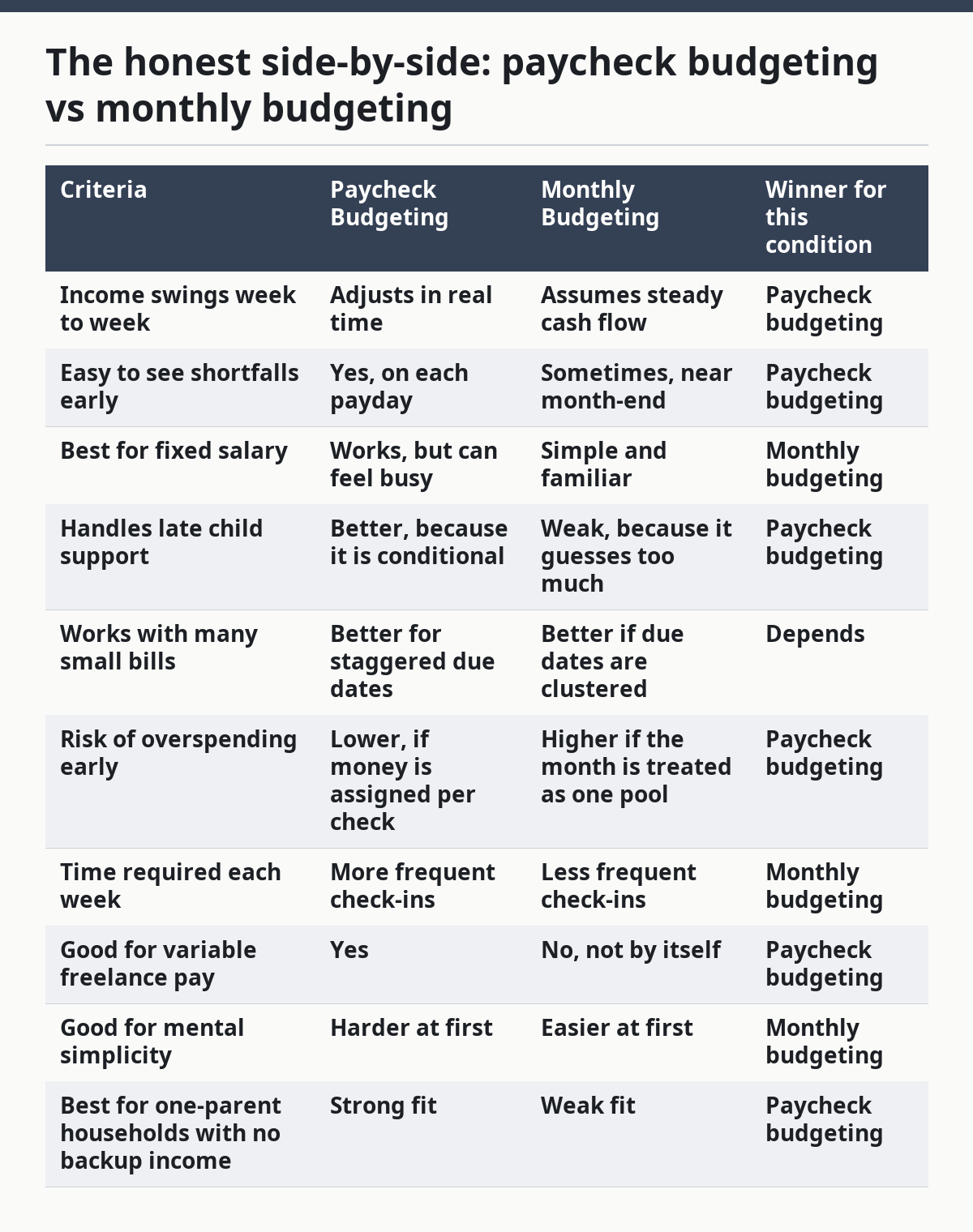
Paycheck budgeting does have drawbacks. It can feel like extra admin work, and that matters when you are already stretched. It also requires more attention to due dates, which means one missed note can cause a problem.
Monthly budgeting has its own weakness: it hides the gap between income and bills. For a single parent with stable pay, that may be fine. For a parent with uneven pay, it can create a false sense of safety.
What a single-parent cash-flow plan should include
A strong cash-flow plan has five parts, and each one does a different job. Without all five, the plan turns into a list that looks good but fails on the 18th.
First, it needs a bill calendar with due dates and draft dates. Second, it needs a minimum income baseline based on the worst normal month, not the best one. Third, it needs a buffer account or sinking fund for predictable irregular costs. Fourth, it needs a rule for which bills get paid first. Fifth, it needs a weekly review.
That weekly review can be short:
- What money came in?
- What bills are still ahead?
- What date is tight?
- What can move?
- What must wait?
This is where many readers want a cleaner trick than the job really allows. There is no magic app that fixes a timing problem by itself. The app can help, but the plan has to fit the family.
One more thing: if child care is part of your work life, it belongs in the core plan, not as an extra. Missed child care can mean missed income. That is a cash-flow issue, not a side expense.
The best cash-flow plans are plain, not fancy. They survive a rough week because they were built for one.
Exception scenarios: when the usual advice flips
The usual advice flips when your income is steady, your bills are flexible, or you already have a meaningful cushion. In those cases, a monthly budget can be simpler and just as effective.
Here are the main exceptions:
- Stable salary with fixed due dates: A monthly budget may be enough if payday and bills line up.
- Large savings cushion: If you can float one full month of expenses, timing is less dangerous.
- Very few bills: If your expenses are simple and predictable, a cash calendar may be overkill.
- Automated transfers from each paycheck: If your system already moves money on payday, the gap is smaller.
The flip side is just as important. If you rely on irregular tips, contract work, or late-arriving support payments, the monthly approach often fails first. It looks neat on paper and messy in real life.
The real test is simple: if one late paycheck can scramble three bills, you need a timing-based plan.
The verdict: which approach to use and why
Choose paycheck budgeting if your income changes, your bill dates do not, or you have no backup adult income in the household. Choose monthly budgeting if your pay is steady, your due dates are predictable, and you already keep a strong buffer. Neither if you are guessing at income and ignoring bill dates, because that is just hoping.
For most single parents with uneven cash flow, paycheck budgeting is the better fit. It makes the gaps visible, protects the bills that keep life running, and gives each paycheck a job before it disappears.
The mistake is thinking the answer is “spend less.” Sometimes that helps. Often the bigger fix is date alignment, not austerity.
FAQ
What’s the fastest way to stop living paycheck to paycheck?
The fastest way is to match bills to paydays and stop treating every deposit as free money. A small buffer, even one paycheck’s worth of slack over time, can help more for stability than a vague promise to cut spending.
Should I pay extra debt or build savings first?
Build a small buffer first if late bills and overdrafts are common, then push extra debt payments after that. If your basic bills are stable and you already have cash set aside, extra debt payments can move up.
How do I handle bills when child support comes late?
Treat late child support as unreliable income until it proves otherwise. Build your core plan without counting on it, then use it when it arrives to refill the buffer or cover irregular child costs.
Is a weekly budget better than a monthly one?
A weekly or paycheck-based budget is usually better when your income changes or your bills are staggered. A monthly budget works better when income is steady and your due dates line up neatly.
What if I can’t save anything right now?
Then the first goal is to stop timing problems from creating fees. Move due dates, pay critical bills first, and keep a tiny cash buffer if possible, even if it grows slowly.
Drafted with AI; not yet reviewed by a person.
