Last updated: November 19, 2026
Quick Answer: A storage unit budget should start with the base rent plus required extras, and in the examples below that total can begin at 2 months or 1 month of storage, depending on how long you need it. How to Budget for Storage Unit Fees as a Single Parent means counting every charge before you sign so the bill does not crowd out rent, childcare, or gas. The steps below show what to count, what to skip, and how to keep the charge from wrecking the rest of your plan.
Key Takeaways
- The monthly rent is only part of the cost; insurance, lock, and late fees can change the real total.
- Month-to-month rentals help if your timeline is uncertain, but they can still carry move-out rules and billing traps.
- A smaller unit is cheaper, but only if your boxes fit without blocking the aisle.
- Climate-controlled space costs more, but it can protect items that would be ruined by heat or humidity.
- A safer budget is one that includes the unit, the extras, and some room for a price bump.
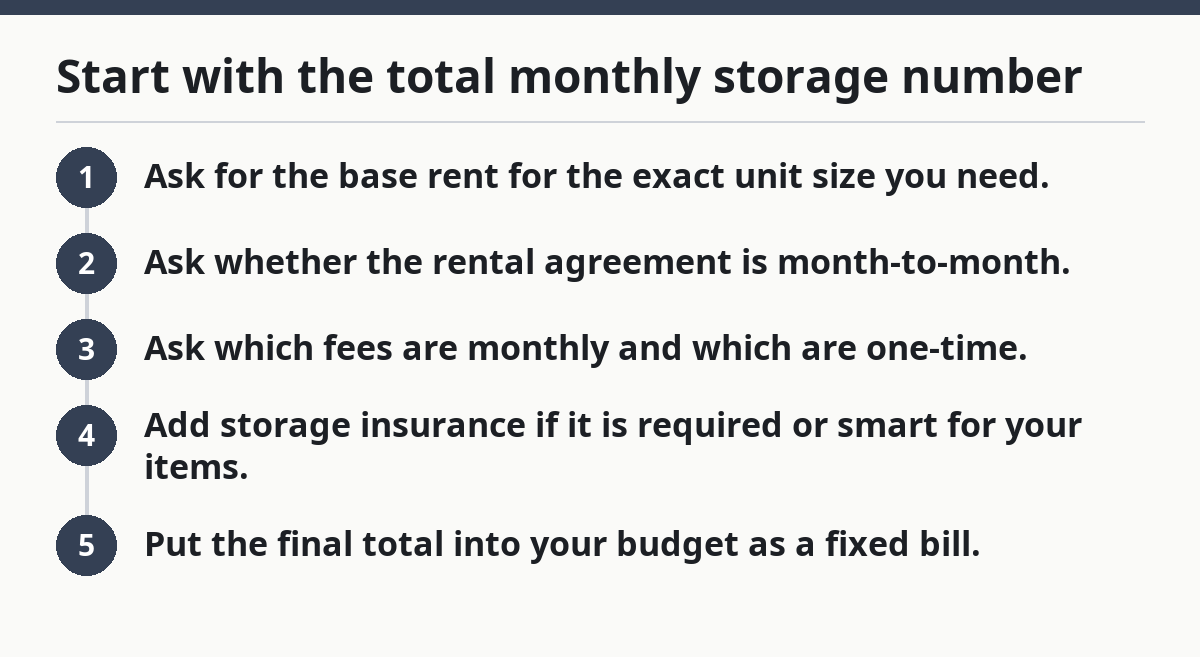
Start with the total monthly storage number

Picture this: you need a storage unit for 2 months while you wait on a move, and you want a number you can actually carry in your budget. Start with the rent, then add the extras the storage facility can charge each month. That total is the number that matters, not the advertised rate on the sign.
Here’s the catch: a storage unit bill is often more than the sticker price. The monthly rent may be joined by storage insurance, a required lock, a one-time admin fee, or a higher rate for climate control. If you skip those pieces, your plan will come up short.
- Ask for the base rent for the exact unit size you need.
- Ask whether the rental agreement is month-to-month.
- Ask which fees are monthly and which are one-time.
- Add storage insurance if it is required or smart for your items.
- Put the final total into your budget as a fixed bill.
Use a simple rule: if the storage unit costs more than the gap in your monthly budget can handle, the unit is too big or the timeline is too long. That sounds blunt because it is. A storage facility does not care that your week is already packed.
If you already have a budget for housing move costs, this page fills in the storage part without repeating the rest of it.
How much storage unit space do you really need?
The right unit size is the cheapest one that still lets you close the door without crushing your things. A unit that is too large wastes money every month, while one that is too small can force you to rent a second unit or move everything twice.
Picture this: your couch, three dresser drawers, and 18 boxes are waiting in the driveway, and you’re deciding between a 5×5 and a 5×10. A 5×5 fits a few boxes and small items; a 5×10 usually gives you room for furniture from a studio or one-bedroom setup. The exact fit depends on how much furniture you are storing and whether you need a walking path.
Use this quick check before you pay:
- Count big pieces first: bed frame, mattress, couch, dresser, table.
- Stack box count second.
- Leave space for one aisle if you need to reach items later.
- Ask the storage facility for the unit’s interior dimensions, not just the label.
- If you are storing for more than 1 or 2 months, choose the size that avoids re-stacking every visit.
The best budget choice is often the smaller unit with good packing, not the bigger unit with extra air space. On the flip side, do not cram items so tightly that a child’s backpack or a winter coat gets damaged every time you open the door. That kind of damage turns a cheap unit into an expensive mistake.
What fees belong in the storage budget?
The true budget includes rent, insurance, access costs, and late fees if the storage facility uses them. A lot of people price the unit and stop there. That leaves the budget blind to the charges that show up after move-in.
Picture this: you sign for a month-to-month storage unit, then discover the first bill is higher because of an admin fee and a required insurance add-on. That is not rare. It is how many rental agreements are written.
Count these items before you sign:
- Monthly rent for the unit size you picked.
- Storage insurance, if the facility requires it.
- A lock, if you do not already own one that fits the latch.
- One-time admin or setup fees.
- Late fees, which can hit fast if the payment date lands between paychecks.
- Any charge for 24-hour access, extended access hours, or climate-controlled units.
Late fees matter more than people think. If your paycheck lands on the 15th and the rent is due on the 1st, that mismatch can cost you every month unless you set up a reminder or auto-pay. A single missed fee can be the difference between staying on track and scrambling.
Ask the front desk for a full price sheet. If they will not hand you one, consult a consumer protection attorney or a local housing counselor, and keep looking. The Consumer Financial Protection Bureau explains why clear fee information matters in consumer contracts, and state consumer agencies may also help if terms are unclear.
Should you pay extra for climate control?
Climate control is worth paying for when heat, cold, or humidity could damage what you store. It is not necessary for every box, and it can make the monthly bill larger than your budget can safely hold.
Picture this: you’re storing baby clothes, paperwork, a wood dresser, and a mattress for 4 months in a hot garage-style unit. In that case, climate control can be the safer choice because temperature swings and moisture are hard on fabric, paper, and wood. If you are only storing plastic bins, sports gear, or items that can handle ordinary storage, a standard unit may be enough.
The budget rule is simple:
- Choose climate control for paper records, electronics, wood furniture, and fabric you want to keep in good shape.
- Skip it for durable items that can handle heat and cold.
- Compare the price difference against the value of the items.
- If the items are cheap to replace, a standard unit may fit your budget better.
The trade-off is real. Climate-controlled units usually cost more each month, and that extra cost can be pointless if you are only keeping a few plastic tubs there for 6 weeks. But if damage would force you to replace furniture or documents, the higher fee can be the cheaper choice in the long run.
For storage insurance and unit care basics, the Self Storage Association and consumer-focused storage guides are good places to compare standard terms before you commit. The Federal Trade Commission also has general guidance on protecting your belongings and reading contracts carefully before you sign.
How to keep storage unit fees from breaking your monthly budget
The best way to keep storage fees under control is to treat them like a bill with a deadline, not a one-time errand. That means giving the unit a spot in your monthly budget and planning for the day you move out.
Picture this: you’re balancing school pickup, work shifts, and a storage payment that repeats every 30 days. The fix is boring, but it works. Set the charge to land on a date that follows your income, and give yourself a 1-week buffer before late fees can hit.
- Write the storage bill as a line item, not a “miscellaneous” expense.
- Put the due date on your phone calendar with a 3-day reminder.
- Keep the account funded 7 days early if you can.
- Review the rental agreement for notice rules before move-out.
- Decide now what will happen when the 2-month or 3-month need ends.
A month-to-month rental can help if your housing timeline is uncertain, but it can also tempt you to leave the unit running longer than planned. That is how a temporary cost becomes a long tail of monthly rent. If you do not set an end date, the storage facility gets to keep charging.
The cleanest budget is the one with a stop date written in. Even even a short overstay can add another month of rent, so planning ahead matters.
Common storage budgeting mistakes single parents make
The most common mistake is budgeting for the unit and forgetting the extras, which can leave you short by a noticeable amount every month. Another mistake is choosing a unit that is bigger than the load because it feels safer. That choice can be costly.
Picture this: you rent a larger unit “just in case,” then realize half of it is air. That unused space is expensive air. If you can fit the items into a smaller unit without stacking so high that you can’t reach the back, the smaller unit is usually the better budget move.
Watch for these problems:
- Paying for climate control you do not need.
- Missing a due date and paying late fees.
- Renting a unit larger than your actual load.
- Skipping storage insurance on items that would be hard to replace.
- Forgetting that a storage facility may raise rates after the first month.
Here’s the catch: some storage facilities advertise a low intro rate, then adjust the rent later. A rent increase is not always avoidable, but it is easier to handle if you expect it and keep a small cushion. Even $20 or $30 in buffer can keep you from missing another bill.
This is the wrong choice for anyone who wants a “set it and forget it” expense. Storage almost never stays perfectly still.
A simple way to build the storage line into your budget
The simplest budget is the one you can repeat for 2 or 3 months without guessing. Take the monthly rent, add the required extras, then set aside a small buffer for late fees or a rate change.
Picture this: you know the unit will only be needed until the end of the school term, and you want a clean number to hold in your phone notes. Build the line like this: base rent + storage insurance + lock or admin fee + small cushion. That gives you a number that is useful instead of wishful.
Use this quick worksheet:
- Base rent: the storage unit price for the exact size.
- Required extras: insurance, lock, and any admin fee.
- Risk cushion: a little extra for a rate bump or billing slip.
- Time limit: 1 month, 2 months, or however long the storage is actually needed.
If the total is too high, the first thing to cut is size, not protection from damage. Downsizing from a 10×10 to a 5×10 can matter far more than shaving a few dollars from the insurance choice. If the total is still too high after that, the storage unit is not a fit right now.
The point is not to make storage cheap. The point is to make it predictable.
What size storage unit do I need?
The size depends on what you’re storing and how long you need access to it. A 5×5 usually works for a few boxes and small household items, while a 5×10 often fits furniture from a small apartment or studio. Ask the storage facility for exact interior dimensions before you sign.
Are storage units month to month?
Yes, many storage units are month to month, but the rental agreement still matters. Month-to-month terms help when your move date is uncertain, yet they can still include notice rules, access limits, and rate changes. Read the agreement before you count on it.
What extra fees come with a storage unit?
A storage unit can come with storage insurance, admin fees, late fees, a required lock, and sometimes higher charges for climate control or special access hours. Ask for the full price sheet, not just the advertised rent, so the monthly total matches what you can actually pay.
Drafted with AI; not yet reviewed by a person.