Last updated: November 19, 2026
Quick Answer: To budget for childcare withdrawal fees as a single parent, set aside the withdrawal fee plus any notice-period tuition and any remaining balance before you give notice. Childcare withdrawal fees can hit a single-parent budget fast, especially when your tuition balance and final payment timing are already tight. This guide shows you how to price the exit, avoid surprise charges, and decide what to pay first.
Key Takeaways
- A withdrawal fee is only one piece of the exit bill; notice periods and unused tuition often cost more.
- Your childcare contract controls the numbers, not guesswork.
- Budget for the last month, not just the fee line.
- Late notice can turn a small exit cost into a bigger termination fee plus extra tuition.
- The cleanest budget is a written tally of fee, balance, and due date.
What a childcare withdrawal fee usually covers
A childcare withdrawal fee is the charge a provider sets when you end care, and it often sits beside notice tuition, a termination fee, or a final tuition balance in How to Budget for Childcare Withdrawal Fees as a Single Parent. The exact bill comes from the provider policy and the enrollment contract, not from a standard rule.
Picture this: you’re planning to leave care, but the invoice may still include one more month, a fee for missed withdrawal notice, and any unpaid extras. That mix is why you need a line-by-line budget, not a single estimate. One number is never enough.
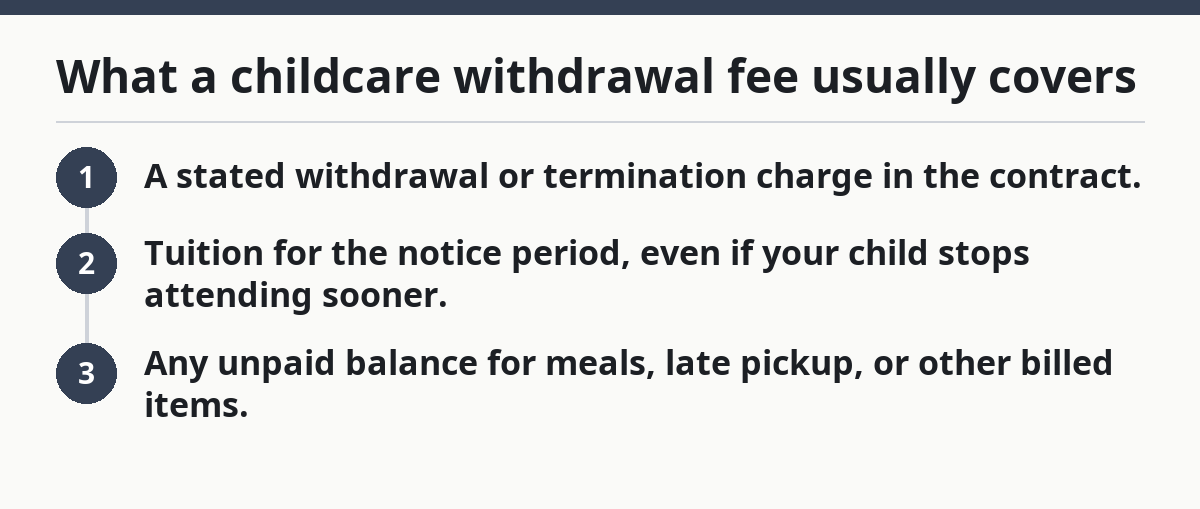
Most parents miss the fact that the exit cost can show up in three parts:
- A stated withdrawal or termination charge in the contract.
- Tuition for the notice period, even if your child stops attending sooner.
- Any unpaid balance for meals, late pickup, or other billed items.
The truth is, the contract language decides whether a fee is flat, tied to a week or month of tuition, or added on top of regular charges. If your provider uses a 2-week or 30-day notice rule, budget as if you will pay that full period.
Here’s a quick way to read the bill:
- Find the line that names the withdrawal fee.
- Find the notice rule, such as 2 weeks or 30 days.
- Check whether tuition still runs during that notice period.
- Look for a due date on the final invoice.
If the wording is unclear, ask for the provider’s written policy before you give notice. A written answer is easier to budget than a phone promise, and if the contract still feels ambiguous, consult a consumer or legal professional and check the provider’s written terms.
How do I budget for childcare withdrawal fees?
You budget for childcare withdrawal fees by listing the exit charge, the notice-period tuition, and any final balance, then setting that total aside before you submit your notice. That keeps the move from eating next month’s rent or groceries in How to Budget for Childcare Withdrawal Fees as a Single Parent.
Picture this: you’re comparing two paths—leave now, or stay one more cycle to avoid the hit. The real job is not predicting the future; it’s mapping the exact cost of leaving under the rules in your childcare contract. Small gap, big impact.
Use this simple procedure:
- Pull the contract and provider policy together in one place, then highlight every mention of notice, termination, final payment, and unused tuition. That gives you the rules in front of you.
- Write down the withdrawal fee amount or formula, if the policy names one. If it says “one week of tuition” or “30 days of tuition,” use that exact unit.
- Add the tuition balance you still owe, even if you plan to leave mid-cycle. This catches the bill that surprises many parents.
- Add the notice-period tuition. If your notice is 2 weeks and tuition is charged weekly, budget for those 2 weeks in full.
- Add any fixed extras already billed, such as late fees or meals, then round up a small cushion for a final invoice adjustment.
On the flip side, don’t budget from memory. A clause buried on page 4 can cost more than the headline fee.
If you want a simple formula, think in layers:
- Exit fee
-
- Notice tuition
-
- Unpaid balance
-
- Small cushion for final billing
That gives you a budget number you can actually save toward. If the total is guaranteed under the contract, count it.
Which contract terms change the amount you need to save?
The contract terms that change your budget are the notice period, the termination clause, the tuition cycle, and the rule on unused tuition. Those four lines decide whether you owe a small fee or a full extra month.
Picture this: you’re reading the childcare contract with a highlighter and a calculator, trying to figure out whether leaving on a Friday means paying through the end of the month. That’s the right question. The wrong one is, “What do most centers charge?” Most centers do not matter. Your policy does.
Look for these phrases and treat each one as money:
- Notice periods: A 7-day, 2-week, or 30-day notice can all trigger tuition during that time. If the wording is unclear, consult the provider in writing and review the contract terms with a consumer or legal professional before you budget.
- Termination clause: This may spell out a flat fee, a percentage, or the last billing cycle.
- Unused tuition: Some providers do not refund prepaid care, even if your child leaves early. If the policy says unused tuition is not refunded, consult the provider in writing and a consumer or legal professional before relying on any refund.
- Final payment timing: Some invoices are due on the day notice is given; others are due on the last day of attendance.
A common mistake is to budget only for the withdrawal fee and ignore prepaid tuition already on the books. That mistake can leave you short by a full cycle. Don’t do that.
Instead, compare the contract language to your pay schedule. If your wages land every other Friday, a 30-day notice can require two paychecks to cover the exit. If you get paid weekly, a 2-week notice is easier to absorb, but only if you set the cash aside right away.
When the wording says “one month’s tuition” and your billing cycle is weekly, ask whether the provider means four weeks, a calendar month, or the next 30 days. Those are not the same bill.
What should I check before I give notice?
You should check the due date, the notice method, the final attendance date, and whether the provider will keep charging tuition after care stops. Those four items decide whether your budget holds or breaks.
Picture this: you’re ready to leave, but the contract says notice must be in writing and sent by email before noon on a business day. Miss that detail and you may owe another billing period. That is the kind of mistake that hurts a single-parent budget most.
Before you send notice, do this:
- Confirm the exact notice method: email, paper form, portal message, or signed letter.
- Confirm when notice starts counting: the day you send it, the next business day, or the first of the month.
- Confirm the last day tuition is charged.
- Ask whether any unused tuition is refundable.
- Ask when the final invoice will arrive and when it must be paid.
Here’s the catch: some centers use “calendar days,” while others use “business days.” A 10-day notice can become 14 days once weekends are counted. If you budget for the shorter version, you may come up short.
You can keep this tight with a one-page checklist:
- Write the provider’s notice rule in plain English.
- Mark the last payable day on your calendar.
- Count the remaining tuition charges.
- Add the withdrawal fee or termination fee.
- Save the total in a separate account or envelope before you notify the provider.
That last step matters. If the money sits in your regular checking account, groceries and gas will claim it before the final invoice does.
How do I plan for unused tuition and the final invoice?
You plan for unused tuition and the final invoice by assuming the provider may keep prepaid money until the contract says otherwise. That keeps you from counting on a refund that never comes in How to Budget for Childcare Withdrawal Fees as a Single Parent.
Picture this: you’ve already paid for a month, but your child leaves after 10 days. The provider may still keep the rest if the contract says tuition is nonrefundable. If that money is part of your next rent payment, the budget gap gets ugly fast.
Start by sorting the final bill into three buckets:
- Money you still owe now.
- Money you already paid but may not get back.
- Money that may show up later, such as a correction to meals, late pickup, or supplies.
Then decide what counts as “gone” money. If the policy says unused tuition is not refunded, treat it as a sunk cost and do not rely on it to fund your next month; if the policy allows a partial refund, do not spend that refund until it actually lands, and consult the provider or a consumer or legal professional if the policy language is unclear. If the policy says unused tuition is not refunded, ask for the rule in writing and verify it against the contract before you rely on it.
A practical rule helps here:
- If it’s guaranteed, count it.
- If it’s possible, don’t count it yet.
- If it’s due, save for it now.
This is where many single parents get tripped up. A center may accept notice today but still invoice through the end of the billing cycle. That is legal under many contracts, and it is also the reason you need cash set aside before you give notice.
One more thing: keep a copy of every email and receipt for at least 30 days after the last payment. If the final invoice is wrong, you’ll want the paper trail ready.
What mistakes make withdrawal fees more expensive?
The biggest mistakes are giving notice too late, forgetting tuition after notice, and assuming a refund will cover the gap. Those errors can turn a modest exit cost into a full month of extra charges.
Picture this: you plan to leave on Friday, but the provider’s policy requires 30 days of written notice. You stop attending anyway, then still owe tuition until the notice ends. That is not a rare corner case. It is the standard trap.
Watch for these costly errors:
- Late notice: You may owe another billing cycle, not just the fee.
- Ignoring the notice period: The fee is often smaller than the tuition it triggers.
- Counting on an unused tuition refund: The contract may block it.
- Skipping the final invoice date: A missed deadline can add a late fee.
- Not asking about payment method: If the provider wants the final payment by cashier’s check, you may need extra time to get it.
The fix is simple, but not easy: budget the full exit cost before you act. If you don’t have the cash yet, delay the notice if the contract allows it, or cut other spending first so the exit does not blow up your month.
That is also why this page belongs inside the wider child care system planning for single parents. Exit costs are one part of the system; they should never be treated as an afterthought, so check the provider policy, compare it with your budget, and ask a consumer or legal professional if the charge seems unclear.
A small warning for this topic: if your contract language is unclear or the provider is charging something you cannot match to the policy, ask for the billing terms in writing. I’m not telling you how to handle a dispute, but a written explanation is the only thing that can keep a vague charge from draining your budget.
FAQ
What is a childcare withdrawal fee?
A childcare withdrawal fee is the charge a provider may apply when you end enrollment. It can be a flat amount, a notice-period charge, or part of the final tuition balance, depending on the childcare contract. The exact amount and timing come from the provider policy, not from one universal standard.
How much notice do providers usually require?
Providers often require written notice, and the period may be 1 week, 2 weeks, or 30 days. The exact rule is set by the center’s contract and enrollment terms. Before you budget, check whether the notice starts on the day you send it or on the next business day.
Can I get money back if I leave childcare early?
Sometimes, but not always. If the contract allows a refund for unused tuition, the provider should explain how it is calculated and when it will be paid. If the policy says tuition is nonrefundable, treat that money as gone and do not build your budget around it.
Drafted with AI; not yet reviewed by a person.